
AnimaliaacceptedtribeAccepted
Melanosaurini

Melanosaurini

Sullivan, 1979

GBIF:181601094

0year

ABOUT

Descriptions(3)

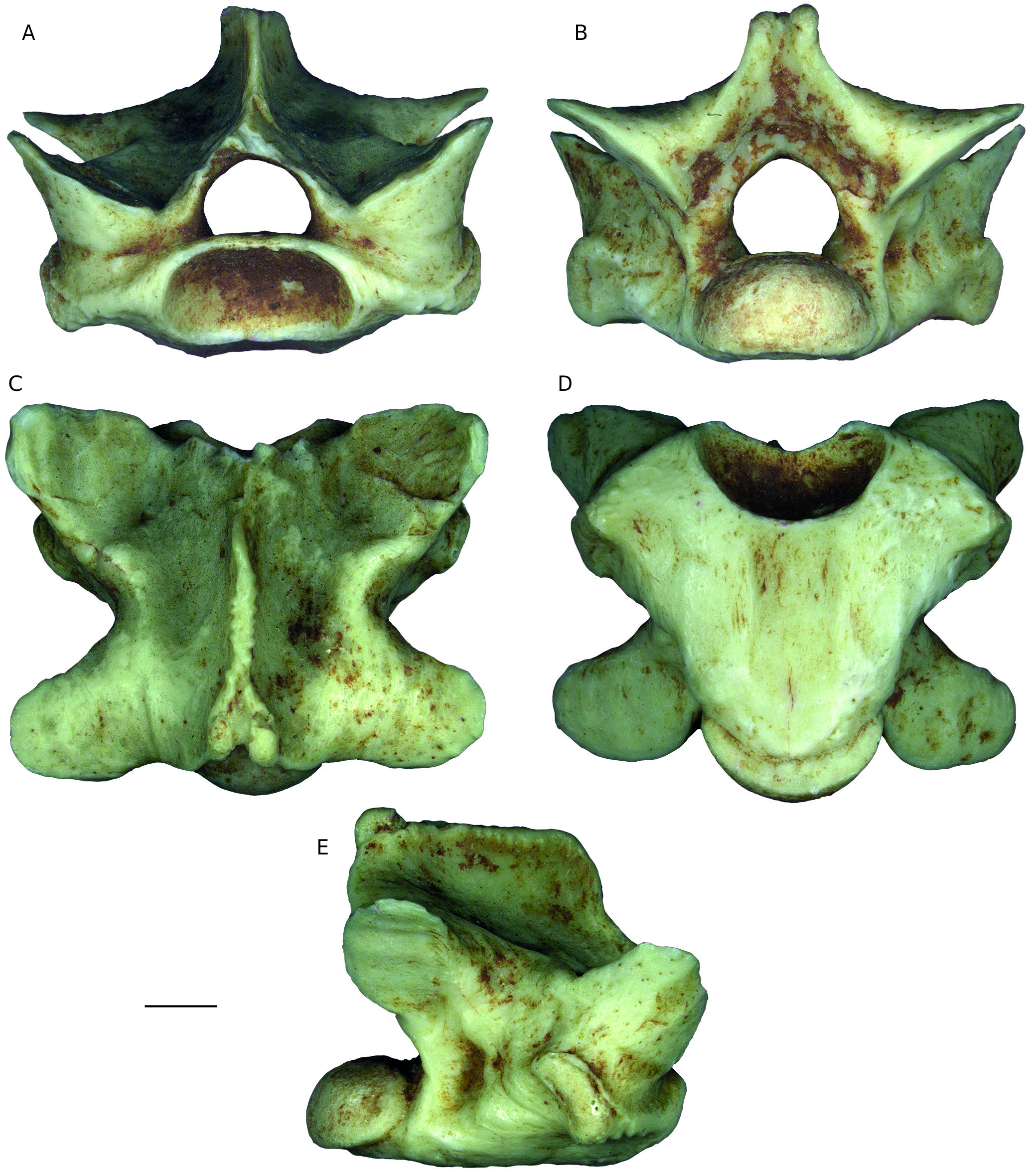
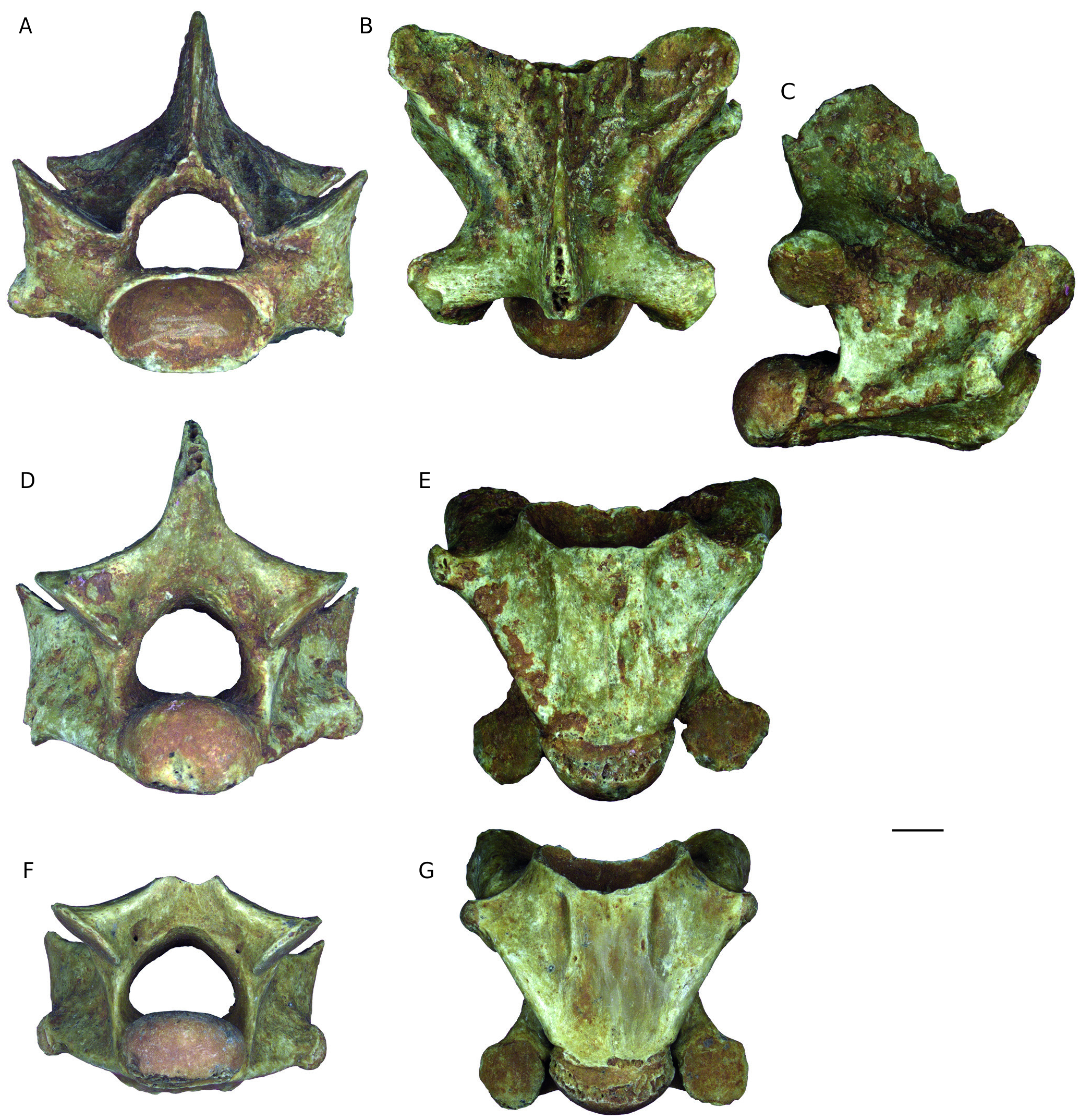
DESCRIPTION Presacral vertebrae (Figs 30; 31) In all specimens, the centrum is significantly anteriorly widened (Figs 30; 31). Their size varies, with centrum lengths ranging between 6 and 9.4 mm (Appendix 1). There is a distinct and rather wide groove in the ventral surface of the centrum, originating anteriorly almost at the level of the cotyle and terminating posteriorly at around the level of the condyle, being almost uniform in wideness across its length. The prezygapophyses are strongly dorsally inclined in anterior view. Both cotyle and condyle are strongly dorsoventrally compressed. The neural spine, when preserved, develops mostly at the posterior half of the neural arch, however, its base extends anteriorly in the shape of a narrow longitudinal ridge until the anterior most edge of the neural arch. The height of the neural spine varies, being either high (NHMW 2019 / 0094 / 0002) or rather short (NHMW 2019 / 0094 / 0001). In one specimen (NHMW 2019 / 0094 / 0001), the posterior edge of the neural spine (as seen in dorsal view) is bifurcated. The postzygapophyses are large and extend much laterally in dorsal view. The neural canal is relatively large and triangular in shape. The shape of the neural arch in posterior view varies, apparently depending on the exact position of the vertebra in the column; as such it can be either depressed (e. g., NHMW 2019 / 0094 / 0005 and NHMW 2019 / 0094 / 0003) or relatively vaulted (e. g., NHMW 2019 / 0094 / 0002).
Georgalis, Georgios L., Čerňanský, Andrej, Klembara, Jozef (2021): Osteological atlas of new lizards from the Phosphorites du Quercy (France), based on historical, forgotten, fossil material. Geodiversitas 43 (9): 219-293, DOI: 10.5252/geodiversitas2021v43a9
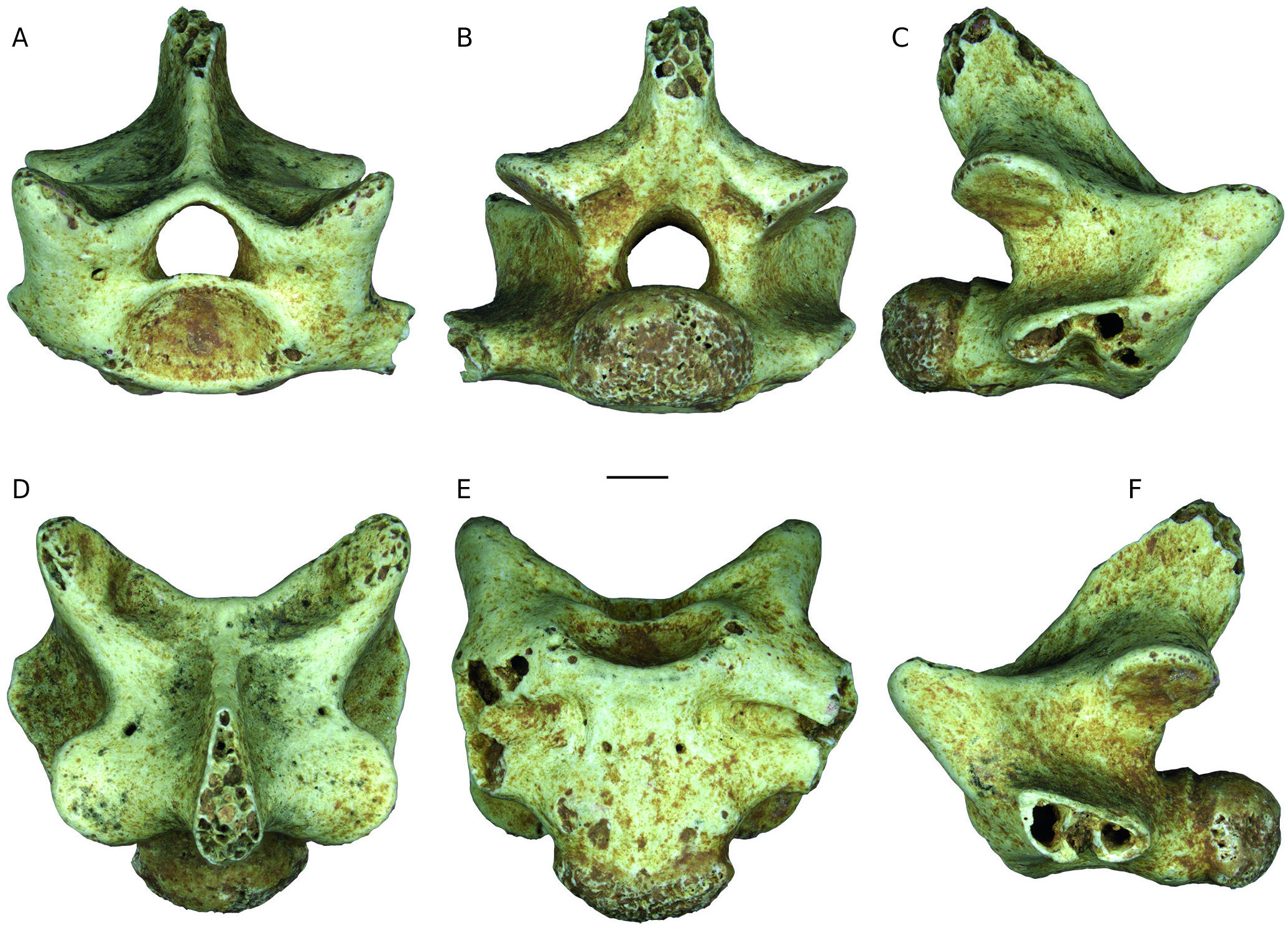
REMARKS The referral of this vertebral material to Melanosaurini is made primarily on the basis of the much anteriorly widened centrum than in other glyptosaurines, similar to that observed for the North American Melanosaurus maximus Gilmore, 1928, and, to a lesser degree, Paraplacosauriops from the Eocene of Europe (see figures in Gilmore 1928 and Augé 2003, 2005). One other important difference between NHMW 2019 / 0094 / 0001 (but not the other melanosaurine vertebrae from our collection) and the above ones referred to Placosaurus is that the former possess much more massive postzygapophyses that extend more prominently laterally in dorsal view. A plausible taxonomic scenario could be that these specimens pertain to Paraplacosauriops quercyi described above from cranial material, however, on the absence of articulated specimens and the imprecisely known locality Meckel’s groove data (including the fact that the material was probably collected from different localities), we refrain from referring them to the same taxon. The presence of two distinct foramina above the cotyle of the sacral vertebra, a feature also prominent in several presacral vertebrae of Palaeovaranus (see below), is interesting. We acknowledge the presence of these structures in large-sized vertebrae of extant specimens of the anguid Pseudopus Merrem, 1820, and the varanid Varanus Merrem, 1820. We consider that their presence is widespread in large-sized anguimorphs and is apparently correlated with large size; we define these structures as “ anocotylar foramina ”, from the Greek words “ ἄνω ” (“ ano ”), meaning “ above ” and “ κότυλος ” (“ cotylos ”), meaning “ cup ”, in a similar trend of the term “ paracotylar foramina ”, which applies in snake vertebrae terminology. The potential taxonomic utility of anocotylar foramina needs to be further investigated in the light of detailed quantitative analyses on extant forms, as well as articulated fossil specimens.
Georgalis, Georgios L., Čerňanský, Andrej, Klembara, Jozef (2021): Osteological atlas of new lizards from the Phosphorites du Quercy (France), based on historical, forgotten, fossil material. Geodiversitas 43 (9): 219-293, DOI: 10.5252/geodiversitas2021v43a9
REFERRED SPECIMENS. — Four presacral vertebrae (NHMW 2019 / 0094 / 0001 - NHMW 2019 / 0094 / 0003 and NHMW 2019 / 0094 / 0005); one sacral vertebra (NHMW 2019 / 0094 / 0004).
Georgalis, Georgios L., Čerňanský, Andrej, Klembara, Jozef (2021): Osteological atlas of new lizards from the Phosphorites du Quercy (France), based on historical, forgotten, fossil material. Geodiversitas 43 (9): 219-293, DOI: 10.5252/geodiversitas2021v43a9

Export occurrence data

Darwin Core Archive (ZIP)

CLASSIFICATION

Taxonomic Classification Tree

MULTIMEDIA

Media Files(3)

FIG. 30. — Melanosaurini indet. Photographs of presacral vertebra NHMW 2019/0094/0001 in anterior (A), posterior (B), dorsal (C), ventral (D), and right lateral (E) views. Scale bar: 2 mm.
Imageimage/png© Georgalis, Georgios L.;Čerňanský, Andrej;Klembara, JozefGeorgalis, Georgios L.;Čerňanský, Andrej;Klembara, Jozef

FIG. 31. — Melanosaurini indet.A-E, photographs of presacral vertebra NHMW 2019/0094/0002 in anterior (A), dorsal (B), right lateral (C), posterior (D), and ventral (E) views; F, G, photographs of presacral vertebra NHMW 2019/0094/0003 in posterior (F) and ventral (G) views. Scale bar: 2 mm.
Imageimage/png© Georgalis, Georgios L.;Čerňanský, Andrej;Klembara, JozefGeorgalis, Georgios L.;Čerňanský, Andrej;Klembara, Jozef

FIG. 32. — Melanosaurini indet. Photographs of sacral vertebra NHMW 2019/0094/0004 in anterior (A), posterior (B), right lateral (C), dorsal (D), ventral (E), and left lateral (F) views. Scale bar: 2 mm.

Imageimage/png© Georgalis, Georgios L.;Čerňanský, Andrej;Klembara, JozefGeorgalis, Georgios L.;Čerňanský, Andrej;Klembara, Jozef

IMAGES

Gallery(3)

See Gallery

Occurrences with images

Source Information

Osteological atlas of new lizards from the Phosphorites du Quercy (France), based on historical, forgotten, fossil material

checklist

This dataset contains the digitized treatments in Plazi based on the original journal article Georgalis, Georgios L., Čerňanský, Andrej, Klembara, Jozef (2021): Osteological atlas of new lizards from the Phosphorites du Quercy (France), based on historical, forgotten, fossil material. Geodiversitas 43 (9): 219-293, DOI: 10.5252/geodiversitas2021v43a9

MOTS CLÉS Squamata, lézards, Quercy, Paléogène, micro-CT, anatomie squelettique, espèces nouvelles.

Georgalis G L, Čerňanský A, Klembara J, felipe (2021). Osteological atlas of new lizards from the Phosphorites du Quercy (France), based on historical, forgotten, fossil material. Geodiversitas. Checklist dataset https://doi.org/10.5252/geodiversitas2021v43a9 accessed via GBIF.org on 2026-06-14.

CC0Published 4/22/2021View dataset
GBIF Usage Key
181601094
Dataset Key
04426a8e-c179-4af0-8e23-d72908e8b4cc
Origin
source
Taxon ID
03A1633BFFBCFFE3316BFA4BF8AD3C03.taxon
Last Crawled
6/10/2026
Last Interpreted
6/10/2026