
AnimaliaNot EvaluatedacceptedspeciesAccepted
Paraplacosauriops quercyi

Paraplacosauriops quercyi

(Filhol, 1882)

GBIF:181601096

0year

ABOUT

Descriptions(3)

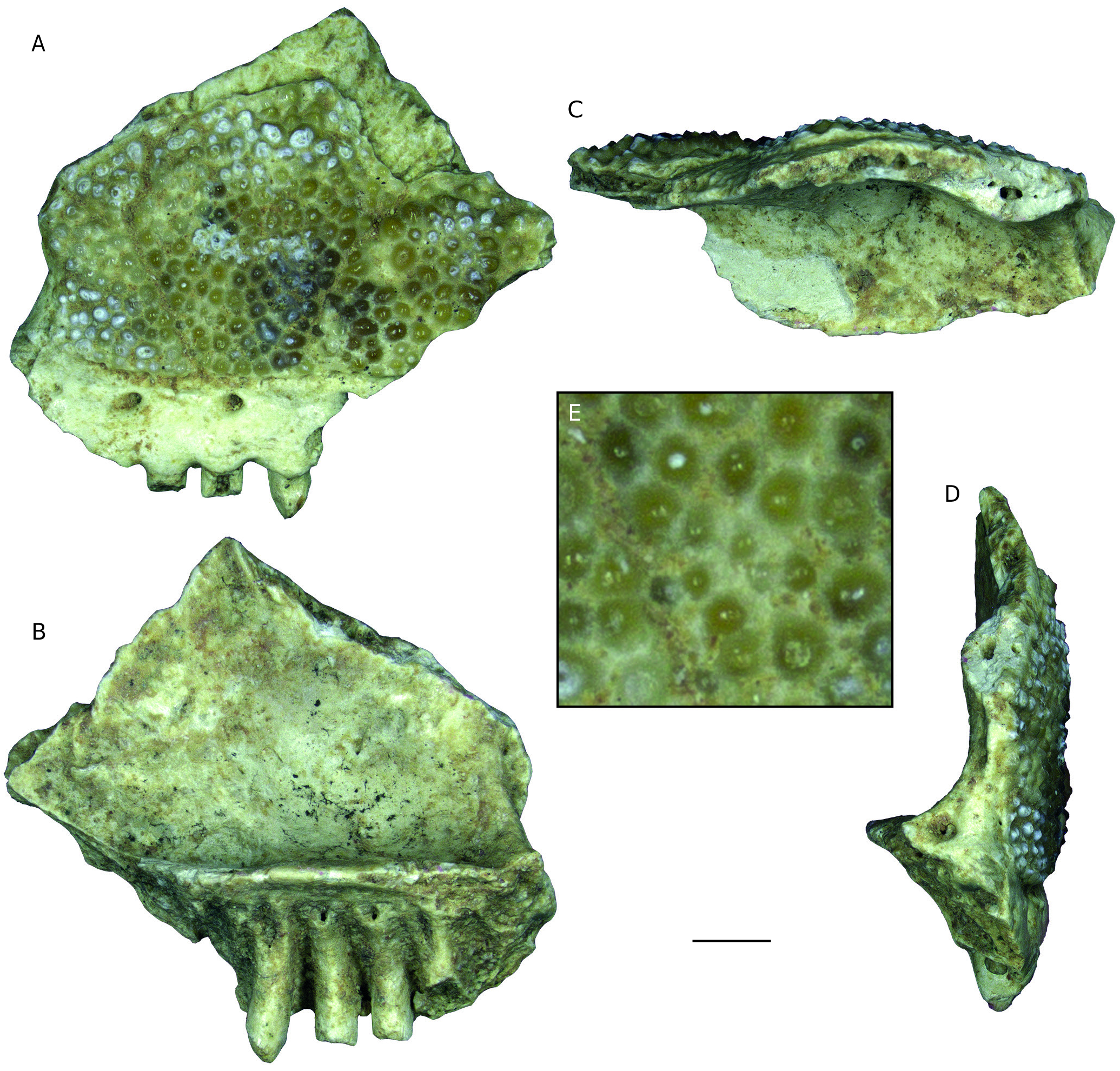
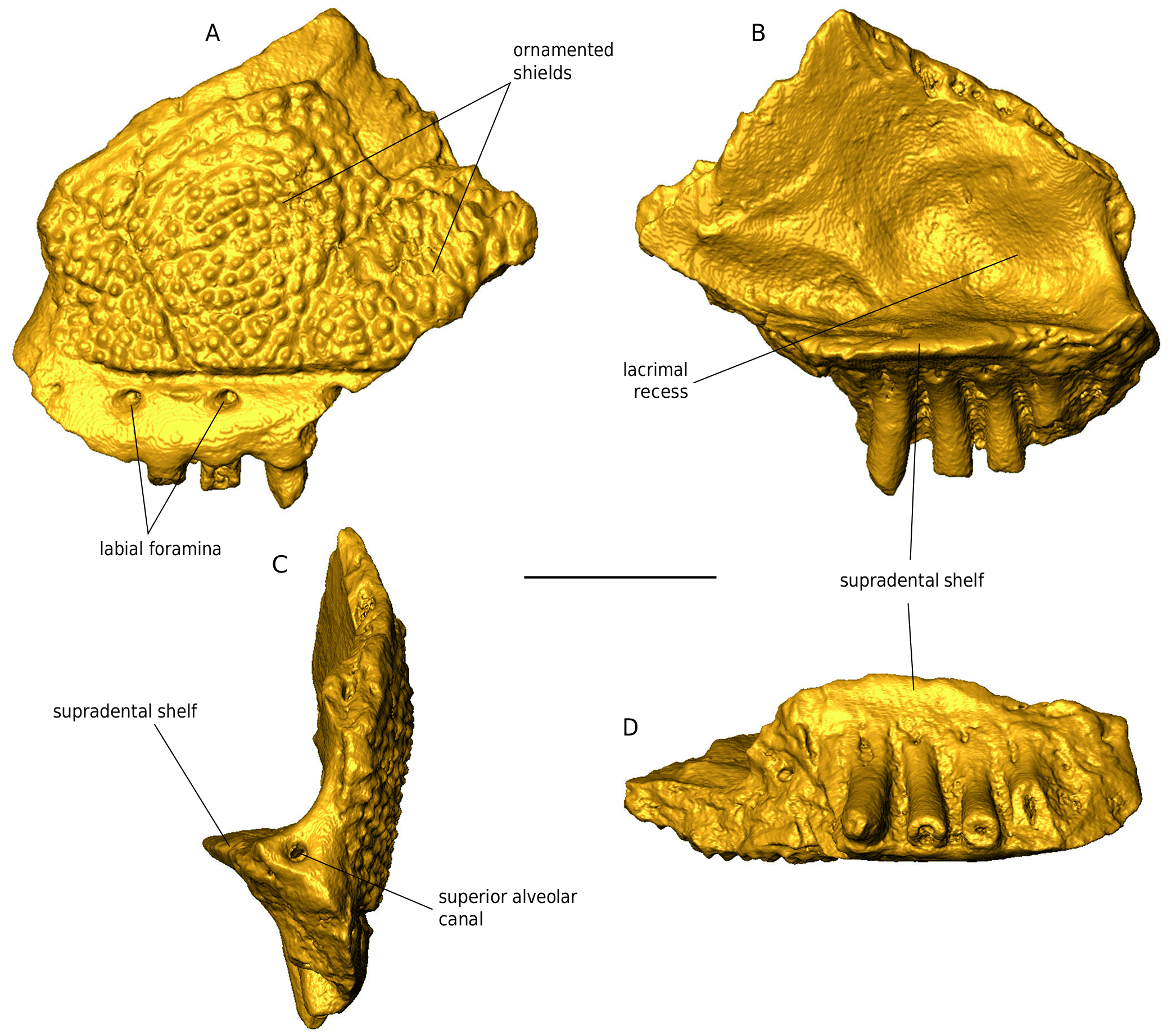
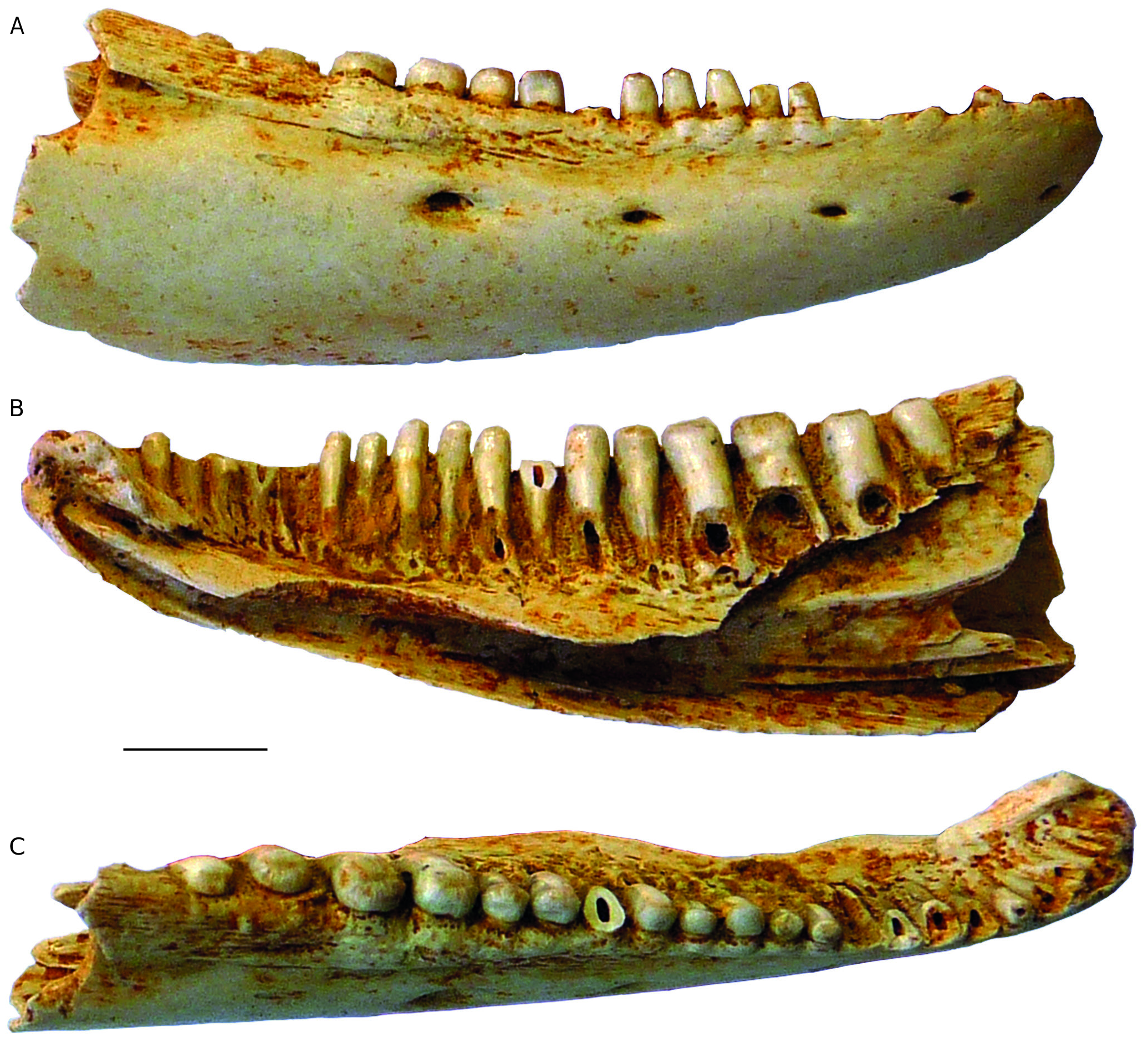
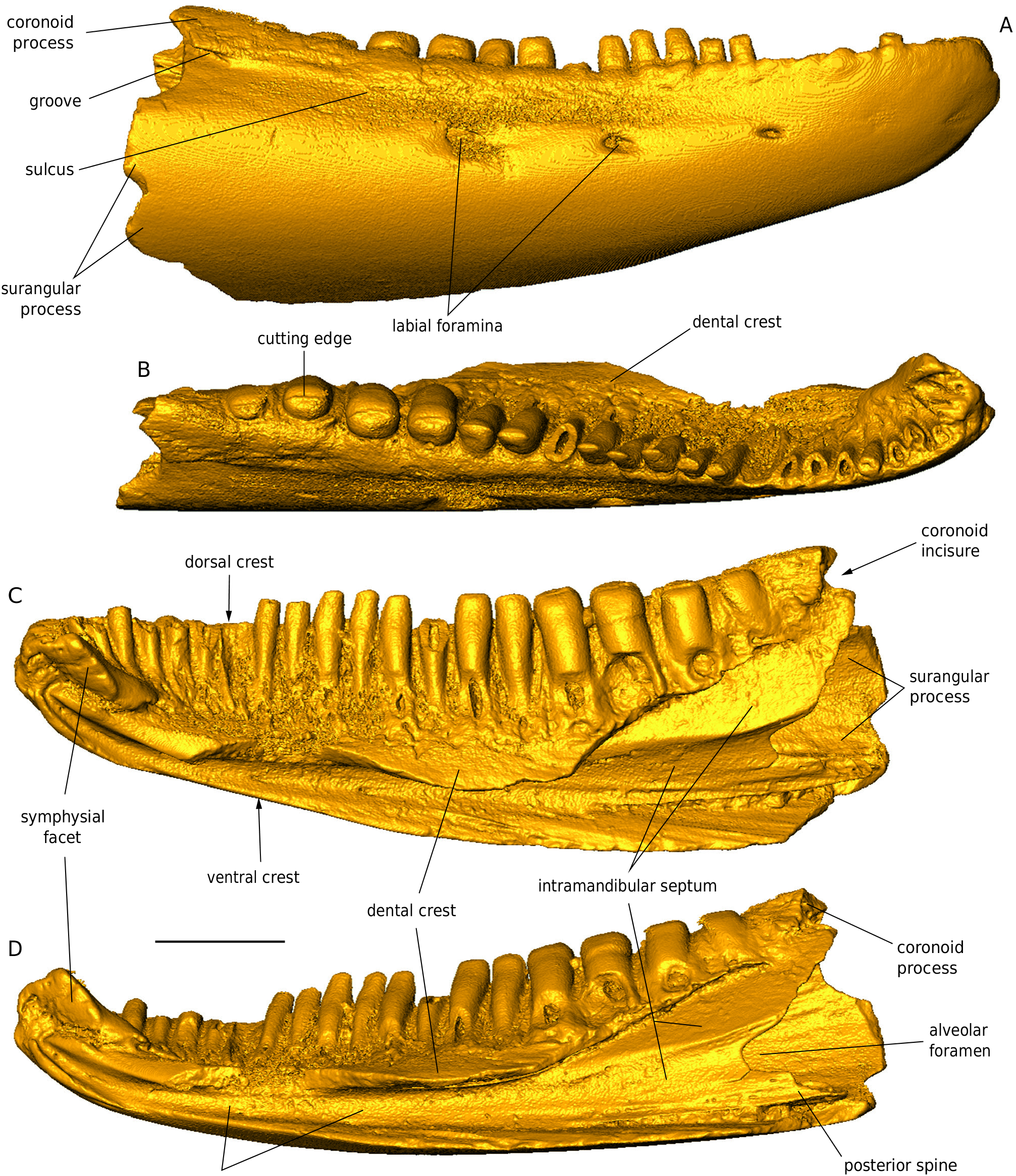
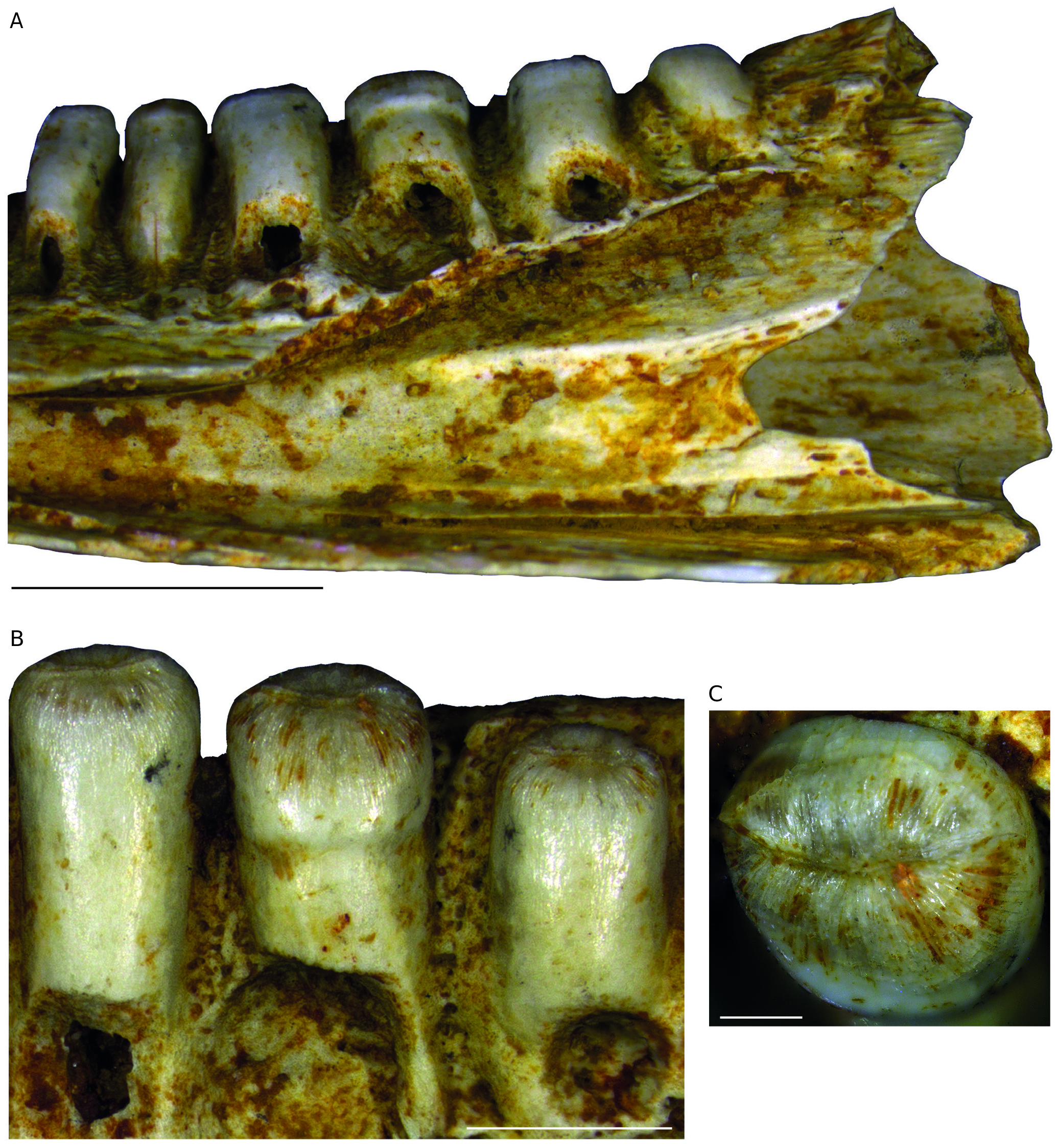
DESCRIPTION Maxilla (Figs 23; 24) About the anterior half of the maxilla is preserved, however, its anteriormost portion is missing (Figs 23; 24). The external wall of the maxilla consists of two complete and three incomplete ornamented shields divided by more or less distinct grooves (Figs 23 A; 24 A). One of the shields lying between the two anterior and two posterior shields is the largest and is of pentagonal shape. The ornamentation consists of small tubercles (Fig. 23 E). The ornamented surface is ventrally delimited by a shallow and narrow, anteroposteriorly running groove. Immediately ventral to the groove, the surface of the maxilla is smooth and four labial foramina are present there (Figs 23 A; 24 A). The smooth medial surface bears two depressions; a large one anteriorly (lacrimal recess) and a smaller one posteriorly (Figs 23 B; 24 B). The supradental shelf is straight and the bone immediately laterally to the posterior portion of the shelf is burrowed by the superior alveolar canal. The teeth are mesiodistally narrow and the apex is pointed. Dentaries (Figs 25 - 29) The right dentary NHMW 2019 / 0049 / 0001 is almost completely preserved, with only several pieces of the posteriormost portion are missing (Figs 25 - 28), while the left dentary NHMW 2019 / 0049 / 0002 is much more incomplete, missing both anterior and posterior portions (Fig. 29). Accordingly, we base our description on the almost complete right dentary NHMW 2019 / 0049 / 0001. The dentary is massively built. Its external surface is smooth. A distinct groove runs immediately anteroventrally to the root portion of the coronoid process (Figs 25 - 28). From there, a shallow sulcus runs anteriorly along the dorsal crest of the dentary. Ventrally to this sulcus, five labial foramina are present. The coronoid process is small and short. The posteriormost portion of the dentary has an almost perpendicular margin and represents a surangular process (Figs 26 C, D; 28 A). The most distinctive feature of the dentary is a huge alveolar canal (Figs 25 - 28). The intramandibular septum runs in dorsolateral-ventromedial direction and, in the place of the alveolar foramen, it is distinctly embayed anteriorly. The ventral margin of the intramandibular septum is divided from the wall of the dentary by a distinct groove (Figs 25 - 28). The posteroventral margin of the intramandibular septum extends to a distinct posterior spine (Figs 25 - 28). The dental crest extends medioventrally. The Meckel’s groove opens medioventrally. There are 22 tooth positions, while at least 10 teeth are rather well preserved (Figs 25 - 27). The teeth are dorsoventrally straight and they increase in size mesiodistally (Figs 25 - 28). The most robust are the 3 rd and 4 th teeth from posterior. The lingual walls of the teeth are medially bulged. The apices become mesiodistally gradually more robust and bear distinct mesiodistally straight cutting edges (Figs 25 - 28). The lingual and labial surfaces of the apices are distinctly striated.
Georgalis, Georgios L., Čerňanský, Andrej, Klembara, Jozef (2021): Osteological atlas of new lizards from the Phosphorites du Quercy (France), based on historical, forgotten, fossil material. Geodiversitas 43 (9): 219-293, DOI: 10.5252/geodiversitas2021v43a9
REMARKS The almost complete dentary NHMW 2019 / 0049 / 0001 bears strong resemblance with the neotype dentary of Para- placosauriops quercyi (MNHN. F. QU 16569). Most characteristically, both specimens share the strongly heterodont dentition, with the anterior teeth being much slender and the posterior ones robust, a developed intramandibular septum, with its ventral margin fused to the floor of the Meckel’s groove (Augé & Sullivan 2006). The fragmentary dentary NHMW 2019 / 0049 / 0002, although much incomplete, seems to possess also this dental morphology. The general morphology of the preserved portion of the maxilla and the type of ornamentation correspond to those described by Augé & Sullivan (2006). The specimen NHMW 2019 / 0049 / 0001 represents the most complete dentary assigned to Paraplacosauriops quercyi and thus, enhances our understanding of this element in this melanosaurine taxon. We agree with recent authors that the species Diploglossus cadurcensis De Stefano, 1903, and Placosaurus leenhardti Leenhardt, 1926 (both from the old collections of the Phosphorites du Quercy) are junior synonyms of Paraplacosauriops quercyi (e. g., Augé 2005), although we have to highlight that the completeness of the holotype of Placosaurus leenhardti is remarkable and this taxon is certainly worth of a comprehensive redescription.
Georgalis, Georgios L., Čerňanský, Andrej, Klembara, Jozef (2021): Osteological atlas of new lizards from the Phosphorites du Quercy (France), based on historical, forgotten, fossil material. Geodiversitas 43 (9): 219-293, DOI: 10.5252/geodiversitas2021v43a9
REFERRED SPECIMENS. — An incomplete left maxilla (NHMW 2019 / 0049 / 0003); a right dentary (NHMW 2019 / 0049 / 0001); a left dentary (NHMW 2019 / 0049 / 0002).
Georgalis, Georgios L., Čerňanský, Andrej, Klembara, Jozef (2021): Osteological atlas of new lizards from the Phosphorites du Quercy (France), based on historical, forgotten, fossil material. Geodiversitas 43 (9): 219-293, DOI: 10.5252/geodiversitas2021v43a9

Export occurrence data

Darwin Core Archive (ZIP)

CLASSIFICATION

Taxonomic Classification Tree

MULTIMEDIA

Media Files(7)

FIG. 23. — Paraplacosauriops quercyi (Filhol, 1882). A-D, photographs of left maxilla NHMW 2019/0049/0003 in lateral (A), medial (B), dorsal (C), and anterior (D) views; E, close up photograph of the sculpturing pattern of the same specimen. Scale bar: A-D, 2 mm.
Imageimage/png© Georgalis, Georgios L.;Čerňanský, Andrej;Klembara, JozefGeorgalis, Georgios L.;Čerňanský, Andrej;Klembara, Jozef

FIG. 24. — Paraplacosauriops quercyi (Filhol, 1882). Virtual 3D models of left maxilla NHMW 2019/0049/0003 in lateral (A), medial (B), anterior (C), and ventral (D) views. Scale bar: 5 mm.
Imageimage/png© Georgalis, Georgios L.;Čerňanský, Andrej;Klembara, JozefGeorgalis, Georgios L.;Čerňanský, Andrej;Klembara, Jozef

FIG. 25. — Paraplacosauriops quercyi(Filhol,1882).Photographs of right dentary NHMW 2019/0049/0001 in lateral (A),medial (B),and dorsal (C) views.Scale bar:5 mm.
Imageimage/png© Georgalis, Georgios L.;Čerňanský, Andrej;Klembara, JozefGeorgalis, Georgios L.;Čerňanský, Andrej;Klembara, Jozef

FIG. 26. — Paraplacosauriops quercyi (Filhol, 1882). Virtual 3D models of right dentary NHMW 2019/0049/0001 in lateral (A), dorsal (B), medial (C), and ventromedial (D) views. Scale bar: 5 mm.
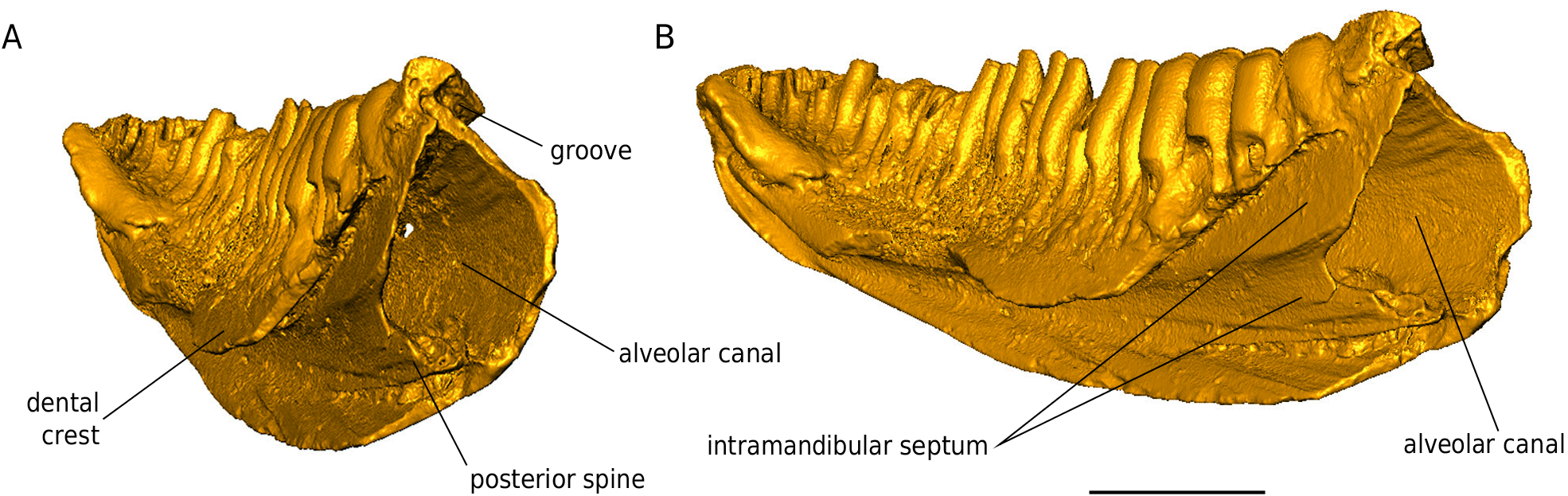
Imageimage/png© Georgalis, Georgios L.;Čerňanský, Andrej;Klembara, JozefGeorgalis, Georgios L.;Čerňanský, Andrej;Klembara, Jozef

FIG. 27. — Paraplacosauriops quercyi (Filhol, 1882). Virtual 3D models of right dentary NHMW 2019/0049/0001 in posterior and slightly medial (A) and posteromedial (B) views. Scale bar: 5 mm.
Imageimage/png© Georgalis, Georgios L.;Čerňanský, Andrej;Klembara, JozefGeorgalis, Georgios L.;Čerňanský, Andrej;Klembara, Jozef

FIG. 28. — Paraplacosauriops quercyi (Filhol, 1882). A, close up photograph of the posterior portion of right dentary NHMW 2019/0049/0001 in medial view; B, close up photograph of the posterior teeth in medial view; C, close up photograph of a posterior tooth in dorsal view.Scale bars: A, 5 mm; B, 2 mm; C, 0.5 mm.

Imageimage/png© Georgalis, Georgios L.;Čerňanský, Andrej;Klembara, JozefGeorgalis, Georgios L.;Čerňanský, Andrej;Klembara, Jozef

IMAGES

Gallery(7)

See Gallery

Occurrences with images

Source Information

Osteological atlas of new lizards from the Phosphorites du Quercy (France), based on historical, forgotten, fossil material

checklist

This dataset contains the digitized treatments in Plazi based on the original journal article Georgalis, Georgios L., Čerňanský, Andrej, Klembara, Jozef (2021): Osteological atlas of new lizards from the Phosphorites du Quercy (France), based on historical, forgotten, fossil material. Geodiversitas 43 (9): 219-293, DOI: 10.5252/geodiversitas2021v43a9

MOTS CLÉS Squamata, lézards, Quercy, Paléogène, micro-CT, anatomie squelettique, espèces nouvelles.

Georgalis G L, Čerňanský A, Klembara J, felipe (2021). Osteological atlas of new lizards from the Phosphorites du Quercy (France), based on historical, forgotten, fossil material. Geodiversitas. Checklist dataset https://doi.org/10.5252/geodiversitas2021v43a9 accessed via GBIF.org on 2026-06-19.

CC0Published 4/22/2021View dataset
GBIF Usage Key
181601096
Dataset Key
04426a8e-c179-4af0-8e23-d72908e8b4cc
Origin
source
Backbone Key
8621723
Taxon ID
03A1633BFFBEFFDF30D7F909FE833FE6.taxon
Last Crawled
6/10/2026
Last Interpreted
6/10/2026