
AnimaliaacceptedsubfamilyAccepted
Anguinae
Gray, 1825
GBIF:181601116
0year
ABOUT
Descriptions(3)
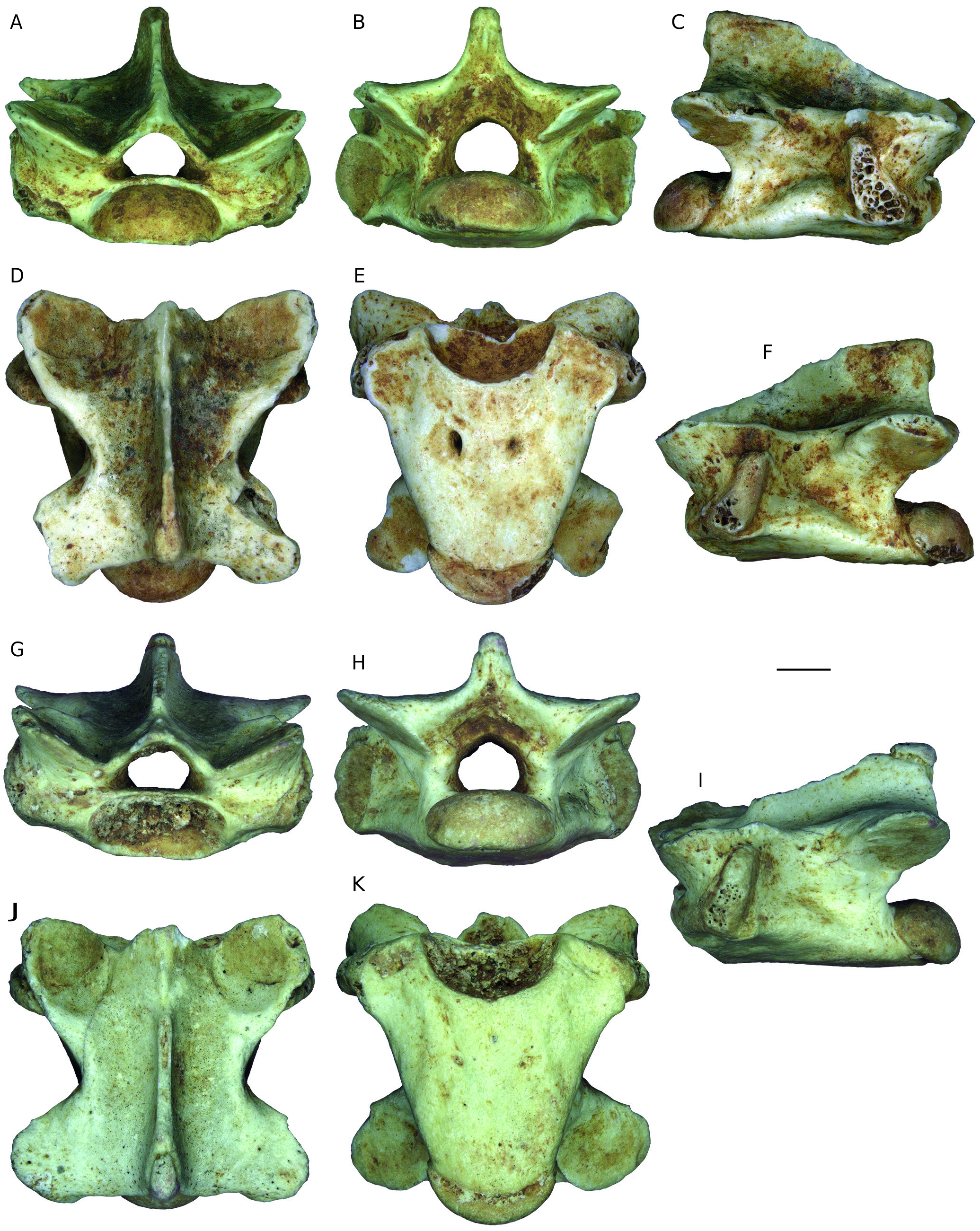
DESCRIPTION The presacral vertebrae NHMW 2019 / 0093 / 0001 and NHMW 2019 / 0093 / 0002 are almost totally complete (Fig. 33). They are relatively large, both having a centrum length of 8.4 mm. In anterior view (Fig. 33 A, G), the prezygapophyses are dorsolaterally inclined. The neural canal is triangular in shape. The cotyle is exceedingly depressed. In posterior view (Fig. 33 B, H), the neural arch is moderately vaulted. The condyle is rather depressed, with its ventral level being flattened. In dorsal view (Fig. 33 D, G), the neural spine extends across the whole midline of the neural arch. The neural spine is relatively thickened in its posterior portion, while it is much thinner throughout its middle and anterior portions, where it takes the shape of a sharp, longitudinal ridge. The prezygapophyseal articular facets are enlarged. In ventral view (Fig. 33 E, K), the centrum is widened anteriorly; its surface is flattened, with only a slight median ridge running throughout its midline. The subcentral ridges are straight; they are not parallel. Two prominent subcentral foramina pierce the centrum of NHMW 2019 / 0093 / 0001, while in the other specimen (NHMW 2019 / 0093 / 0002) these are smaller. In lateral view (Fig. 33 C, F, I), the neural spine is rather short. It augments in height gradually towards the posterior portion of the neural arch, reaching its maximum height at its posteriormost portion. Its dorsal surface is straight, with its posterodorsal edge being slightly inclined posteriorly. The synapophyses are large and elongated.
Georgalis, Georgios L., Čerňanský, Andrej, Klembara, Jozef (2021): Osteological atlas of new lizards from the Phosphorites du Quercy (France), based on historical, forgotten, fossil material. Geodiversitas 43 (9): 219-293, DOI: 10.5252/geodiversitas2021v43a9
REMARKS These two vertebrae are strongly resembling to the ones of the genus Pseudopus on the basis of their wide centrum, being wider anteriorly, straight subcentral ridges in ventral view, and their neural spine slightly inclined posteriorly (Klembara 1979, 1981; Klembara & Rummel 2018; Čerňanský et al. 2019). Such resemblance is also supported by a biogeographic and stratigraphic rationale, as material assigned (or tentatively assigned) to Pseudopus is known in the Oligocene of Western Europe (Boettger 1875). However, it is known that at least other three non-glyptosaurine anguid genera were present in the Paleogene of Western and Central Europe, i. e., Helvetisaurus Augé, 2005, Ophisauromimus Čerňanský, Klembara & Müller, 2016, and Ophisauriscus Kuhn, 1940 (Augé 2005; Čerňanský et al. 2016 a). Considering that the vertebral morphology of Ophisauromimus is currently unknown, we refrain from further assigning these two NHMW vertebrae to Pseudopus, although their overall large size, may suggest that such taxonomic referral may be most plausible.
Georgalis, Georgios L., Čerňanský, Andrej, Klembara, Jozef (2021): Osteological atlas of new lizards from the Phosphorites du Quercy (France), based on historical, forgotten, fossil material. Geodiversitas 43 (9): 219-293, DOI: 10.5252/geodiversitas2021v43a9
REFERRED SPECIMENS. — Two presacral vertebrae (NHMW 2019 / 0093 / 0001 and NHMW 2019 / 0093 / 0002).
Georgalis, Georgios L., Čerňanský, Andrej, Klembara, Jozef (2021): Osteological atlas of new lizards from the Phosphorites du Quercy (France), based on historical, forgotten, fossil material. Geodiversitas 43 (9): 219-293, DOI: 10.5252/geodiversitas2021v43a9
Export occurrence data
Darwin Core Archive (ZIP)

MULTIMEDIA
Media Files(1)
FIG. 33. — Anguinae indet. A-F, photographs of presacral vertebra NHMW 2019/0093/0001 in anterior (A), posterior (B), right lateral (C), dorsal (D), ventral (E), and left lateral (F) views; G-K, photographs of presacral vertebra NHMW 2019/0093/0002 in anterior (G), posterior (H), left lateral (I), dorsal (J), and ventral (K) views. Scale bar: 2 mm.
Imageimage/png© Georgalis, Georgios L.;Čerňanský, Andrej;Klembara, JozefGeorgalis, Georgios L.;Čerňanský, Andrej;Klembara, Jozef
IMAGES