
AnimaliaacceptedgenusAccepted
Aphanostichopathes
Opresko, Bo, Stein, Evankow, Distel & Brugler, 2021
GBIF:182383881
0year
0
Synonyms
ABOUT
Descriptions(3)
Diagnosis. Colonies unbranched. Stem straight or curved and often forming wide distal coils. Spines usually conical, acute or blunt, with conical tubercles on their surface most often confined to near the apex. Polyps up to 3.4 mm in transverse diameter, and arranged in a single series.
Opresko, Dennis M., Bo, Marzia, Stein, David P., Evankow, Ann, Distel, Daniel L., Brugler, Mercer R. (2021): Description of two new genera and two new species of antipatharian corals in the family Aphanipathidae (Cnidaria: Anthozoa: Antipatharia). Zootaxa 4966 (2): 161-174, DOI: 10.11646/zootaxa.4966.2.4
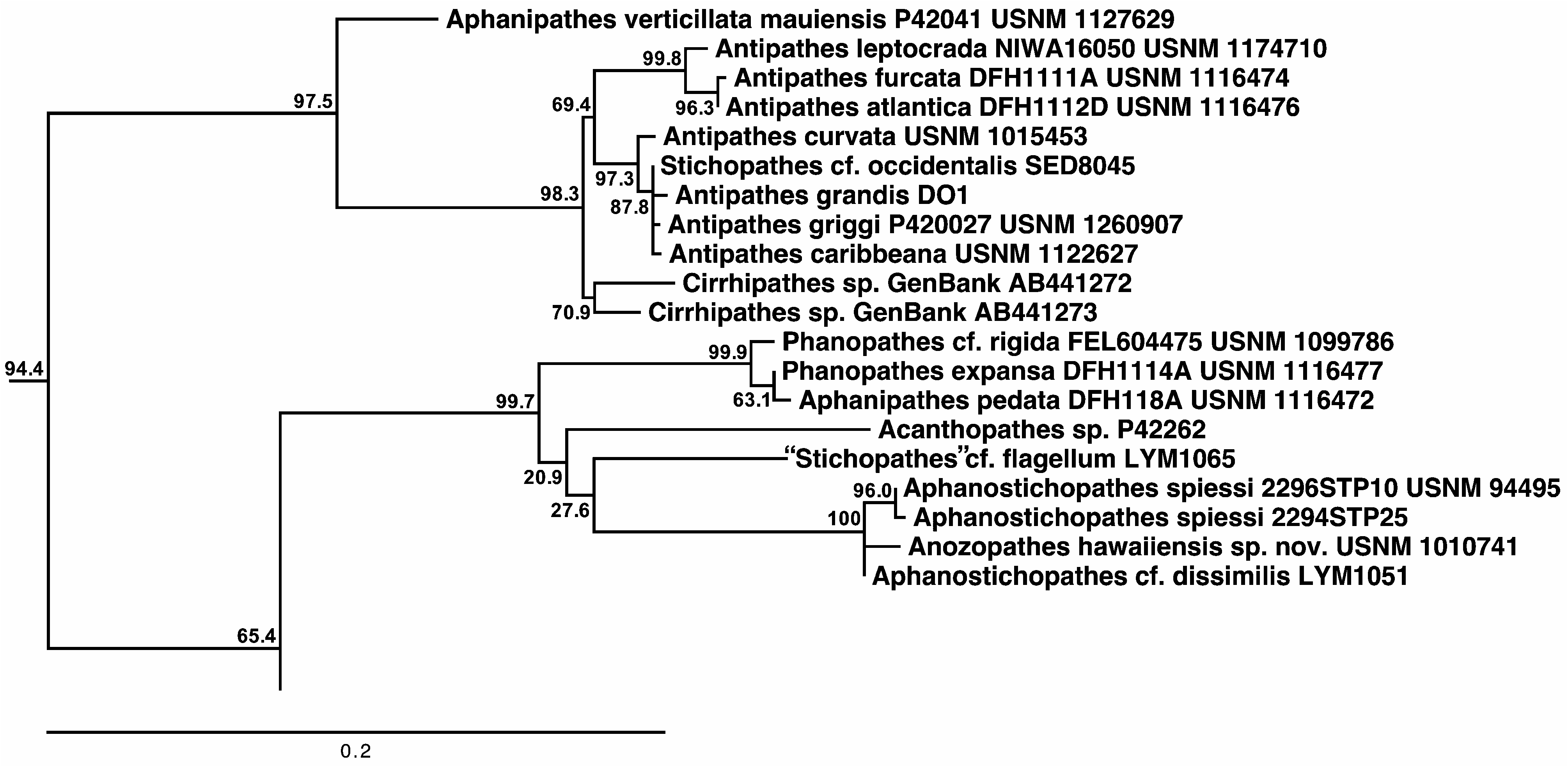
Remarks. In outward appearance Aphanostichopathes very closely resembles the genus Stichopathes in the family Antipathidae. The distinct tuberculate nature of the skeletal spines, the apparent aphanipathid like appearance of the polyps, and the molecular data as discussed below, confirm its relationship to the Aphanipathidae. Species in genus. Stichopathes euoplos Schultze, 1903; Stichopathes dissimilis Roule, 1902, 1905; and Stichopathes spiessi Opresko and Genin, 1990. One other species that might belong to the new genus is Stichopathes flagellum Roule, 1902, 1905; however, the type specimen needs to be re-examined for the presence of tubercles on the spines. Phylogenetic data. The type specimen of Aphanostichopathes paucispina (Brook) has not been evaluated in DNA sequencing studies. However, two specimens identified as Stichopathes spiessi Opresko & Genin, a species which is morphologically very similar, and may be identical to A. paucispina, were analyzed by Chery et al. (2018) using the mitochondrial gene regions nad 5 - IGR- nad 1 and cox 3 - cox 1. The resulting phylogenetic tree of the families Antipathidae and Aphanipathidae based on cox 3 - cox 1 is shown in Figure 5. The genera Aphanipathes, Phanopathes, Anozopathes and Acanthopathes shown in Figure 5 are all currently placed in the family Aphanipathidae. Aphanostichopathes clearly falls within the same clade and all typically have spines with conical tubercles. In contrast, species of Stichopathes that remain within the Antipathidae have spines that are smooth or have small round or oblong papillae, rather than conical tubercles. The specimen of Stichopathes cf. occidentalis in the Antipathidae clade in the Figure 5 (SED 8045) was not available for examination; however, assuming it has spines that are similar to S. occidentalis Gray, then the spines should have numerous small roundish papillae typical of some species of Stichopathes in the family Antipathidae. Note: the species identified as Stichopathes cf. flagellum in Figure 5 has faint morphological features indicating that it might also belong in the family Aphanipathidae; however, the fact that it groups separate from the two species of Aphanostichopathes requires further study.
Opresko, Dennis M., Bo, Marzia, Stein, David P., Evankow, Ann, Distel, Daniel L., Brugler, Mercer R. (2021): Description of two new genera and two new species of antipatharian corals in the family Aphanipathidae (Cnidaria: Anthozoa: Antipatharia). Zootaxa 4966 (2): 161-174, DOI: 10.11646/zootaxa.4966.2.4
Type species. Cirripathes paucispina Brook, 1889 (= Cirrhipathes paucispina Brook).
Opresko, Dennis M., Bo, Marzia, Stein, David P., Evankow, Ann, Distel, Daniel L., Brugler, Mercer R. (2021): Description of two new genera and two new species of antipatharian corals in the family Aphanipathidae (Cnidaria: Anthozoa: Antipatharia). Zootaxa 4966 (2): 161-174, DOI: 10.11646/zootaxa.4966.2.4
Export occurrence data
Darwin Core Archive (ZIP)
CLASSIFICATION
Taxonomic Classification Tree

NOMENCLATURE
Synonyms(2)
MULTIMEDIA
Media Files(1)
FIGURE 5. A maximum likelihood-based phylogenetic tree of the families Antipathidae and Aphanipathidae based on mitochondrial cox3-cox1 sequence data (Chery et al. 2018). The original tree consisted of 84 taxa and 1,111 sites and was rooted to anemones and zoanthids. PhyML used the GTR+I+G model of sequence evolution and 1,000 bootstrap replicates.
Imageimage/png© Opresko, Dennis M.;Bo, Marzia;Stein, David P.;Evankow, Ann;Distel, Daniel L.;Brugler, Mercer R.Opresko, Dennis M.;Bo, Marzia;Stein, David P.;Evankow, Ann;Distel, Daniel L.;Brugler, Mercer R.
IMAGES