
AnimaliaNot EvaluatedacceptedspeciesAccepted
Anozopathes palauensis
Opresko, Bo, Stein, Evankow, Distel & Brugler, 2021
GBIF:182383883
0year
ABOUT
Descriptions(6)
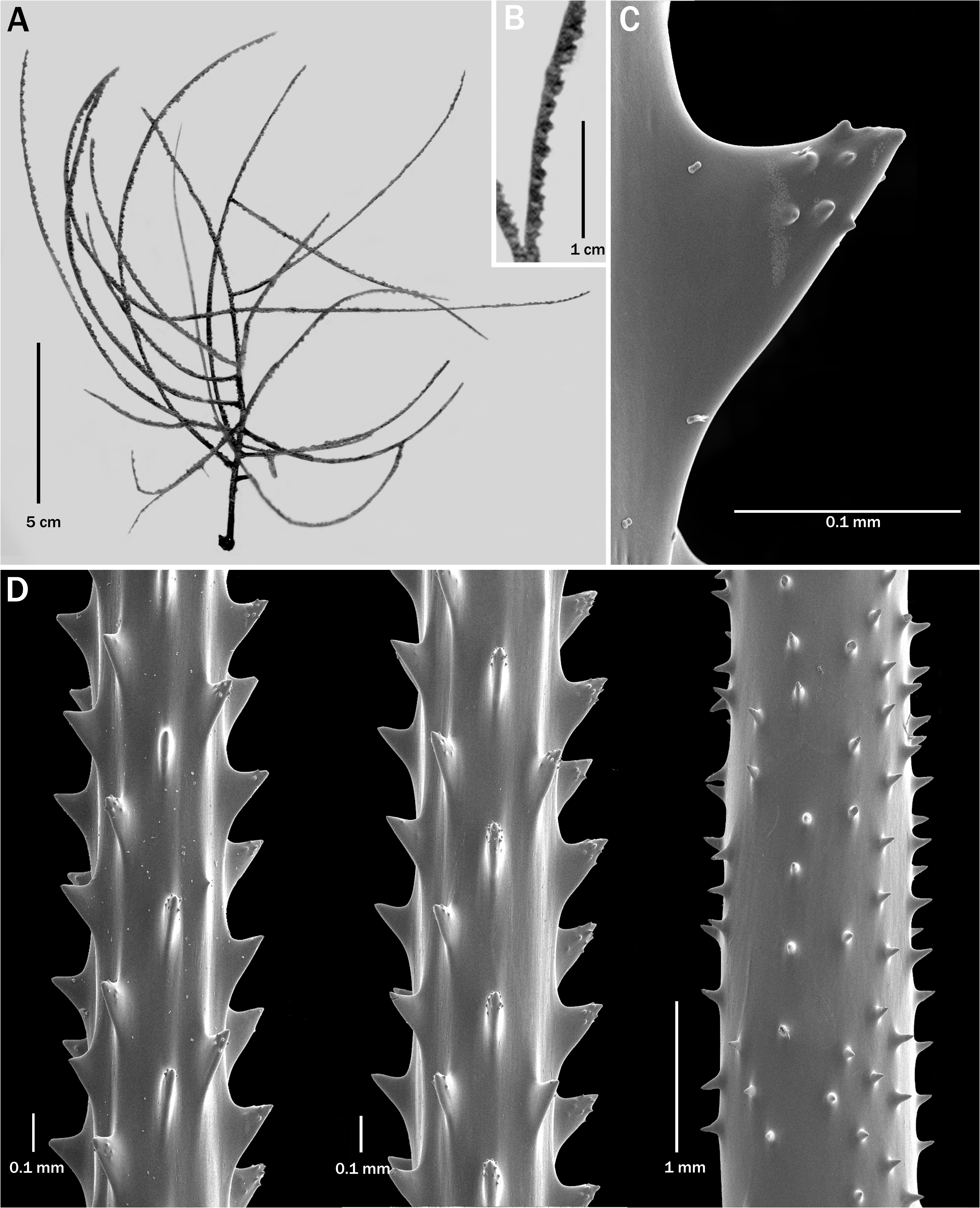
(Fig. 4)
Opresko, Dennis M., Bo, Marzia, Stein, David P., Evankow, Ann, Distel, Daniel L., Brugler, Mercer R. (2021): Description of two new genera and two new species of antipatharian corals in the family Aphanipathidae (Cnidaria: Anthozoa: Antipatharia). Zootaxa 4966 (2): 161-174, DOI: 10.11646/zootaxa.4966.2.4
Description of holotype. The holotype (Fig. 4 A) is about 16 cm tall, 17 cm wide and has a basal stem diameter of about 2 mm. The main stem is 14 cm long and slightly curved. The branching is very sparse, and mostly to the first order and rarely to the second order. Most of the branches originate from the lower half of the stem. The branches are long, and although the distal branch angles are close to 90 º, most branches are curved upward. The longest branch is about 13.7 cm long and about 1.3 mm in diameter near its connection to the stem. The branches are spaced varying distances apart, with as many as four occurring along 3 cm of the stem. The spines (Fig. 4 C – D) are relatively short, cone-shaped in lateral view, but compressed laterally, with a long shallow-sloped proximal edge, and with a few conical tubercles near the apex. On a branch 0.38 mm in diameter the polypar spines reach a maximum size of about 0.14 mm (as measured from middle of base to apex), and the abpolypar spines are 0.11 mm. Six longitudinal rows of spines can be seen in one lateral view (excluding rows in which the spines are only partially visible). Within each row the spines are about 0.5 mm apart, resulting in three per mm. The cone-shaped tubercles near the apex of the spines are 0.005 to 0.007 mm tall. The number of tubercles varies from spine to spine and the greatest number occur on the polypar spines; most of the abpolypar spines lack tubercles or just have one or two visible in lateral view. On the polypar spines a maximum of about eight tubercles can be seen in lateral view (including those on the edges and seen in profile). On the lower part of a branch (diameter 1.2 mm) the spines are 0.15 – 0.16 mm tall, more conical, and narrower than those on upper part of the branches, and tubercles are not present. The polyps (Fig. 4 B) are arranged in a single row. In the preserved state most polyps measure about 2 mm in transverse diameter. The interpolypar space is generally less than 1 mm, and there are 4 to 5 polyps per cm. Comparisons. This species is related to Anozopathes hawaiiensis in the general morphology of the corallum. It differs from that species in having straighter, stiffer branches; smaller spines (0.14 mm vs. 0.25 mm) with a much shallower slope along the lower proximal edge; and slightly more tubercles per spine as seen in lateral view (up to about 8 vs. up to about 6).
Opresko, Dennis M., Bo, Marzia, Stein, David P., Evankow, Ann, Distel, Daniel L., Brugler, Mercer R. (2021): Description of two new genera and two new species of antipatharian corals in the family Aphanipathidae (Cnidaria: Anthozoa: Antipatharia). Zootaxa 4966 (2): 161-174, DOI: 10.11646/zootaxa.4966.2.4
Diagnosis. Colony small, very sparsely branched to the second order, with long curved branches disposed irregularly on all sides of the stem but curving upward. Branch angles usually close to 90 º. Spines up to about 0.14 mm tall, 0.5 mm apart, with 3 spines per mm in each row. Polyps about 2 mm in transverse diameter, arranged in a single series, with four to five polyps per cm.
Opresko, Dennis M., Bo, Marzia, Stein, David P., Evankow, Ann, Distel, Daniel L., Brugler, Mercer R. (2021): Description of two new genera and two new species of antipatharian corals in the family Aphanipathidae (Cnidaria: Anthozoa: Antipatharia). Zootaxa 4966 (2): 161-174, DOI: 10.11646/zootaxa.4966.2.4
Distribution. Known only from Palau, 192 m
Opresko, Dennis M., Bo, Marzia, Stein, David P., Evankow, Ann, Distel, Daniel L., Brugler, Mercer R. (2021): Description of two new genera and two new species of antipatharian corals in the family Aphanipathidae (Cnidaria: Anthozoa: Antipatharia). Zootaxa 4966 (2): 161-174, DOI: 10.11646/zootaxa.4966.2.4
Etymology. The species name is based on the type locality.
Opresko, Dennis M., Bo, Marzia, Stein, David P., Evankow, Ann, Distel, Daniel L., Brugler, Mercer R. (2021): Description of two new genera and two new species of antipatharian corals in the family Aphanipathidae (Cnidaria: Anthozoa: Antipatharia). Zootaxa 4966 (2): 161-174, DOI: 10.11646/zootaxa.4966.2.4
Material examined. Holotype: USNM 1007104 (SEM stub 260), Palau, off Koror, 7.2735 ºN, 134.524 ºE, Coral Reef Research Foundation, sta. Mutremdiu 2, 192 m, coll. P. Colin, 28 March 2001. Type locality. Palau, off Koror, 192 m.
Opresko, Dennis M., Bo, Marzia, Stein, David P., Evankow, Ann, Distel, Daniel L., Brugler, Mercer R. (2021): Description of two new genera and two new species of antipatharian corals in the family Aphanipathidae (Cnidaria: Anthozoa: Antipatharia). Zootaxa 4966 (2): 161-174, DOI: 10.11646/zootaxa.4966.2.4
Export occurrence data
Darwin Core Archive (ZIP)
CLASSIFICATION
Taxonomic Classification Tree

MULTIMEDIA
Media Files(1)
FIGURE 4. Anozopathes palauensis sp. nov. holotype (USNM 1007104): A. entire corallum; B. polyps; C. individual spines with tubercles. D. sections of branchlets and a larger branch (on right). (C and D from NMNH SEM stub 260).
Imageimage/png© Opresko, Dennis M.;Bo, Marzia;Stein, David P.;Evankow, Ann;Distel, Daniel L.;Brugler, Mercer R.Opresko, Dennis M.;Bo, Marzia;Stein, David P.;Evankow, Ann;Distel, Daniel L.;Brugler, Mercer R.
IMAGES