
AnimaliaNot EvaluatedacceptedspeciesAccepted

Entomobrya bicincta
Jordana & Baquero, 2021
GBIF:182398228
0year
ABOUT
Descriptions(7)
Ecology. Unknown.
Baquero, Enrique, Potapov, Mikhail, Jordana, Rafael (2021): New species and a new record of Entomobryinae (Collembola, Entomobryomorpha) from Amurskaya Region (the Far East of Russia). Zootaxa 4969 (1): 119-134, DOI: 10.11646/zootaxa.4969.1.6
Description. Body length (excluding antennae) 1.10 mm (n = 1). Ground colour white or very pale, with pigment between the eyes, antennae, front and anterior Th II, more than half posterior Th III, complete dorsal Abd III, two dorsolateral patches on Abd IV, and lateral bands on AbdV – VI. Head. Eight eyes, GH slightly smaller than EF. Antennae length 0.40 mm, 2.05 times the length of the head (n = 1); Ant IV with bilobed apical vesicle and pin chaeta present; subapical organite very small (drumstick shape); sensory organ of Ant III with the special sensilla long-ovoidal, and three guard additional sensilla; relative length of Ant I / II / III / IV = 1 / 2.00 / 2.00 / 3.00 (n = 1). Prelabral chaetae ciliated. Labral papillae almost smooth (a slight irregularity was observed). Lateral process of labial papilla E not reaching its apex. Maxillary palp bifurcate, with three sublobal chaetae. Body. Length ratio of Abd IV / III = 3.75 (n = 1). Trochanteral organ with approximately eight chaetae. Tibiotarsus not sub-segmented, without smooth chaetae, except for smooth terminal chaeta on leg III. Claw with four inner teeth: paired teeth at 50 % from the basis and first unpaired at 75 % from the basis, second unpaired; subapical unpaired dorsal tooth basal (Fig. 4 E). Empodium lanceolate, with smooth external lamella (pe) in leg III. Tenent hair clavate, longer than the claw. Length of manubrium and dens 0.20 and 0.21 mm, respectively (n = 1). Manubrial plate with three chaetae and two pseudopores. Mucro with teeth similar in size, mucronal spine reaching the tip of the subapical tooth; area not crenulated of dens two times the length of mucro. Macrochaetotaxy (Figs 4 A – D). Simplified Mc formula: 3 - 1 (2) - 0 - 3 - 2 / 3 - 5 / 2 - 4 (3) / 0 - 2 - 1 / 0 - 0 - 2 - 2 - 2. Head: H 1 area with Mc An 2, An 3 a 1, and An 3; H 2 area with one Mc (A 5) and sometimes an additional chaeta (A 6); H 4 area with three Mc (S 1, S 3, and S 4 i); H 4 ’ area with three Mc (S 5, S 5 i, and S 4); H 5 area with Ps 2 and Ps 5 Mc. Mesothorax: area T 1 with three Mc (m 1, m 2, and m 2 i); T 2 with five Mc (a 5, m 4, m 4 p, m 4 i, and m 5). Abdomen: Abd II area A 1 with two Mc (a 2 and a 3), area A 2 with four Mc (m 3, m 3 ep, m 3 e, and m 3 ea; one specimen from sample 2 R has lacked Mc m 3 ea); Abd III without Mc on A 3, two on A 4 (a 2 and a 3) and one on A 5 (m 3); Abd IV without Mc on A 6 and A 7 areas, two on A 8 (A 4 and B 4), two on A 9 (A 5 and B 5), two on A 10 (A 6 and B 6); sensillar formula from Th II to Abd V normal as in the rest of Entomobryinae: 2,2 / 1,2,2,7,3; microsensillar formula from Th II to Abd III: 1,0 / 1,0,1.
Baquero, Enrique, Potapov, Mikhail, Jordana, Rafael (2021): New species and a new record of Entomobryinae (Collembola, Entomobryomorpha) from Amurskaya Region (the Far East of Russia). Zootaxa 4969 (1): 119-134, DOI: 10.11646/zootaxa.4969.1.6
Figs 2 B, 4 A – E
Baquero, Enrique, Potapov, Mikhail, Jordana, Rafael (2021): New species and a new record of Entomobryinae (Collembola, Entomobryomorpha) from Amurskaya Region (the Far East of Russia). Zootaxa 4969 (1): 119-134, DOI: 10.11646/zootaxa.4969.1.6
Diagnosis. The unequivocal identification of the species can only be done using the abbreviated formula of head (H 1 – 5 areas), Th II (T 1 – 2 areas), Abd II (A 1 – 2 areas), Abd III (A 3 – 5 areas), and Abd IV (A 6 – 10 areas) Mc, that for it is: 3 - 1 (2) - 0 - 3 - 2 / 3 - 5 / 2 - 4 (3) / 0 - 2 - 1 / 0 - 0 - 2 - 2 - 2.
Baquero, Enrique, Potapov, Mikhail, Jordana, Rafael (2021): New species and a new record of Entomobryinae (Collembola, Entomobryomorpha) from Amurskaya Region (the Far East of Russia). Zootaxa 4969 (1): 119-134, DOI: 10.11646/zootaxa.4969.1.6
Remarks. This species shares the dorsal macrochaetotaxy of Abd II – III with E. amurica sp. nov. Further comparisons are presented in the remarks of the late species (see also Table 1).
Baquero, Enrique, Potapov, Mikhail, Jordana, Rafael (2021): New species and a new record of Entomobryinae (Collembola, Entomobryomorpha) from Amurskaya Region (the Far East of Russia). Zootaxa 4969 (1): 119-134, DOI: 10.11646/zootaxa.4969.1.6
Etymology. The specific epithet refers to the pigmented transversal bands on Th III and Abd III.
Baquero, Enrique, Potapov, Mikhail, Jordana, Rafael (2021): New species and a new record of Entomobryinae (Collembola, Entomobryomorpha) from Amurskaya Region (the Far East of Russia). Zootaxa 4969 (1): 119-134, DOI: 10.11646/zootaxa.4969.1.6
Type material. Holotype: female on a slide, RUSSIA, Amurskaya Region, ~ 3 km NE Arkhara, top of a hill, dry young oak-forest, litter, (49.47551, 130.12499), 17. viii. 2014, cod AO 2014 - 2 R- 13. Paratypes: same data as Holotype, three females on slide (AO 2014 - 2 R- 14 to 16); 1 female on a slide (AO 2014 - 19 R- 01), Khingansky Reserve, Kundur, in grass turf (49.103646, 130.758800, 168 m a. s. l.), 19. iv. 2018, hand collection. All Potapov, M. and Kuznetsova, N. leg.
Baquero, Enrique, Potapov, Mikhail, Jordana, Rafael (2021): New species and a new record of Entomobryinae (Collembola, Entomobryomorpha) from Amurskaya Region (the Far East of Russia). Zootaxa 4969 (1): 119-134, DOI: 10.11646/zootaxa.4969.1.6
Export occurrence data
Darwin Core Archive (ZIP)
CLASSIFICATION
Taxonomic Classification Tree

MULTIMEDIA
Media Files(2)
FIGURE 2. Colour patterns of the new species.A. Entomobrya amurica sp. nov.; B, E. bicincta sp. nov.; C, E. mediostriata sp. nov.; D, E. umbroviolacea sp. nov.; E, Willowsia babykinae sp. nov. (scale bars: 0.2mm).
Imageimage/png© Baquero, Enrique;Potapov, Mikhail;Jordana, RafaelBaquero, Enrique;Potapov, Mikhail;Jordana, Rafael
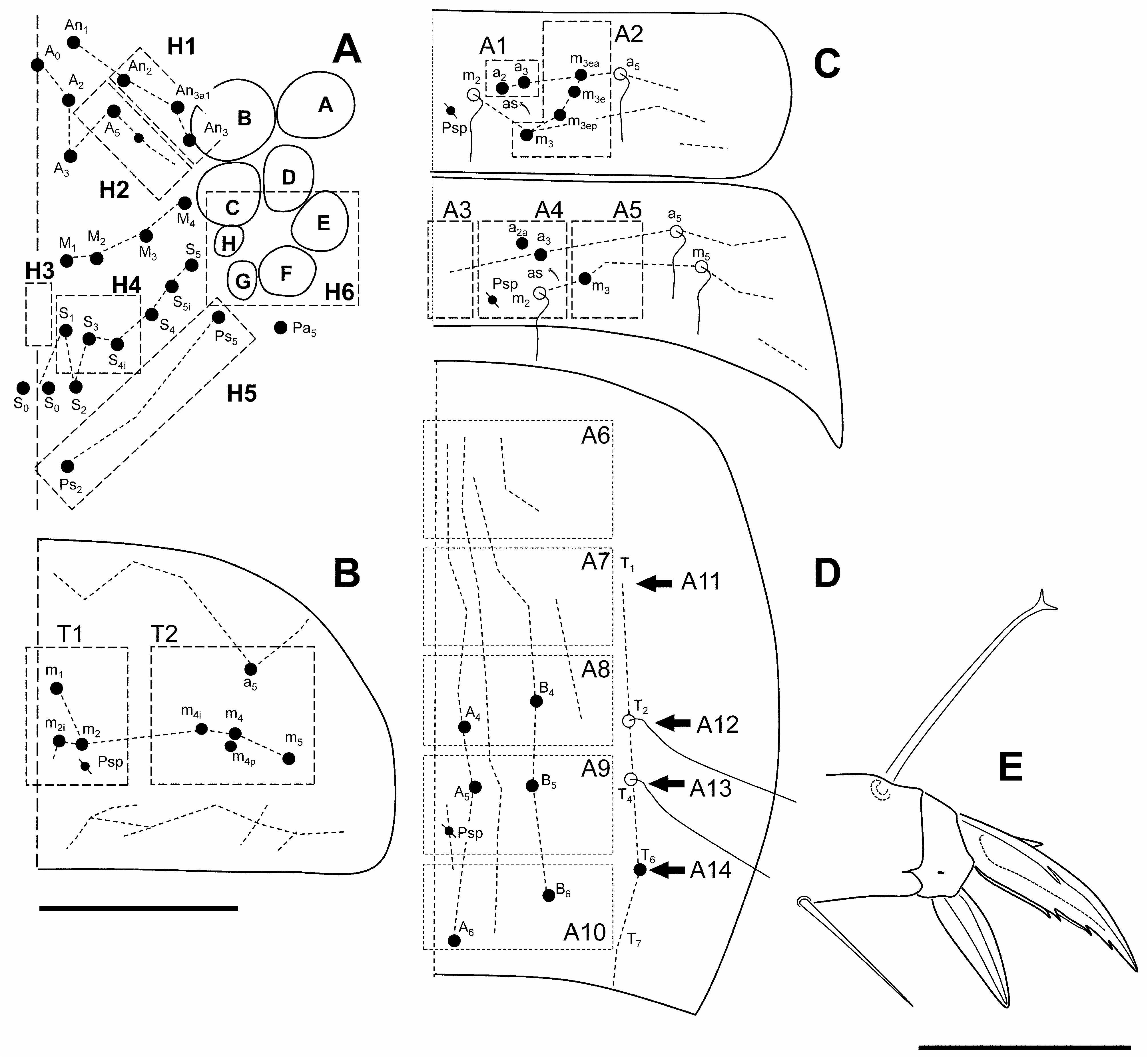
FIGURE 4. Entomobrya bicincta sp. nov. A, head chaetotaxy; B, ThII dorsal macrochaetotaxy; C, AbdII–III dorsal macrochaetotaxy; D, AbdIV dorsal macrochaetotaxy; E, claw and empodium (scale bars: A–D, 0.1mm; E, 0.025 mm).
Imageimage/png© Baquero, Enrique;Potapov, Mikhail;Jordana, RafaelBaquero, Enrique;Potapov, Mikhail;Jordana, Rafael
IMAGES