
AnimaliaNot EvaluatedacceptedspeciesAccepted
Stoliczkella subovata

Stoliczkella subovata

(Stoliczka, 1862) Zágoršek & Gordon, 2014

GBIF:182405764

0year

0

Synonyms

ABOUT

Descriptions(3)

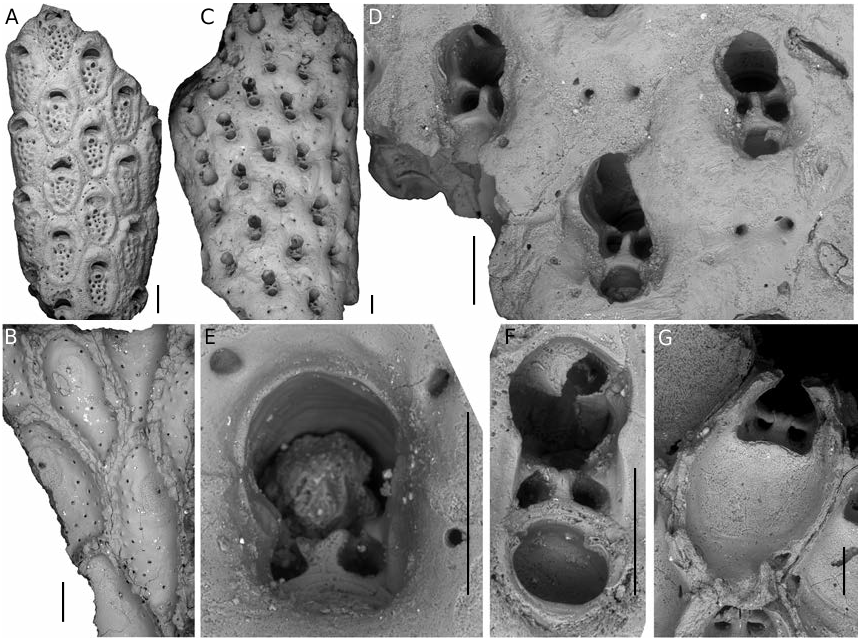
DESCRIPTION Colony erect, bilamellar, flat or with lensoidal cross section, with zooecial orientation indicative of potential bifurcation distally, autozooecia opening on both faces. Autozooecia somewhat elongateoval (especially in interior view) to rhomboidal, although exterior boundary lines can disappear with secondary calcification. Frontal shield umbonuloid, frontally smooth, convex, imperforate except for tiny marginal areolar pores, these often tending to be lacking laterally, paired proximally. Interior view shows a large area of planar-spherulitic microstructure bordered by a ring scar. Peristomial aperture shows a proximal median process that may or may not have 2 – 3 slight projections distally; median process fusing with a projection from either side to form a pair of spiramina; this arrangement more clearly seen from interior view, with the median process sometimes grooved. ‘ Primary orifice’ (observable from interior view) semicircular with slightly convex proximal margin. Oral spines absent. Median suboral avicularium relatively large, subcircular, rostrum proximofrontally directed, crossbar mostly broken. Ooecium deeply immersed, recumbent on distal zooecium, ectooecium imperforate, typically somewhat concealed by secondary calcification. Additional smaller adventitious avicularia, circular, sparsely found laterofrontally or proximally on frontal shield, with rostrum directed obliquely laterally or proximally. Vicarious avicularia situated on margin of the colony, these larger than autozooecia with a rounded rostrum and oval aperture.
Zágoršek, Kamil, Gordon, Dennis P. (2014): Revision of the Oligocene bryozoan taxa described by Stoliczka (1862), with the description of a new genus of Bryocryptellidae. Geodiversitas 36 (4): 541-564, DOI: 10.5252/g2014n4a3, URL: http://dx.doi.org/10.5252/g2014n4a3
REMARKS Two species occurred in a single box with the same name (Eschara (Flustrina) subovata) and registration number. Five specimens are Stoliczkella subovata n. comb. and correspond with Stoliczka’s original description and illustrations. Ŋe remaining two specimens belong to Reteporella and comprise colony fragments with apertures opening only on one side. Ŋese two specimens were erroneously cited as Eschara (Flustrina) subovata by Zágoršek (2001, 2003) and listed under Reteporella. According to Stoliczka’s original description and illustration, Eschara (Flustrina) subovata has bilamellar colonies (with a medial lamella) that definitely do not belong to Phidoloporidae; the species described as Reteporella subovata from Eocene sediments of Reingruberhohe (Zágoršek 2003) and Buda Marls (Zágoršek 2001) may represent a new species of Reteporella. Ŋe specimen described by Zágoršek (2003) as Galeopsis cf. subquadrangularis (Reuss) corresponds to Stoliczkella subovata n. comb. in having elongateoval autozooecia, large suboral avicularia and one pair of areolar septular pores in the proximal part of the autozooecium. Although adventitious and vicarious avicularia have not been observed in the Reingruberhohe specimens, we believe they belong to Stoliczkella subovata n. comb.
Zágoršek, Kamil, Gordon, Dennis P. (2014): Revision of the Oligocene bryozoan taxa described by Stoliczka (1862), with the description of a new genus of Bryocryptellidae. Geodiversitas 36 (4): 541-564, DOI: 10.5252/g2014n4a3, URL: http://dx.doi.org/10.5252/g2014n4a3
MATERIAL EXAMINED. — Seven specimens labelled as Eschara (Flustrina) subovata registered as 2010 / 0259 / 0006, but only five may be regarded as syntypes. Two specimens belong to the genus Reteporella. Ŋe chosen lectotype (designated here) corresponds with Stoliczka’s illustration (1862: pl. 2, fig. 9) and is depicted as Figure 4 B herein.
Zágoršek, Kamil, Gordon, Dennis P. (2014): Revision of the Oligocene bryozoan taxa described by Stoliczka (1862), with the description of a new genus of Bryocryptellidae. Geodiversitas 36 (4): 541-564, DOI: 10.5252/g2014n4a3, URL: http://dx.doi.org/10.5252/g2014n4a3

Export occurrence data

Darwin Core Archive (ZIP)

CLASSIFICATION

Taxonomic Classification Tree

MULTIMEDIA

Media Files(1)

FIG. 4. — A, Adeonellopsis pulchra (Stoliczka, 1862) n. comb., lectotype showing arrangement of autozooecia; B, interior view of holotype of Lepralia pedicularis showing elongate zooecial chambers with mixed frontal shields and scattered lepralioid pseudopores; due to the very poor preservation and the absence any other characteristic features described here as “Lepralia pedicularis Stoliczka, 1862” nomen dubium; C-G, Stoliczkella subovata (Stoliczka,1862) n. comb.;C, general view of lectotype;D, detail of three autozooecia showing deeply immersed apertures and a proximal pair of frontal areolar pores;E, autozooecial aperture showing a Y-shaped denticle;F, autozooecial aperture showing spiraminal openings produced by fusion of lateral processes, proximal to which is a suboral avicularium; G, interior of the autozooecium showing umbonuloid surface and primary aperture with slightly convex proximal margin. Scale bars:100 μm.

Imageimage/png© Zágoršek, Kamil;Gordon, Dennis P.Zágoršek, Kamil;Gordon, Dennis P.

IMAGES

Gallery(1)

See Gallery

Occurrences with images

Source Information

Revision of the Oligocene bryozoan taxa described by Stoliczka (1862), with the description of a new genus of Bryocryptellidae

checklist

This dataset contains the digitized treatments in Plazi based on the original journal article Zágoršek, Kamil, Gordon, Dennis P. (2014): Revision of the Oligocene bryozoan taxa described by Stoliczka (1862), with the description of a new genus of Bryocryptellidae. Geodiversitas 36 (4): 541-564, DOI: 10.5252/g2014n4a3, URL: http://dx.doi.org/10.5252/g2014n4a3

ABSTRACT

A collection of bryozoans from the Oligocene of Latdorf, Germany, first described by Ferdinand Stoliczka in 1862 and not examined since, has been reexamined. Stoliczka had recognized 47 species, 24 of them new. Of these latter, 14 names remain valid; the remainder are synonyms of previously described taxa or, owing to the originally inadequate state of the fossil material examined, taxonomically indeterminable. Ŋe genera Orbitulipora Stoliczka, 1862 and Stichoporina Stoliczka, 1862, both introduced by Stoliczka in 1862 along with their type species, are still valid. Two of his species, one of which had not been examined since its first description, comprise a new bryocryptellid genus, Stoliczkella n. gen., which superficially resembles the celleporid genus Galeopsis Jullien & Calvet, 1903. Diagnoses or descriptions are provided herein for all of the taxa in the collection and lectotypes selected. Ŋe results of this revision will be applied to a forthcoming analysis of a recent extended excavation of the Latdorf section by the University of Leipzig, in which bryozoans are among the most abundant fossil groups.

Zágoršek K, Gordon D P, felipe (2014). Revision of the Oligocene bryozoan taxa described by Stoliczka (1862), with the description of a new genus of Bryocryptellidae. Geodiversitas. Checklist dataset https://doi.org/10.5252/g2014n4a3 accessed via GBIF.org on 2026-06-19.

CC0Published 12/26/2014View dataset
GBIF Usage Key
182405764
Dataset Key
348e847c-f4e9-4aec-9917-b8b894a85e71
Origin
source
Backbone Key
10825081
Taxon ID
926087BC1606FFE2FFC4FCF1FC25F934.taxon
Last Crawled
6/10/2026
Last Interpreted
6/10/2026