
AnimaliaNot EvaluatedacceptedspeciesAccepted
Australonura paraguayensis
Palacios-Vargas & Deharveng, 2014
GBIF:183232181
0year
ABOUT
Descriptions(4)
(Figs 15 – 24)
Palacios-Vargas, José G., Deharveng, Louis (2014): First record of the genus Australonura Cassagnau 1980 (Collembola: Neanuridae) in the New World, with description of a new species from Paraguay. Zootaxa 3779 (1): 33-47, DOI: 10.11646/zootaxa.3779.1.6
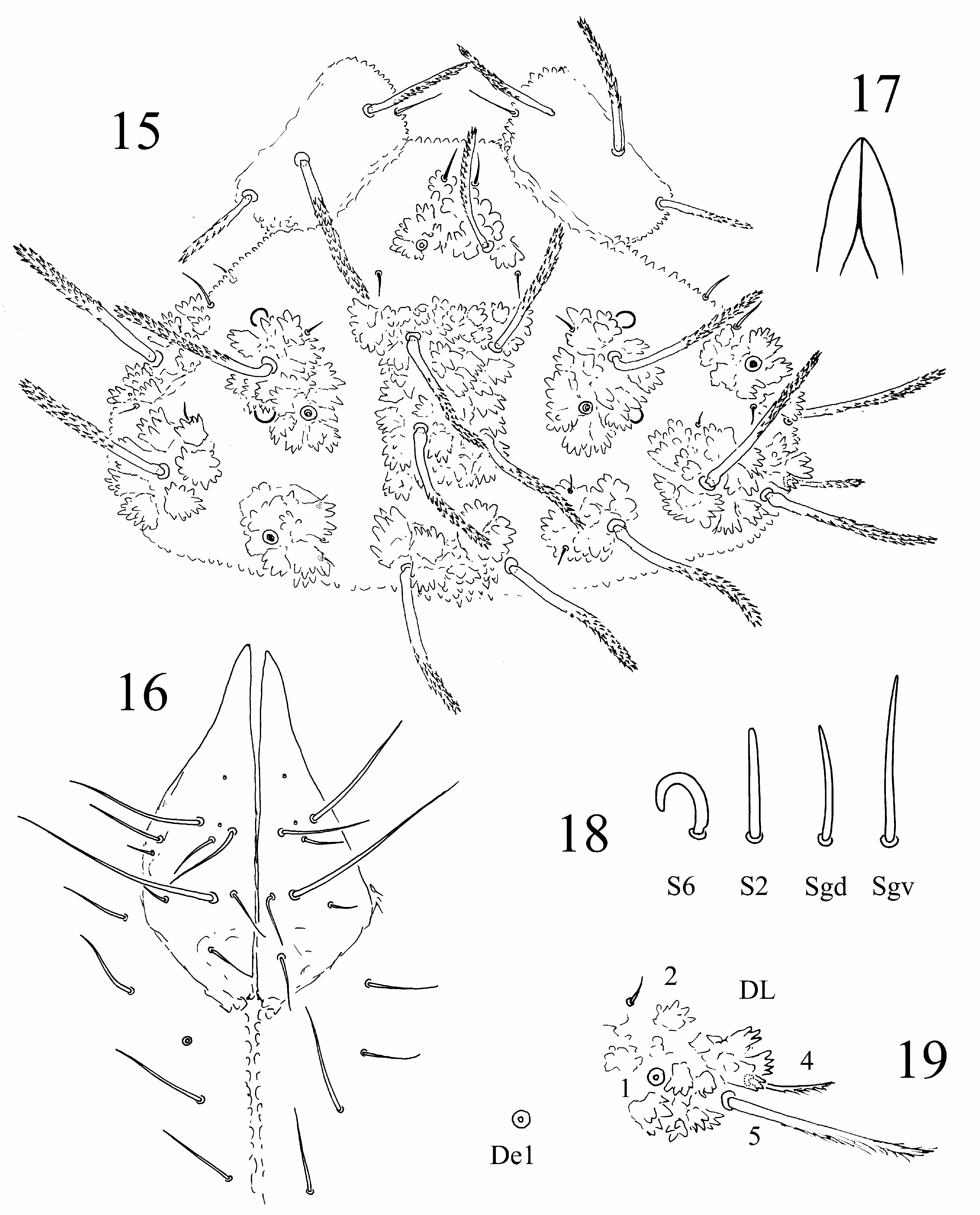
Description. Length: 0.76 – 1.11 mm (N = 2). Habitus of stocky Paleonura. Color white in ethanol. Secondary granules conical. Tertiary granules (elementary tubercles) well differentiated dorsally on head and body, often papillate, grouped in conspicuous tubercles, including the dorso-internal ones on tergites. Cephalic tubercles Di fused on the midline. Four kinds of dorsal ordinary chaetae: (i) unilaterally strongly ciliated mac, swollen basally; (ii) ciliated mes morphologically similar to ciliated mac, but shorter and usually thinner; (iii) smooth and acuminate mes; (iv) smooth and acuminate mic (Figs 15, 19, 20, 21, 22 and 23). Tergite S-chaetae much thinner than mac and at least 30 % shorter than closest mac (Figs 21 and 23). Antennae. Ant. I with seven chaetae, of which three dorsal ciliated mac (Fig. 15); Ant. II with eleven chaetae, of which three ciliated mac dorsally. Ant. III sensorial organ with two thickened ms in a cuticular fold; two guard S straight, Sgv as thick as and 20 – 25 % longer than Sgd, and thinner and longer than Ant. IV S 1 – S 8 (Fig. 18); one ventro-external ms more basally. Ant. IV with S 1 - S 8 thick, strongly bent and subequal (Fig. 18). Ocelli 2 + 2 without pigment, located on the edges of tubercle Oc (Fig. 15). Mandibles thin, bidentate; maxilla heads styliform. Labium long with four basal chaetae (E, F, G, f with F very long), three distal chaetae (A, C, D) with one or possibly two minute x-papillae, and three lateral chaetae (c, d, e) (Fig. 16). Labrum ogival, rounded apically (Fig. 17); labral formula 0 / 2,4. Vi: 5 chaetae; Ve: ≥ 6 chaetae Dorsal head chaetotaxy and tubercles (Table 3 A and Fig. 15). Eleven tubercles in total: CL, Af, 2 Oc, (Di + Di), 2 De, 2 DL, 2 (L + So). Four chaetae on tubercle Af, chaeta O absent, chaeta D free or on the edge of tubercle CL. Three chaetae on ocular tubercle, Ocp present. Dorso-internal tubercles of the head fused on axis, with four elementary tubercles anterior to the line Di 1 - Di 1 and a few other ones poorly delimited between the mac Di 1. DL tubercle with 4 DL chaetae; mac L 1 included in the (L + So) tubercle of head. * Lateral chaetal group of Abd. V located ventrally without individualized tubercle, probably including one chaeta VL. Postcephalic chaetotaxy and tubercles (Table 3 B and Figs 20 – 23). Chaetae Di 1, 2, 3 not on a line on Th. II – III, Di 1 being clearly external to the line Di 2 – Di 3; Di 3 as a mic, much shorter than Di 2 (Fig. 20). Chaetae Di 2 posterointernal to Di 1 on Abd. I – IV. Chaetal group Di of Abd. IV at the same level as De and DL. Tubercles Di of Abd. V closely adjacent, but not fused across the midline, their anterior mes (Di 2) less distant than Di 1 mac (Fig 23). Legs (Table 3 B and Fig. 24). Tita without tenent hairs and without chaeta M; B 4 and B 5 moderately elongate. Pretarsal mic rather long. Unguis without tooth. Microchaetae not seen on furcal rest. Male genital plate with 4 + 4 genital and 12 circumgenital chaetae; female genital plate with 1 + 1 genital and 12 circumgenital chaetae.
Palacios-Vargas, José G., Deharveng, Louis (2014): First record of the genus Australonura Cassagnau 1980 (Collembola: Neanuridae) in the New World, with description of a new species from Paraguay. Zootaxa 3779 (1): 33-47, DOI: 10.11646/zootaxa.3779.1.6
Discussion. Australonura paraguayensis sp. nov. was recorded as Paleonura sp. from Paraguay by Palacios- Vargas & Mejía Recamier (2009). It differs from all Australonura described so far by the separation of tubercle Di on Abd. V. Aside this character, it is very similar to A. grossi (Yosii, 1966) from Australia in tubercle arrangement and chaetotaxy. It is easily distinguished from A. limnophila and A. friasica by its dorsal mes and mac densely ciliated and the strong differentiation of its dorsal tubercles, as well as important chaetotaxic characters (Table 4).
Palacios-Vargas, José G., Deharveng, Louis (2014): First record of the genus Australonura Cassagnau 1980 (Collembola: Neanuridae) in the New World, with description of a new species from Paraguay. Zootaxa 3779 (1): 33-47, DOI: 10.11646/zootaxa.3779.1.6
Type material. Holotype male: Paraguay, Departamento de Alto Parana, Ciudad del Este, 10 / 03 / 1983, leg C. Dlouhy. Original slide label: “ 3 a Paraguay (Alto Parana): Centre forestier (C. F. A. P) échantillon du sol. Puerto Presidente Stroessner, Parcella IV. (pin). 10 - III- 1983 / 03. leg C. Dlouhy ”; deposited in UNAM. Paratypes: Paraguay, Departamento de Alto Parana, 12 km south of Ciudad del Este (ex-Puerto Presidente Stroessner), April 1984, Ecole Forestière, soil sample, C. Dlouhy col., two females (one deposited in UNAM, one in MNHN) and one male (deposited in UNAM). Ibid, 24 March 1983, Centre forestier (C. F. A. P), soil sample, C. Dlouhy, one female (deposited in UNAM). Paraguay, Departamento de Canindeyú, 2 November 1979, “ près de l’embouchure du Rio Carapa et du Rio Alta Paraná. Tamisage de feuilles mortes et bois pourri dans forêt, Expédition zoologique du Muséum de Genève ”, one female and one juvenile (deposited in Museum de Genève).
Palacios-Vargas, José G., Deharveng, Louis (2014): First record of the genus Australonura Cassagnau 1980 (Collembola: Neanuridae) in the New World, with description of a new species from Paraguay. Zootaxa 3779 (1): 33-47, DOI: 10.11646/zootaxa.3779.1.6
Export occurrence data
Darwin Core Archive (ZIP)
CLASSIFICATION
Taxonomic Classification Tree

MULTIMEDIA
Media Files(2)
FIGURES 15–19. Australonura paraguayensis sp. nov. 15, head in dorsal view; 16, labium; 17, dorso-distal part of labrum; 18, antennal S-chaetae: S6 and S2 of Ant. IV, Sgv and Sgd of Ant. III; 19, dorso-lateral tubercle of head.
Imageimage/png© Palacios-Vargas, José G.;Deharveng, LouisPalacios-Vargas, José G.;Deharveng, Louis

FIGURES 20–24. Australonura paraguayensis sp. nov. 20, tubercles Di on Th. II, with Di3 as free mic; 21, tubercle DL on Th. II; 22, Chaetal group L of Abd. III including a mac, a smooth mes and a ciliated mes; 23, tergites of Abd. V–VI; 24, tibiotarsus of leg I in lateral view.
Imageimage/png© Palacios-Vargas, José G.;Deharveng, LouisPalacios-Vargas, José G.;Deharveng, Louis
IMAGES