AnimaliaNot EvaluatedacceptedspeciesAccepted
Australonura limnophila

Australonura limnophila

(Cassagnau & Rapoport, 1962) Palacios-Vargas & Deharveng, 2014

GBIF:183232184

0year

0

Synonyms

ABOUT

Descriptions(4)

(Figs 2 – 10)
Palacios-Vargas, José G., Deharveng, Louis (2014): First record of the genus Australonura Cassagnau 1980 (Collembola: Neanuridae) in the New World, with description of a new species from Paraguay. Zootaxa 3779 (1): 33-47, DOI: 10.11646/zootaxa.3779.1.6

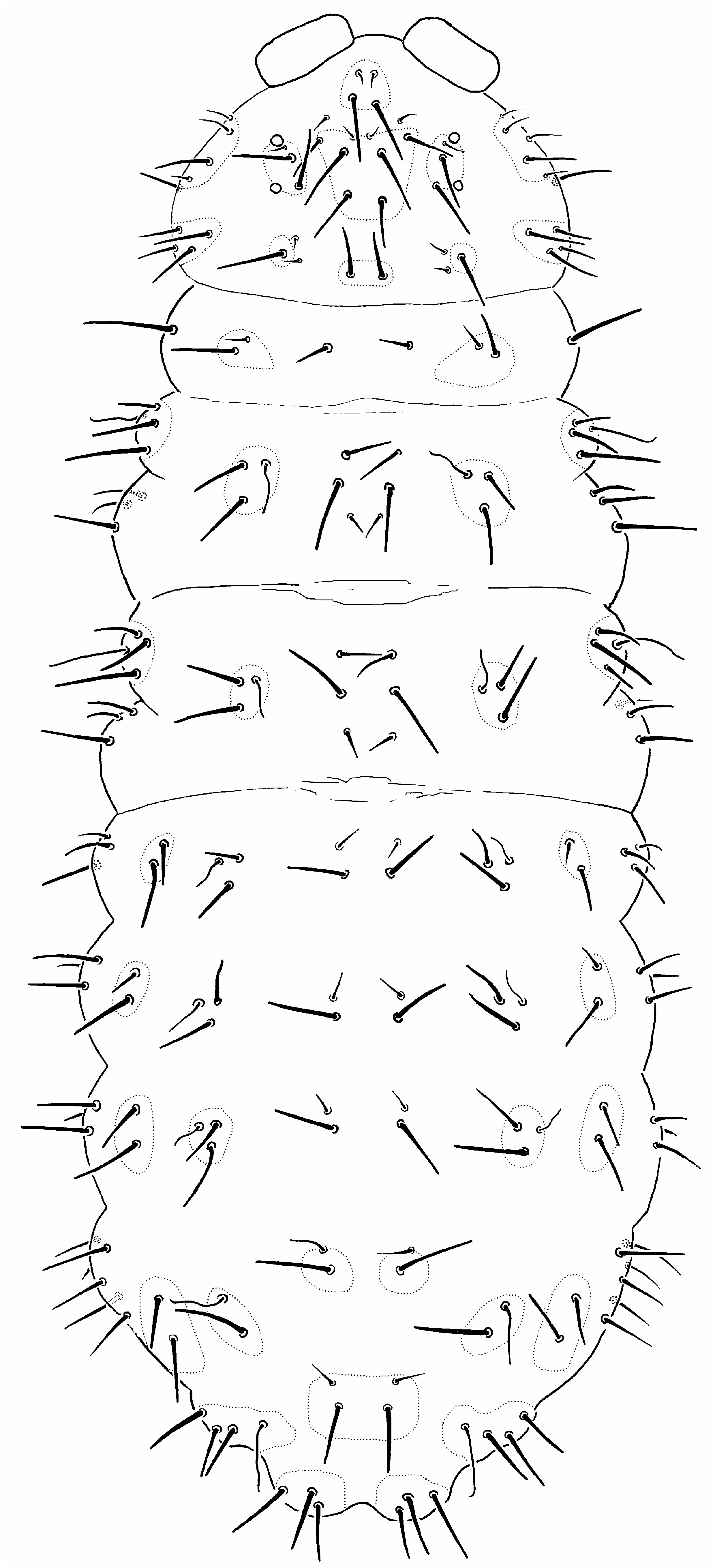
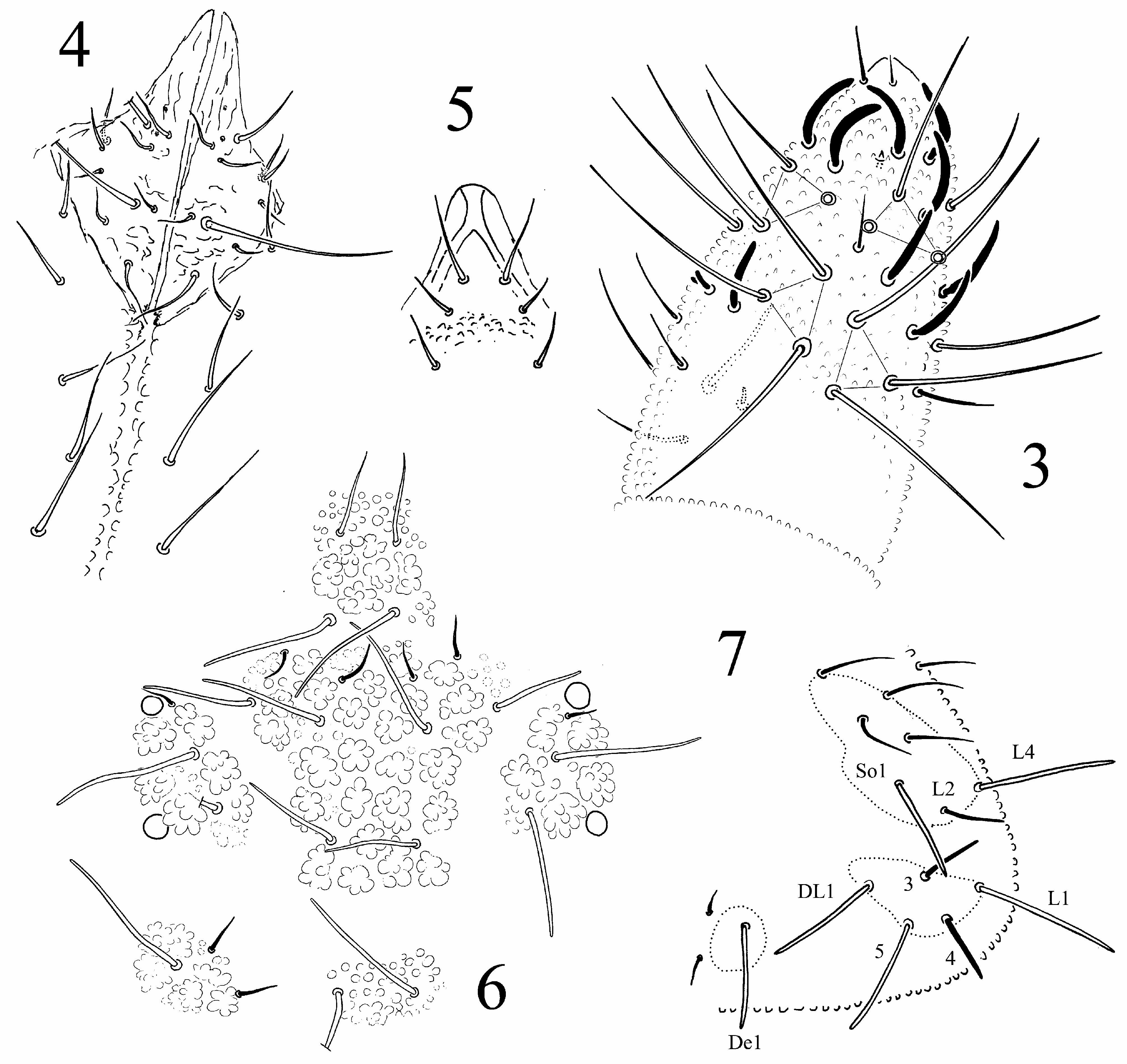
Redescription. Length: from 0.78 – 1.73 mm (all specimens, N = 18). Females larger than males; specimens from the type locality are larger, while non-type specimens exhibit a wider range of size: females (types): 1.13 – 1.73 mm (N = 8); males (types): 1.18 – 1.47 (N = 2); females (non-types): 0.78 – 1.47 (N = 4); males (non-types): 0.88 – 1.45 mm (N = 4). Habitus similar to Paleonura sp. (Fig. 2). Colour white in ethanol. Secondary granulation regular, constituted of rounded granules, equal to or less than a mac socket in diameter (Figs 6 and 8). No reticulations. Dorsal chaetal groups on weakly differentiated tubercles; tubercles absent or faint on Th. I; tubercles Di and De of Th. II – Abd. III and Di of Abd. IV feebly indicated; DL and L of Th. II – Abd. IV and head tubercles moderately differentiated; tubercles De of Abd. IV and tubercles of Abd. V and VI stronger, with distinct elementary tubercles (Figs 6 and 8). Elementary tubercles faint to well differentiated, marked by stronger secondary granules, without or with low integument boss, not grouped on papilla. Two kinds of ordinary chaetae on tergites: (i) thick mac, straight, slightly tapering, with blunt tips, smooth or, for some of them (mostly laterally and on Abd. VI), very sparsely serrated when carefully examined, the dorsal ones slightly sheathed and feebly tapering, the lateral ones not distinctly sheathed and more distinctly tapering; (ii) smooth mes of similar morphology, often bent and more tapering distally. Tergite S-chaetae thin and long, thinner and subequal or slightly shorter than closest large mac (Figs 2 and 8). Antennae (Fig. 3). All antennal chaetae smooth. Ant. I with seven chaetae, Ant. II with eleven chaetae, the dorsal ones thicker and longer than ventral ones. Ant. III sensorial organ with two thick, bent ms slightly buried in a cuticular fold; guard S thinner than S 1 - S 8 of Ant. IV, with Sgv straight and 30 % longer than Sgd; and one ventral ms. Ant. IV with S 1 - 8, 12 long “ mou ” chaetae, one short ordinary chaeta (i), one small subapical organ; apical bulb indistinct flat, entire, fused to Ant. IV tip. Ocelli 2 + 2 without pigment, located on the edges of tubercle Oc (Fig. 6). Mandibles thin, bidentate; maxilla heads styliform. Labium long with four basal chaetae (E, F, G, f) with F very long), three distal chaetae (A, C, D) with one minute x-papilla, and three lateral chaetae (c, d, e) (Fig. 4). Labrum elongate, large and rounded apically, with planaria-head-like ventral sclerifications (Fig. 5); labral formula 0 / 2,4. Dorsal head chaetotaxy and tubercles (Table 1 A, Fig. 2, 6 and 7). Eleven tubercles in total: CL, Af, 2 Oc, (Di + Di), 2 De, 2 DL, 2 (L + So). Ten chaetae on tubercle Af, chaeta O absent. Three chaetae present in ocular tubercle including Ocp. Dorso-internal tubercles of the head fused on axis, with four elementary tubercles often inconspicuous anterior to the line Di 1 – Di 1 and none posteriorly. On lateral area of head, mac L 1 displaced towards tubercle DL (Fig. 7). Postcephalic chaetotaxy and tubercles (Table 1 B, Fig. 2 and Fig. 8). Chaetae Di 1, 2, 3 almost on a line parallel to the axis on Th. II – III. Chaetae Di 2 anterior to Di 1 on Abd. I – IV. Chaetal group Di of Abd. IV shifted anteriorly to De. On the tubercle Di of Abd. V, the anterior mes are possibly homologous to Di 3 rather than Di 2, being more distant than Di 1 mac. Legs (Table 1 B and Fig. 9). Ventral mac of the femur moderately differentiated, slightly longer than ventral side of femur. Tita without tenent hairs, without chaeta M and with chaetae B 4 and B 5 moderately elongate. Pretarsal mic relatively long. Unguis without tooth. Microchaetae of furcal rest either present (Fig. 10) or undetectable. Male genital plate with 4 + 4 genital and 7 – 12 circumgenital chaetae; female genital plate with 1 + 1 genital and 11 – 14 circumgenital chaetae. Vi: 5 chaetae; Ve: 8 – 9 chaetae
Palacios-Vargas, José G., Deharveng, Louis (2014): First record of the genus Australonura Cassagnau 1980 (Collembola: Neanuridae) in the New World, with description of a new species from Paraguay. Zootaxa 3779 (1): 33-47, DOI: 10.11646/zootaxa.3779.1.6
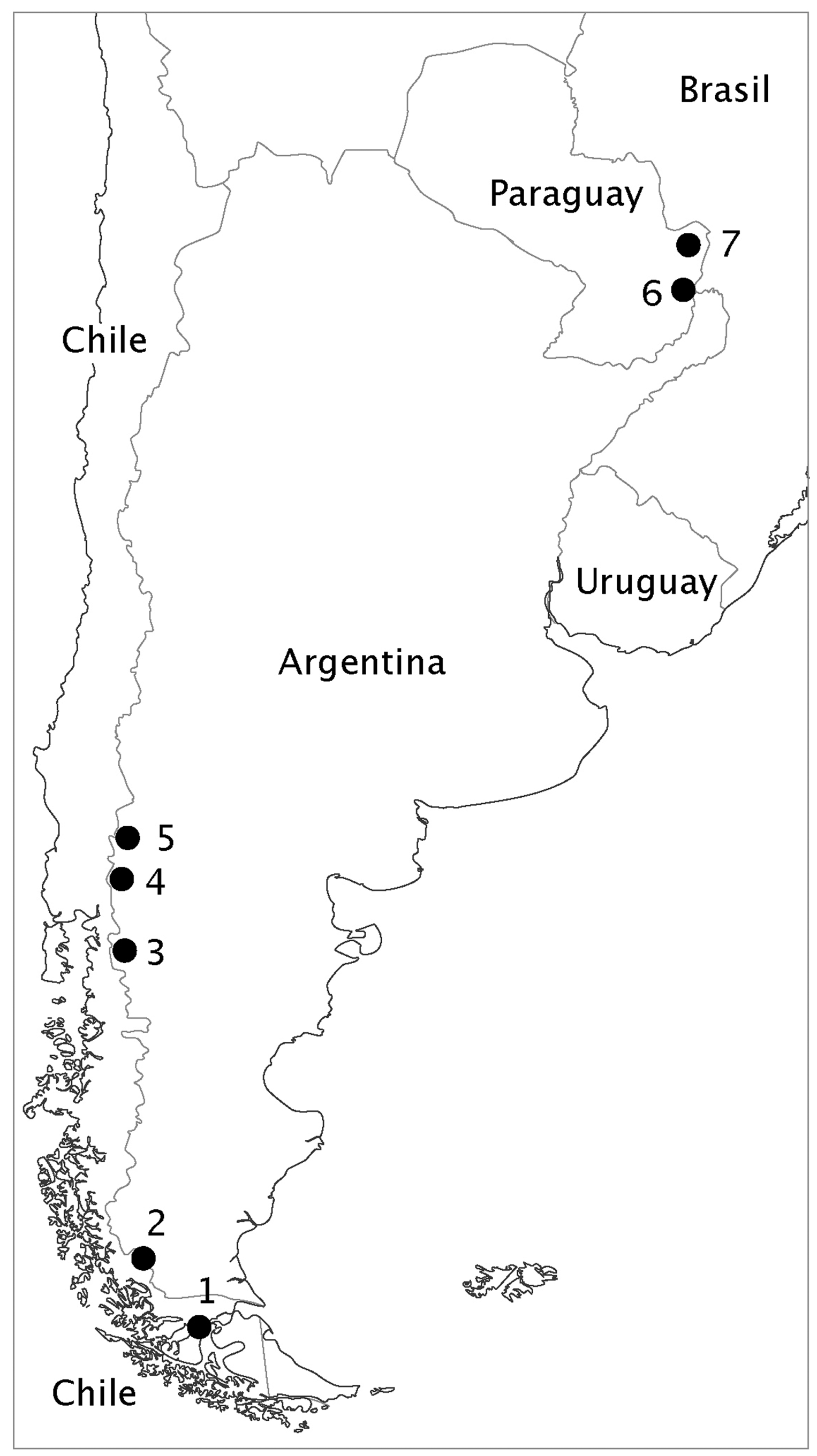
Discussion. Australonura limnophila was described from specimens of various locations in Southern Argentina, all located at the southern limit of the Valdivian temperate forest ecoregion (Fig. 1). In the original description of the species, the clypeal tubercle is fused with the antenno-frontal; these tubercles are in fact separate on the type specimens we have examined, in agreement with Cassagnau & Oliveira (1990) who already corrected this mistake. Tubercles Di of the head are fused to each other on axis (Fig. 2). It is this character, together with separation of Di and De and the presence of a well-differentiated antenno-frontal tubercle on head, that led us to assign Neanura limnophila to the genus Australonura. However, the uneven dorso-internal cephalic tubercle is very faint, without clearly recognizable elementary tubercles. From the specimens listed in the original description of Cassagnau & Rapoport (1962), some were isolated subsequently in a new species, A. friasica (Cassagnau & Oliveira 1990). A closer examination leads us to consider the specimens of Lago Lacar area as another new species, which is briefly characterized below.
Palacios-Vargas, José G., Deharveng, Louis (2014): First record of the genus Australonura Cassagnau 1980 (Collembola: Neanuridae) in the New World, with description of a new species from Paraguay. Zootaxa 3779 (1): 33-47, DOI: 10.11646/zootaxa.3779.1.6
Type material examined. Holotype (male) and two female paratypes on slide from Cassagnau collection: Argentina: Chubut Province: near Lago Futulaufquen, 15 / 03 / 59, Delamare-Deboutteville leg (ARG-Pat 063); deposited in MNHN. Eight paratypes (1 male, 7 females) on slides from Cassagnau collection: ibid: near Lago Menéndez, 16 / 03 / 59, Delamare-Deboutteville leg (ARG-Pat 104); deposited in MNHN (one male, six females) and UNAM (1 female). Other material examined. Specimens of three other populations were listed by Cassagnau & Rapoport (1962). One population (ARG-Pat 025 from Lago Frías) was subsequently separated as a new species, A. friasica, described in Cassagnau & Oliveira 1990. The other two populations are listed as other material, not as types, in Cassagnau & Oliveira (1990). One of them (ARG-Pat 047 from Isla Victoria) corresponds to A. limnophila. The other one (ARG-Pat 111 of Lago Lacar) differs from both A. limnophila and A. friasica, and is probably a new species. Another population from Lago Frías (station ARG-Pat 045) was represented by four specimens on slide in the Cassagnau collection, but not cited in his publications; they can be assigned to A. limnophila. It remains finally two samples in the Cassagnau collection that correspond to A. limnophila; in addition, two recent samples of D’Haese are also A. limnophila; all four samples were taken about 180 km North of the type locality (Fig. 1). Four specimens (two males, two females) on slides. Argentina: Neuquen Province: Villa la Angostura: near Lago Nahuel Huapi: Isla Victoria, dead wood, 03 / 03 / 59, Delamare-Deboutteville leg (ARG-Pat 047). Deposited in MNHN (1 male, two females) and UNAM (1 male). One male on slide. Argentina: Neuquen Province: Parque Nacional Nahuel Huapi: los Arrayanes, Northern part of Quetrihué peninsula, under barks of rotten logs, aspirator sampling, 29 / 10 / 05, D'Haese leg (A 142). Deposited in MNHN. Four specimens (two males, one female and one juvenile) on slides. Argentina: Rio Negro Province: near Lago Frías, 07 / 03 / 59, Delamare-Deboutteville leg (ARG-Pat 045). Deposited in MNHN. One female on slide. Argentina: Rio Negro Province: Parque Nacional Nahuel Huapi: Puerto Blest, 12 / 11 / 05, D'Haese leg (A 190). Deposited in MNHN.
Palacios-Vargas, José G., Deharveng, Louis (2014): First record of the genus Australonura Cassagnau 1980 (Collembola: Neanuridae) in the New World, with description of a new species from Paraguay. Zootaxa 3779 (1): 33-47, DOI: 10.11646/zootaxa.3779.1.6

Export occurrence data

Darwin Core Archive (ZIP)

CLASSIFICATION

Taxonomic Classification Tree

MULTIMEDIA

Media Files(4)

FIGURE 1. Distribution map of Australonura species in South America. 1, Australonura sp.; 2, A. sp.; 3, A. limnophila (types); 4, A. limnophila (non-types) and A. friasica (types); 5, A. sp.; 6, A. paraguayensis sp. nov. (holotype, Alto Parana); 7, A. paraguayensis sp. nov.

Imageimage/png© Palacios-Vargas, José G.;Deharveng, LouisPalacios-Vargas, José G.;Deharveng, Louis

FIGURE 2. Australonura limnophila (Cassagnau & Rapoport, 1962). Dorsal chaetotaxy and tubercles.

Imageimage/png© Palacios-Vargas, José G.;Deharveng, LouisPalacios-Vargas, José G.;Deharveng, Louis

FIGURES 3–7. Australonura limnophila (Cassagnau & Rapoport, 1962). 3, Ant. III and IV in dorsal view; 4, labium; 5, dorsodistal part of labrum; 6, tubercles and chaetotaxy of central and posterior areas of head; 7, chaetotaxy of lateral area of head (dotted line: tubercle limits).

Imageimage/png© Palacios-Vargas, José G.;Deharveng, LouisPalacios-Vargas, José G.;Deharveng, Louis

FIGURES 8–10. Australonura limnophila (Cassagnau & Rapoport, 1962). 8, tergites of Abd. IV–VI; 9, tibiotarsus of leg II in ventro-lateral view; 10, furcal area.

Imageimage/png© Palacios-Vargas, José G.;Deharveng, LouisPalacios-Vargas, José G.;Deharveng, Louis

IMAGES

Gallery(4)

See Gallery

Occurrences with images

Source Information

First record of the genus Australonura Cassagnau 1980 (Collembola: Neanuridae) in the New World, with description of a new species from Paraguay

checklist

This dataset contains the digitized treatments in Plazi based on the original journal article Palacios-Vargas, José G., Deharveng, Louis (2014): First record of the genus Australonura Cassagnau 1980 (Collembola: Neanuridae) in the New World, with description of a new species from Paraguay. Zootaxa 3779 (1): 33-47, DOI: 10.11646/zootaxa.3779.1.6

Abstract

The genus Australonura Cassagnau 1980 is newly recorded from South America. The Patagonian species Paleonura limnophila (Cassagnau & Rapoport, 1962) and Paleonura friasica Cassagnau & Oliveira, 1990 are redescribed from type material and recombined in Australonura. A new species, A. paraguayensis sp. nov., is described from Paraguay and assigned to Australonura for its head tubercle arrangement. It differs from other species of the genus by its adjacent but separate dorso-internal tubercles of Abd. V.

Palacios-Vargas J G, Deharveng L, felipe (2014). First record of the genus Australonura Cassagnau 1980 (Collembola: Neanuridae) in the New World, with description of a new species from Paraguay. Plazi.org taxonomic treatments database. Checklist dataset https://doi.org/10.11646/zootaxa.3779.1.6 accessed via GBIF.org on 2026-06-15.

CC0Published 3/13/2014View dataset
GBIF Usage Key
183232184
Dataset Key
013bf857-98ef-4282-8211-80fcf0494cd5
Origin
source
Backbone Key
10831060
Taxon ID
03CF879CBD11FF882192FB9FFB1FF815.taxon
Last Crawled
6/10/2026
Last Interpreted
6/10/2026