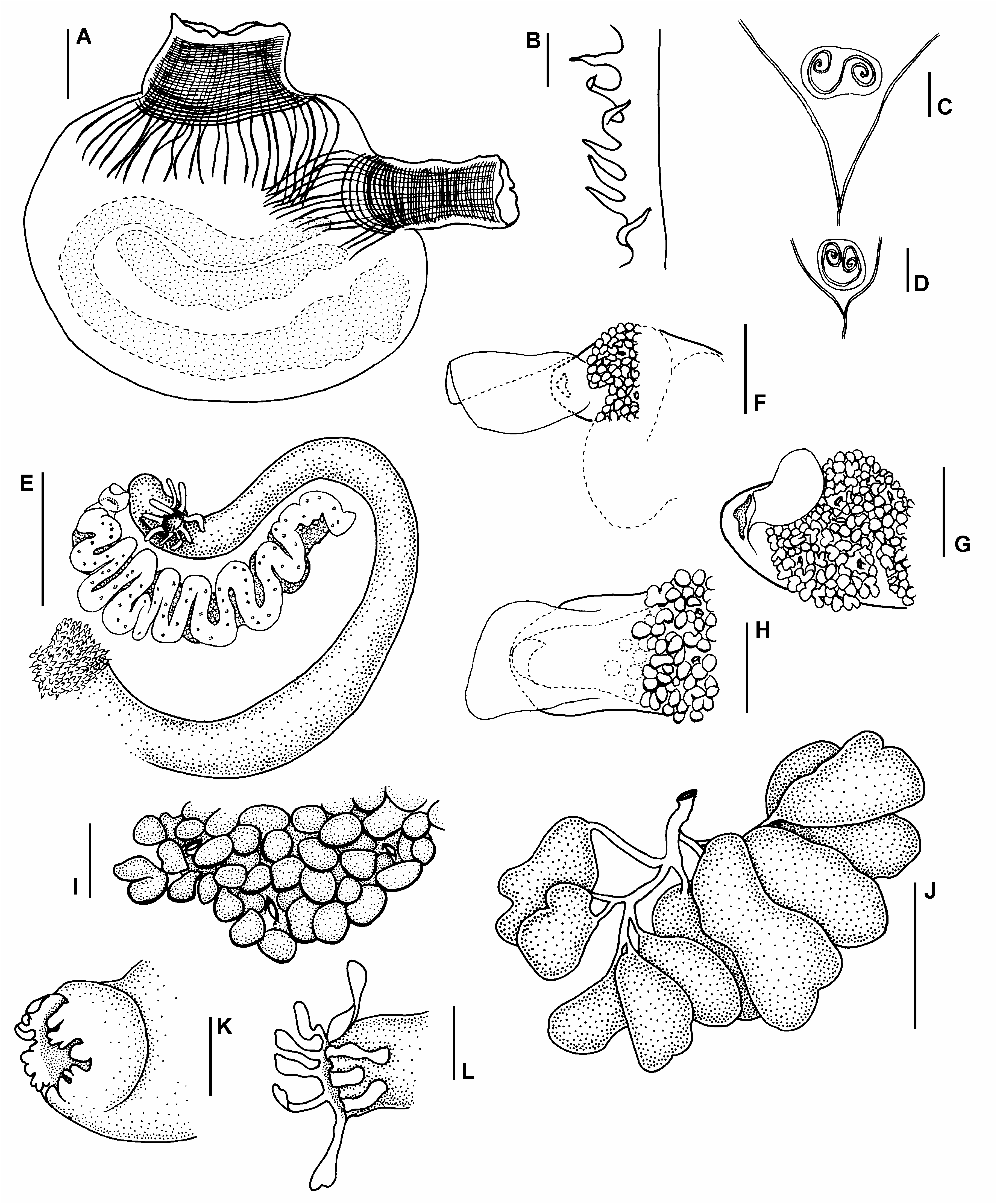
Michaelsen (1918 a, b) reviewed and tabulated those taxa (as formae) known to contain the long echinated needle-like spines characteristic of this genus. In the group he assigned to f. typica (Michaelsen, 1918 b: 40 no. 42) are specimens with the ovary a straight tube with small branches and testes around the edges. These and other specimens may not be accurately assigned. Nevertheless he interpreted the type specimens of H. momus as having a continuously winding band of testis follicles along the top of the ovary. Although neither Savigny nor Michaelsen saw the separate male ducts, Savigny (1816) correctly identified the oviducal opening with a membranous ‘ cornet’ around it. Kott (1957, 1966, 1972 a) referred to H. momus var. curvata as a junior synonym of H. momus var. typica. Later (1985), she regarded all varieties of Herdmania as growth forms of the one taxon until Kennett (1997) observed the release of sperm from many points along the surface of the ovary. The multiplicity of separate short vasa deferentia from crowded clumps of lobed testis follicles were duly demonstrated, evenly spaced along the curved band of testis follicles on the surface of a tightly curved ovarian tube in specimens referable to H. curvata Kott, 1952 (a senior synonym of H. contorta Monniot, 1992: see Kott, 1998), now known to be a junior synonym of H. momus. Although Monniot (1992) shows a male duct opening at the base of the oviduct (Monniot, 1992, fig. 6 b), he reports that he did not see either a vas deferens or its opening. Cynthia pallida billitonensis Sluiter, 1885 from Indonesia has relatively few longitudinal muscles, the dorsal tubercle and dorsal lamina are like H. momus and the convoluted course of the testis follicles along the surface of the ovary can be seen in the figure (Sluiter, 1885; pl. IV figs 1 – 2). Also like the present species, Rhabdocynthia tenuis: Sluiter, 1895 from Ambon, with a translucent thin, gelatinous test, has seven folds per side, two internal longitudinal vessels in the interspace, a broad dorsal lamina with long thin languets and the slit on the dorsal tubercle with both horns spiralling in. It is taken from the same location as Cynthia pallida: Herdman, 1886, which also has a undulating ovary. Cynthia papietensis Herdman, 1882 and 1886, from Tahiti, with the same broad dorsal lamina as the present species and lacking internal longitudinal branchial vessels between the dorsal midline and the dorsal folds, is conspecific. Herdmania momus: Millar, 1975 from Japan, Singapore and Indonesia cannot be accurately assigned owing to lack of information on gonads and gonoducts. Some specimens of the present species may be included, although others also may be present. The species is distinguished by the tight undulations of its ovarian tube; the hood over and in front of the oviducal opening produced from the body wall over the oviduct; the undulating band of crowded clumps of testis follicles along the top of the ovary; a separate short, vertical duct from each clump of testis follicles; absence of a male opening at the base of the oviduct; relatively small dorsal tubercle with one or two Ushaped openings with the horns turned or spiralling in or out (except in one large specimen 8 cm, in which the slit is convoluted); and relatively few internal longitudinal vessels between the dorsal lamina and dorsal fold. Herdmania momus: Nishikawa, 1991 from the Sea of Japan has an oviducal hood and numerous vas deferens openings but the course of the ovary is not recorded. Herdmania fimbriae has a lobed anal border, an undulating ovarian tube and an oviducal hood, but it has a large, straight common vas deferens with a single opening surrounded by an elaborate membranous fringe. Herdmania mentula has a similar oviducal hood but a common vas deferens projecting into the atrial cavity at its distal end, a gently undulating ovary and the anal rim divided into four smooth, shallow lips. Herdmania inflata (Van Name, 1918), from the Philippines (Fig. 5 A), like the present species has many short vasa deferentia opening over the surface of the male follicles which are in a conspicuous undulating band. However, in H. inflata the ovary is straight, it lacks an oviducal hood, the vas deferens is less interrupted and the separate openings fewer than in H. momus and the terminal part of the vas deferens opens with the oviduct, on a cylindrical short projection into the atrial cavity.
Kott, Patricia (2002): The genus Herdmania Lahille, 1888 (Tunicata, Ascidiacea) in Australian waters. Zoological Journal of the Linnean Society 134 (3): 359-374, DOI: 10.1046/j.1096-3642.2002.00009.x, URL: https://academic.oup.com/zoolinnean/article-lookup/doi/10.1046/j.1096-3642.2002.00009.x