
AnimaliaNot EvaluatedacceptedspeciesAccepted
Vasopora ceramica

Vasopora ceramica

Grischenko, Gordon & Melnik, 2021

GBIF:188539273

0year

ABOUT

Descriptions(6)

(Figs 2 – 4) Genus et species indet.: Grischenko, Gordon & Melnik 2018: p. 55, figs 36 – 38.
Grischenko, Andrei V., Gordon, Dennis P., Melnik, Viacheslav P. (2021): Vasopora ceramica n. gen., n. sp. - a new abyssal cyclostome bryozoan from polymetallic nodules in the Russian exploration area, Clarion-Clipperton Fracture Zone, eastern Pacific Ocean. Zootaxa 5047 (4): 444-452, DOI: 10.11646/zootaxa.5047.4.4
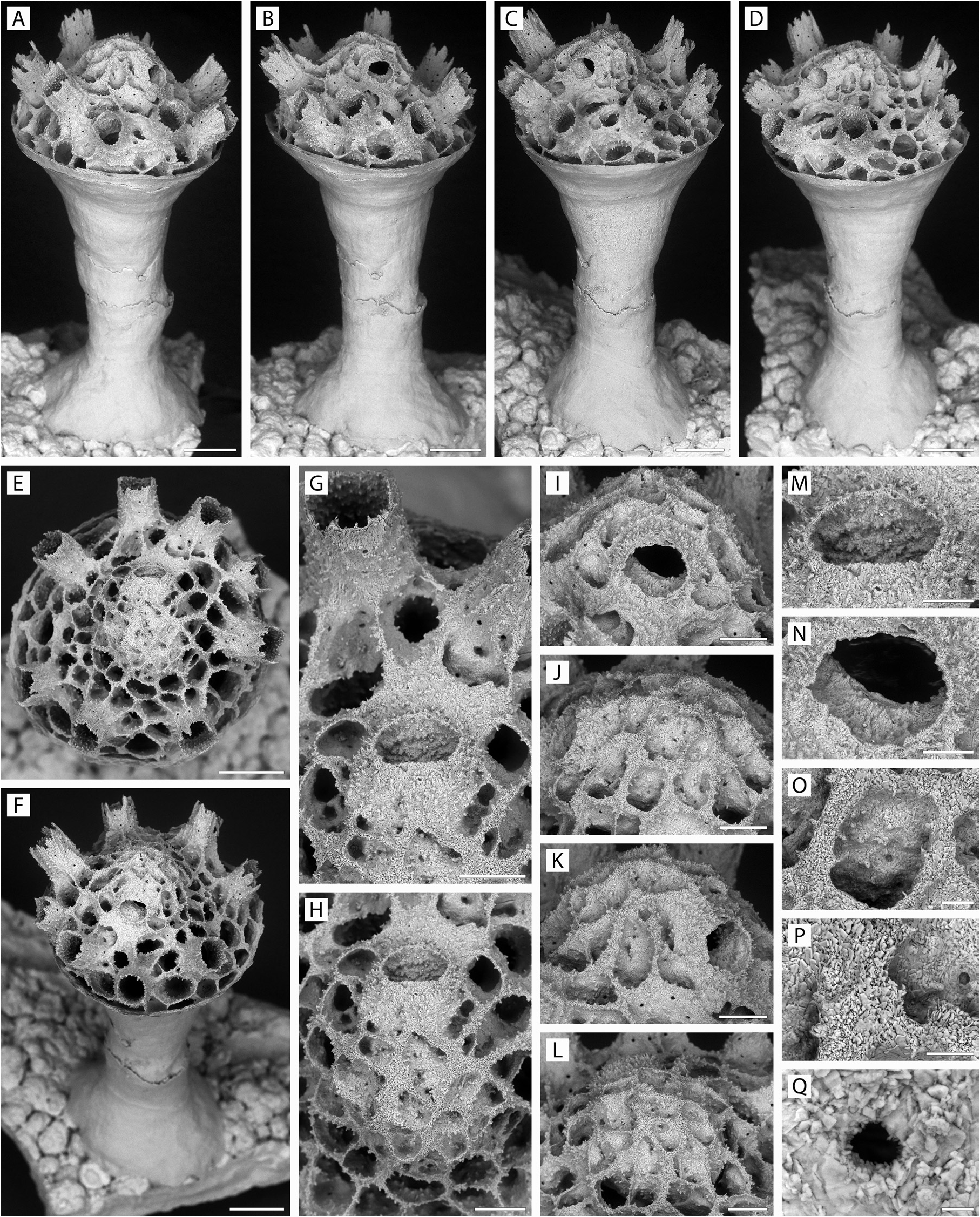
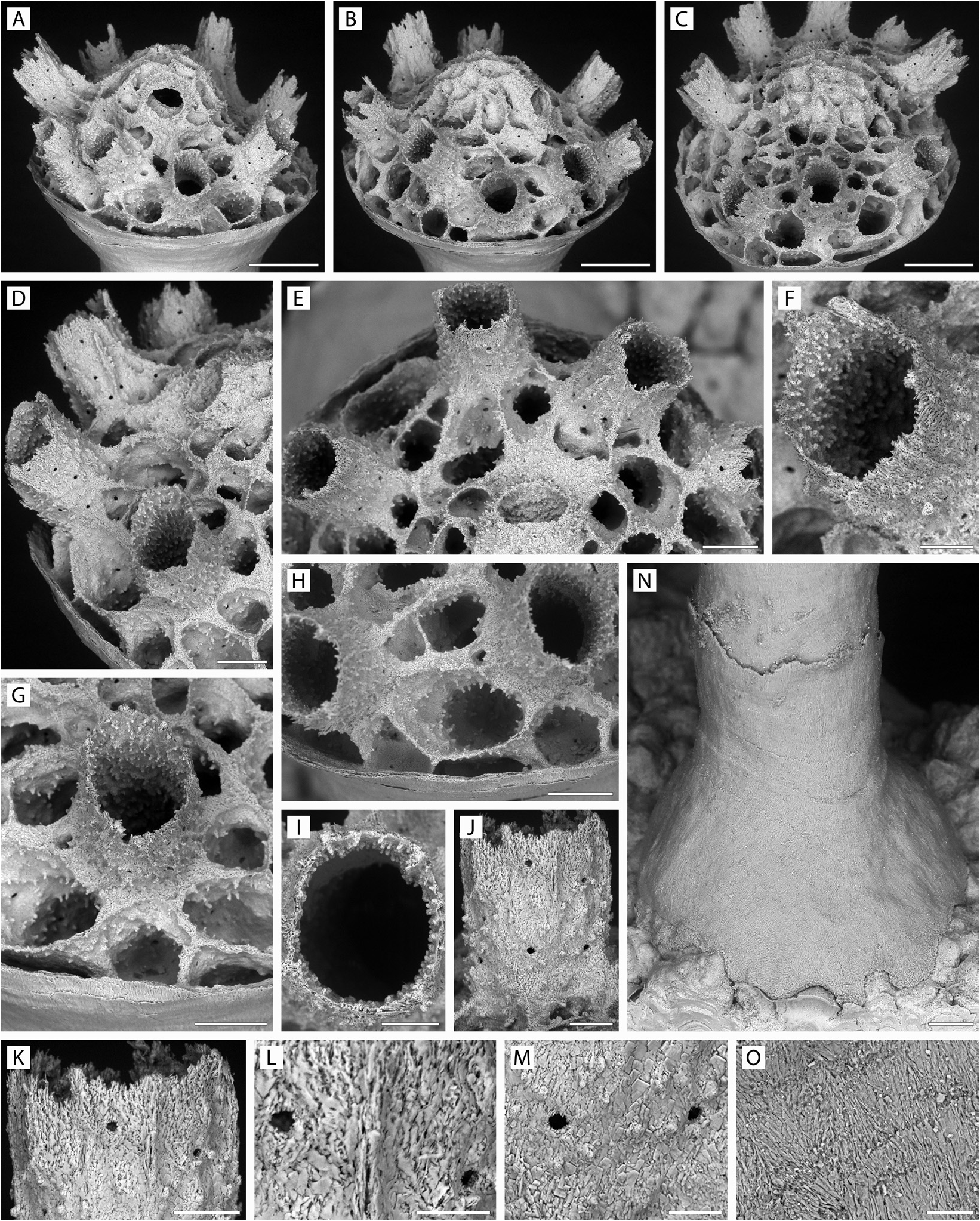
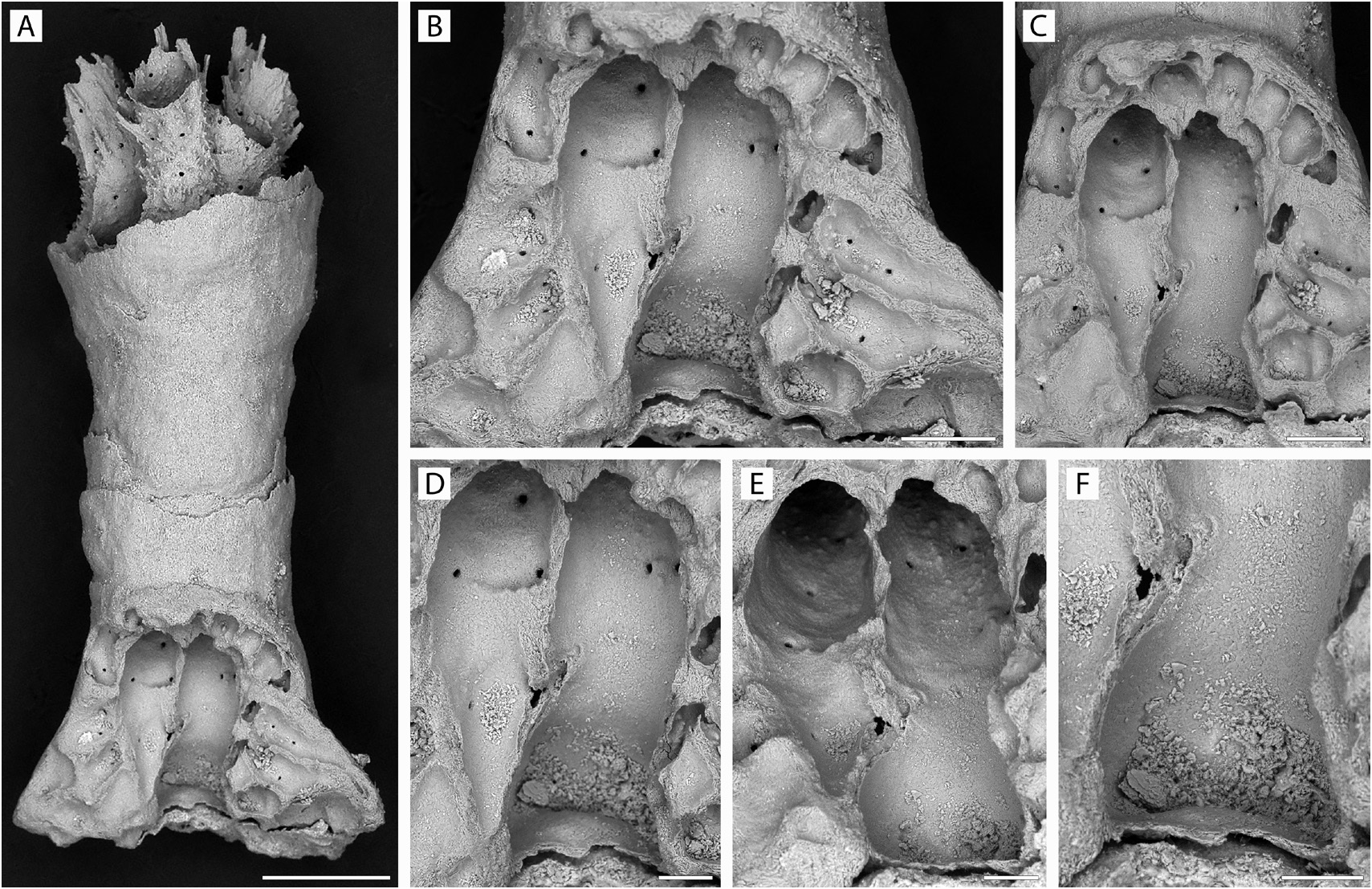
Description. Colony erect, miniature, vasiform, with relatively convex capitulum on proportionately thin and tall column (Figs 2 A – D, F, 3 A, B). Capitulum: column height ratio 1: 3. Capitulum with thin outer rim encircling eight radially orientated autozooidal peristomes and alveoli arranged along periphery (Fig. 2 E, F), with centrally located incubation chamber on top (Figs 2 E, F, 3 A – C). Alveoli immediately inside calyx rim ovoid to slit-like. Much of remainder of capitulum comprising polygonal to subrounded alveoli, their combined rims giving a reticulated appearance (Fig. 2 E, F). Entire skeletal surface of capitulum minutely densely granular to subspinulate (Figs 2 G ‒ L, 3 D ‒ H). Peristomes relatively short, eight in number, directed obliquely outwards at angle of c. 30 – 65 ° (Figs 2 F, 3 A – F). Peristomial rims of a few well-preserved peristomes with six to eight spine-like processes around margin (Figs 2 F, 3 A – D), each associated with longitudinal ridge on outside of peristomial base (Fig. 3 D, E, J – L). Peristomial walls with sparse, simple communication pores (Figs 2 G, 3 D, E, J ‒ M). At higher magnification, outer surface constructed of irregular (Fig. 3 L) or wedge-shaped crystallites (Fig. 3 M). Gonozooid solitary, capacious, sac-like, domed, swollen, located centrally, with insignificant marginal shift relative to capitulum center, unidirectional (Figs 2 E, F, I – L, 3 A – C). Ooeciostome negligible, barely discernible, in form of very narrow, densely granulated band of calcification encircling ooeciopore and lacking pores (Fig. 2 G, J, K). Ooeciopore (Fig. 2 M, N) transversely subcircular, with flatter and straighter upper margin, located on slope of gonozooid, orientated perpendicularly relative to main colony axis, facing outwards (Figs 2 F, I – K, 3 D, E). Gonozooid with tiny circular pores concentrated on roof and less frequent on lateral and back sides (Fig. 2 G ‒ L). Gonozooid covered by dense network of polygonal ridges (Fig. 2 E, H) representing shallow alveoli, continuous with larger, deeper surrounding alveoli. Surface microstructure of gonozooid with imbricated irregular crystallites (Fig. 2 O – Q). Column vase-like, elongated (Fig. 2 A – D), 75 % of colony height, narrowest in middle, flaring toward base (Fig. 3 N) and capitulum. Entire column surface exterior-walled, smooth, glabrous, lacking pseudopores, with traces of regeneration preserved in form of weakly prominent rims with roughly uneven edges (Figs 2 A – D, 3 N). Skeletal microstructure (Fig. 3 O) comprising planar-spherulitic surface fabric of closely appressed acicular to irregular sharp crystallites, clustered into parallel horizontal to oblique strips or fans parallel to wall surface. Upper margin of column (outer rim) even along whole perimeter (Figs 2 A – D, 3 A – E, G, H), smooth-surfaced, identically to main column surface, locally with gentle undulations in horizontal profile and very short straightening in vertical profile. Basal column margin deeply undulating over entire length (Figs 2 A – D, 3 N), following irregularities of substratum microrelief. Early astogeny (examined using non-type specimen, Fig. 4 A – F) indicates protoecial dome, rather narrow in diameter (Fig. 4 F), with erect ancestrular peristome arising from its entire roof (Fig. 4 B, D, F), with first zooid also produced from dome adjacent to it (best seen in Fig. 4 E). Multiple elongated to shortened trabeculae occupy periphery of expanded colony base to support continuing elevation and expansion, with greatly variable (tubular, cubical, oval to irregular) extrazooidal alveolar spaces or kenozooid-like chambers supporting base and stem (Fig. 4 B, C). Measurements (mm). Holotype, ZIRAS 1 / 50740 (Figs 2, 3): Colony height 2.18; capitulum height 0.55; capitulum cross-section 1.16 × 1.06; column height 1.63; base at substratum cross-section 0.93 × 0.80; column narrowest cross-section 0.42 × 0.38; column upper margin (outer rim) cross-section 1.11 × 1.08. ZL 0.306 – 0.507 (0.423 ± 0.058) (n = 8); PeL 0.141 – 0.306 (0.240 ± 0.050) (n = 8); PeD 0.153 – 0.173 (0.163 ± 0.007) (n = 8); ApL 0.143 – 0.164 (0.153 ± 0.007) (n = 8); ApW 0.121 – 0.134 (0.127 ± 0.004) (n = 8). Gonozooid (n = 1): GZL 0.504; GZW 0.341; GZH 0.357; OpL 0.111; OpW 0.132. Non-type specimen YMG 4 – 17, Stn 381 (Fig. 4 D, E): AnPrD 0.149 (n = 1); AnPeD 0.094 (n = 1).
Grischenko, Andrei V., Gordon, Dennis P., Melnik, Viacheslav P. (2021): Vasopora ceramica n. gen., n. sp. - a new abyssal cyclostome bryozoan from polymetallic nodules in the Russian exploration area, Clarion-Clipperton Fracture Zone, eastern Pacific Ocean. Zootaxa 5047 (4): 444-452, DOI: 10.11646/zootaxa.5047.4.4
Remarks. Vasopora n. gen. clearly conforms to the characters of the rectangulate cyclostome family Alyonushkidae in general gross morphology, i. e. in possessing: 1) erect pedunculate colony with flaring capitulum of radially orientated autozooidal peristomes in one irregular level; 2) relatively large incubation chamber located in calyx center and surrounded by alveoli; 3) proximally tapering column to expanded base, incorporating vertically erect ancestrula with peristome arising from apex of protoecial dome (Fig. 4). At the same time, the new genus displays a combination of characters not previously observed in the two earlier-described alyonushkid genera. A comparison shows the following principal differences: 1) Species of Alyonushka and Calyssopora have no distinct structural boundary between the stalk (column) and capitulum, so that the stalk calcification is continuous with that of the capitulum and autozooidal peristomes in both of these taxa; in contrast, in Vasopora n. gen. the capitulum is encircled by a thin outer rim, present at all stages of astogeny, including ancestrulate and young infertile colonies (Grischenko et al. 2018, p. 58, fig. 38), conferring a consistent vasiform appearance, with a clear border between column and capitulum, where the autozooidal peristomes are always trapped inside the edge of the vase-like column. Among CCFZ fungiform cyclostomes, the sharp margin between stalk and capitulum is also known for Discantenna metallica Grischenko, Gordon & Melnik, 2018, but the latter species is tubuliporine, and clearly differs in having a stem with peristomes of feeding zooids between substratum and disk. 2) The reticulate appearance of the gonozooid roof and whole capitulum, giving the appearance of a network of ridges and contrasting with the smooth column, is unknown in any species of Alyonushka and Calyssopora. An alveolate calyx surface with a moderately developed trabeculate network is seen only in C. vasiformis (Grischenko et al. 2018, p. 50, fig. 31) but colonies of the latter species have a wholly dimpled surface over the capitulum and stalk. 3) Colonies of known species of Alyonushka and Calyssopora have a single type of microscopic calcification. Specifically, the entire outer colony surface is minutely prickled in every Alyonushka species, while in Calyssopora it is granular-tubercular (C. volcano), irregularly textured with minute dimples and granules (C. clarionensis), or dimpled (C. vasiformis), but in all cases the surface shows uniform topography for each given species. Microstructurally, the surface of these taxa is nearly identical, with imbricated platy crystallites (see for detail Grischenko et al. 2018, p. 38, fig. 22 E; p. 42, fig. 25; p. 44, fig. 27 E; p. 48, fig. 29 H; p. 50, fig. 31 I; p. 53, fig. 34 J, K). In contrast, V. ceramica n. gen., n. sp. shows two different types of calcification with two clearly distinguishable forms of crystallites within colony: whereas surfaces of capitulum structures (peristomes, gonozooid, and trabeculate network) are minutely granular to subspinulate, the column surface is exterior-walled, smooth, glabrous and lacking pseudopores. Capitulum microstructure comprises polygonal wedge-shaped crystallites, while that of the column is planar-spherulitic with appressed acicular crystallites, clustered into horizontal to oblique belts or fans parallel to the surface. At the macro-level, these microstructural differences result in the strongly contrasting appearance of capitulum and column. In sum, the vivid contrast between the coarsely-surfaced reticulate capitulum and perfectly smooth glabrous column, with a clear boundary (rim) between, supplemented with two types of calcification and two forms of crystallites, makes Vasopora ceramica n. gen., n. sp. clearly distinguishable from other alyonushkids and hence a unique taxon among cyclostome genera described from the CCFZ.
Grischenko, Andrei V., Gordon, Dennis P., Melnik, Viacheslav P. (2021): Vasopora ceramica n. gen., n. sp. - a new abyssal cyclostome bryozoan from polymetallic nodules in the Russian exploration area, Clarion-Clipperton Fracture Zone, eastern Pacific Ocean. Zootaxa 5047 (4): 444-452, DOI: 10.11646/zootaxa.5047.4.4
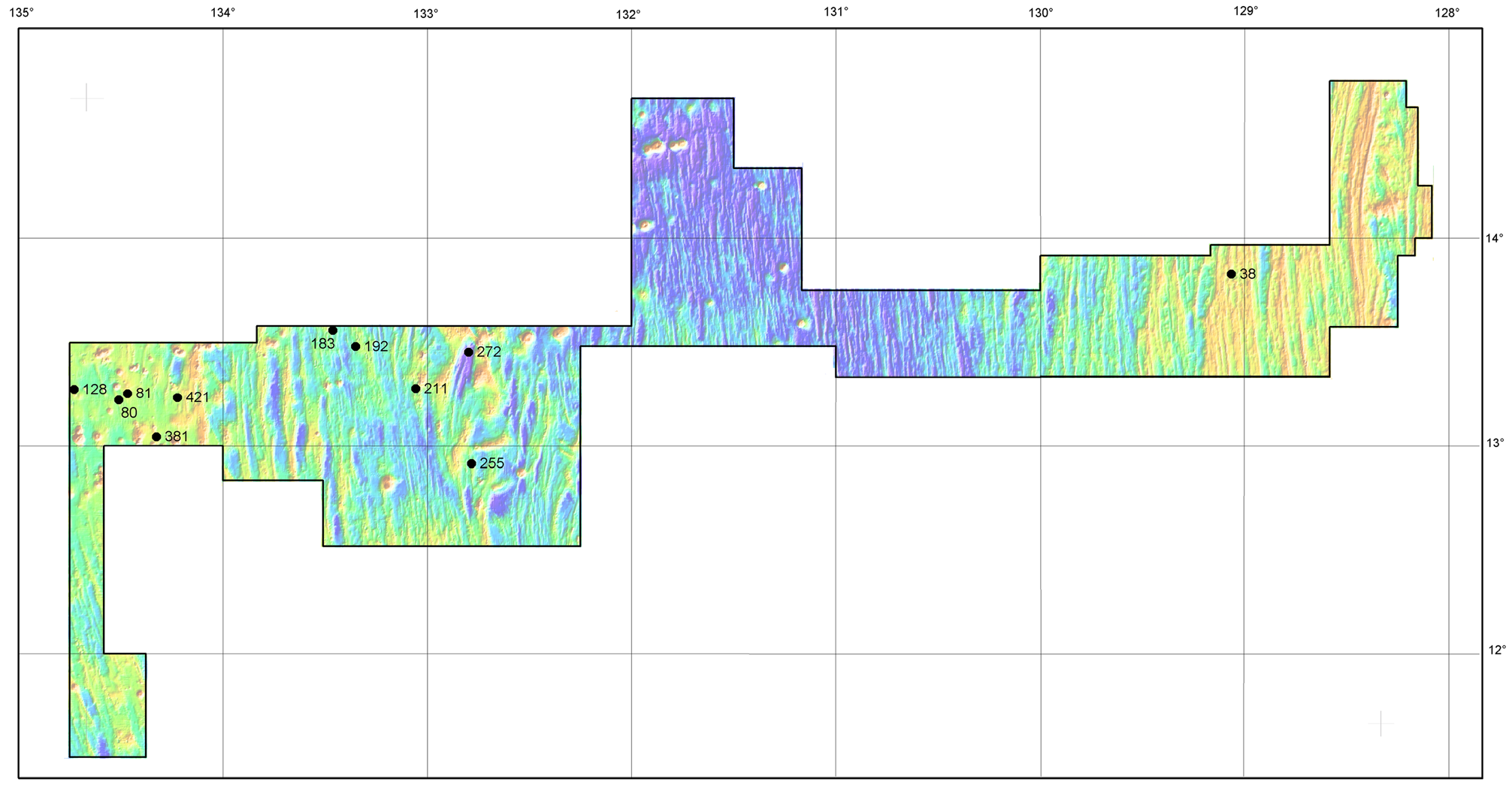
Distribution. The newly obtained holotype colony was collected from 13.23408 ° N, 134.22180 ° W at 4809 m. Overall, Vasopora ceramica n. gen., n. sp. so far occurs only within the Russian exploration area of the Clarion – Clipperton Fracture Zone from eleven stations (Fig. 1), bounded by coordinates 12.91588 – 13.82842 ° N, 129.06438 – 134.73936 ° W, at 4725 – 5280 m depth.
Grischenko, Andrei V., Gordon, Dennis P., Melnik, Viacheslav P. (2021): Vasopora ceramica n. gen., n. sp. - a new abyssal cyclostome bryozoan from polymetallic nodules in the Russian exploration area, Clarion-Clipperton Fracture Zone, eastern Pacific Ocean. Zootaxa 5047 (4): 444-452, DOI: 10.11646/zootaxa.5047.4.4
Etymology. Latinized form of Greek keramos, ceramic, alluding to the very smooth, glabrous surface of the colony stalk (column), resembling the surface of a ceramic vase. Gender feminine.
Grischenko, Andrei V., Gordon, Dennis P., Melnik, Viacheslav P. (2021): Vasopora ceramica n. gen., n. sp. - a new abyssal cyclostome bryozoan from polymetallic nodules in the Russian exploration area, Clarion-Clipperton Fracture Zone, eastern Pacific Ocean. Zootaxa 5047 (4): 444-452, DOI: 10.11646/zootaxa.5047.4.4
Material examined. Holotype: ZIRAS 1 / 50740, colony attached to nodule particle, YMG R. V. Gelendzhik cruise GLD 4 – 19, Stn 421, 8 February 2021, 13.23408 ° N, 134.22180 ° W, 4809 m. Paratype 1: ZIRAS 2 / 50738, colony (‘ colony 1 ’ in Grischenko et al. 2018, p. 55, figs 36 A, B, 37 A, D, F, G), attached to nodule particle, YMG R. V. Gelendzhik cruise GLD 4 – 11, Stn 211, 21 April 2012, 13.27820 ° N, 133.05707 ° W, 4846 m. Paratype 2: ZIRAS 3 / 50739, colony (‘ colony 2 ’ in Grischenko et al. 2018, p. 55, figs 36 C, D, 37 B, C, E, H, I), attached to nodule particle, YMG R. V. Gelendzhik cruise GLD 4 – 12, Stn 255, 8 April 2013, 12.91588 ° N, 132.78325 ° W, 4801 m. Additional material: YMG 18 – 01, Stn 38; YMG 4 – 06, Stns 80, 81; YMG 4 – 07, Stn 128; GLD 4 – 09, Stns 183, 192; GLD 4 – 12, Stn 272; YMG 4 – 17, Stn 381; GLD 4 – 19, Stn 421. Total specimens examined eleven.
Grischenko, Andrei V., Gordon, Dennis P., Melnik, Viacheslav P. (2021): Vasopora ceramica n. gen., n. sp. - a new abyssal cyclostome bryozoan from polymetallic nodules in the Russian exploration area, Clarion-Clipperton Fracture Zone, eastern Pacific Ocean. Zootaxa 5047 (4): 444-452, DOI: 10.11646/zootaxa.5047.4.4

Export occurrence data

Darwin Core Archive (ZIP)

CLASSIFICATION

Taxonomic Classification Tree

MULTIMEDIA

Media Files(4)

FIGURE 1. The eastern Russian exploration area of the CCFZ, with depth intervals ranging from 4510 m (orange) to 5280 m (purplish-blue), showing sampling stations for Vasopora ceramica n. gen., n. sp.
Imageimage/png© Grischenko, Andrei V.;Gordon, Dennis P.;Melnik, Viacheslav P.Grischenko, Andrei V.;Gordon, Dennis P.;Melnik, Viacheslav P.

FIGURE 2. Vasopora ceramica n. gen., n. sp. Holotype, ZIRAS 1/50740. A–D, rotational views of fertile colony; E, capitulum with centrally located incubation chamber, covered and surrounded by network of ridges and alveoli, with radially arranged autozooidal peristomes at periphery; F, oblique view of colony attached to nodule particle; G, center to margin of capitulum, showing distal half of incubation chamber with ooeciopore, with trabecular ridges in-between, and connecting peristomes with gonozooid, encircling deep alveoli; H, gonozooid with numerous irregular pores within shallow alveoli on roof surface, surrounded by dense network of tuberculated ridges defining deep marginal alveoli; I–L, rotational views of gonozooid: I, distal, J, lateral, K, distolateral, and L, back-side view; note continuous cover of thick ridges, connected to trabecular network around peristomes; M, N, frontal and distal views of ooeciopore, respectively; O, close-up of L, showing shallow alveolus and coarse surface; P, enlargement of trabeculate ridge margin, showing imbricated foliated fabric of wedge-shaped crystallites; Q, enlargement of gonozooid wall, showing pore surrounded by wedge-shaped crystallites. Scale bars: A–F, 250 µm; G–L, 100 µm; M, N, 50 µm; O, P, 25 µm; Q, 5 µm.
Imageimage/png© Grischenko, Andrei V.;Gordon, Dennis P.;Melnik, Viacheslav P.Grischenko, Andrei V.;Gordon, Dennis P.;Melnik, Viacheslav P.

FIGURE 3. Vasopora ceramica n. gen., n. sp. Holotype, ZIRAS 1/50740. A–C, rotational views of capitulum; D, lateral view of capitulum periphery, showing relatively short, radially arranged peristomes connected with trabeculate network defining alveoli and extrazooidal spaces; E, frontal view of half the capitulum, showing distal third of gonozooid connected with marginal peristomes by narrow vertical ridges/trabeculae; F, oblique view of autozooidal peristome and aperture, showing dense spinose granulation of interior surfaces and less evident sparse tubercules on exterior; G, autozooidal peristome surrounded by alveoli and extrazooidal spaces; H, side-view of capitulum margin with peristomes surrounded by alveoli and extrazooidal spaces; note densely spinulate to granular surface of all capitulum structures contrasting with smooth surface of outer rim and column; I, vertical view of autozooidal aperture with dense spinose granulation around internal margin; J, frontal view of zooidal peristome with thin parallel ridges (continuations of spine-like marginal processes) and sparse circular communication pores on coarse tuberculated surface; K, enlargement of J, showing distal third of peristome with partially abraded/broken margin; L, close-up of K, showing irregularly-shaped crystallites flanking peristomial ridge and surrounding communication pores; M, close-up of J, showing basal part of peristome with imbricated foliated fabric of wedge-shaped crystallites; N, basal region of column, showing its smooth surface; note undulating basal margin of column, following micro-relief irregularities along attachment to substratum; O, enlargement of column surface, showing planar-spherulitic fabric of closely appressed acicular crystallites. Scale bars: A–C, 250 µm; D, E, G, H, N, 100 µm; F, I–K, 50 µm; L, M, O, 25 µm.
Imageimage/png© Grischenko, Andrei V.;Gordon, Dennis P.;Melnik, Viacheslav P.Grischenko, Andrei V.;Gordon, Dennis P.;Melnik, Viacheslav P.

FIGURE 4. Vasopora ceramica n. gen., n. sp. Specimen YMG4–17, Stn 381. A, general view of ancestrular colony with three mature zooids, attached to nodule particle, fractured along expanded base; B, base of colony, showing protoecial dome (central zooid with own basal wall) with ancestrular peristome emerging from its apex, and first daughter zooid also originating from protoecium laterally (precise place of its communication pore outside plane of section); note elongated marginal, radially arranged trabeculae separating tubular extrazooidal alveolar spaces and kenozooid-like chambers; C, same, tilted forward; note shortened trabeculae delineating oval to cubical kenozooid-like chambers, surrounding ancestrular peristome with first daughter zooid in arch-like pattern; D, enlargement of protoecial dome with ancestrular peristome emerging from its entire roof and first daughter zooid also originating from protoecium laterally; E, same, tilted forward; F, detail of protoecial dome. Scale bars: A, 250 µm; B, C, 100 µm; D–F, 50 µm.

Imageimage/png© Grischenko, Andrei V.;Gordon, Dennis P.;Melnik, Viacheslav P.Grischenko, Andrei V.;Gordon, Dennis P.;Melnik, Viacheslav P.

IMAGES

Gallery(4)

See Gallery

Occurrences with images

Source Information

Vasopora ceramica n. gen., n. sp. - a new abyssal cyclostome bryozoan from polymetallic nodules in the Russian exploration area, Clarion-Clipperton Fracture Zone, eastern Pacific Ocean

checklist

This dataset contains the digitized treatments in Plazi based on the original journal article Grischenko, Andrei V., Gordon, Dennis P., Melnik, Viacheslav P. (2021): Vasopora ceramica n. gen., n. sp. - a new abyssal cyclostome bryozoan from polymetallic nodules in the Russian exploration area, Clarion-Clipperton Fracture Zone, eastern Pacific Ocean. Zootaxa 5047 (4): 444-452, DOI: 10.11646/zootaxa.5047.4.4

Abstract

A new abyssal cyclostome bryozoan genus and species, Vasopora ceramica n. gen., n. sp., is described from the eastern Russian exploration area of the Clarion– Clipperton Fracture Zone based on newly collected material from Yuzhmorgeologiya GLD4–19 station 421 (13.23408° N, 134.22180° W, 4809 m depth). Generic characters include an erect pedunculate colony with a distinct boundary between column and flared capitulum, short autozooidal peristomes in a single whorl, numerous alveoli, a central unidirectional sac-like gonozooid covered by a surficial network of crossed ridges continuous with adjacent rims of alveoli, a laterally opening ooeciopore, and the entire capitulum surface being minutely densely granular to subspinulate. Whereas the skeletal microstructure of the capitulum surface comprises irregular imbricated crystallites, the column has a planar-spherulitic fabric of acicular crystallites in fan-like arrays, and there are no pseudopores. The sharp boundary between capitulum and column, with their different microstructure separates Vasopora n. gen. from the two existing genera of Alyonushkidae that are found in the same environment. Vasopora n. gen. has a stalk formed of calcified exterior wall, whereas it is interior-walled in Alyonushka and Calyssopora.

Grischenko A V, Gordon D P, Melnik V P, plazi (2021). Vasopora ceramica n. gen., n. sp. - a new abyssal cyclostome bryozoan from polymetallic nodules in the Russian exploration area, Clarion-Clipperton Fracture Zone, eastern Pacific Ocean. Plazi.org taxonomic treatments database. Checklist dataset https://doi.org/10.11646/zootaxa.5047.4.4 accessed via GBIF.org on 2026-06-14.

CC0Published 10/1/2021View dataset
GBIF Usage Key
188539273
Dataset Key
013b5b50-ab43-4199-89dd-d4996515754b
Origin
source
Backbone Key
11376411
Taxon ID
20051D752E26FFC0D1F6E9330A3FDECB.taxon
Last Crawled
6/9/2026
Last Interpreted
6/9/2026