AnimaliaNot EvaluatedacceptedspeciesAccepted
Sabellaria floridensis

Sabellaria floridensis

Hartman, 1944

GBIF:188580745

0year

ABOUT

Descriptions(5)

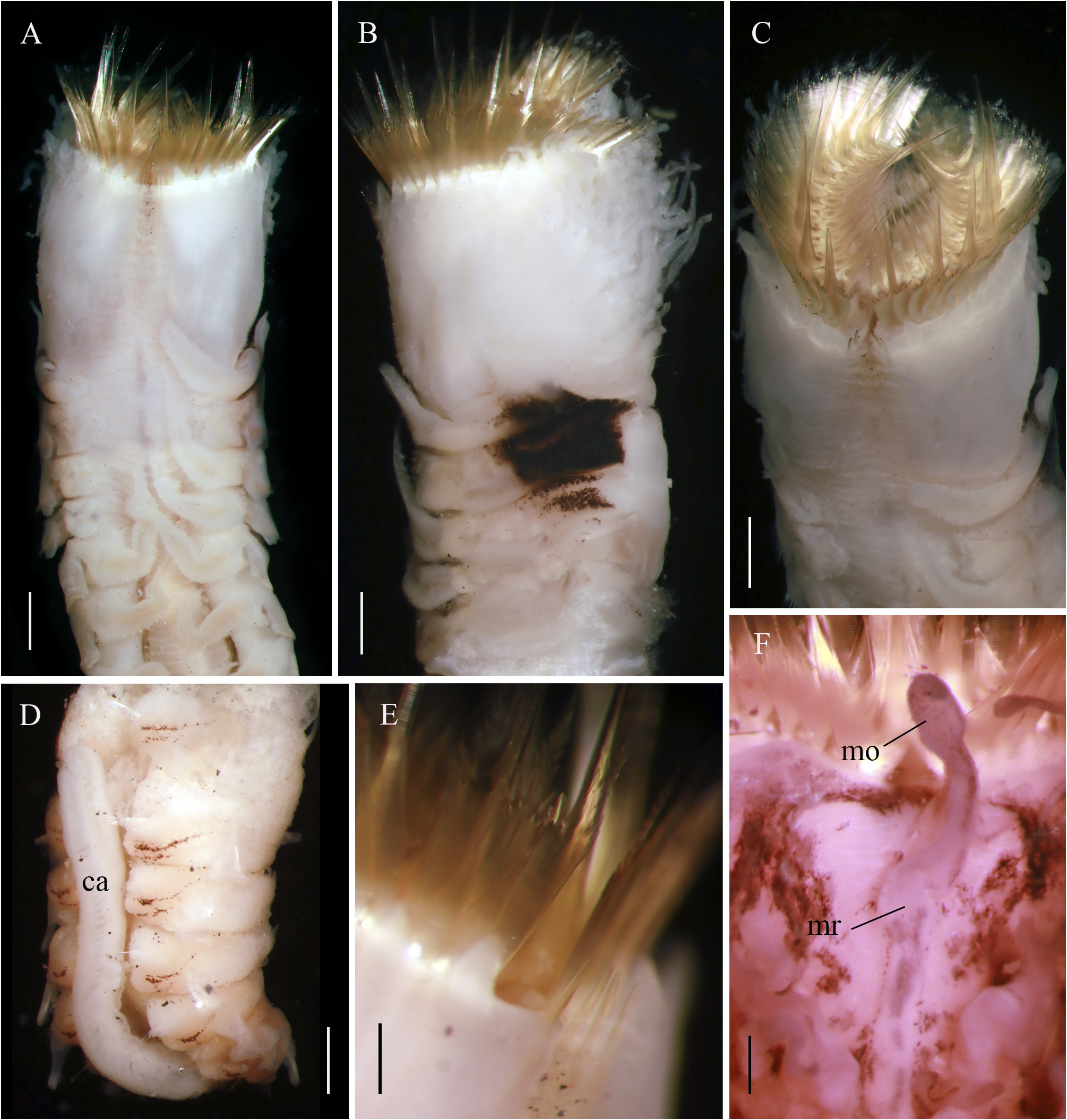
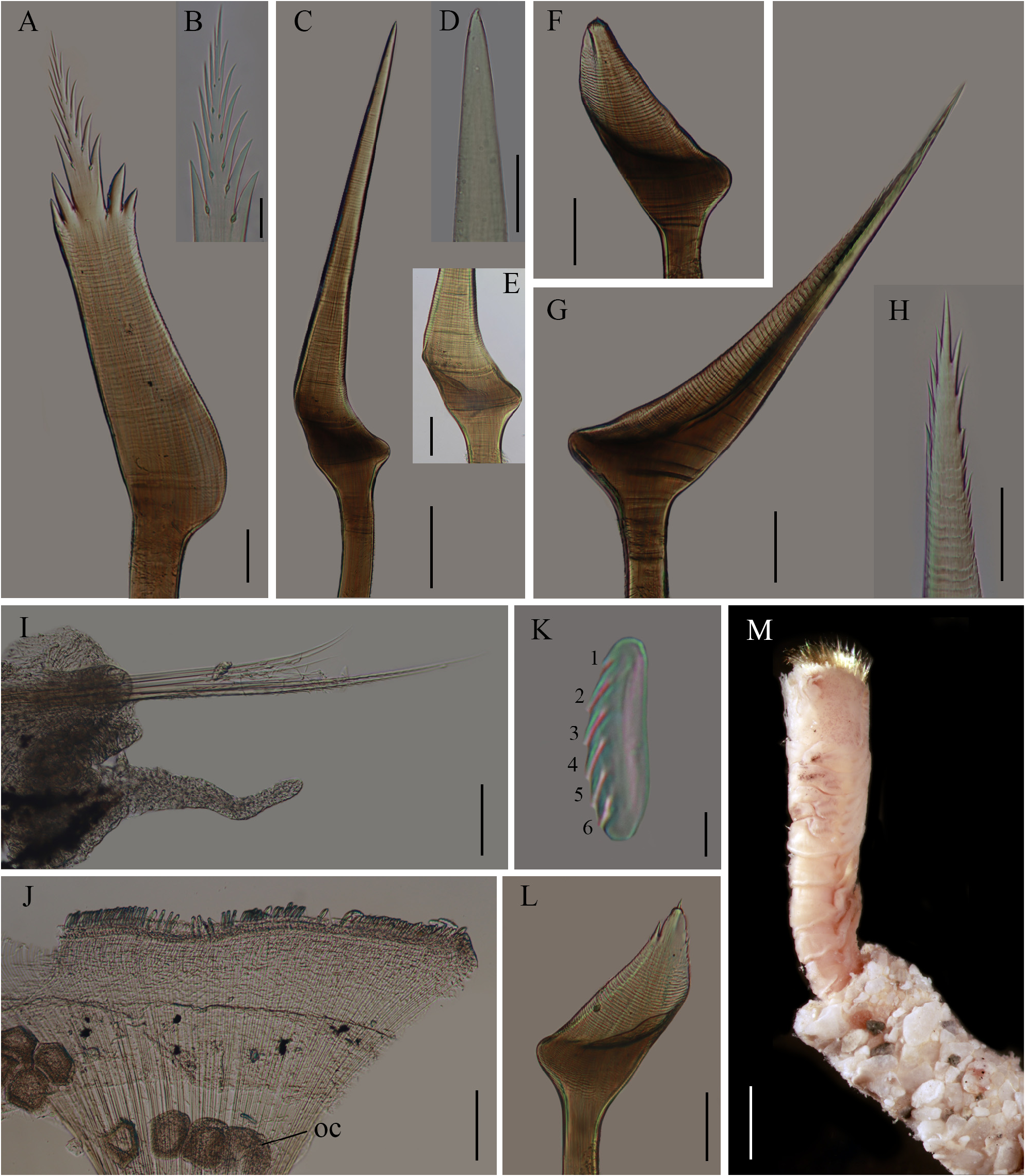
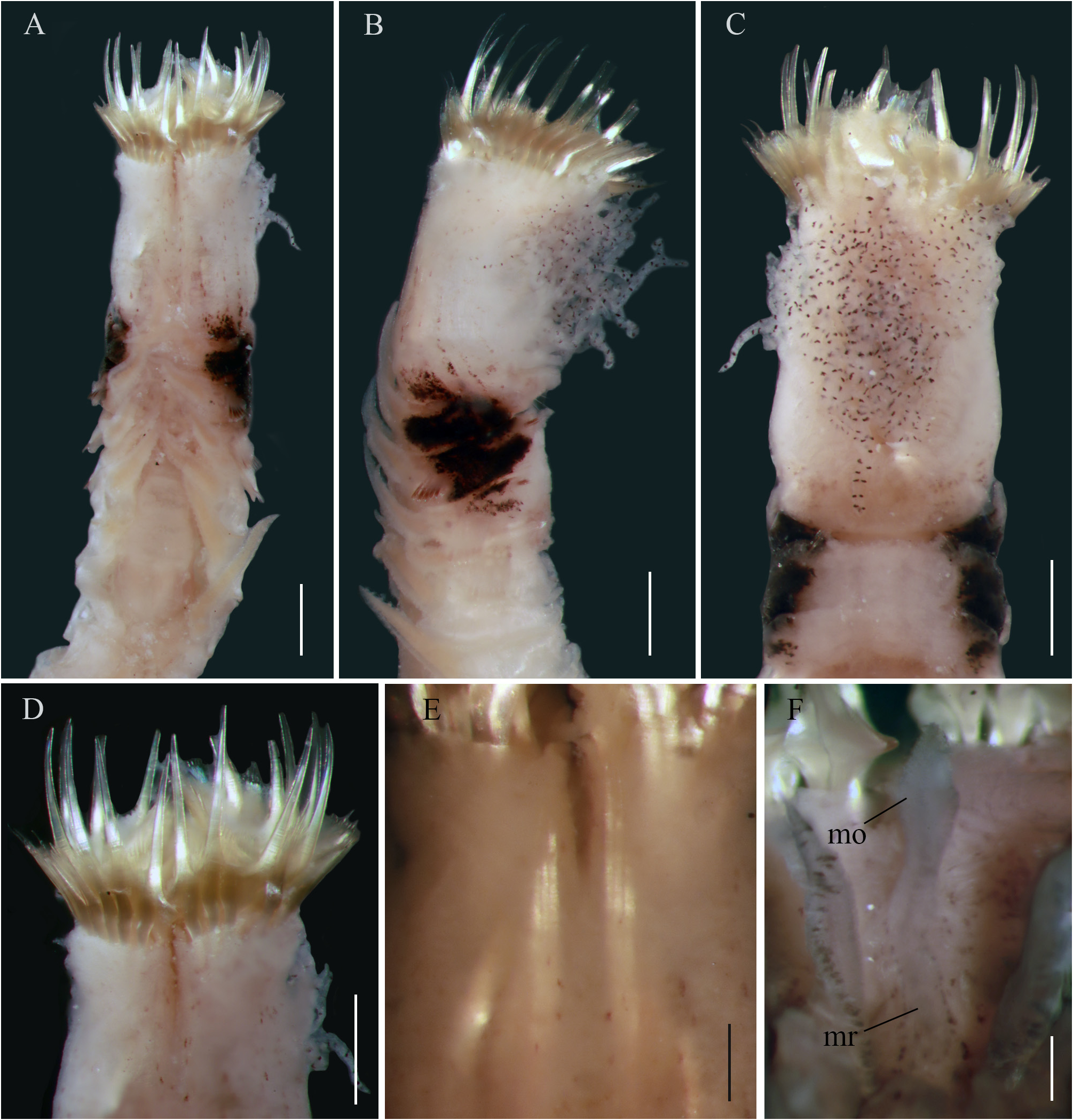
Description. Complete specimen (ECOSUR-P 3199), broken in the last segments, mature female. Body colorless, 15 mm long, 2 mm wide, with three parathoracic segments, 21 abdominal segments, caudal peduncle 3 mm long (Fig. 6 A – D). Opercular crown and opercular stalk partially fused (Fig. 6 C). Opercular disc oblique, three rows of amber paleae; outer row with 24 – 25 paleae per side, middle row with 6 – 7 long and 7 – 8 short paleae per side, inner row with 15 – 16 paleae per side. Outer paleae with two lateral teeth; blade flat, oblong, basally wider, almost five times longer than wide; thecae transverse with finely serrate margins. Blade bent towards the outside of the opercular crown; blade and handle at an angle of almost 170 ° (Fig. 7 A). Medial spike straight, ½ as long as blade, with six pairs of lateral teeth bearing a wedge-shaped process at the base (Fig. 7 B). Middle row with long and short interspersed paleae. Long paleae geniculate, slightly longer than outer paleae; blade almost straight at an angle of 155 °, thecae transverse with finely serrate margins (Fig. 7 C); tips blunt, smooth (Fig. 7 D). Blade base concave with a short lateral expansion (Fig. 7 E). Short middle paleae geniculate, with concave blade directed outwards; thecae transverse with finely serrate margin; tips blunt, smooth (Fig. 7 F). Blade basally with a thin lateral expansion. Inner paleae geniculate, ½ as long as middle dorsal paleae (Fig. 7 G); concave blade directed inwards, distally serrate; thecae transverse with serrate margin (Fig. 7 H). Opercular peduncle colorless (Fig. 6 A, C). Two nuchal spines on left lobe and three spines on right lobe (Fig. 6 C, E). Fifteen pairs of opercular papillae. Tentacles and palps pale (Fig. 6 B). Median ridge as long as the opercular stalk, with marginal dark eyespots. Median organ globular. Building organ pale. Thorax without notochaetae. Chaetiger 1 with a pair of neuropodia with capillary chaetae. Chaetiger 2 with intensely dark pigment laterally, capillary neurochaetae, and a pair of branchiae (Fig. 6 B). Parathorax with three segments, all with one pair of branchiae. First parathoracic segment darkly pigmented laterally. Second parathoracic segment paler. Third segment colorless. Notopodia with 10 lanceolate chaetae, 11 capillary chaetae. Neurochaetae lanceolate, thinner than notochaetae. Abdominal segments colorless, branchiae decreasing in size posteriorly; absent in the last five chaetigers. First two segments with long neuropodial cirri (Fig. 10 I). Neurochaetae verticillate. Notopodia with a series of uncini with six transverse rows of teeth (Fig. 7 J – K). Caudal peduncle colorless, cylindrical, slightly annulate (Fig. 6 D). Parathoracic and abdominal parapodia with oocytes, each about 60 µm in diameter (Fig. 7 J). Variation. Body 3 – 21 mm in total length, 0.4 – 2.5 mm wide, 10 – 24 abdominal segments, caudal peduncle 0.5 – 3 mm long. The number of opercular paleae varied after the size of specimens: 16 – 25 outer paleae per lobe, 4 – 8 middle long paleae per lobe, 4 – 8 middle short paleae per lobe, and 10 – 15 inner paleae per lobe. Outer paleae with 2 – 3 lateral teeth. Medial spike with 4 – 7 pairs of lateral teeth. Only one specimen (ECOSUR-P 3197) had short middle paleae with serrate tips, and terminal spine (Fig. 7 L). The marginal spines decrease in size from dorsal to ventral paleae. Some specimens with fragments of tubes made of sand and shell fragments (ECOSUR-P 3198; Fig. 7 M).
Chávez-López, Yessica (2021): Sabellariids (Annelida: Sedentaria: Sabellariidae) from shallow waters of the Gulf of Mexico and the Caribbean Sea, including three new species. Zootaxa 5048 (2): 191-214, DOI: 10.11646/zootaxa.5048.2.3

Figures 6 A – F; 7 A – M; 8 A – E
Chávez-López, Yessica (2021): Sabellariids (Annelida: Sedentaria: Sabellariidae) from shallow waters of the Gulf of Mexico and the Caribbean Sea, including three new species. Zootaxa 5048 (2): 191-214, DOI: 10.11646/zootaxa.5048.2.3
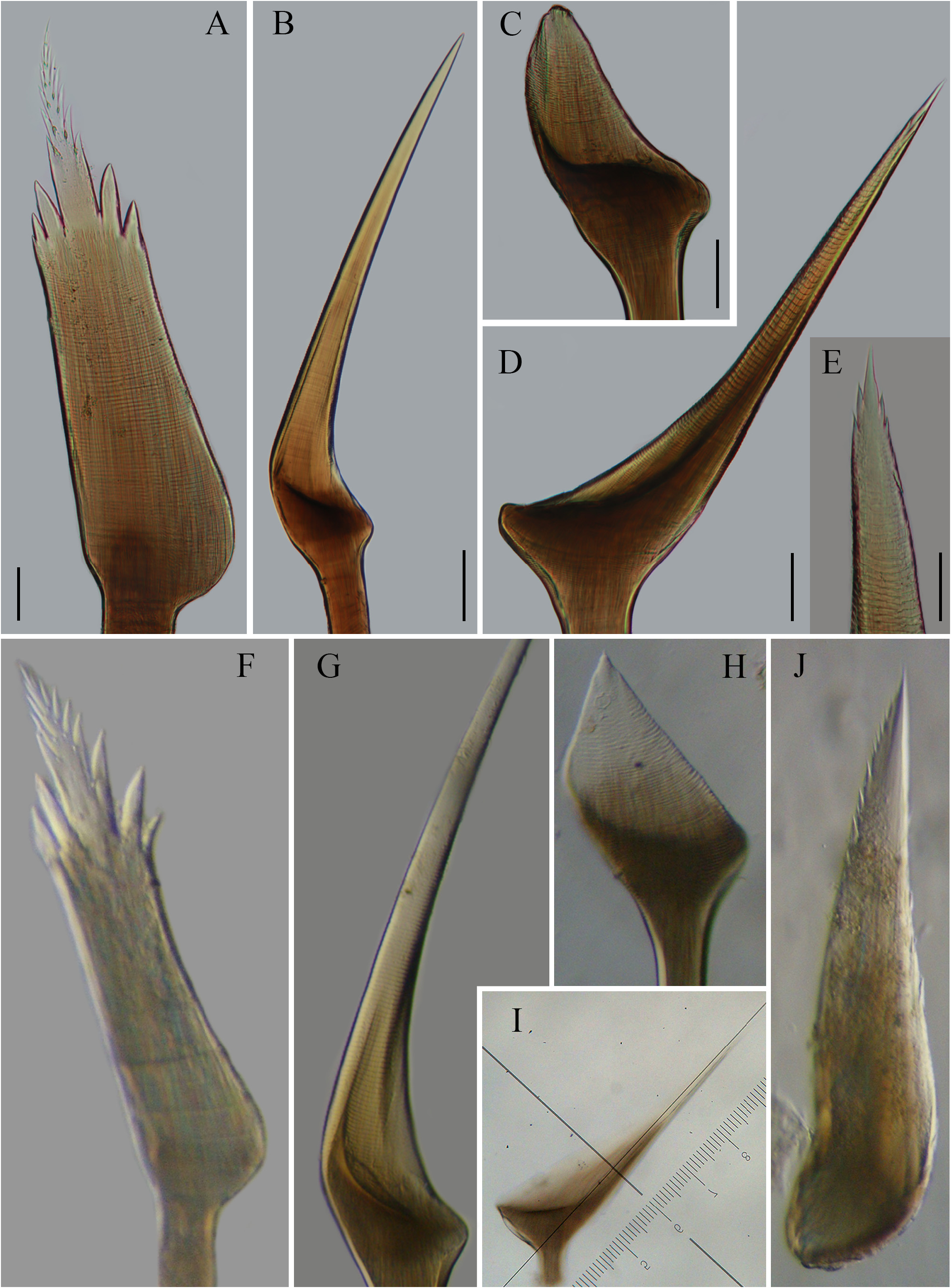
Remarks. Sabellaria floridensis Hartman, 1944 and S. bella Grube, 1870 are two closely related species that share outer paleae with denticulate medial spike, and middle paleae with long and short forms. Grube (1870) made a brief description of S. bella from Desterro (now Florianópolis), Southern Brazil. Augener (1934) re-described the type material and illustrated the opercular paleae. Augener mentioned that outer paleae have 6 – 8 teeth with a central tooth larger than the others. The central tooth (or medial spike) has a fine, hair-like tip, with about 10 pairs of lateral teeth. The inner paleae have lateral teeth in the distal third of the blade. Hartman (1944) described S. floridensis from Lemon Bay, Florida with “ 22 pairs of prolonged outer paleae with two larger serrations on a side and a minute tooth at the outer base; six pairs of alternating long and short middle paleae; and 11 pairs of inner paleae terminating distally in a serrated edge ”. Also, Hartman (1944) recorded S. bella from Beaufort, North Carolina, and Independencia Bay, Peru, and she indicated in her identification key (Hartman 1944: p. 339 – 340), that the differences between these species were in the tip of the inner paleae, being entire in S. bella and serrate in S. floridensis. However, Augener (1934) described S. bella with serrate inner paleae as well. Thus, S. bella and S. floridensis share outer paleae with lateral teeth and denticulate medial spike, middle paleae with long and short forms, and inner paleae with serrate tip. Gruet & Lana (1988) commented on the differences in the opercular paleae of S. bella and S. bellis Hansen, 1882, both species from southern Brazil. Here, I focus on the description of S. bella. According Gruet & Lana (1988), Sabellaria bella has 20 pairs of outer paleae with 2 – 3 lateral spines (or teeth) on each side of a central or medial spike; 13 pairs of middle paleae, and 12 pairs of inner paleae. Some differences can be seen between the redescriptions of S. bella by Augener (1934) and by Gruet & Lana (1988). The medial spike has 5 – 6 lateral teeth in Gruet & Lana (1988) and not 10 pairs as Augener (1934) described. The long middle paleae have a more robust base, three times wider than the median blade region as seen in Augener’s illustrations (1934: Fig. 31 c), and almost twice as wide in the photographs and illustrations by Gruet & Lana (1988: Figs. 1 F, 2 D). On the other hand, the short middle paleae illustrated by Augener (1934: Fig. 31 b) are more concave, with recurved margins and with an abrupt sharp point at the apex, whereas Gruet & Lana (1988: Figs. 1 D – E, 2 C) show slightly concave paleae, with straighter margins and sharp apex. The inner palea has a serrate tip; however, these inner paleae have a bent blade in base, an angle of around 130 ° between handle and blade in Gruet & Lana (1988: Figs. 1 H, 2 E), while Augener (1934: Fig. 31 d) does not mention anything about the bending, but the angle between handle and blade is larger than 137 °. The differences observed can be due to the position where the paleae illustrated were taken from, lateral in Augener’s schemes, and ventral, upper, or another position as in Gruet & Lana’s photographs and drawings. Both Augener (1934) and Gruet & Lana (1988) examined one or two specimens, so it is difficult to infer the morphological variations that may be present in the opercular paleae of S. bella. Other records of S. bella have also included few specimens in their descriptions (Kirtley 1994: two spec.; Santos et al. 2011: four spec.; Liñero-Arana 2013: five spec.), and it has even been mentioned that S. bella is a solitary species (Santos et al. 2011). However, it is recommended that S. bella should be revised to expand its description and include variations in the opercular paleae to better delimit the specific diagnostic characters. Although Kirtley (1944) reviewed the type material of Sabellaria bella and S. floridensis, he neither emphasized the differences in the two species nor provided illustrations for S. bella, but took those of Gruet & Lana (1988) to illustrate the opercular morphology. Besides, there are some contradictions between his identification key to species of Sabellaria and the corresponding species descriptions. For example, Kirtley described S. bella with denticulate medial plume on the outer paleae, although in the key this species is grouped with those lacking this feature. Therefore, it is not possible to deduce which features he considered diagnostic for S. bella and S. floridensis. Regarding S. floridensis, Kirtley (1994) mentioned that there are morphological variations in the middle paleae, and that rigorous analysis is needed. He stated that some short middle paleae were slightly bent; however, in none of the specimens reviewed herein was this pattern identified. This is probably due to the number of samples reviewed (33 lots), the size of the specimens, or the localities of collection, as Kirtley (1994) included specimens from North Carolina to the Gulf of Mexico, Venezuela, and Panama (Atlantic coast), whereas most of the specimens reviewed here are from the Gulf of Mexico. Based on the above, some morphological differences between S. bella and S. floridensis (Figs. 7 – 12) can be determined. The medial plume of the outer paleae is slightly longer in S. floridensis (blade 1.6 times longer than medial spike, Figs. 7 A; 12 A) than in S. bella (blade twice longer than median spike, Fig. 8 F). The short middle paleae have blunt tips in S. floridensis (Figs. 7 F; 12 C) and sharp tips in S. bella (Fig. 8 H). The inner paleae are seen bent from the base, with marginal spines 1 / 3 – ¼ as long as distal middle spine in S. bella (Gruet & Lana 1988: p. 33, Figs. 1 H – I; 8 J) and straight paleae with marginal spines half as long as the distal middle spine in S. floridensis (Figs. 7 H; 12 E). Sabellaria floridensis has been found from the same aggregation as S. salazari n. sp. Both species are distinguished mainly by the characteristics of the medial spike in the outer paleae and the morphology of the middle paleae. Sabellaria salazari n. sp. has penicillate medial spike (Fig. 10 A – C) and only middle paleae in long-form (Fig. 10 D – E), while S. floridensis has denticulate medial spike (Fig. 7 A – B) and middle paleae in long and short forms (Fig. 7 C – F).
Chávez-López, Yessica (2021): Sabellariids (Annelida: Sedentaria: Sabellariidae) from shallow waters of the Gulf of Mexico and the Caribbean Sea, including three new species. Zootaxa 5048 (2): 191-214, DOI: 10.11646/zootaxa.5048.2.3
Distribution. North Carolina to Campeche (Uebelacker 1984) on rocks, intertidal to 6.5 m depth.
Chávez-López, Yessica (2021): Sabellariids (Annelida: Sedentaria: Sabellariidae) from shallow waters of the Gulf of Mexico and the Caribbean Sea, including three new species. Zootaxa 5048 (2): 191-214, DOI: 10.11646/zootaxa.5048.2.3
Material examined: 39 specimens. Campeche: ECOSUR-P 3197, one spec. (Champotón, on rock, 4 – 5 m, February 16, 1999, coll. J. R. Bastida-Zavala & S. I. Salazar-Vallejo). ECOSUR-P 3198, two spec. (Champotón, February 16, 1999, coll. J. R. Bastida-Zavala & S. I. Salazar-Vallejo). ECOSUR-P 3199, one spec. (Sabancuy, July 28, 1984, coll. S. I. Salazar-Vallejo). ECOSUR-P 3200, eight spec. (Champotón, February 16, 1999, coll. J. R. Bastida-Zavala & S. I. Salazar-Vallejo). ECOSUR-P 3201, five spec. (Champotón, 3 m, February 15, 1999, coll. J. R. Bastida-Zavala & S. I. Salazar-Vallejo). ECOSUR-P 3202, 12 spec. (Champotón, 6 – 6.5 m, February 16, 1999, coll. L. Cosgalla Delgado & V. Reyes Galindo). ECOSUR-P 3203, one spec. (Champotón, February 14, 1999, coll. J. R. Bastida-Zavala & S. I. Salazar-Vallejo). ECOSUR-P 3204, one spec. (Campamento Tortugero Punta Xen, Champotón, May 24, 2005, on rock, 20 m from the coast, 1 m, coll. S. I. Salazar-Vallejo & L. F. Carrera-Parra). Florida: UF 283, six spec. (Seahorse Key, Cedar Keys, 29 ° 06 ’ N, 83 ° 04 ’ W, March 31, 1973).
Chávez-López, Yessica (2021): Sabellariids (Annelida: Sedentaria: Sabellariidae) from shallow waters of the Gulf of Mexico and the Caribbean Sea, including three new species. Zootaxa 5048 (2): 191-214, DOI: 10.11646/zootaxa.5048.2.3

Export occurrence data

Darwin Core Archive (ZIP)

CLASSIFICATION

Taxonomic Classification Tree

MULTIMEDIA

Media Files(9)

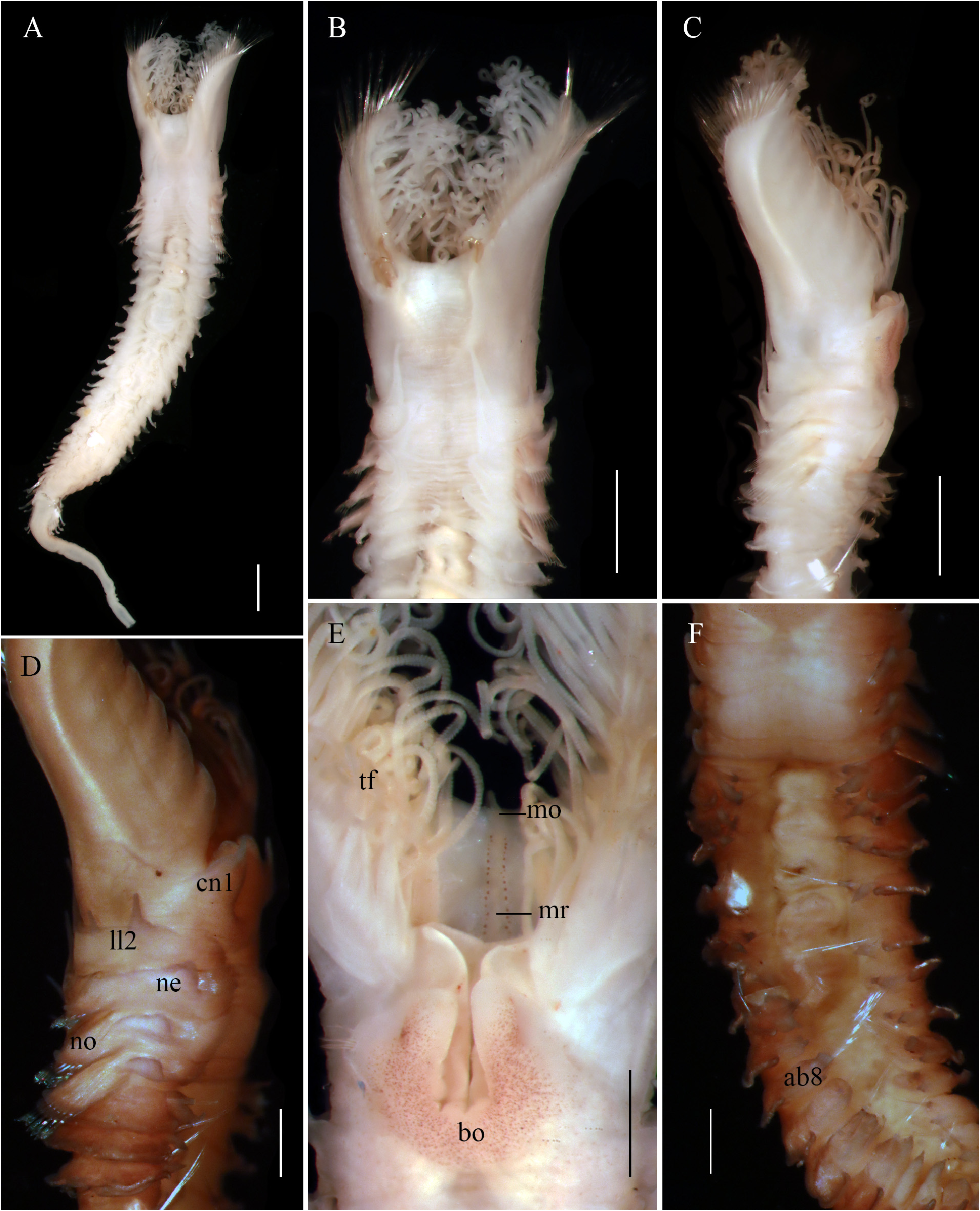
FIGURE 1. Idanthyrsus bastidai n. sp. (ECOSUR-250). A, Holotype complete specimen. B, Anterior region, dorsal view. C, Anterior region, lateral view. D, Thorax and parathorax, lateral view. E, Opercular peduncle, ventral view. F, Abdominal region, ventral view. Scale bars: A–C: 1 mm, D–F: 0.5 mm. Abbreviations: ab8, abdominal neuropodia segment 8; bo, building organ; cn1, cirrus neuropodia segment 1; ll2, lateral lamellae segment 2; mo, median organ; mr, median ridge; ne, parathoracic neuropodia; no, parathoracic notopodia; tf, tentacular filaments.

Imageimage/png© Chávez-López, YessicaChávez-López, Yessica

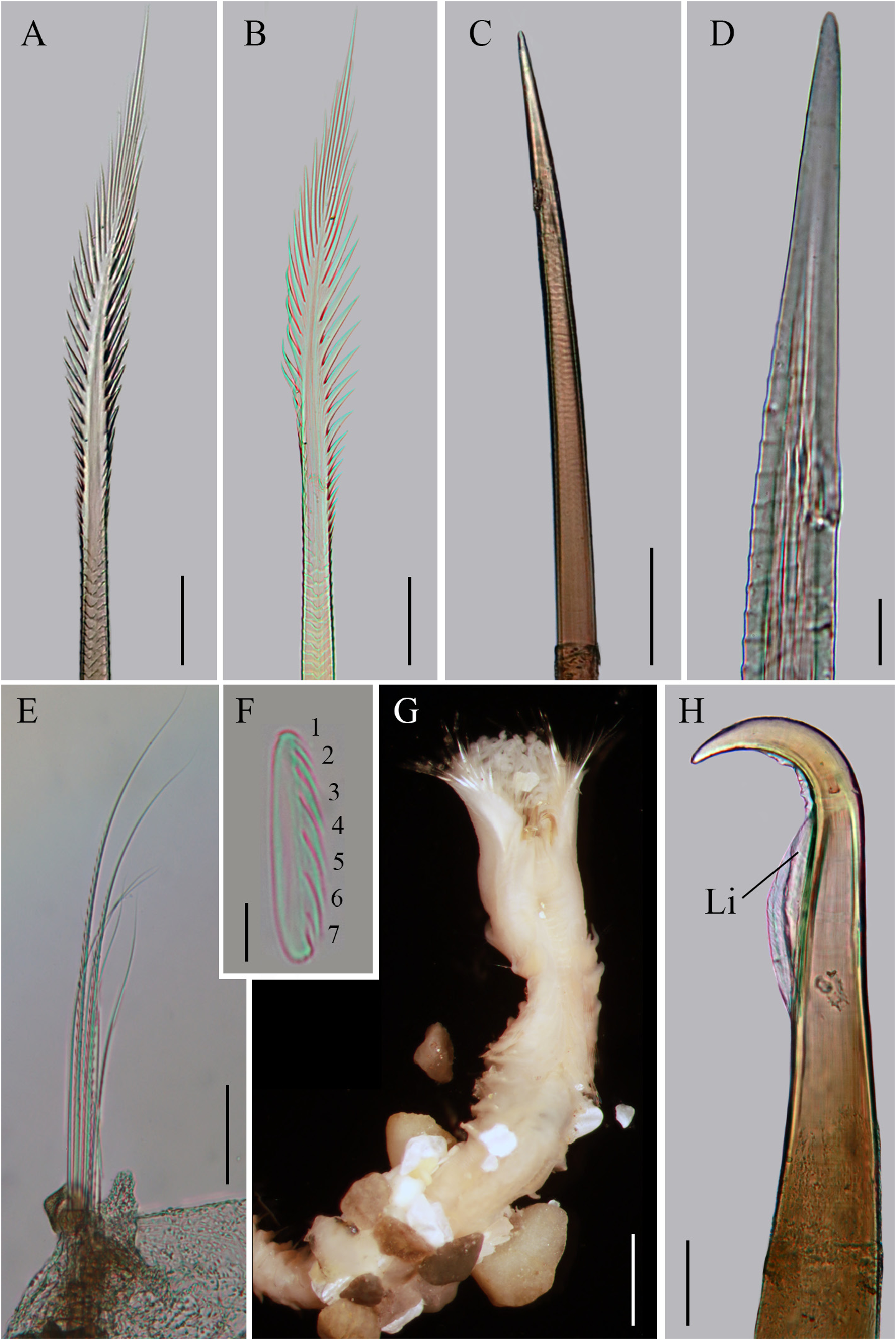
FIGURE 2. Idanthyrsus bastidai n. sp. (ECOSUR-250). A–B, Outer palea. C, Inner palea. D, Tip of inner palea. E, Abdominal neurochaetae. F, Abdominal uncini. G, Paratype with fragments of tubes (ECOSUR-251). H, Nuchal hook of another paratype. Scale bars: A–C, E: 100 µm; D: 20 µm; F: 10 µm; G: 1 mm. Abbreviation: Li, limbation.

Imageimage/png© Chávez-López, YessicaChávez-López, Yessica

FIGURE 6. Sabellaria floridensis (ECOSUR-P3199). A, Anterior region, dorsal view. B, Anterior region, right lateral view. C, Opercular crown, upper view. D, Caudal peduncle. E, Nuchal spines. F. Median ridge and median organ. Scale bars: A–D, F: 0.5 mm; E, 0.2 mm. Abbreviations: ca, cauda; mo, median organ; mr, median ridge.

Imageimage/png© Chávez-López, YessicaChávez-López, Yessica

FIGURE 7. Sabellaria floridensis (ECOSUR-P3199). A, Outer palea. B, Details of the median spike. C, Middle long palea. D, Tip of middle long palea. E, Details of the lateral expansion. F, Middle short palea. G, Inner palea. H, Tip of the inner palea. I, First abdominal parapodium with long cirri notopodial. J, Notopodial uncini with oocytes (oc). K, Abdominal uncini. L, Middle short palea with distal spines (ECOSUR-P3197). M, Specimen with tube (ECOSUR-P3198). Scale bars: A, E–J, L: 100 µm; B, D: 50 µm; C: 200 µm; K: 5 µm; M: 1 mm.

Imageimage/png© Chávez-López, YessicaChávez-López, Yessica

FIGURE 8. Comparison between S. floridensis (UF283, Florida, A–E) and S. bella (Brazil, F–J).A, Outer palea. B, Middle long palea, lateral view. C, Middle short palea, ventral view. D, Inner palea, lateral view. E, Tip of the inner palea. F, Outer palea, G, Middle long palea, lateral view. H, Middle short palea, dorsal view. I, Inner palea, lateral view. J, Inner palea, ventral view. Scale bars: A, C–E: 100 µm, B, 200 µm. Photos taken by Ivison Brandão: F–J.

Imageimage/png© Chávez-López, YessicaChávez-López, Yessica

FIGURE 9. Sabellaria salazari n. sp. Holotype (ECOSUR-254). A. Anterior region, dorsal view. B, Anterior region, right lateral view. C, Anterior region, ventral view. D, Opercular crown, dorsal view. E, Nuchal spines. F, Median ridge, and median organ, non-type specimen (ECOSUR-P3207). Scale bars: A–D: 0.5 mm, E–F: 0.2 mm. Abbreviations: mo, median organ; mr, median ridge.

Imageimage/png© Chávez-López, YessicaChávez-López, Yessica

IMAGES

Gallery(9)

See Gallery

Occurrences with images

Source Information

Sabellariids (Annelida: Sedentaria: Sabellariidae) from shallow waters of the Gulf of Mexico and the Caribbean Sea, including three new species

checklist

This dataset contains the digitized treatments in Plazi based on the original journal article Chávez-López, Yessica (2021): Sabellariids (Annelida: Sedentaria: Sabellariidae) from shallow waters of the Gulf of Mexico and the Caribbean Sea, including three new species. Zootaxa 5048 (2): 191-214, DOI: 10.11646/zootaxa.5048.2.3

Abstract

The Sabellariidae has been scarcely studied in the Gulf of Mexico and the Caribbean Sea, and there are 18 species recorded out of 140 species known in the world. This work aims to improve the knowledge of the sabellariids in the northwestern tropical Atlantic region, provide standardized descriptions, and generate taxonomic identification keys. Sabellariids from three scientific collections were revised: Reference Collection of Laboratorio de Poliquetos, El Colegio de la Frontera Sur (ECOSUR), Chetumal, Collection of Laboratorio de Biodiversidad y Cambio Climático, ECOSUR, Campeche and Invertebrate Zoology Collection of Florida Natural History Museum, University of Florida, Gainesville. Three new species are described: Idanthyrsus bastidai n. sp. and I. mikeli n. sp. from Venezuela, and Sabellaria salazari n. sp. from the Yucatán Peninsula. In addition, new records of S. floridensis Hartman, 1944, S. vulgaris Verrill, 1873, and Phragmatopoma caudata Krøyer in Mörch, 1863 are provided.

Chávez-López Y, plazi (2021). Sabellariids (Annelida: Sedentaria: Sabellariidae) from shallow waters of the Gulf of Mexico and the Caribbean Sea, including three new species. Plazi.org taxonomic treatments database. Checklist dataset https://doi.org/10.11646/zootaxa.5048.2.3 accessed via GBIF.org on 2026-06-19.

CC0Published 10/6/2021View dataset
GBIF Usage Key
188580745
Dataset Key
78efc8a8-333c-4847-aad9-d9f7943b8da8
Origin
source
Backbone Key
5199287
Taxon ID
03D0AE23516CFFD8FF73FE01FEC81705.taxon
Last Crawled
6/9/2026
Last Interpreted
6/9/2026