
AnimaliaNot EvaluatedacceptedspeciesAccepted
Idanthyrsus mikeli

Idanthyrsus mikeli

Chávez-López, 2021

GBIF:188580751

0year

ABOUT

Descriptions(6)

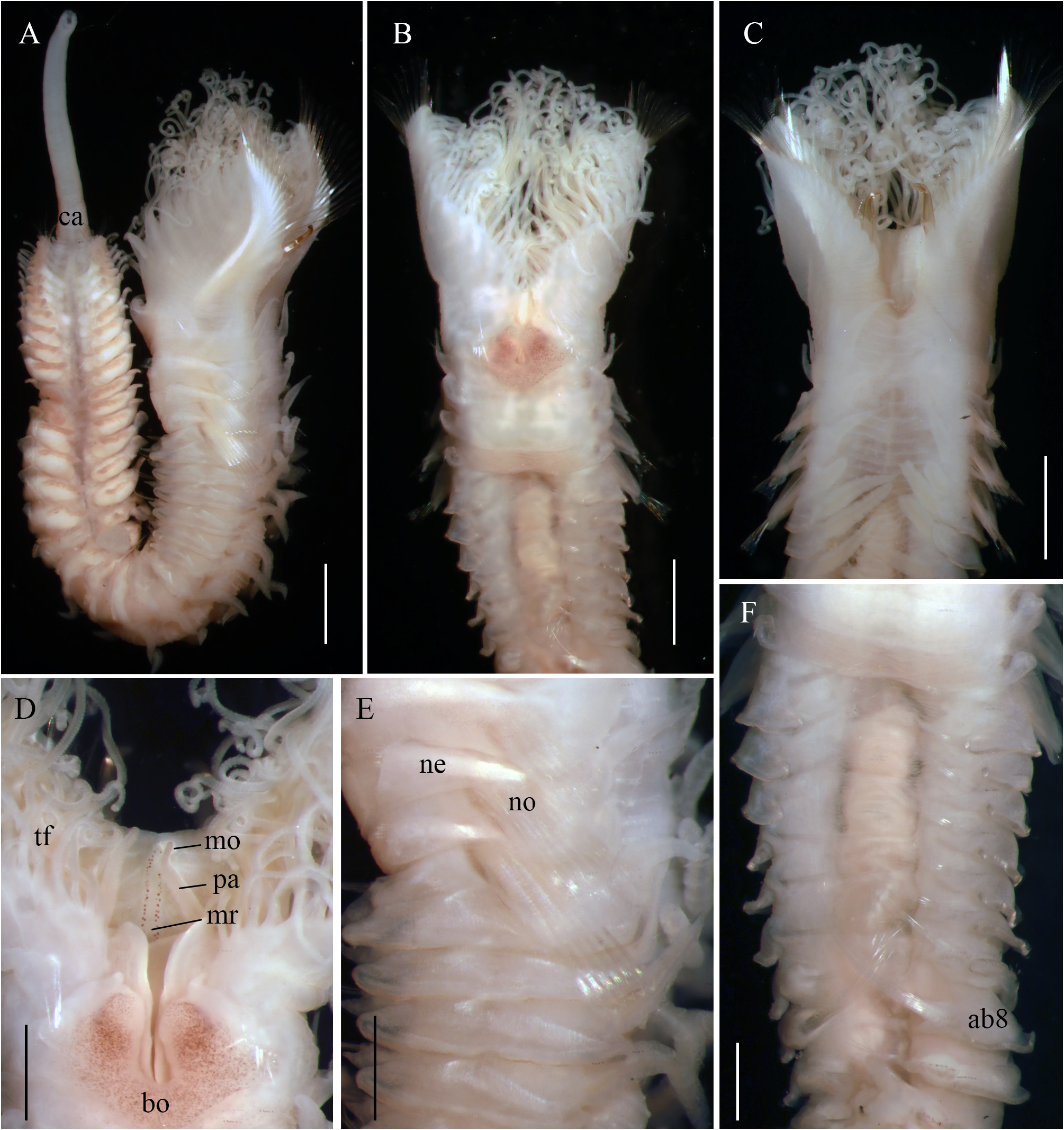
Description. Holotype complete (ECOSUR- 252) mature male. Body colorless, 12 mm long, 2 mm wide, with three parathoracic segments, 34 abdominal segments, caudal peduncle 3 mm long (Fig. 3). Opercular crown and opercular stalk completely divided into two lobes (Fig. 3 C). Opercular disc oblique, with two rows of amber paleae; outer row with 19 paleae per lobe, inner row with 13 paleae per lobe. Outer paleae denticulate, 10 – 14 pairs of lateral denticles, curved on convex margin, straight or slightly curved on concave side of paleae (Fig. 4 A). Base of the blade with transverse thecae (Fig. 4 B). Blade distally curved at an angle of 150 ° – 155 °. Inner paleae cylindrical, straight, slowly tapering towards the blunt tip; blade with transverse compact thecae (Fig. 4 C). Opercular peduncle colorless (Fig. 3 A – C). One pair of amber nuchal hooks, slightly recurved, with long limbation, tip blunt (Figs. 3 C; 4 J). Tentacles and palps colorless. Median ridge as long as the opercular stalk, with marginal brown eyespots. Median organ small, conical, colorless, without eyespots (Fig. 3 D). Building organ with small brownish spots. Thorax without notochaetae. Chaetiger 1 with a pair of neuropodia bearing capillary chaetae. Chaetiger 2 with capillary neurochaetae, two pairs of small cirri, and a pair of branchiae. Parathorax colorless with three segments, all with paired branchiae (Fig. 3 E). Notopodia with six lanceolate chaetae, seven capillary chaetae (Fig. 4 D). Neurochaetae lanceolate and capillaries, thinner than notochaetae (Fig. 4 E). Abdominal segments colorless, with a pair of branchiae of decreasing size towards posterior segments; absent in the last five segments. Neuropodia with verticillate chaetae (Fig. 4 F). Notopodia with a series of uncini with 7 – 8 transverse rows of teeth (Fig. 4 G). Abdominal segment eight with longer neurochaetae (Fig. 3 F). Caudal peduncle cylindrical, colorless, translucent (Fig. 3 A). Variation. Body 8 – 14 mm in total length, 1.2 – 2 mm wide, 25 – 34 abdominal segments, caudal peduncle 2 – 3 mm. Opercular crown made of 11 – 19 outer paleae per lobe (commonly 17 – 18 paleae), and 7 – 18 inner paleae per lobe (regularly 13 – 15 paleae). Almost all specimens had one pair of hooks, except for two that had two hooks on the left side.
Chávez-López, Yessica (2021): Sabellariids (Annelida: Sedentaria: Sabellariidae) from shallow waters of the Gulf of Mexico and the Caribbean Sea, including three new species. Zootaxa 5048 (2): 191-214, DOI: 10.11646/zootaxa.5048.2.3
Figures 3 A – F; 4 A – J LSID: urn: lsid: zoobank. org: act: 09483 D 75 - FE 35 - 4 D 78 - 8 C 51 - B 2104692 E 305
Chávez-López, Yessica (2021): Sabellariids (Annelida: Sedentaria: Sabellariidae) from shallow waters of the Gulf of Mexico and the Caribbean Sea, including three new species. Zootaxa 5048 (2): 191-214, DOI: 10.11646/zootaxa.5048.2.3
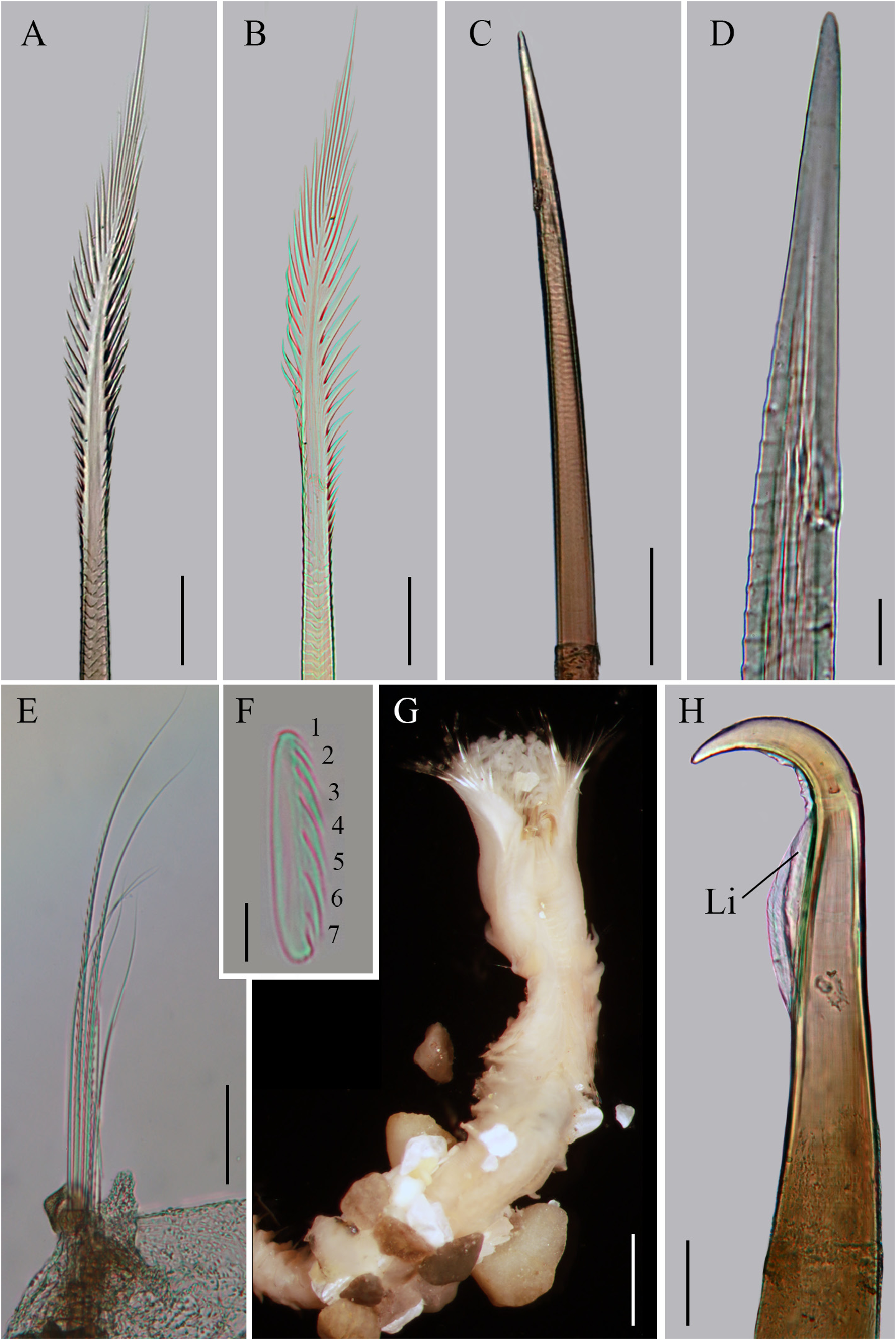
Remarks. Idanthyrsus mikeli n. sp. resembles I. cretus Chamberlin, 1919 b, from Taboguilla Island, Panama, in having denticulate outer paleae with distally curved blades. However, these species differ in the morphology of the opercular paleae and nuchal hooks. Idanthyrsus mikeli n. sp. has outer paleae with broad transverse thecae in the basal region and 10 – 18 lateral denticles of similar size (Fig. 4 A – B), whereas I. cretus has outer paleae with thinner, less elevated, and compact thecae and 16 – 32 pairs of lateral denticles with finer denticles on one margin. The margins of the inner paleae are also different, being slightly annulated in I. mikeli n. sp. (Fig. 4 C, I) and completely smooth in I. cretus. Besides, I. mikeli n. sp. has blunt nuchal hooks with a long limbation that almost reaches the tip (Fig. 4 J), whereas in I. cretus nuchal hooks are sharp with short limbation that does not reach the convex region. Idanthyrsus mikeli n. sp. was found in the same aggregation as I. bastidai n. sp. Both species are distinguished mainly by the morphology of the outer paleae, presenting distally curved blades and short, curved marginal denticles in I. mikeli n. sp. (Fig. 4 A, H) and nearly straight blades with long, slender, straight marginal spines in I. bastidai n. sp. (Fig. 2 A – B).
Chávez-López, Yessica (2021): Sabellariids (Annelida: Sedentaria: Sabellariidae) from shallow waters of the Gulf of Mexico and the Caribbean Sea, including three new species. Zootaxa 5048 (2): 191-214, DOI: 10.11646/zootaxa.5048.2.3
Distribution. Turpialito, Cumaná, Venezuela at 1.5 m depth. Associated with Millepora corals. Specimens in the same aggregation as I. bastidai n. sp.
Chávez-López, Yessica (2021): Sabellariids (Annelida: Sedentaria: Sabellariidae) from shallow waters of the Gulf of Mexico and the Caribbean Sea, including three new species. Zootaxa 5048 (2): 191-214, DOI: 10.11646/zootaxa.5048.2.3
Etymology. This species is named after Dr. Ildelfonso Liñero-Arana (Mikel), who collected the type specimens. The name is based on his nickname ‘ Mikel’. The species name is a noun in the genitive case (ICZN 1999, Art. 31.1.2).
Chávez-López, Yessica (2021): Sabellariids (Annelida: Sedentaria: Sabellariidae) from shallow waters of the Gulf of Mexico and the Caribbean Sea, including three new species. Zootaxa 5048 (2): 191-214, DOI: 10.11646/zootaxa.5048.2.3
Material examined. Venezuela. Holotype (ECOSUR- 252), Cumaná Turpialito, on Millepora, 1.5 m, February 22, 2002, coll. I. Liñero-Arana. Nine paratypes (ECOSUR- 253), Cumaná, Turpialito, same data as for holotype.
Chávez-López, Yessica (2021): Sabellariids (Annelida: Sedentaria: Sabellariidae) from shallow waters of the Gulf of Mexico and the Caribbean Sea, including three new species. Zootaxa 5048 (2): 191-214, DOI: 10.11646/zootaxa.5048.2.3

Export occurrence data

Darwin Core Archive (ZIP)

CLASSIFICATION

Taxonomic Classification Tree

MULTIMEDIA

Media Files(3)

FIGURE 2. Idanthyrsus bastidai n. sp. (ECOSUR-250). A–B, Outer palea. C, Inner palea. D, Tip of inner palea. E, Abdominal neurochaetae. F, Abdominal uncini. G, Paratype with fragments of tubes (ECOSUR-251). H, Nuchal hook of another paratype. Scale bars: A–C, E: 100 µm; D: 20 µm; F: 10 µm; G: 1 mm. Abbreviation: Li, limbation.
Imageimage/png© Chávez-López, YessicaChávez-López, Yessica

FIGURE 3. Idanthyrsus mikeli n. sp. (ECOSUR-252).A, Holotype complete specimen, lateral view. B,Anterior region, ventral view. C, Anterior region, dorsal view. D, Median ridge and median organ, ventral view. E, Parathoracic region, lateral view. F, Abdomen, ventral view. Scale bars:A–C: 1 mm; D–F: 0.5 mm.Abbreviations: ab8, abdominal neuropodia segment 8; bo, building organ; ca, cauda; mo, median organ; mr, median ridge; ne, parathoracic neuropodia; no, parathoracic notopodia; pa, palps; tf, tentacular filaments.

Imageimage/png© Chávez-López, YessicaChávez-López, Yessica

FIGURE 4. Idanthyrsus mikeli n. sp. (ECOSUR-252). A, Outer palea. B, Basal region of the outer palea. C, Inner palea. D, Notochaetae parathoracic. E, Neurochaetae parathoracic. F, Abdominal chaetae. G, Abdominal uncini. H–I, Opercular paleae and nuchal hook of one paratype (ECOSUR-253). Scale bars: A, C–D, F, H–J: 100 µm; B: 20 µm; E: 50 µm; G: 5 µm. Abbreviation: Li, limbation.

Imageimage/png© Chávez-López, YessicaChávez-López, Yessica

IMAGES

Gallery(3)

See Gallery

Occurrences with images

Source Information

Sabellariids (Annelida: Sedentaria: Sabellariidae) from shallow waters of the Gulf of Mexico and the Caribbean Sea, including three new species

checklist

This dataset contains the digitized treatments in Plazi based on the original journal article Chávez-López, Yessica (2021): Sabellariids (Annelida: Sedentaria: Sabellariidae) from shallow waters of the Gulf of Mexico and the Caribbean Sea, including three new species. Zootaxa 5048 (2): 191-214, DOI: 10.11646/zootaxa.5048.2.3

Abstract

The Sabellariidae has been scarcely studied in the Gulf of Mexico and the Caribbean Sea, and there are 18 species recorded out of 140 species known in the world. This work aims to improve the knowledge of the sabellariids in the northwestern tropical Atlantic region, provide standardized descriptions, and generate taxonomic identification keys. Sabellariids from three scientific collections were revised: Reference Collection of Laboratorio de Poliquetos, El Colegio de la Frontera Sur (ECOSUR), Chetumal, Collection of Laboratorio de Biodiversidad y Cambio Climático, ECOSUR, Campeche and Invertebrate Zoology Collection of Florida Natural History Museum, University of Florida, Gainesville. Three new species are described: Idanthyrsus bastidai n. sp. and I. mikeli n. sp. from Venezuela, and Sabellaria salazari n. sp. from the Yucatán Peninsula. In addition, new records of S. floridensis Hartman, 1944, S. vulgaris Verrill, 1873, and Phragmatopoma caudata Krøyer in Mörch, 1863 are provided.

Chávez-López Y, plazi (2021). Sabellariids (Annelida: Sedentaria: Sabellariidae) from shallow waters of the Gulf of Mexico and the Caribbean Sea, including three new species. Plazi.org taxonomic treatments database. Checklist dataset https://doi.org/10.11646/zootaxa.5048.2.3 accessed via GBIF.org on 2026-06-19.

CC0Published 10/6/2021View dataset
GBIF Usage Key
188580751
Dataset Key
78efc8a8-333c-4847-aad9-d9f7943b8da8
Origin
source
Backbone Key
11375573
Taxon ID
03D0AE235162FFD0FF73F9BAFECD12E5.taxon
Last Crawled
6/9/2026
Last Interpreted
6/9/2026