
AnimaliaNot EvaluatedacceptedspeciesAccepted
Phragmatopoma caudata
Kroyer, 1863
GBIF:188580753
0year
ABOUT
Descriptions(5)
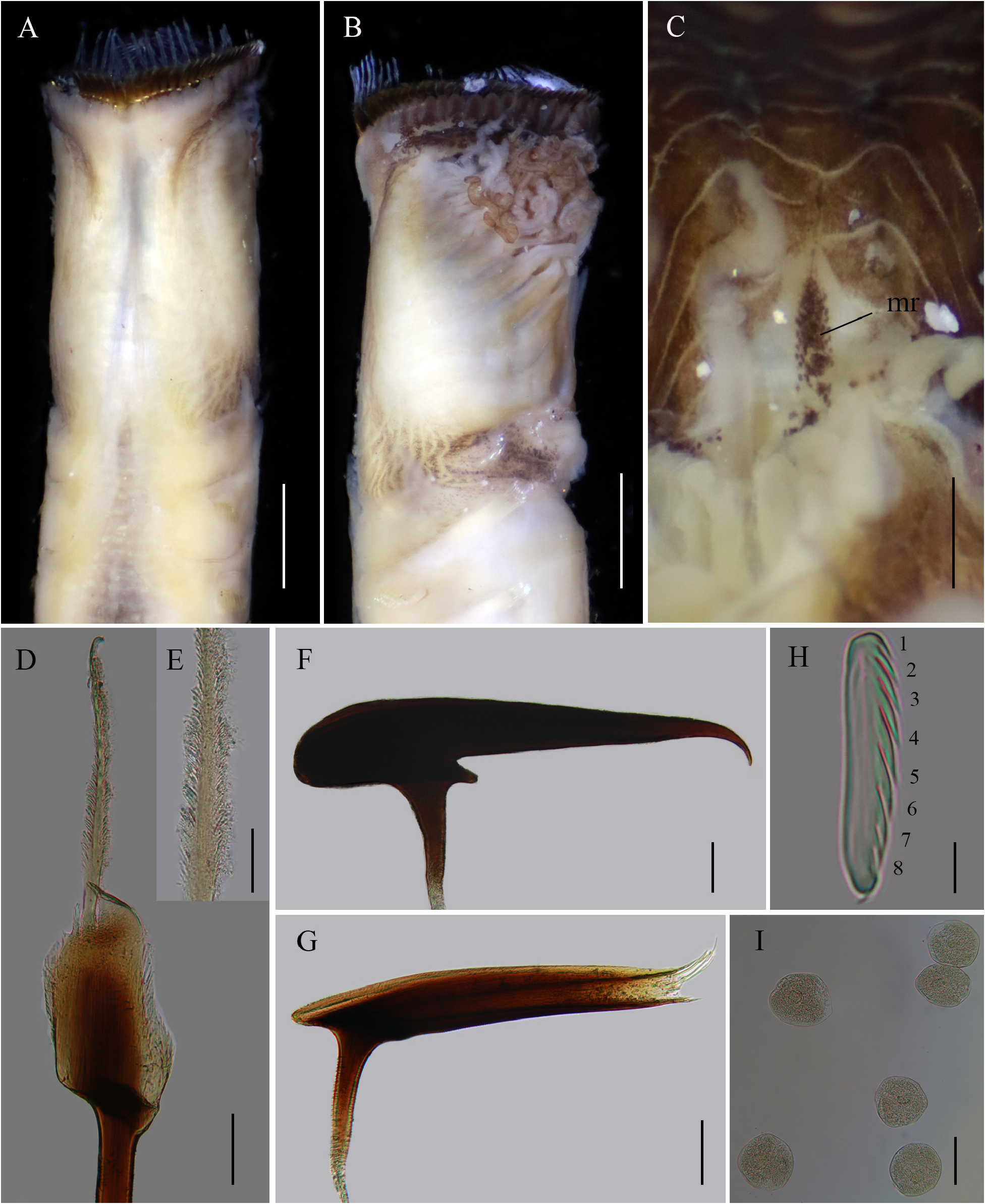
Description. Largest and best-preserved specimen (UF 3106), mature female. Body pale yellow, 31 mm long, 2 mm wide, with three parathoracic segments, abdominal region broken with 17 segments, caudal peduncle lost. Opercular crown and opercular stalk completely fused (Fig. 5 A – B). Opercular disc oblong, wider than longer, three rows of paleae, middle paleae completely covering inner ones; outer row with around 70 paleae, middle and inner rows each with 33 paleae. Outer paleae with a pair of heterodont teeth, medial plume long, acicular, and pectinate (Fig. 5 D – E). Middle paleae strongly geniculate, nape large, slightly decurrent; tip sharp, strongly curved (Fig. 5 F). Inner paleae strongly geniculate with straight peak and distal filaments (Fig. 5 G). Opercular peduncle pale yellow with brown light stretch marks (Fig. 5 A – B). Tentacles light brown. Palps pale yellow. Median ridge short, ½ as long as opercular stalk (Fig. 5 C). Median organ absent. Building organ U-shaped with some dark spots. Thorax without notochaetae. Chaetiger 1 with a pair of neuropodia bearing capillary chaetae. Chaetiger 2 with capillary neurochaetae and two pairs of small cirri and branchiae. Parathorax with three segments, all with paired branchiae. Notopodia with lanceolate and capillary chaetae. Neurochaetae lanceolate thinner than notochaetae. Abdominal segments pale yellow, all with a pair of branchiae. Neurochaetae verticillate. Notopodia with a series of uncini with eight transverse rows of teeth (Fig. 5 H). Caudal peduncle lost. Abdominal parapodia with oocytes about 110 µm in diameter (Fig. 5 I). Variation. Body 8 – 44 mm in total length, 0.5 – 2 mm wide, 11 – 27 abdominal segments, caudal peduncle 1 mm long. Opercular crown made of 45 – 70 outer paleae, 18 – 33 middle paleae, and 18 – 33 inner paleae. The color of middle paleae varied from light brown to dark brown.
Chávez-López, Yessica (2021): Sabellariids (Annelida: Sedentaria: Sabellariidae) from shallow waters of the Gulf of Mexico and the Caribbean Sea, including three new species. Zootaxa 5048 (2): 191-214, DOI: 10.11646/zootaxa.5048.2.3
Figure 5 A – I
Chávez-López, Yessica (2021): Sabellariids (Annelida: Sedentaria: Sabellariidae) from shallow waters of the Gulf of Mexico and the Caribbean Sea, including three new species. Zootaxa 5048 (2): 191-214, DOI: 10.11646/zootaxa.5048.2.3
Remarks. Phragmatopoma caudata Krøyer in Mörch, 1863 is the best-known sabellariid species on the western Atlantic coast. This species is characterized by outer paleae with medial long and pectinate plume. The examined material agrees with the description of Chávez-López (2020).
Chávez-López, Yessica (2021): Sabellariids (Annelida: Sedentaria: Sabellariidae) from shallow waters of the Gulf of Mexico and the Caribbean Sea, including three new species. Zootaxa 5048 (2): 191-214, DOI: 10.11646/zootaxa.5048.2.3
Distribution. Florida to southern Brazil, including the Gulf of Mexico (Kirtley, 1994, Chávez-López 2020).
Chávez-López, Yessica (2021): Sabellariids (Annelida: Sedentaria: Sabellariidae) from shallow waters of the Gulf of Mexico and the Caribbean Sea, including three new species. Zootaxa 5048 (2): 191-214, DOI: 10.11646/zootaxa.5048.2.3
Material examined. Veracruz. ECOSUR-P 3195, colony (Mocambo beach, April 1, 1960, coll. E. Rioja). ECO- SUR-P 3196, one spec. (La Mancha, September 23, 2004). Florida. UF 681, one spec. (Peanut Island, Palm Beach, 0 – 1 m, March 4, 2008, coll. Gustav Paulay). UF 683, one spec. (Peanut Island, Palm Beach, 0 – 1 m, March 4, 2008, coll. Gustav Paulay). UF 684, colony (Peanut Island, Palm Beach, 0 – 1 m, March 4, 2008, coll. Gustav Paulay). Guadeloupe. UF 3106, colony (Pointe de la Saline, 16 ° 12 ’ 10.1 ” N 61 ° 26 ’ 41.2 ” W, May 20, 2012, coll. Dirberg, Guillaume, Poupin & Joseph).
Chávez-López, Yessica (2021): Sabellariids (Annelida: Sedentaria: Sabellariidae) from shallow waters of the Gulf of Mexico and the Caribbean Sea, including three new species. Zootaxa 5048 (2): 191-214, DOI: 10.11646/zootaxa.5048.2.3
Export occurrence data
Darwin Core Archive (ZIP)
CLASSIFICATION
Taxonomic Classification Tree

MULTIMEDIA
Media Files(1)
FIGURE 5. Phragmatopoma caudata (UF3106). A, Anterior region, dorsal view. B, Anterior region, right lateral view. C, Median ridge. D, Outer dorsal palea. E, Details of median plume. F, Middle dorsal palea. G, Inner dorsal palea. H, Abdominal uncini; I, Oocytes. Scales bars: A–B: 1 mm; C: 0.5 mm; D, F–G, I: 100 µm; E: 50 µm; H: 10 µm. Abbreviation: mo, median ridge.
Imageimage/png© Chávez-López, YessicaChávez-López, Yessica
IMAGES