AnimaliaacceptedfamilyAccepted
Charinidae

Charinidae

Quintero, 1986

GBIF:188640091

0year

ABOUT

Descriptions(4)

Diagnosis Charinidae may be separated from other families of Amblypygi by the following combination of characters: pedipalp trochanter with two ventral spines (dorsal spine absent); pedipalp tibia with two dorsal spines and one ventral spine; ventral spine on pedipalp tibia situated distally; pedipalp tarsus with one to three dorsal spines; anteroventral apophysis of pedipalp trochanter setiform not spiniform; basal segment of chelicera with four teeth, proximal tooth bicuspid; pedipalp tarsus and claw articulated; distitibia IV with bc and bf series with same trichobothrial counts, from four to nine; tarsus of walking leg with arolium.
Miranda, Gustavo Silva de, Giupponi, Alessandro P. L., Prendini, Lorenzo, Scharff, Nikolaj (2021): Systematic revision of the pantropical whip spider family Charinidae Quintero, 1986 (Arachnida, Amblypygi). European Journal of Taxonomy 772: 1-409, DOI: 10.5852/ejt.2021.772.1505, URL: http://dx.doi.org/10.5852/ejt.2021.772.1505
Remarks The family name Charinidae has been widely used for Amblypygi since first proposed by Quintero (1986) (Appendix, Table 1). However, Pyron et al. (2014) pointed out that Charinidae is a homonym, as the snake family Charinidae Gray, 1849 has nomenclatural priority (Appendix, Table 2), and argued that the whip spider family Charinidae should be suppressed and replaced with the name Charinusiidae. Quintero & Shear (2016) submitted a case to the ICZN, demonstrating that Charinidae had been used only nine times for snakes since formalized by Cope (1886 a, 1886 b), whereas Charinidae had been used more than ninety times for whip spiders since 1986. Quintero & Shear (2016) suggested the family name should be prioritized for whip spiders rather than for snakes, citing article 23.9 in the Code, the so-called precedence act. As the case is yet to be considered by the ICZN, the opinion of Quintero & Shear (2016) is followed in the present contribution: Charinidae Quintero, 1986 is considered a nomen protectum and a valid name whereas Charinidae Gray, 1849 is considered a nomen oblitum and consequently an invalid name (Quintero & Shear 2016). Key to identification of the genera of Charinidae Quintero, 1986
Miranda, Gustavo Silva de, Giupponi, Alessandro P. L., Prendini, Lorenzo, Scharff, Nikolaj (2021): Systematic revision of the pantropical whip spider family Charinidae Quintero, 1986 (Arachnida, Amblypygi). European Journal of Taxonomy 772: 1-409, DOI: 10.5852/ejt.2021.772.1505, URL: http://dx.doi.org/10.5852/ejt.2021.772.1505
Distribution Charinids occur on all tropical continents and the eastern Mediterranean. Despite the wide distribution of the family, most of the species are narrowly distributed, often known from one location only. The family has been reported from the following countries and territories: Australia, Belize, Brazil, Cambodia, Colombia, Cuba, Dominican Republic, Ecuador, Equatorial Guinea, French Guiana, Ghana, Greece, Guadeloupe, Guinea, Guyana, India, Indonesia, Israel, Italy, Jamaica, Jordan, Kenya, Laos, Madagascar, Malaysia, Martinique, New Caledonia, Oman, Pakistan, Palau, Panama, Papua New Guinea, Philippines, Puerto Rico, Saint-Barthélemy, Samoa, São Tomé and Príncipe, Seychelles, Sierra Leone, Singapore, Solomon Islands, Somalia, Surinam, Thailand, Timor-Leste, Turkey, US Virgin Islands, Venezuela, Vietnam, Yemen.
Miranda, Gustavo Silva de, Giupponi, Alessandro P. L., Prendini, Lorenzo, Scharff, Nikolaj (2021): Systematic revision of the pantropical whip spider family Charinidae Quintero, 1986 (Arachnida, Amblypygi). European Journal of Taxonomy 772: 1-409, DOI: 10.5852/ejt.2021.772.1505, URL: http://dx.doi.org/10.5852/ejt.2021.772.1505
Type genus Charinus Simon, 1892, by original designation.
Miranda, Gustavo Silva de, Giupponi, Alessandro P. L., Prendini, Lorenzo, Scharff, Nikolaj (2021): Systematic revision of the pantropical whip spider family Charinidae Quintero, 1986 (Arachnida, Amblypygi). European Journal of Taxonomy 772: 1-409, DOI: 10.5852/ejt.2021.772.1505, URL: http://dx.doi.org/10.5852/ejt.2021.772.1505

Export occurrence data

Darwin Core Archive (ZIP)

CLASSIFICATION

Taxonomic Classification Tree

MULTIMEDIA

Media Files(5)

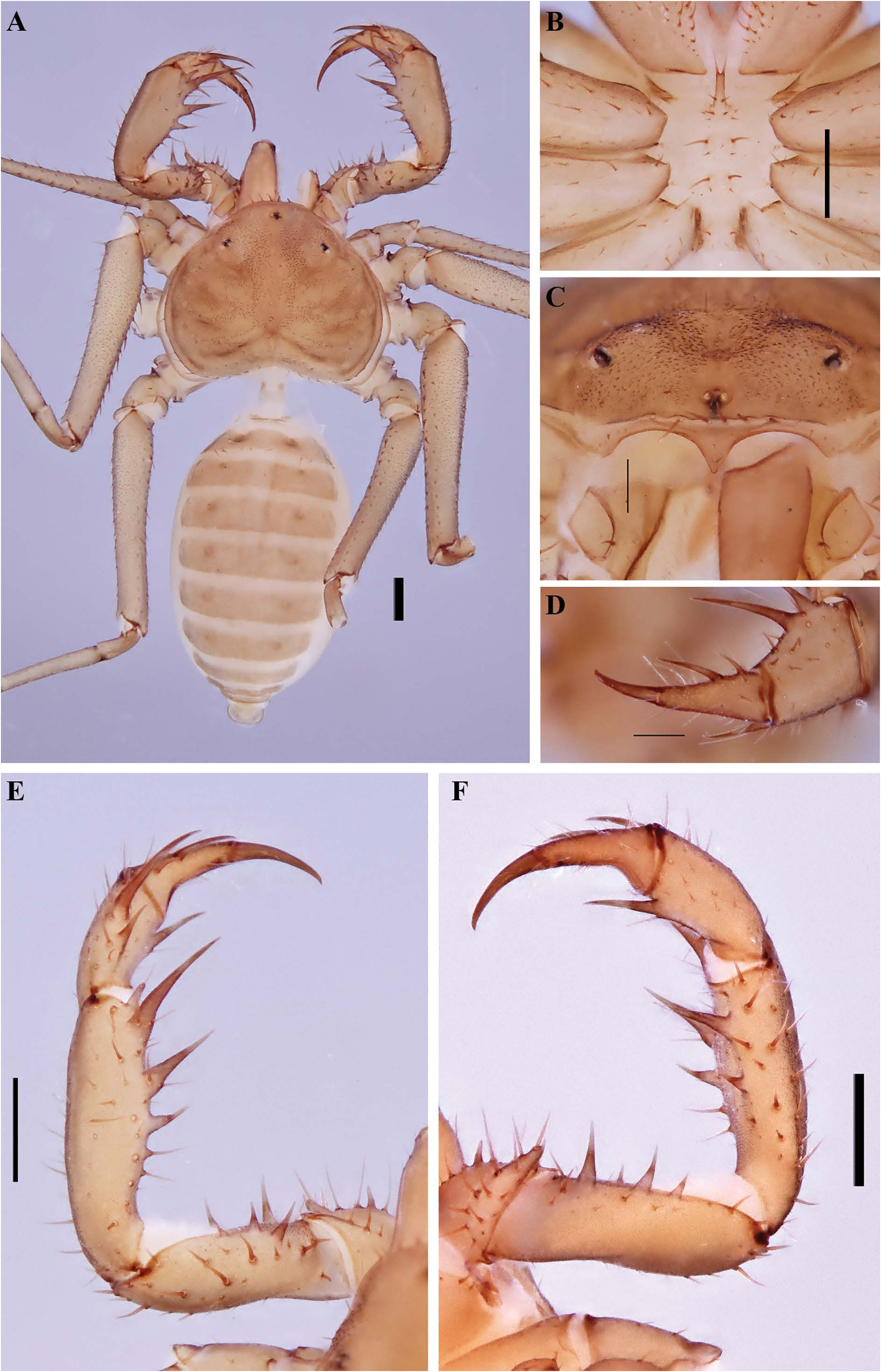
Fig. 20. Charinus cubensis (Quintero, 1983) (USNM 784407), general morphology, ♀. A. Carapace, dorsal view. B. Sternum, ventral view. C. Frontal process. D. Pedipalp tarsus, frontal view. E. Pedipalp, dorsal view. F. Pedipalp, ventral view. Scale bars: A, E–F = 1 mm; B = 0.1 mm; C–D = 0.5 mm.

Imageimage/png© Miranda, Gustavo Silva de;Giupponi, Alessandro P. L.;Prendini, Lorenzo;Scharff, NikolajMiranda, Gustavo Silva de;Giupponi, Alessandro P. L.;Prendini, Lorenzo;Scharff, Nikolaj

Fig. 35. Charinus guayaquil sp. nov. (MNRJ 9302), general morphology, ♀. A. Habitus, dorsal view. B. Sternum, ventral view. C. Frontal process. D. Pedipalp tarsus, frontal view. E. Pedipalp, dorsal view. F. Pedipalp, ventral view. Scale bars: A–B, E–F = 1 mm; C–D = 0.5 mm.

Imageimage/png© Miranda, Gustavo Silva de;Giupponi, Alessandro P. L.;Prendini, Lorenzo;Scharff, NikolajMiranda, Gustavo Silva de;Giupponi, Alessandro P. L.;Prendini, Lorenzo;Scharff, Nikolaj

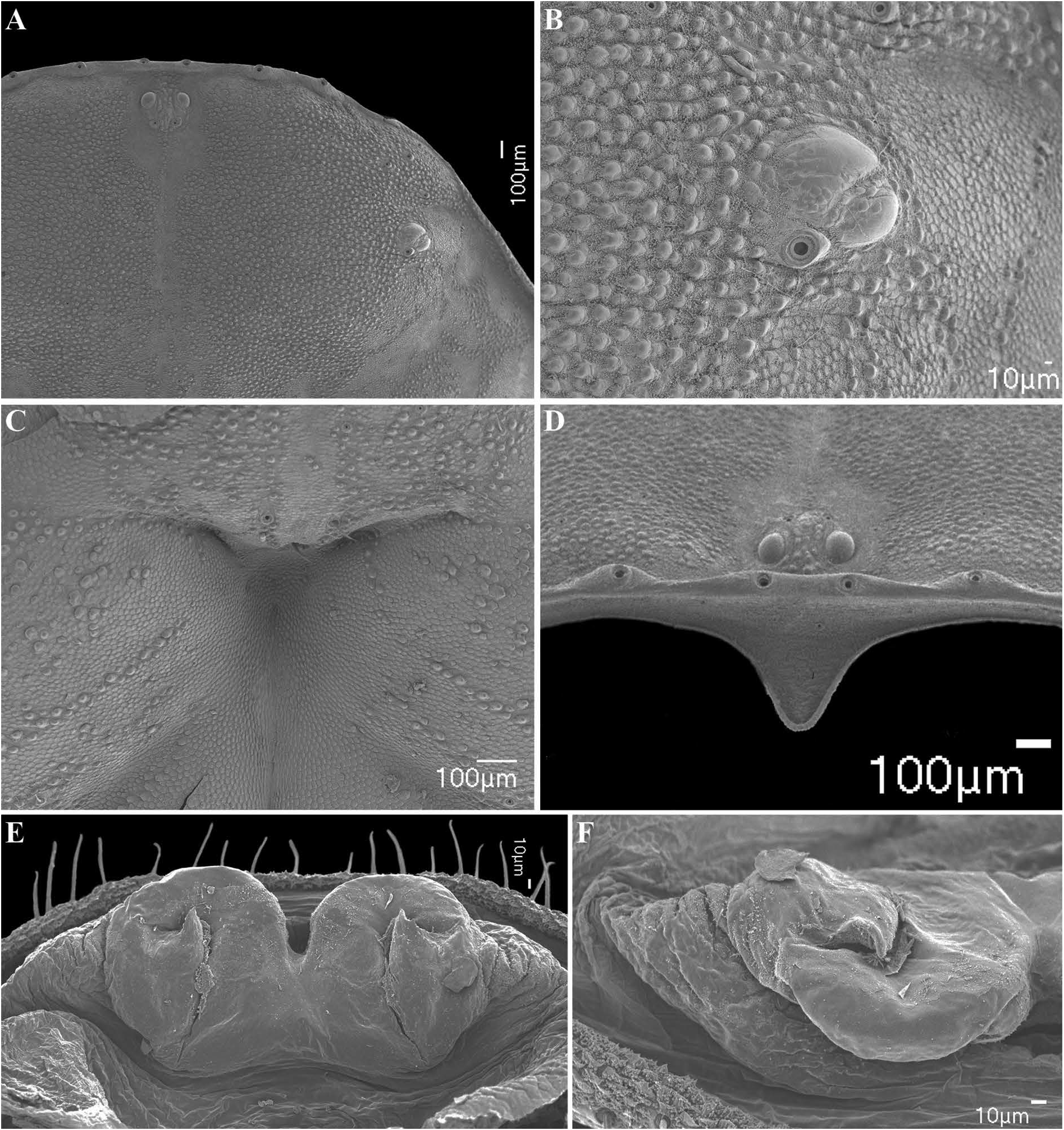
Fig. 37. Charinus insularis Banks 1902 (RBINS), carapace and female gonopod. A. Carapace, anterior part illustrating granular macrosculpture. B. Lateral ocular triad, setal socket and carapace macrosculpture. C. Fovea and granules. D. Frontal process. E. Female gonopod, dorsal view. F. Female gonopod, sinistral side.

Imageimage/png© Miranda, Gustavo Silva de;Giupponi, Alessandro P. L.;Prendini, Lorenzo;Scharff, NikolajMiranda, Gustavo Silva de;Giupponi, Alessandro P. L.;Prendini, Lorenzo;Scharff, Nikolaj

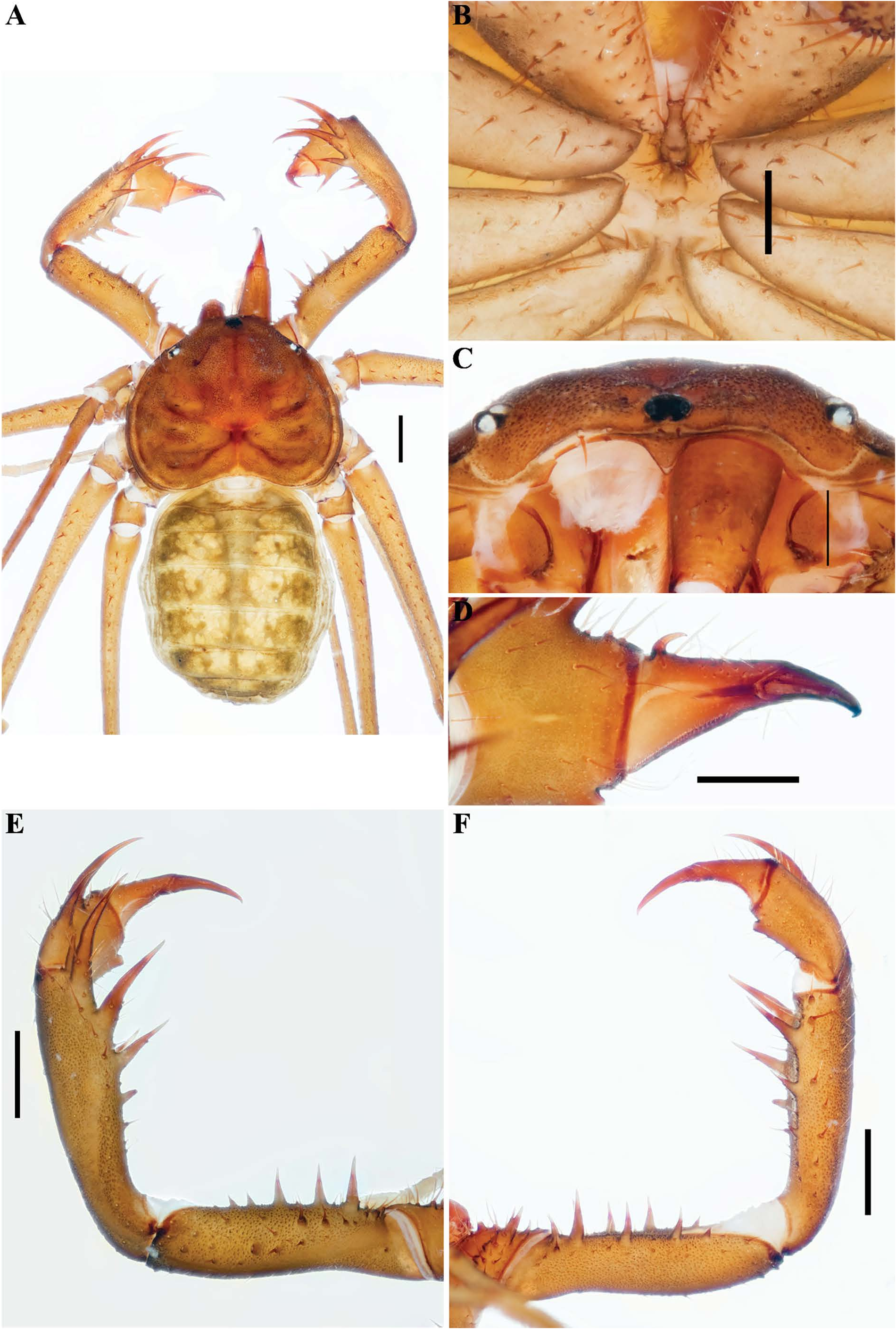
Fig. 105. Sarax bilua sp. nov. (AMCC [LP 5564]), general morphology, ♀. A. Habitus, dorsal view. B. Sternum, ventral view. C. Frontal process. D. Pedipalp tarsus, frontal view. E. Pedipalp, dorsal view. F. Pedipalp, ventral view. Scale bars: A, E–F = 1 mm; B–D = 0.5 mm.

Imageimage/png© Miranda, Gustavo Silva de;Giupponi, Alessandro P. L.;Prendini, Lorenzo;Scharff, NikolajMiranda, Gustavo Silva de;Giupponi, Alessandro P. L.;Prendini, Lorenzo;Scharff, Nikolaj

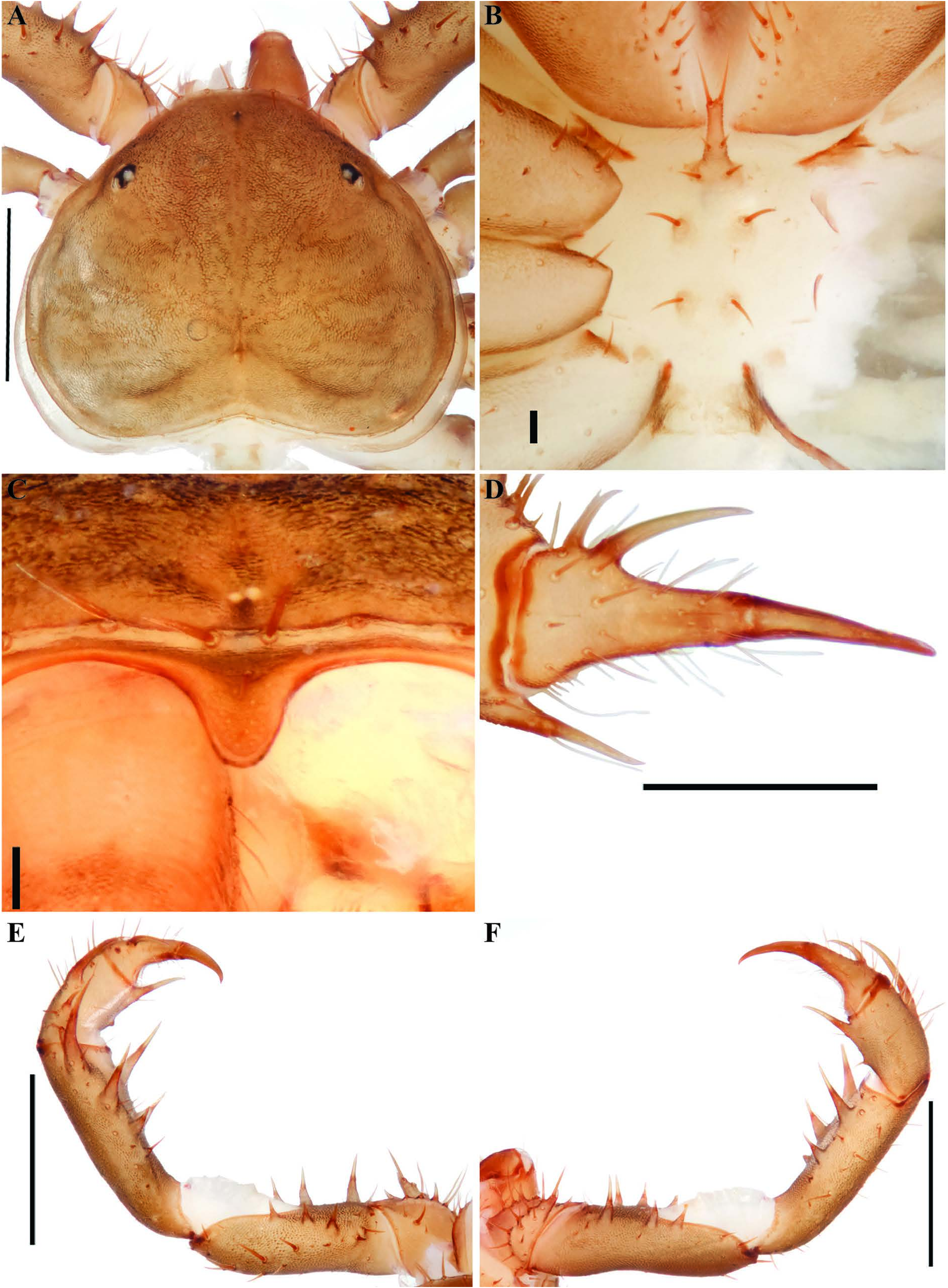
Fig. 151. Weygoldtia consonensis sp. nov. (AMNH), general morphology, ♀. A. Habitus, dorsal view. B. Sternum, ventral view. C. Frontal process. D. Pedipalp, dorsal view. F. Pedipalp, ventral view. Scale bars: A–B, E–F = 1 mm; C–D = 0.5 mm.

Imageimage/png© Miranda, Gustavo Silva de;Giupponi, Alessandro P. L.;Prendini, Lorenzo;Scharff, NikolajMiranda, Gustavo Silva de;Giupponi, Alessandro P. L.;Prendini, Lorenzo;Scharff, Nikolaj

IMAGES

Gallery(5)

See Gallery

Occurrences with images

Source Information

Systematic revision of the pantropical whip spider family Charinidae Quintero, 1986 (Arachnida, Amblypygi)

checklist

This dataset contains the digitized treatments in Plazi based on the original journal article Miranda, Gustavo Silva de, Giupponi, Alessandro P. L., Prendini, Lorenzo, Scharff, Nikolaj (2021): Systematic revision of the pantropical whip spider family Charinidae Quintero, 1986 (Arachnida, Amblypygi). European Journal of Taxonomy 772: 1-409, DOI: 10.5852/ejt.2021.772.1505, URL: http://dx.doi.org/10.5852/ejt.2021.772.1505

Abstract. The whip spider family Charinidae Quintero, 1986 is the most speciose and widely distributed in the arachnid order Amblypygi Thorell, 1883. It comprises three genera and 95 species distributed across all tropical continents and the eastern Mediterranean. Despite recent advances in the taxonomy of the family, a global revision of all its species, necessary to advance understanding of its systematics, biogeography and evolution, has never been conducted. In the present contribution, the family is revised in its entirety for the first time, including all previous names and 33 new species, 24 in the genus Charinus Simon, 1892: C. alagoanus sp. nov., C. apiaca sp. nov., C. carinae sp. nov., C. carioca sp. nov., C. carvalhoi sp. nov., C. cearensis sp. nov., C. diamantinus sp. nov., C. euclidesi sp. nov., C. goitaca sp. nov., C. guayaquil sp. nov., C. imperialis sp. nov., C. loko sp. nov., C. magalhaesi sp. nov., C. miskito sp. nov., C. mocoa sp. nov., C. monasticus sp. nov., C. palikur sp. nov., C. perquerens sp. nov., C. puri sp. nov., C. renneri sp. nov., C. sooretama sp. nov., C. souzai sp. nov., C. susuwa sp. nov., C. una sp. nov.; eight in the genus Sarax Simon, 1892: S. bilua sp. nov., S. dunni sp. nov., S. gravelyi sp. nov., S. indochinensis sp. nov., S. lembeh sp. nov., S. palau sp. nov., S. rahmadii sp. nov., S. tiomanensis sp. nov.; and one in the genus Weygoldtia Miranda et al., 2018: W. consonensis sp. nov. Taxonomic keys to the 132 species (excluding four nomina dubia) are presented and several taxonomic rearrangements implemented. Four subspecies are elevated to species level: Charinus cavernicolus Weygoldt, 2006, C. elegans Weygoldt, 2006, C. longipes Weygoldt, 2006, and Sarax bispinosus (Nair, 1934). Sarax batuensis Roewer, 1962 is removed from synonymy with Sarax buxtoni (Gravely, 1915) and S. buxtoni newly synonymized with Sarax rimosus (Simon, 1901). Stygophrynus moultoni Gravely, 1915 is transferred to Sarax, resulting in Sarax moultoni (Gravely, 1915) comb. nov. Ten species are transferred from Charinus to Sarax, resulting in new combinations: S. abbatei (Delle Cave, 1986) comb. nov., S. bengalensis (Gravely, 1911) comb. nov., S. dhofarensis (Weygoldt, Pohl & Polak, 2002) comb. nov., S. ioanniticus (Kritscher, 1959) comb. nov., S. israelensis (Miranda et al., 2016) comb. nov., S. omanensis (Delle Cave, Gardner & Weygoldt, 2009) comb. nov., S. pakistanus (Weygoldt, 2005) comb. nov., S. seychellarum (Kraepelin, 1898) comb. nov., S. socotranus (Weygoldt, Pohl & Polak, 2002) comb. nov. and S. stygochthobius (Weygoldt & Van Damme, 2004) comb. nov.

Miranda G S D, Giupponi A P L, Prendini L, Scharff N, felipe (2021). Systematic revision of the pantropical whip spider family Charinidae Quintero, 1986 (Arachnida, Amblypygi). European Journal of Taxonomy. Checklist dataset https://doi.org/10.5852/ejt.2021.772.1505 accessed via GBIF.org on 2026-06-16.

CC0Published 9/24/2021View dataset
GBIF Usage Key
188640091
Dataset Key
b65bb5a9-bbe7-49a4-af44-4b4c03121288
Origin
source
Backbone Key
3693
Taxon ID
8F431375FF9FFFD4A559FE4CFAB1DF3C.taxon
Last Crawled
6/9/2026
Last Interpreted
6/9/2026