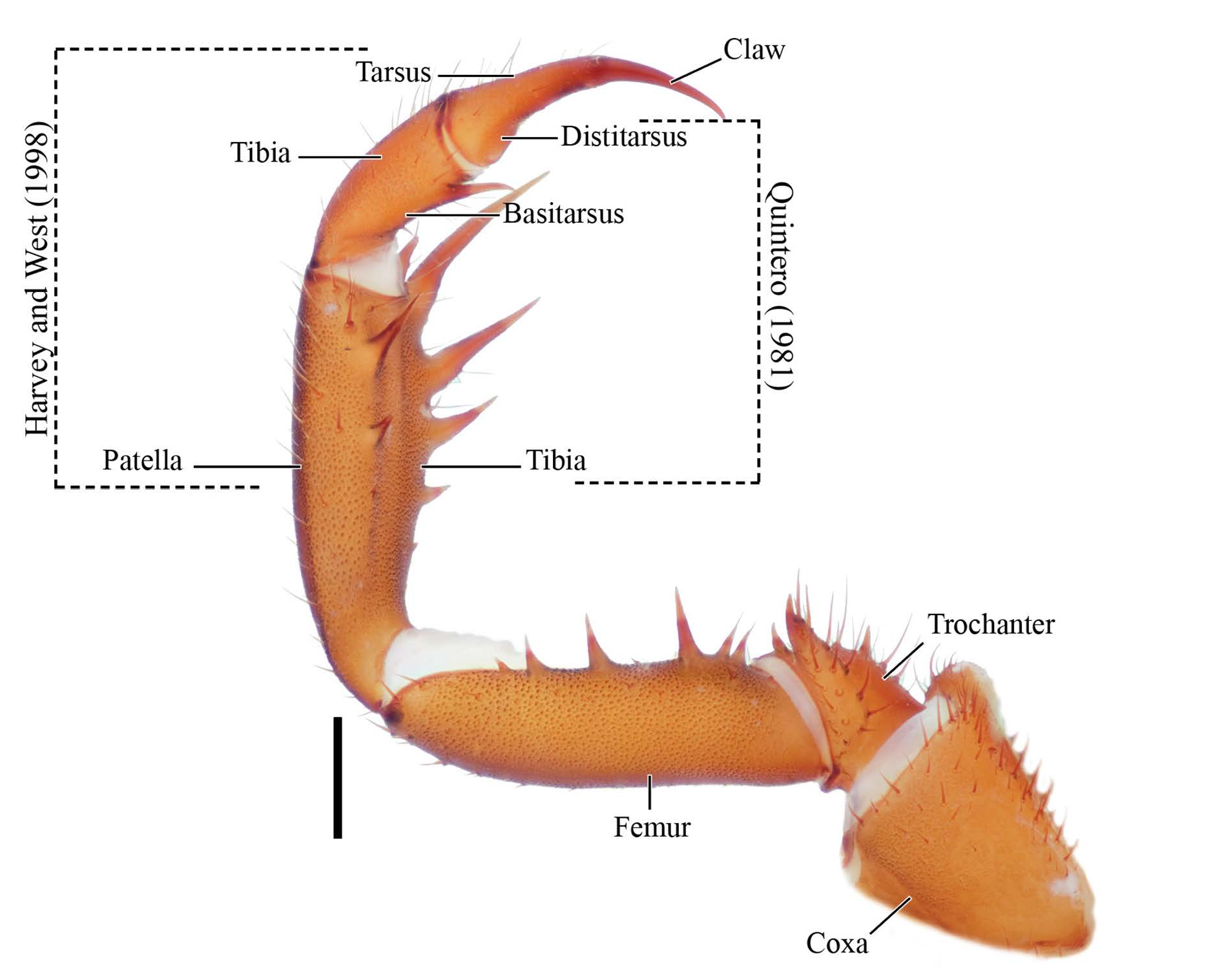
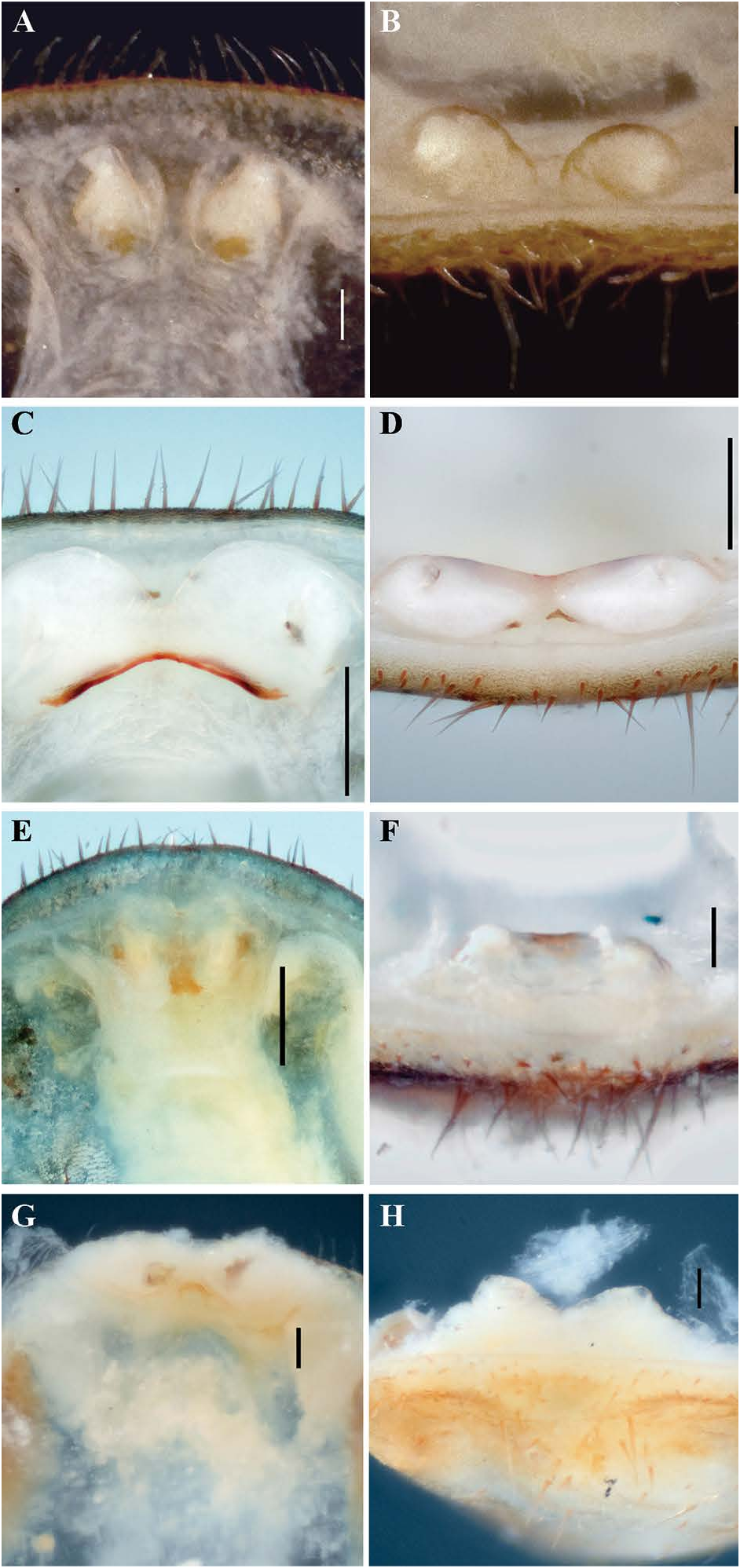
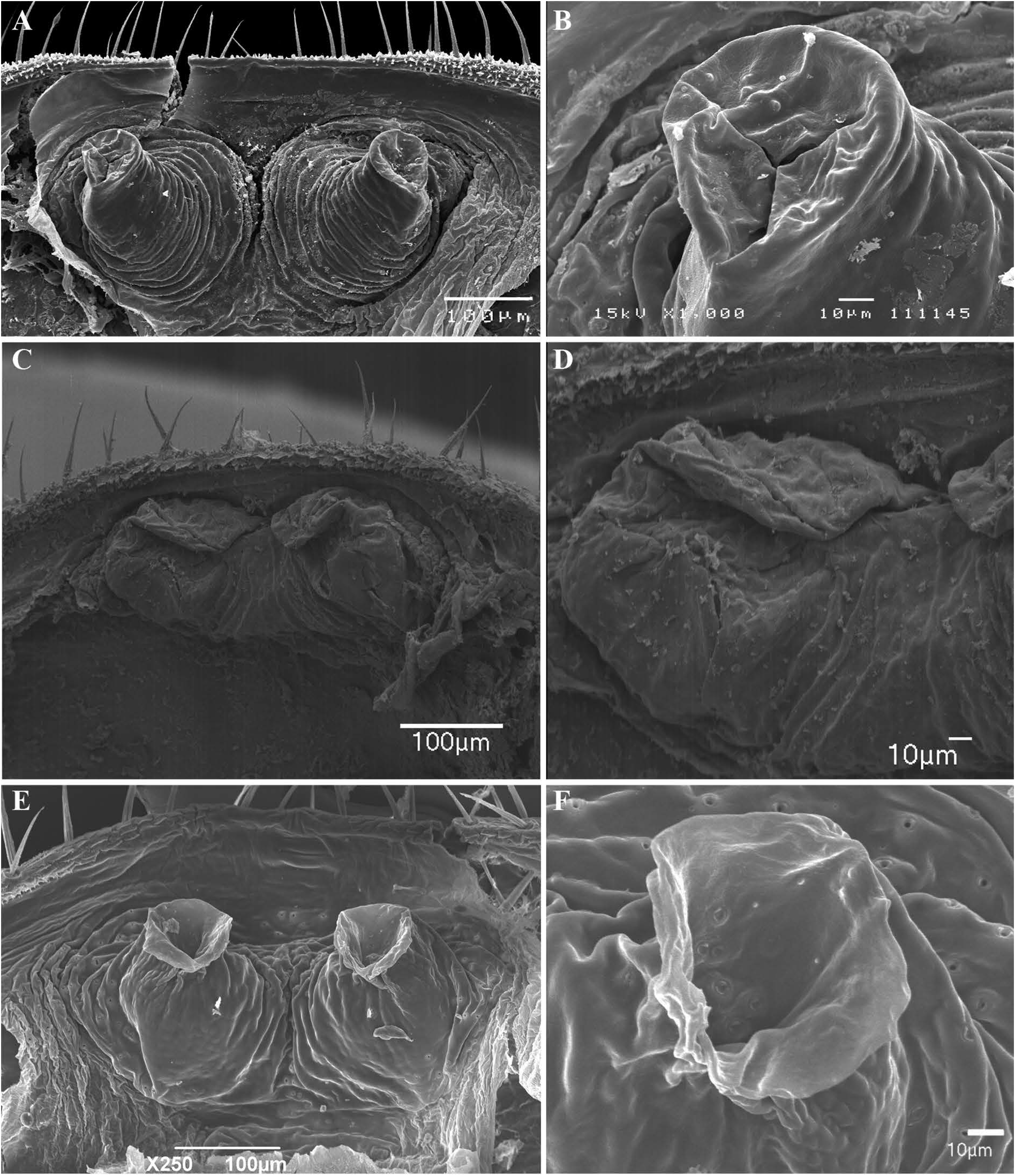
Description CARAPACE. Frontal process well developed, much wider than long, with blunt, rebordered or acute apex (Figs 42 C, 54 C). Carapace dorsoventrally compressed, wider than long. Median eyes and ocular tubercle or, when tubercle absent, anterior depression, leading to narrow medial sulcus that extends around posterior area of pair of lateral humps situated behind lateral eyespots (Fig. 35 A). Anterior margin rounded with fine setae and corners slightly depressed; with 6 – 10 small setae, two medial setae usually directly anterior to median ocular tubercle (Fig. 37 A). Carina originating at anterolateral margin, widening posteriorly from coxa I and onwards, widest dorsal to coxae III and IV, and reaching posterior margin. Many tiny punctations, more abundant in anterior area (Fig. 33 A), arranged in lines and spots, irradiating from fovea and interspersed with glabrous areas. Three pairs of deep sulci and very deep, rectangular or triangular fovea (corners form starting point of second and third sulci). First pair of sulci situated slightly posterior to lateral boss and not reaching midline. Four pairs of lateral depressions (first placed over first pair of sulci). Lateral eyes well developed, or reduced to small, whitish spot, without cornea or clearly defined lens (only small roundish knob), rarely absent. STERNUM. Four-segmented, all platelets sclerotized and convex (Fig. 31 B). Tritosternum with round base, projected anteriorly into long or small, blunt tubercle, with two apical setae and two basal setae (Fig. 24 B). Medial platelet (tetrasternum) rounded, convex, with two setae and few setulae; formed by single (Fig. 30 B) or paired (Fig. 24 B) platelets. Third platelet (pentasternum) also rounded and convex, but smaller, with shorter setae than second platelet; formed by single (Fig. 30 B) or paired (Fig. 24 B) platelets. Metasternum paired in anterior half, with anterior setae in membranous region followed by two or three setae in sclerotized area, arranged in longitudinal row from unsclerotized to sclerotized region; distal border with small elevation bearing 2 – 8 large setae. Sternites separated from each other by twice diameter of medial platelet. OPISTHOSOMA. Oblong, with almost indistinguishable punctations, finer than on carapace (Fig. 30 A). GENITALIA. Female gonopods rounded or oval, sucker-like (barrel shaped), with rounded opening (Fig. 65), finger-like (in C. africanus Hansen, 1921 only) or cushion-like, with wide atrial opening or covered with claw-like projection (Fig. 22). Male gonopods slightly wider than long, soft, only posterolateral margin of dorsal lobes and basal sclerite of lateral lobes sclerotized; median lobes long and thin, lamellar, with wide, rounded tip, almost reaching apex of lateral lobes (Fig. 25). CHELICERAE. Cheliceral furrow with four prolateral teeth (Fig. 10), distal tooth bifid. Fourth tooth twice as long as others and much stouter. Tooth length (from tip to base) IV> Ia> Ib = II> III. Claw with 5 – 13 denticles (Fig. 11 A – B, E – F). PEDIPALPS. Coxa with dorsal carina rounded in shape; 2 – 5 equidistant setae along prolateral margin, and 0 – 6 setae encircled by round carina. Trochanter with large distal, spiniform, ventral apophysis, bearing many prominent setae, and with blunt apex pointed anteriorly, and two subequal spines, one in median third and other at distal apex of prolateral surface (Fig. 2). Femur with 2 – 7 dorsal spines in primary series, decreasing in size, sometimes with secondary row of spines (Fig. 3 A – D); femur dorsal surface with row of 2 – 4 setiferous tubercles between spine 1 and proximal margin of segment; 2 – 6 ventral spines in primary series, sometimes with secondary row of spines; setiferous tubercle or spine between spine ventral 1 and proximal margin, aligned with primary series or displaced dorsally. Patella with 3 – 6 dorsal spines in primary series, decreasing in lengths (Fig. 4 A – D); small setal tubercle between spine I and distal margin of patella; 2 – 6 ventral spines, distal larger; 1 – 4 setiferous tubercles or 1 – 2 spines between ventral spine I and distal margin. Tibia with two dorsal spines, distal at end of proximal half, proximal in proximal third (Fig. 30); ventral spine in distal half, around two-thirds length of tibia, and 2 or 3 setal tubercles proximal to spine; row of 2 – 5 long, thin setae (longer than others in vicinity). Tarsus with 1 – 3 curved spines in proximal half (Figs 13, 52 D); cleaning organ about half article length of tarsus. Claw (apotele) with long, acute, curved apex. LEGS. All very setose. Femur length on leg I> III> IV> II; ventral corner of prolateral surface of leg II – IV femora projecting into distinct spiniform process. Tibia of leg I with 16 – 25 articles (up to 47 in regenerated legs); distal articles of tibia each with two small trichobothria, one on dorsal and one on prolateral side of article; one trichobothrium on second, third and fourth (from distal to proximal) articles, close to distal border, all situated dorsally; no trichobothria on other articles. Leg I tarsus (basitarsus + distitarsus) with 23 – 43 articles (up to 62 in regenerated legs); apical article with claw, tarsal organ and rod sensilla (Fig. 16). Leg IV basitibia with 2 – 4 pseudo-articles, one trichobothrium on last pseudo-article. Leg IV distitibia with one basal, two median and 13 – 18 distal trichobothria. Leg IV basitibia – distitibia length BT 1> DT> BT 3 = BT 4> BT 2. Leg IV basitarsus / distitarsus ratio 7 / 4, distitarsus tetramerous. Included taxa Charinus acaraje Pinto-da-Rocha, Machado & Weygoldt, 2002; Charinus acosta (Quintero, 1983); Charinus africanus Hansen, 1921; Charinus aguayoi Moyá-Guzmán, 2009; Charinus alagoanus sp. nov.; Charinus apiaca sp. nov.; Charinus asturius Pinto-da-Rocha, Machado & Weygoldt, 2002; Charinus australianus (L. Koch, 1867); Charinus bahoruco Teruel, 2016; Charinus belizensis Miranda, Giupponi & Wizen, 2016; Charinus bichuetteae Giupponi & Miranda, 2016; Charinus bonaldoi Giupponi & Miranda, 2016; Charinus bordoni (Ravelo, 1977); Charinus brasilianus Weygoldt, 1972; Charinus brescoviti Giupponi & Miranda, 2016; Charinus bromeliaea Jocqué & Giupponi, 2012; Charinus bruneti Teruel & Questel, 2011; Charinus caatingae Vasconcelos & Ferreira, 2016; Charinus camachoi (González-Sponga, 1998); Charinus carajas Giupponi & Miranda, 2016; Charinus caribensis (Quintero, 1986); Charinus carinae sp. nov.; Charinus carioca sp. nov.; Charinus carvalhoi sp. nov.; Charinus cavernicolus Weygoldt, 2006, new rank; Charinus cearensis sp. nov.; Charinus centralis Armas & Ávila Calvo, 2000; Charinus cubensis (Quintero, 1983); Charinus decu (Quintero, 1983); Charinus desirade Teruel & Questel, 2015; Charinus diamantinus sp. nov. Charinus diblemma Simon, 1936, nomen dubium; Charinus dominicanus Armas & Pérez, 2001; Charinus elegans Weygoldt, 2006, stat. nov.; Charinus eleonorae Baptista & Giupponi, 2003; Charinus euclidesi sp. nov.; Charinus fagei Weygoldt, 1972; Charinus ferreus Giupponi & Miranda, 2016; Charinus gertschi Goodnight & Goodnight, 1946; Charinus goitaca sp. nov.; Charinus guayaquil sp. nov.; Charinus guianensis (Caporiacco, 1947), nomen dubium; Charinus guto Giupponi & Miranda, 2016; Charinus imperialis sp. nov.; Charinus insularis Banks, 1902; Charinus iuiu Vasconcelos & Ferreira, 2016; Charinus jeanneli Simon, 1936, nomen dubium; Charinus jibaossu Vasconcelos, Giupponi & Ferreira, 2014; Charinus kakum Harms, 2018; Charinus koepckei Weygoldt, 1972; Charinus loko sp. nov.; Charinus longipes Weygoldt, 2006, stat. nov.; Charinus longitarsus Armas & Palomino-Cárdenas, 2016; Charinus madagascariensis Fage, 1954; Charinus magalhaesi sp. nov.; Charinus magua Seiter, Schramm & Schwaha, 2018; Charinus martinicensis Teruel & Coulis, 2017; Charinus milloti Fage, 1939; Charinus miskito sp. nov.; Charinus mocoa sp. nov.; Charinus monasticus sp. nov.; Charinus montanus Weygoldt, 1972; Charinus muchmorei Armas & Teruel, 1997; Charinus mysticus Giupponi & Kury, 2002; Charinus neocaledonicus Kraepelin, 1895; Charinus orientalis Giupponi & Miranda (2016); Charinus palikur sp. nov.; Charinus papuanus Weygoldt, 2006; Charinus pardillalensis (González-Sponga, 1998); Charinus pecki Weygoldt, 2006; Charinus perezassoi Armas, 2010; Charinus perquerens sp. nov.; Charinus pescotti Dunn, 1949; Charinus platnicki (Quintero, 1986); Charinus potiguar Vasconcelos, Giupponi & Ferreira, 2013; Charinus puri sp. nov.; Charinus quinteroi Weygoldt, 2002; Charinus reddelli Miranda, Giupponi & Wizen, 2016; Charinus renneri sp. nov.; Charinus ricardoi Giupponi & Miranda, 2016; Charinus rocamadre Torres-Contreras, García & Armas, 2015; Charinus ruschii Miranda et al., 2016; Charinus santanensis Vasconcelos & Ferreira, 2017; Charinus schirchii (Mello-Leitão, 1931); Charinus sillami Réveillion & Maquart, 2015; Charinus sooretama sp. nov.; Charinus souzai sp. nov.; Charinus spelaeus Vasconcelos & Ferreira, 2017; Charinus susuwa sp. nov.; Charinus taboa Vasconcelos, Giupponi & Ferreira, 2016; Charinus tingomaria Ballón-Estacio & Armas, 2019; Charinus tomasmicheli Armas, 2006; Charinus troglobius Baptista & Giupponi, 2002; Charinus tronchonii (Ravelo, 1975); Charinus una sp. nov.; Charinus vulgaris Miranda & Giupponi, 2011; Charinus wanlessi (Quintero, 1983).
Miranda, Gustavo Silva de, Giupponi, Alessandro P. L., Prendini, Lorenzo, Scharff, Nikolaj (2021): Systematic revision of the pantropical whip spider family Charinidae Quintero, 1986 (Arachnida, Amblypygi). European Journal of Taxonomy 772: 1-409, DOI: 10.5852/ejt.2021.772.1505, URL: http://dx.doi.org/10.5852/ejt.2021.772.1505