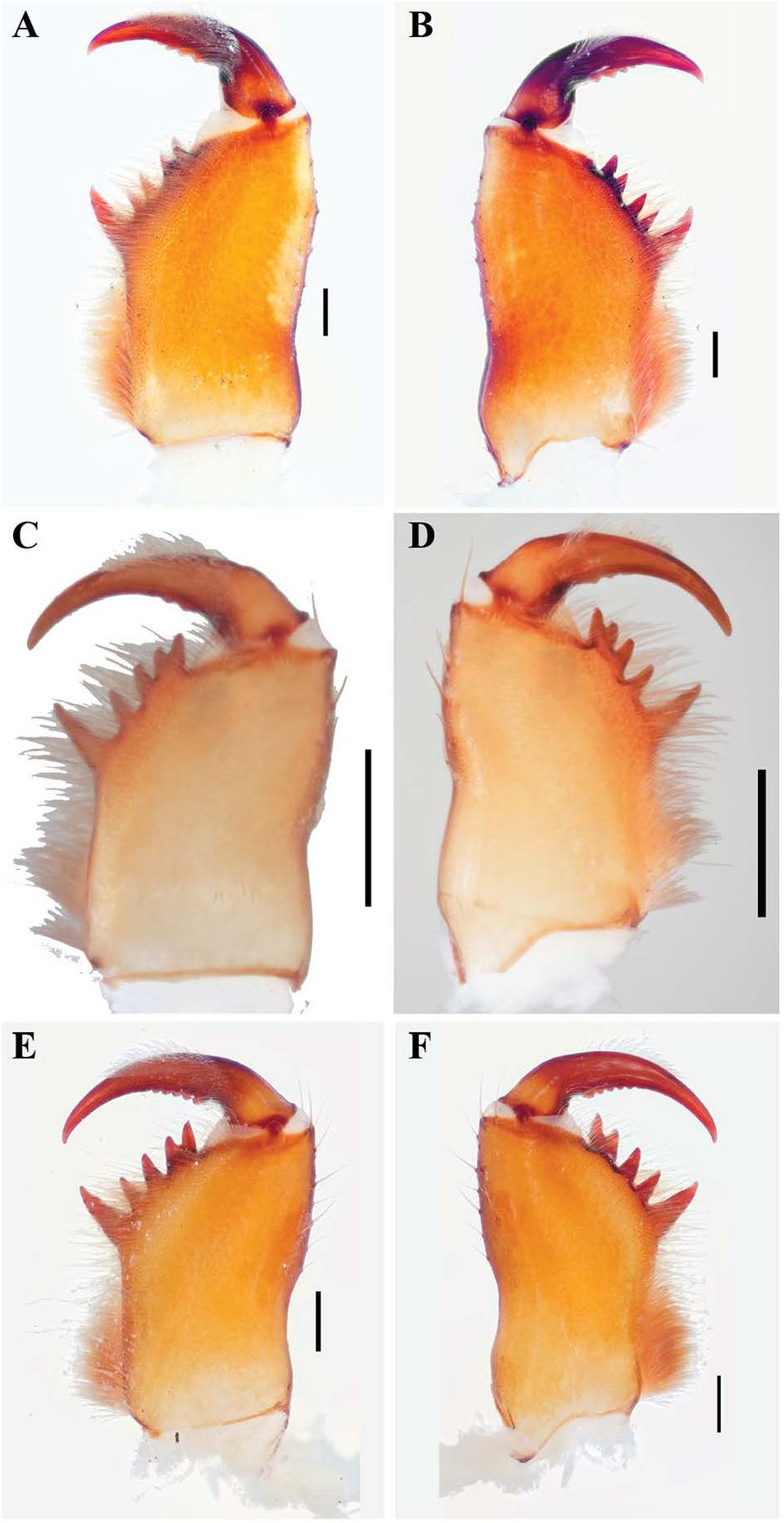
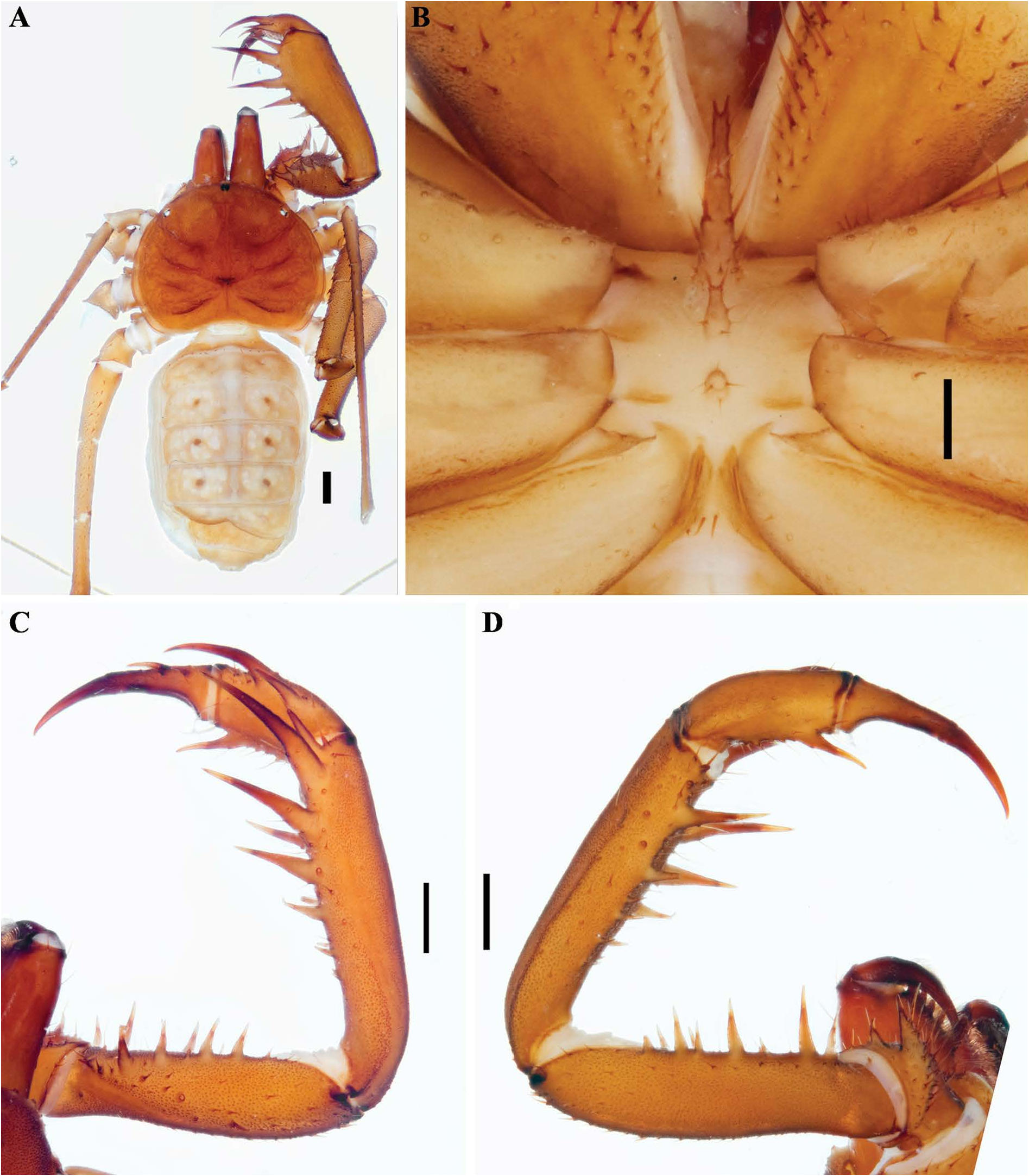
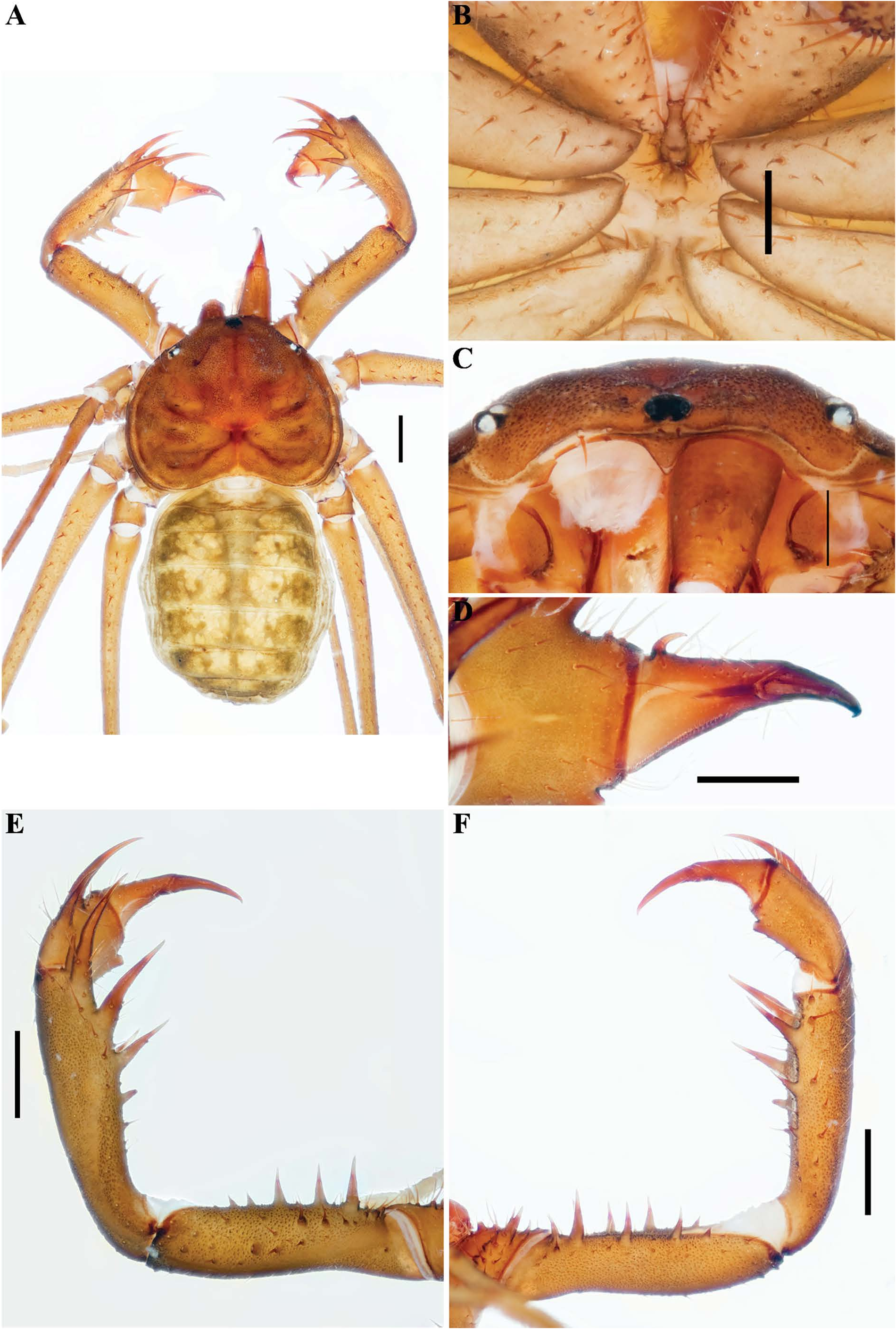
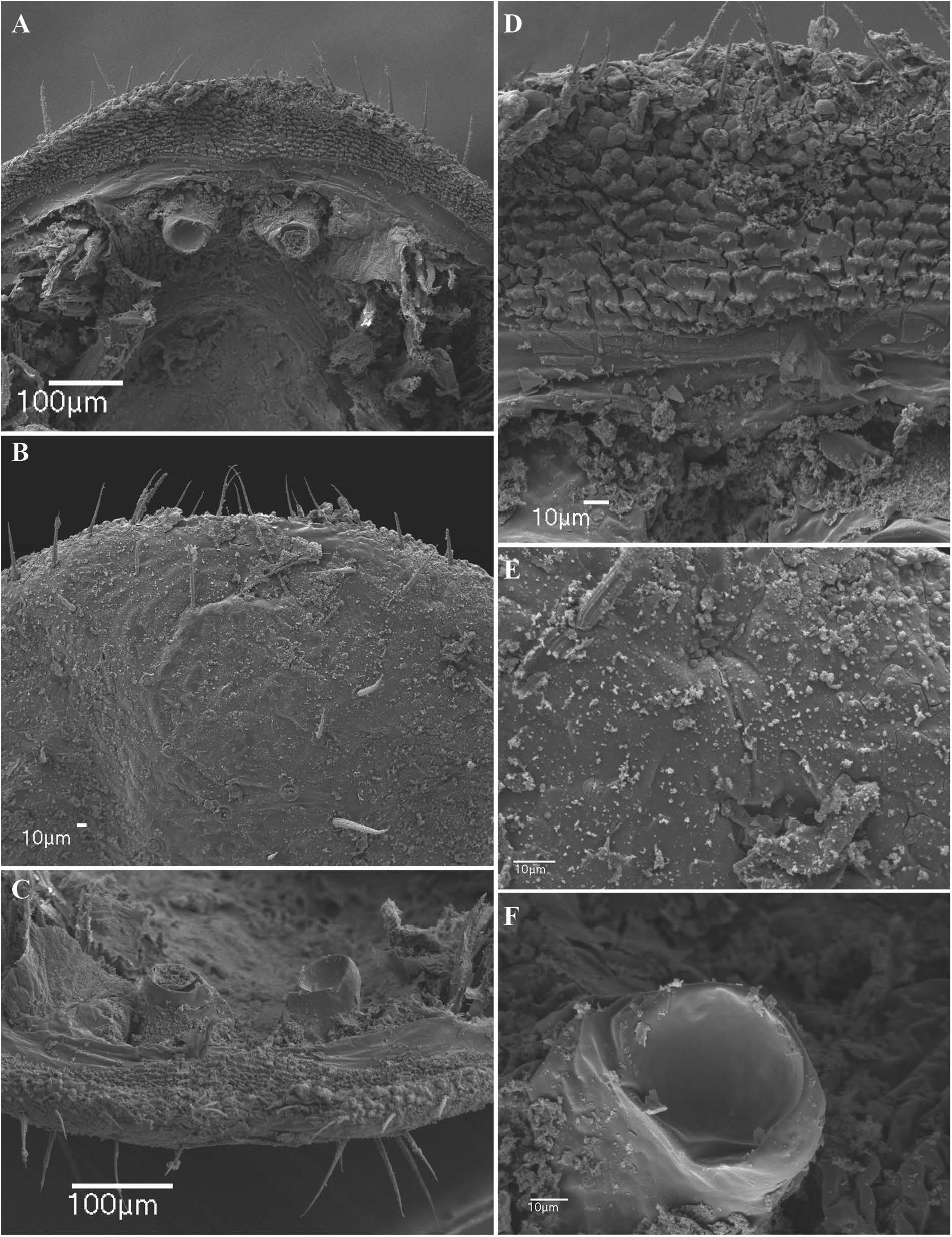
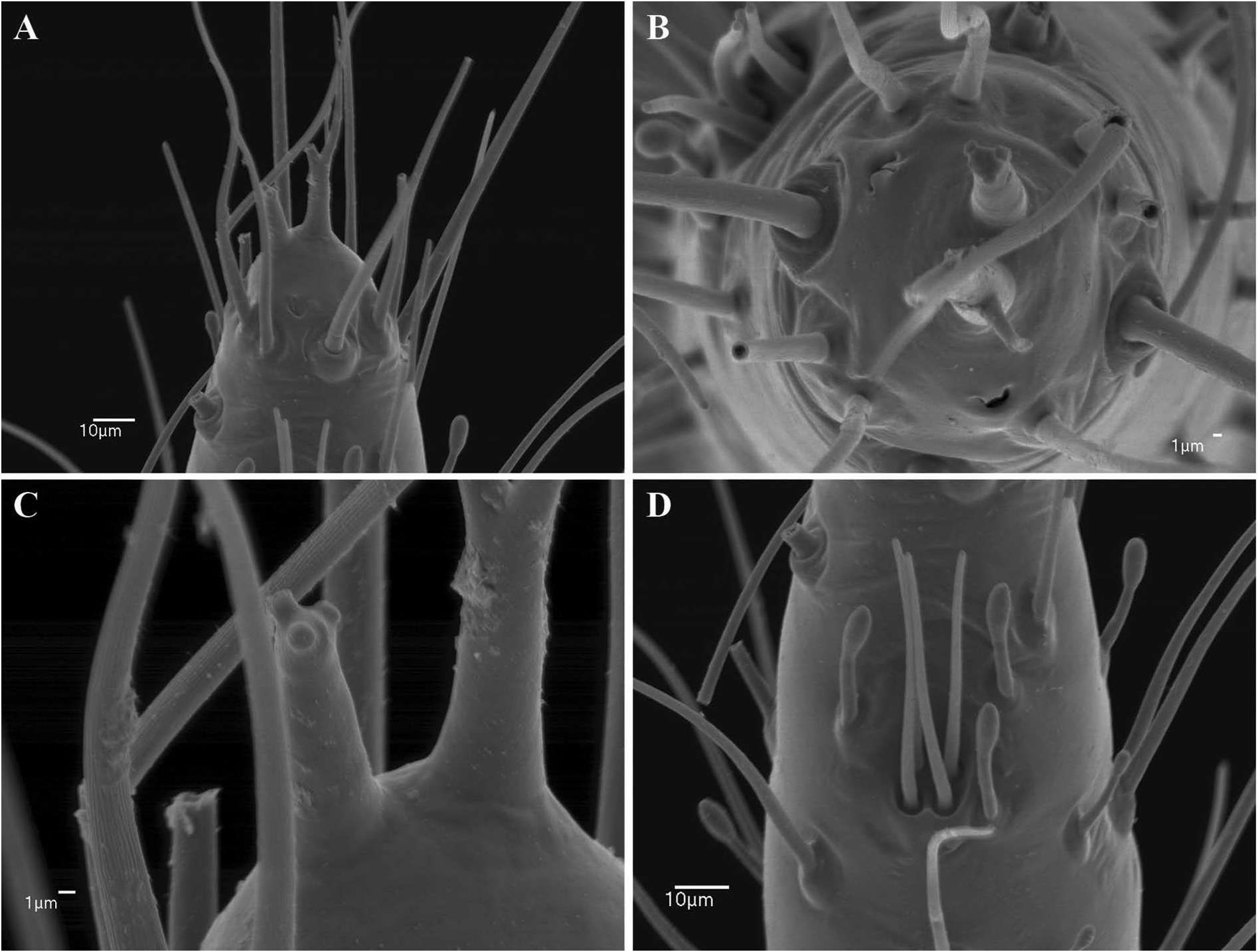
Description CARAPACE. Dorsoventrally compressed, wider than long, slightly bent downwards, ventral to lateral eyes; narrow median sulcus extending from median ocular tubercle to fovea. Anterior margin rounded, with six to eight anterior setae. Frontal process large, triangular, not visible in dorsal view. Three pairs of shallow sulci laterally on carapace, first pair of sulci slightly posterior to lateral boss; no sulci reaching midline; deep, oval fovea posteromedially. Median eyes and median ocular tubercle well developed, reduced or absent, depending on the species; two setae on median ocular tubercle. Lateral eyes well developed, reduced or absent, depending on the species, pale, small seta posterior to each lateral ocular triad; lenses directed anteriorly and dorsally. STERNUM. Tetra-segmented, all platelets markedly sclerotized. Tritosternum rounded posteriorly and projected anteriorly into large, blunt tubercle, surpassing base of pedipalp coxae, with two anterior, two median, and two posterior setae, and seta between two posterior pairs, with smaller setae posteriorly. Medial platelet (tetrasternum) with single convex platelet, with pair of large setae anteriorly, and several small setae posteriorly. Third platelet (pentasternum) forming single convex platelet, smaller than medial platelet, with two setae anteriorly and some setae posteriorly. Sternites separated from each other by length of third platelet. No anterior setae in membranous region and four setae posteriorly. OPISTHOSOMA. Oblong, tegument with nearly indistinguishable punctation. Ventral sacs and ventral sac cover present or absent, depending on the species. GENITALIA. Female genital operculum broadly sclerotized between gonopods (projections) and posteromedian margin. Female gonopods finger-like (narrow and tubular) or plunger-like (narrow and tubular with apical invagination) with wrinkled base; wide plaque of genital operculum posterior to gonopods. Male gonopods soft, as wide as long; median lobes short and narrow, not surpassing fistula, lamellar; wide, rounded apex, almost reaching apex of lateral lobe; inner surface of gonopod spinous or glabrous. CHELICERAE. Cheliceral sulcus with four prolateral teeth; first (dorsal) tooth bifid, dorsal cusp larger than ventral cusp. Third tooth slightly narrower and shorter than second tooth. Fourth tooth one-third longer than third tooth. Prolateral surface with two parallel, transverse rows of around fifteen small setae, ventrally to dorsally. Two setae, prolateral and retrolateral, on dorsodistal border, near membranous region of claw. Retrolateral surface of claw with row of setae, basally to dorsally. Claw with three to twelve denticles. PEDIPALPS. Coxae dorsally with rounded carina in dorsal view, with or without seta inside carina and two or three setae on anterior margin. Trochanter with large, spiniform ventral apophysis with blunt apex pointing anteriorly, bearing 11 – 16 large setae and several smaller setae, at posterior margin; two subequal spines, one medially in anterior row of setiferous tubercles, other at retrolateral border, dorsal to apophysis, slightly curved prolaterally. Femur with two distinct setiferous tubercles proximal to spine 1; primary series with two to four dorsal spines; three to five ventral spines; setiferous tubercle proximal to ventral spine 1, between spine 1 and proximal margin. Patella with three to five dorsal spines; setiferous tubercle distal to spine I, about one-third length of spine I; spine I with three large and several small setae in proximal third; spine II with two large and some small setae in proximal third; spine III with one seta in distal third, one medially, and one proximally; spine IV (when present) one-third length of spine III with setae medially; spine V (when present) half length of spine IV, with seta medially. Two to four ventral spines, decreasing in length; setiferous tubercle between spine I and distal margin. Tibia with two dorsal spines, proximal spine two-thirds length of distal spine; ventral spine in distal half of tibia, with prominent setiferous tubercle close to its base; long setae between spine and distal margin. Tarsus with one to three dorsal spines. Cleaning organ about half length of tarsus article; ventral row of cleaning brush with 25 – 34 setae. Claw with long, curved, acute apex. LEGS. All legs setose. Femur length on leg I> III> II> IV; ventral corner of prolateral surface of leg II – IV femora projecting into distinct spiniform process. Tibia of leg I with 21 – 28 articles; distal articles with two small trichobothria, dorsally and prolaterally; one trichobothrium on second, third and fourth (distal to proximal) articles, near distal margin, all situated dorsally; trichobothria absent on other articles. Leg I tarsus (basitarsus + distitarsus) with 37 – 41 articles covered with large number of sensilla. Leg IV basitibia with two to four pseudo-article. Leg IV distitibia with three proximal and 13 – 15 distal trichobothria. Leg IV basitibia – distitibia length DT> BT 1> BT 4> BT 3> BT 2. Included taxa Sarax abbatei (Delle Cave, 1986) comb. nov.; Sarax batuensis Roewer, 1962, new status, Sarax bengalensis (Gravely, 1911) comb. nov.; Sarax bilua sp. nov.; Sarax bispinosus (Nair, 1934), stat. nov.; Sarax brachydactylus Simon, 1892; Sarax cavernicola Rahmadi, Harvey & Kojima, 2010; Sarax cochinensis (Gravely, 1915); Sarax curioi Giupponi & Miranda, 2012; Sarax dhofarensis (Weygoldt, Pohl & Polak, 2002) comb. nov.; Sarax dunni sp. nov.; Sarax gravelyi sp. nov.; Sarax huberi Seiter, Wolff & Hörweg, 2015; Sarax indochinensis sp. nov.; Sarax ioanniticus (Kritscher, 1959) comb. nov.; Sarax israelensis (Miranda et al., 2016) comb. nov.; Sarax javensis (Gravely, 1915); Sarax lembeh sp. nov.; Sarax mardua Rahmadi, Harvey & Kojima, 2010; Sarax monodenticulatus Rahmadi & Kojima, 2010; Sarax moultoni (Gravely, 1915) comb. nov., nomen dubium; Sarax newbritainensis Rahmadi & Kojima, 2010; Sarax omanensis (Delle Cave, Gardner & Weygoldt, 2009) comb. nov.; Sarax pakistanus (Weygoldt, 2005) comb. nov.; Sarax palau sp. nov.; Sarax rahmadii sp. nov.; Sarax rimosus (Simon, 1901); Sarax sangkulirangensis Rahmadi, Harvey & Kojima, 2010; Sarax sarawakensis (Thorell, 1888); Sarax seychellarum (Kraepelin, 1898) comb. nov.; Sarax singaporae Gravely, 1911; Sarax socotranus (Weygoldt, Pohl & Polak, 2002) comb. nov.; Sarax stygochthobius (Weygoldt & Van Damme, 2004) comb. nov.; Sarax timorensis Miranda & Reboleira, 2018; Sarax tiomanensis sp. nov.; Sarax willeyi Gravely, 1915; Sarax yayukae Rahmadi, Harvey & Kojima, 2010,
Miranda, Gustavo Silva de, Giupponi, Alessandro P. L., Prendini, Lorenzo, Scharff, Nikolaj (2021): Systematic revision of the pantropical whip spider family Charinidae Quintero, 1986 (Arachnida, Amblypygi). European Journal of Taxonomy 772: 1-409, DOI: 10.5852/ejt.2021.772.1505, URL: http://dx.doi.org/10.5852/ejt.2021.772.1505