
AnimaliaNot EvaluatedacceptedspeciesAccepted
Sarax bengalensis
(Gravely, 1911) Miranda, Giupponi, Prendini & Scharff, 2021
GBIF:188640177
0year
0
Synonyms
ABOUT
Descriptions(8)
Natural history This epigean species is found in under bricks in shady places in the city of Calcutta (Weygoldt, 2005 a).
Miranda, Gustavo Silva de, Giupponi, Alessandro P. L., Prendini, Lorenzo, Scharff, Nikolaj (2021): Systematic revision of the pantropical whip spider family Charinidae Quintero, 1986 (Arachnida, Amblypygi). European Journal of Taxonomy 772: 1-409, DOI: 10.5852/ejt.2021.772.1505, URL: http://dx.doi.org/10.5852/ejt.2021.772.1505
Description CARAPACE. Six anterior setae; anterior margin projected; frontal process triangular. Small granules densely scattered between ocular triads and among sulci. Median eyes and median ocular tubercle well developed; pair of setae on median ocular tubercle; lateral eyes well developed, pale, seta lateral to lateral ocular triad; lateral ocular triad situated near carapace margin. STERNUM. Tritosternum projected anteriorly with typical setation, long, surpassing base of pedipalp coxae; other sternal platelets narrow and projected, with pair of setae anteriorly on plaque and some smaller setae posteriorly; pentasternum with two setae posteriorly. OPISTHOSOMA. Ventral sac cover absent. GENITALIA. Female genital operculum with short setae posteromedially; median region projected posteriorly; gonopod finger-like, unsclerotized basally; markedly sclerotized margin posterior to fingerlike projections. CHELICERAE. Retrolateral surface of basal segment without projection opposite to bifid tooth; retrolateral surface of claw with row of setae basally to medially; claw with seven or eight teeth; bifid tooth on basal segment with dorsal cusp larger than ventral cusp. PEDIPALPS. Coxae without seta encircled by round carina and with two setae on margin. Femur with three or four dorsal spines and three or four ventral spines; two prominent setiferous tubercles between dorsal spine 1 and proximal margin; setiferous tubercle between ventral spine 1 and proximal margin. Patella with four dorsal spines in primary series; prominent setiferous tubercle distal to spine I; three ventral spines; small setiferous tubercle between spine I and distal margin. Tibia with ventral spine distally and two setae between spine and distal margin. Tarsus with two dorsal spines, distal spine long, about onethird length of tarsus, proximal spine one-third length of dista spine; cleaning brush with 34 setae. LEGS. Tibia of leg I with 21 articles; tarsus I with 35 articles; first tarsal article similar in length to second article. Leg IV basitibia with three pseudo-articles; trichobothrium bt situated in proximal third of pseudo-article; distitibia trichobothrium bc situated closer to bf than to s bf, with first two closer the proximal end of article and sbf in medial on article; sc and sf series each with five trichobothria, closest two displaced from series and situated close together. Measurements See Table 9.
Miranda, Gustavo Silva de, Giupponi, Alessandro P. L., Prendini, Lorenzo, Scharff, Nikolaj (2021): Systematic revision of the pantropical whip spider family Charinidae Quintero, 1986 (Arachnida, Amblypygi). European Journal of Taxonomy 772: 1-409, DOI: 10.5852/ejt.2021.772.1505, URL: http://dx.doi.org/10.5852/ejt.2021.772.1505
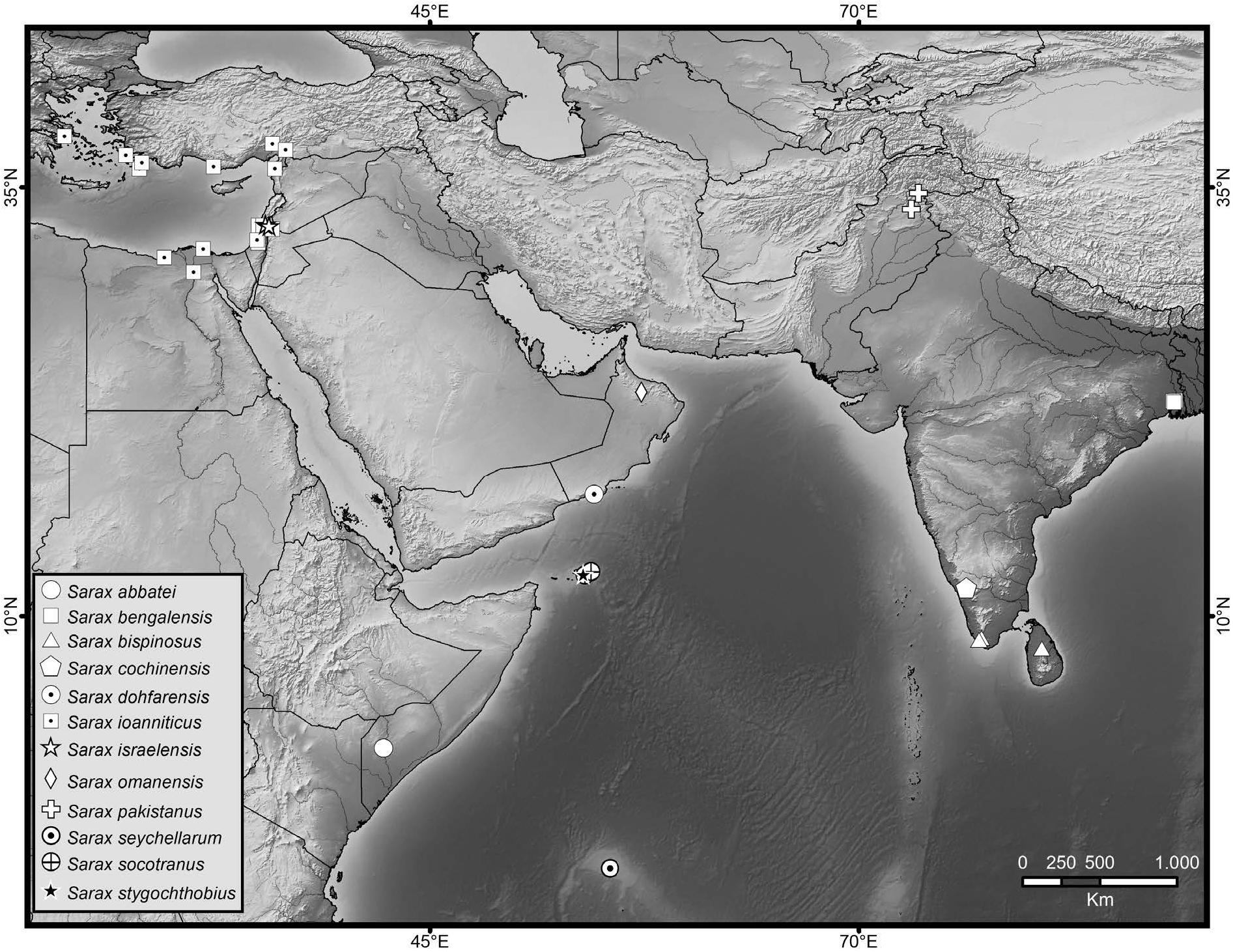
Fig. 135; Table 9
Miranda, Gustavo Silva de, Giupponi, Alessandro P. L., Prendini, Lorenzo, Scharff, Nikolaj (2021): Systematic revision of the pantropical whip spider family Charinidae Quintero, 1986 (Arachnida, Amblypygi). European Journal of Taxonomy 772: 1-409, DOI: 10.5852/ejt.2021.772.1505, URL: http://dx.doi.org/10.5852/ejt.2021.772.1505
Diagnosis This species may be separated from other species of Sarax in Africa, the Middle East and South Asia by the following combination of characters: sexual dimorphism in male pedipalp length; carapace anterior margin projected; female gonopod finger-like; female genital plate markedly sclerotized posteriorly, with median projection; leg IV basitibia with three pseudo-articles; distitibia with trichobothrium bc situated near bf and both situated near proximal margin of article; sc and sf series each with five trichobothria, proximal two displaced from series. The female gonopod and trichobothria of leg IV resemble those of S. ioanniticus comb. nov., S. israelensis comb. nov., and S. socotranus comb. nov. The median projection of the female genital plate resembles that of Charinus africanus, but is shorter. The markedly sclerotized posterior margin of the genital plate in dorsal view resembles that of S. abbatei comb. nov., in which the leg IV basitibia consists of an equal number of articles.
Miranda, Gustavo Silva de, Giupponi, Alessandro P. L., Prendini, Lorenzo, Scharff, Nikolaj (2021): Systematic revision of the pantropical whip spider family Charinidae Quintero, 1986 (Arachnida, Amblypygi). European Journal of Taxonomy 772: 1-409, DOI: 10.5852/ejt.2021.772.1505, URL: http://dx.doi.org/10.5852/ejt.2021.772.1505
Remarks The jar containing the paratypes contains two detached legs, leg II or III and leg IV, and three vials: one with 2 subad., 1 juv.; another with 2 ♂♂, 1 juv. ♀; and another with two chelicerae and one gonopod. Charinides bengalensis is the type species of Charinides by monotypy. The genus was synonymized with Charinus by Delle Cave (1986). Here, C. bengalensis is transferred to Sarax based on the phylogenetic analyses of Miranda et al. (2021), resulting in the synonymy of Charinides with Sarax. All other species once placed in Charinides (C. acosta, C. bordoni, C. camachoi, C. cubensis, C. decu, C. pardillalensis, C. tronchonii, and C. wanlessi) remain in Charinus.
Miranda, Gustavo Silva de, Giupponi, Alessandro P. L., Prendini, Lorenzo, Scharff, Nikolaj (2021): Systematic revision of the pantropical whip spider family Charinidae Quintero, 1986 (Arachnida, Amblypygi). European Journal of Taxonomy 772: 1-409, DOI: 10.5852/ejt.2021.772.1505, URL: http://dx.doi.org/10.5852/ejt.2021.772.1505
Distribution Known only from Calcutta, India.
Miranda, Gustavo Silva de, Giupponi, Alessandro P. L., Prendini, Lorenzo, Scharff, Nikolaj (2021): Systematic revision of the pantropical whip spider family Charinidae Quintero, 1986 (Arachnida, Amblypygi). European Journal of Taxonomy 772: 1-409, DOI: 10.5852/ejt.2021.772.1505, URL: http://dx.doi.org/10.5852/ejt.2021.772.1505
Etymology Although unspecified, the species name evidently refers to the Bengal region of India in which the type locality is situated.
Miranda, Gustavo Silva de, Giupponi, Alessandro P. L., Prendini, Lorenzo, Scharff, Nikolaj (2021): Systematic revision of the pantropical whip spider family Charinidae Quintero, 1986 (Arachnida, Amblypygi). European Journal of Taxonomy 772: 1-409, DOI: 10.5852/ejt.2021.772.1505, URL: http://dx.doi.org/10.5852/ejt.2021.772.1505
Type material Holotype INDIA • ♂; West Bengal, Calcutta; SMF 64590. Paratypes INDIA • 6 ex.; Mus. Calcutta, Calcutta; Jun. 1911; Zool. Mus. Hamburg. Typenkatalog Nr. 1; ZMH. Additional material INDIA • 1 ♀, 1 ♂; Calcutta; 21 Sep. 1910; CUMZ I. 48105 • 1 ♀, 2 ♂♂; Calcutta; May 1913; ZMH.
Miranda, Gustavo Silva de, Giupponi, Alessandro P. L., Prendini, Lorenzo, Scharff, Nikolaj (2021): Systematic revision of the pantropical whip spider family Charinidae Quintero, 1986 (Arachnida, Amblypygi). European Journal of Taxonomy 772: 1-409, DOI: 10.5852/ejt.2021.772.1505, URL: http://dx.doi.org/10.5852/ejt.2021.772.1505
Export occurrence data
Darwin Core Archive (ZIP)
CLASSIFICATION
Taxonomic Classification Tree

NOMENCLATURE
Synonyms(2)
MULTIMEDIA
Media Files(1)
Fig. 135. Map plotting known distributions of species of Sarax Simon, 1892 in Africa, the Middle East and South Asia.
Imageimage/png© Miranda, Gustavo Silva de;Giupponi, Alessandro P. L.;Prendini, Lorenzo;Scharff, NikolajMiranda, Gustavo Silva de;Giupponi, Alessandro P. L.;Prendini, Lorenzo;Scharff, Nikolaj
IMAGES