
AnimaliaNot EvaluatedacceptedspeciesAccepted
Charinus acosta
(Quintero, 1983)
GBIF:188640199
0year
0
Synonyms
ABOUT
Descriptions(8)
Natural history Epigean, found in forests, but well adapted to disturbed habitats, e. g., Santiago de Cuba, south of the Sierra Maestra range (Teruel et al. 2009). The widespread distribution of this species may be attributed to its parthenogenetic biology (Armas 2000 b, 2005, 2006 b).
Miranda, Gustavo Silva de, Giupponi, Alessandro P. L., Prendini, Lorenzo, Scharff, Nikolaj (2021): Systematic revision of the pantropical whip spider family Charinidae Quintero, 1986 (Arachnida, Amblypygi). European Journal of Taxonomy 772: 1-409, DOI: 10.5852/ejt.2021.772.1505, URL: http://dx.doi.org/10.5852/ejt.2021.772.1505
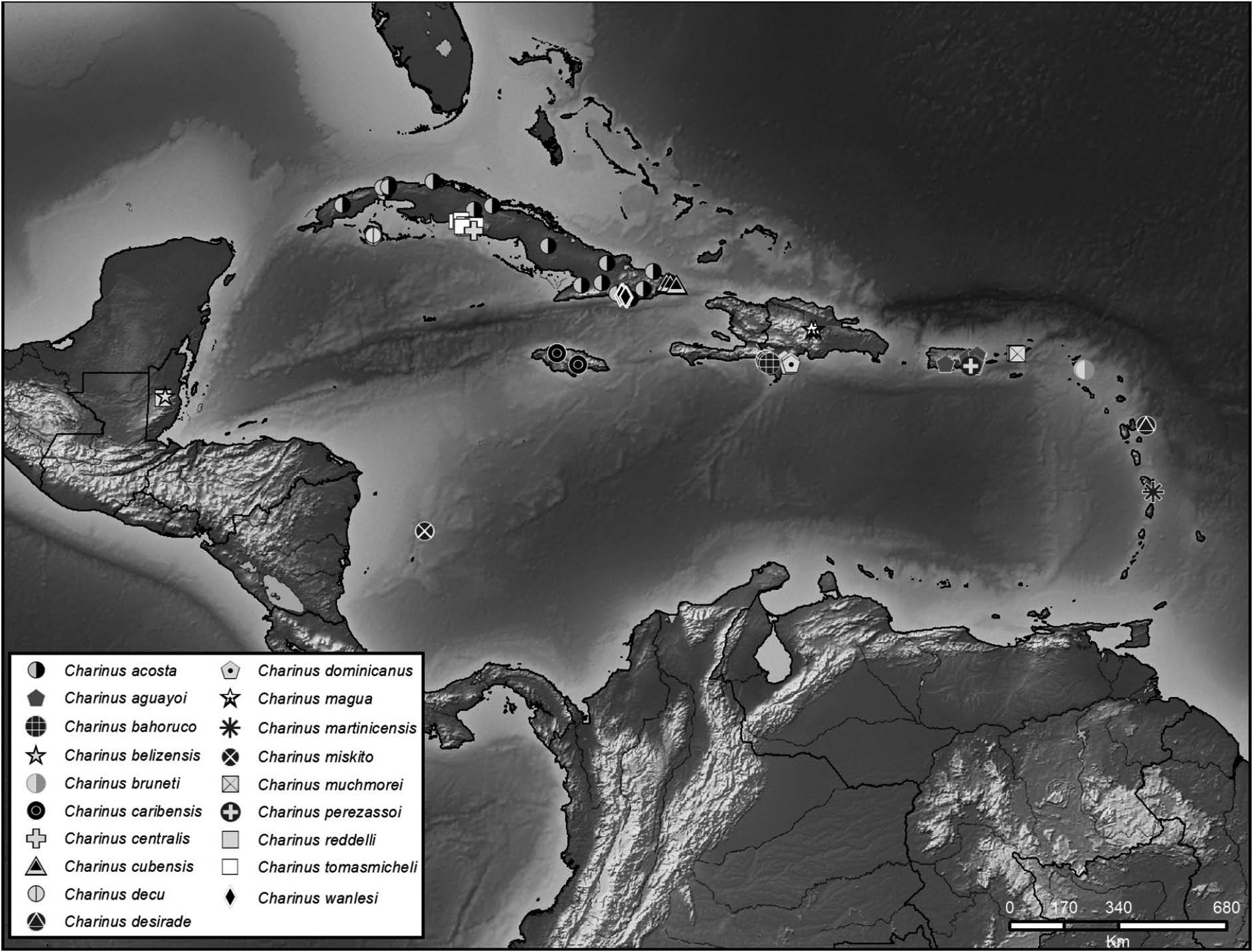
Fig. 12; Table 1
Miranda, Gustavo Silva de, Giupponi, Alessandro P. L., Prendini, Lorenzo, Scharff, Nikolaj (2021): Systematic revision of the pantropical whip spider family Charinidae Quintero, 1986 (Arachnida, Amblypygi). European Journal of Taxonomy 772: 1-409, DOI: 10.5852/ejt.2021.772.1505, URL: http://dx.doi.org/10.5852/ejt.2021.772.1505
Measurements See Table 1.
Miranda, Gustavo Silva de, Giupponi, Alessandro P. L., Prendini, Lorenzo, Scharff, Nikolaj (2021): Systematic revision of the pantropical whip spider family Charinidae Quintero, 1986 (Arachnida, Amblypygi). European Journal of Taxonomy 772: 1-409, DOI: 10.5852/ejt.2021.772.1505, URL: http://dx.doi.org/10.5852/ejt.2021.772.1505
Diagnosis This species may be separated from other Caribbean and Central American Charinus by means of the following combination of characters: carapace frontal process with rounded apex; black median ocular tubercle reduced, sunken in carapace, with well-developed median eyes; lateral eyes well developed, black; bifid tooth of cheliceral basal segment with dorsal cusp shorter than ventral cusp; tritosternum projected anteriorly with meso- and metasternum undivided; prolateral surface of cheliceral basal segment with row of six fine setae; cheliceral claw with five teeth; pedipalp femur with three dorsal spines and three ventral spines; pedipalp femur with pair of setiferous tubercles preceding first dorsal and ventral spines; pedipalp patella with three dorsal spines and two ventral spines; pedipalp tarsus with two dorsal spines, proximal spine less than half length of distal spine; tibia of leg I with 23 articles, tarsus I with 41 articles; first tarsal article 1.4 times as long as second article; leg IV basitibia trichobothrium bc situated equidistant between bf and sbf; sc and sf series each with five trichobothria; female gonopod rounded, flat and cushion-like, without claw-like projection (Quintero 1983: fig. 8 g). The male is unknown.
Miranda, Gustavo Silva de, Giupponi, Alessandro P. L., Prendini, Lorenzo, Scharff, Nikolaj (2021): Systematic revision of the pantropical whip spider family Charinidae Quintero, 1986 (Arachnida, Amblypygi). European Journal of Taxonomy 772: 1-409, DOI: 10.5852/ejt.2021.772.1505, URL: http://dx.doi.org/10.5852/ejt.2021.772.1505
Remarks The internal and external morphology of the Caribbean species of Charinus are quite homogenous, making it difficult to delimit and identify these species (Miranda et al. 2016 b). Separating the Cuban species is among the most difficult, especially when comparing C. acosta and C. cubensis. The only reliable characters to separate the two species are the development of the median eyes and the counts of articles on the tarsus of leg I. Charinus acosta has reduced median eyes and the leg I tarsus consists of 41 articles, whereas C. cubensis lacks median eyes (occasionally visible as small blackish spots below the tegument) and the leg I tarsus consists of 36 – 37 articles. Genetic studies of the different populations of C. acosta and other Cuban species may illuminate the true diversity of the genus on the island.
Miranda, Gustavo Silva de, Giupponi, Alessandro P. L., Prendini, Lorenzo, Scharff, Nikolaj (2021): Systematic revision of the pantropical whip spider family Charinidae Quintero, 1986 (Arachnida, Amblypygi). European Journal of Taxonomy 772: 1-409, DOI: 10.5852/ejt.2021.772.1505, URL: http://dx.doi.org/10.5852/ejt.2021.772.1505
Distribution Widespread in Cuba, recorded at several locations on the island (Teruel & Rodríguez-Cabrera 2016), even in the same habitat as other Charinus, e. g., C. wanlessi, although not at the same time of year (Teruel 2011).
Miranda, Gustavo Silva de, Giupponi, Alessandro P. L., Prendini, Lorenzo, Scharff, Nikolaj (2021): Systematic revision of the pantropical whip spider family Charinidae Quintero, 1986 (Arachnida, Amblypygi). European Journal of Taxonomy 772: 1-409, DOI: 10.5852/ejt.2021.772.1505, URL: http://dx.doi.org/10.5852/ejt.2021.772.1505
Etymology Patronym honoring the Cuban micropaleontologist Dr J. T. Acosta (Quintero 1983).
Miranda, Gustavo Silva de, Giupponi, Alessandro P. L., Prendini, Lorenzo, Scharff, Nikolaj (2021): Systematic revision of the pantropical whip spider family Charinidae Quintero, 1986 (Arachnida, Amblypygi). European Journal of Taxonomy 772: 1-409, DOI: 10.5852/ejt.2021.772.1505, URL: http://dx.doi.org/10.5852/ejt.2021.772.1505
Type material Holotype CUBA • ♀; Camagüey Province, Camagüey; 21 ° 23 ′ 33.26 ″ N, 77 ° 54 ′ 19.05 ″ W; 1954; J. T. Acosta leg.; MCZ [not examined].
Miranda, Gustavo Silva de, Giupponi, Alessandro P. L., Prendini, Lorenzo, Scharff, Nikolaj (2021): Systematic revision of the pantropical whip spider family Charinidae Quintero, 1986 (Arachnida, Amblypygi). European Journal of Taxonomy 772: 1-409, DOI: 10.5852/ejt.2021.772.1505, URL: http://dx.doi.org/10.5852/ejt.2021.772.1505
Export occurrence data
Darwin Core Archive (ZIP)
CLASSIFICATION
Taxonomic Classification Tree

NOMENCLATURE
Synonyms(1)
MULTIMEDIA
Media Files(1)
Fig. 12. Map plotting known distributions of species of Charinus Simon, 1892 in the Caribbean and Central America.
Imageimage/png© Miranda, Gustavo Silva de;Giupponi, Alessandro P. L.;Prendini, Lorenzo;Scharff, NikolajMiranda, Gustavo Silva de;Giupponi, Alessandro P. L.;Prendini, Lorenzo;Scharff, Nikolaj
IMAGES