AnimaliaNot EvaluatedacceptedspeciesAccepted
Charinus aguayoi

Charinus aguayoi

Moya-Guzman, 2009

GBIF:188640202

0year

0

Synonyms

ABOUT

Descriptions(7)

Natural history Found under stones and inside a cave in tropical rainforest. Females may have 4 – 7 eggs or embryos (Armas 2010).
Miranda, Gustavo Silva de, Giupponi, Alessandro P. L., Prendini, Lorenzo, Scharff, Nikolaj (2021): Systematic revision of the pantropical whip spider family Charinidae Quintero, 1986 (Arachnida, Amblypygi). European Journal of Taxonomy 772: 1-409, DOI: 10.5852/ejt.2021.772.1505, URL: http://dx.doi.org/10.5852/ejt.2021.772.1505
Figs 12 – 16; Table 1
Miranda, Gustavo Silva de, Giupponi, Alessandro P. L., Prendini, Lorenzo, Scharff, Nikolaj (2021): Systematic revision of the pantropical whip spider family Charinidae Quintero, 1986 (Arachnida, Amblypygi). European Journal of Taxonomy 772: 1-409, DOI: 10.5852/ejt.2021.772.1505, URL: http://dx.doi.org/10.5852/ejt.2021.772.1505
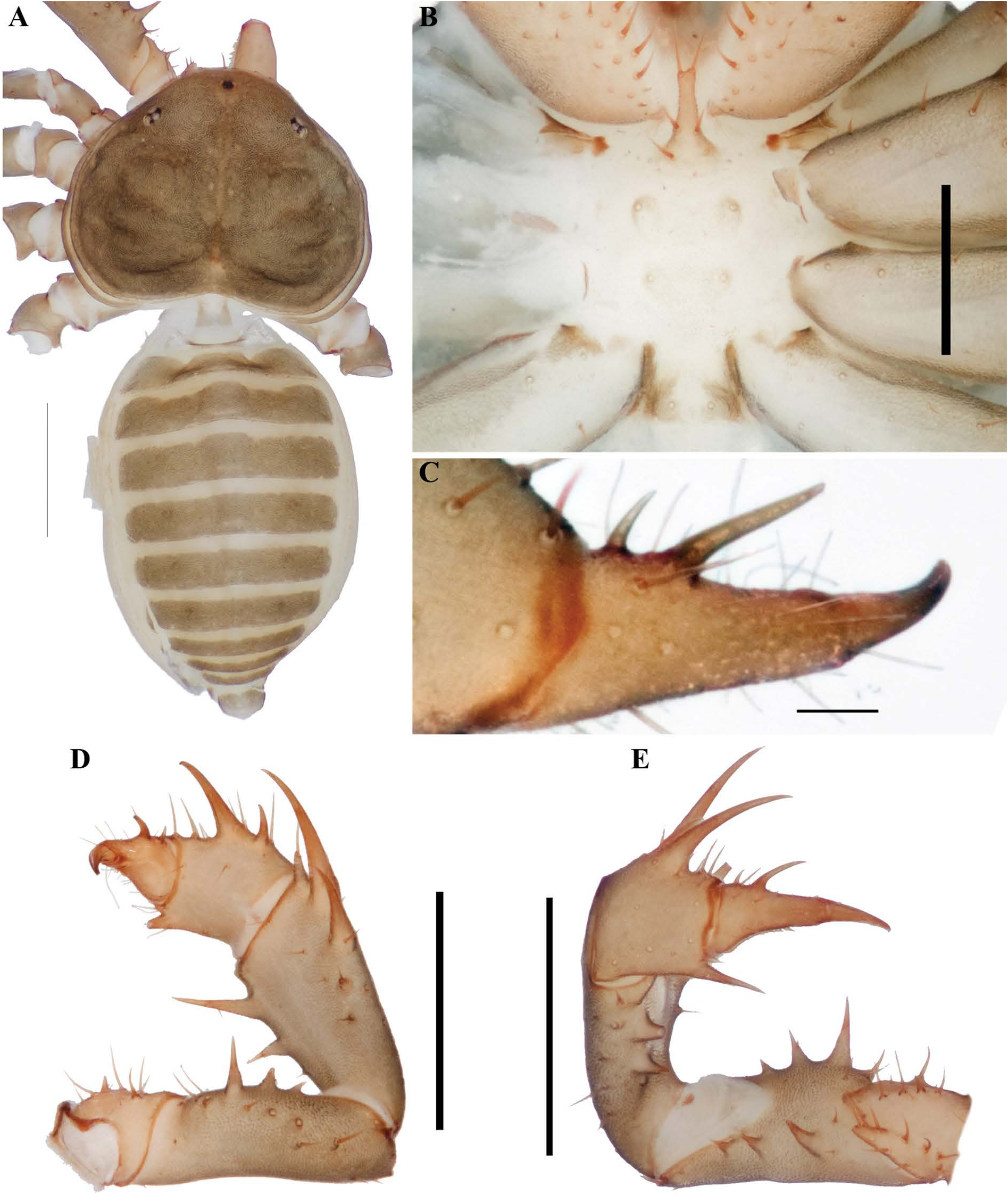
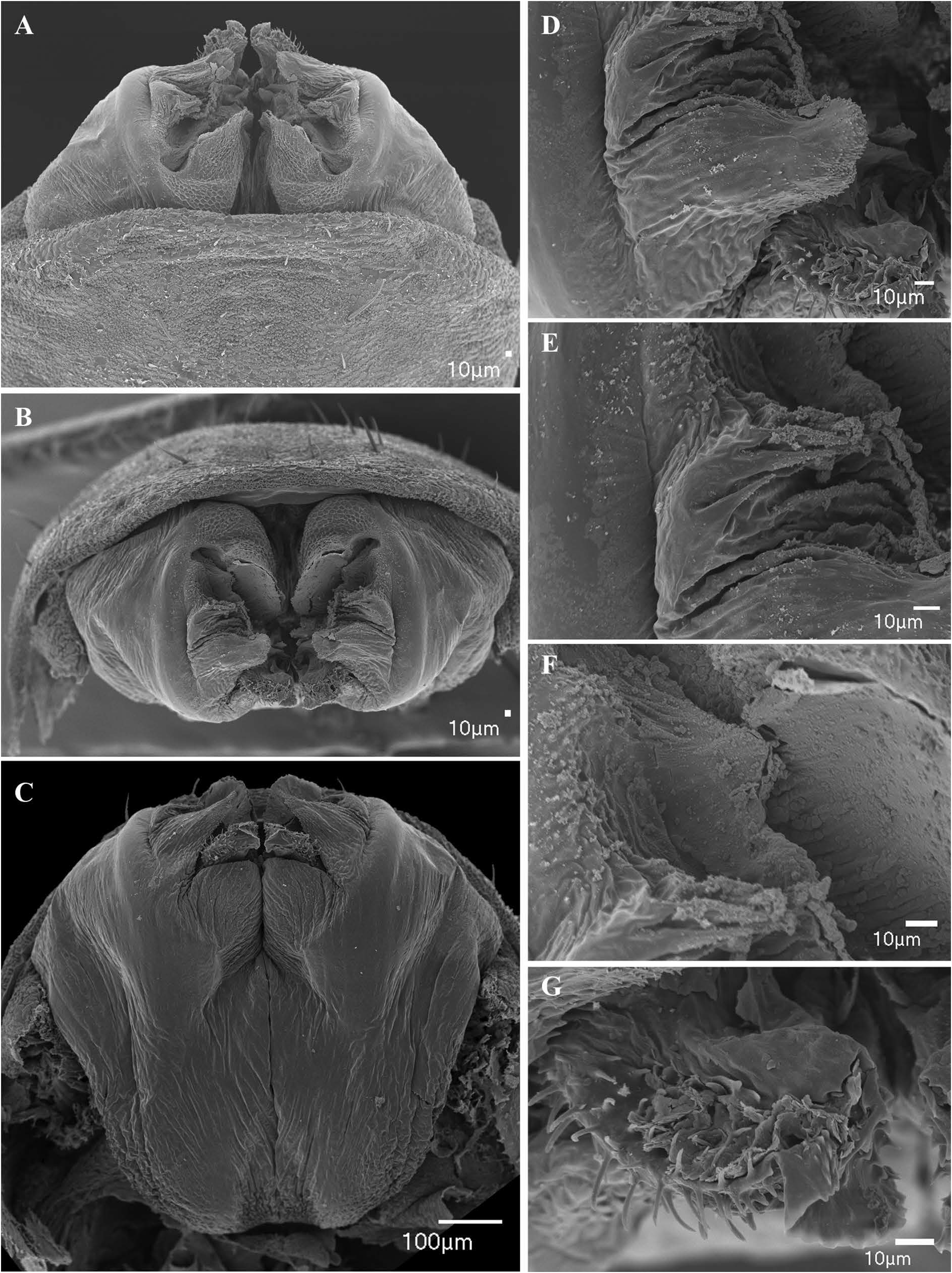
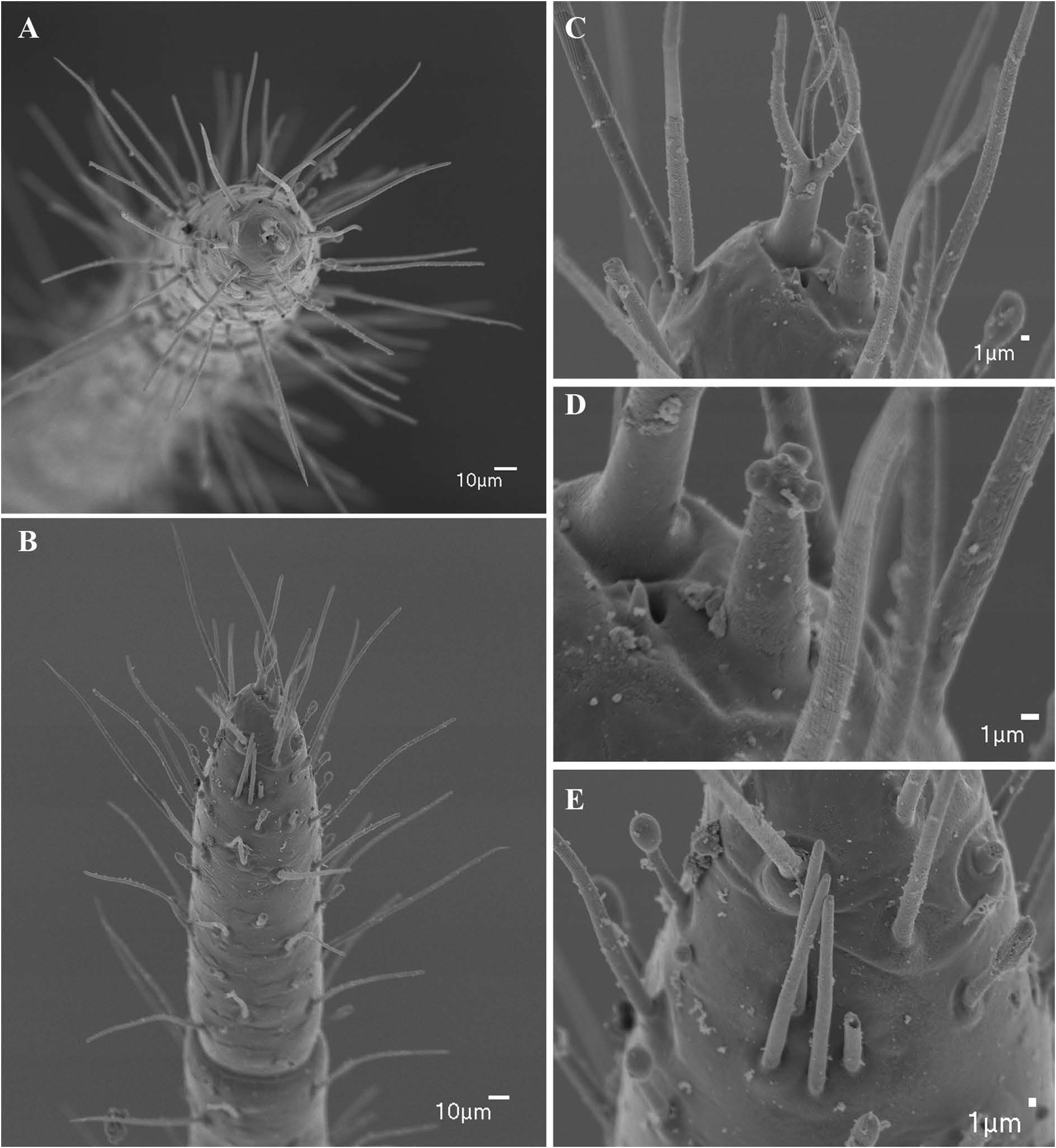
Supplementary description CARAPACE. Six anterior setae (Fig. 13 A); frontal process triangular. Small granules densely scattered between ocular triads and among sulci. Median eyes present but median ocular tubercle shallow (Fig. 13 A); pair of setae on median ocular tubercle; lateral eyes well developed, seta posterior to each lateral ocular triad (Fig. 13 A); lateral ocular triad well separated from carapace margin (Fig. 13 A). STERNUM. Tritosternum projected anteriorly with typical setation, long, surpassing base of pedipalp coxae (Fig. 13 B); other sternal platelets narrow and concave, each divided (forming pairs), with seta on its top; pentasternum with two setae posteriorly and without setae near membranous region. OPISTHOSOMA. Ventral sacs and ventral sac cover absent. GENITALIA. Female genital operculum with large setae posteromedially and some smaller setae near margin (Fig. 14 A – C); posterior margin convex (Fig. 14 A – B, E); gonopod cushion-like with basal sclerotization (Fig. 14 A, C); slit sensilla on lateral side of genital operculum on ventral surface (Fig. 14 F). Male gonopod with apex of fistula and base of lateral lobe strongly sclerotized; lateral lobe 2 fimbriate, short (Fig. 15 A – B, E); lamella medialis short (Fig. 15 A); dorsal lobe with long, acute projections apically (Fig. 15 A – C, G); processus internus short (Fig. 15 F). CHELICERAE. Small tooth slightly projecting from retrolateral surface of basal segment, opposite to bifid tooth; retrolateral surface of claw with small row of setae at base of claw; claw with four or five teeth; row of around ten setae on prolateral surface of basal segment; bifid tooth with dorsal cusp larger than ventral cusp. PEDIPALPS. Coxal dorsal carina with three setae on anterior margin, without setae encircled by round carina. Femur with three dorsal spines and three ventral spines (Fig. 13 D); two prominent setiferous tubercles between dorsal spine 1 and proximal margin; setiferous tubercle between ventral spine 1 and proximal margin. Patella with three dorsal spines in primary series (Fig. 13 E); prominent setiferous tubercle distal to spine I, one-third length of spine I; two ventral spines; distinct setiferous tubercle between spine I and distal margin. Tibia with ventral spine distally and seta between spine and distal margin. Tarsus with two dorsal spines, distal spine long, more than half length of tarsus, proximal spine one-third length of distal spine (Fig. 13 C); cleaning organ with 29 – 33 setae in ventral row. LEGS. Tibia of leg I with 21 articles, tarsus I with 32 – 34 articles; first tarsal article three times as long as second; tarsal organ situated near base of claw (Fig. 16 A, C – D); rod sensilla with four setae in shallow groove (Fig. 16 B, E). Leg IV basitibia with three pseudo-articles, without sclerotized, denticulate margin projecting from apex of articles; trichobothrium bt situated in proximal third of pseudo-article; distitibia trichobothrium bc situated closer to bf than to sbf; sc and sf series each with five trichobothria. Measurements See Table 1.
Miranda, Gustavo Silva de, Giupponi, Alessandro P. L., Prendini, Lorenzo, Scharff, Nikolaj (2021): Systematic revision of the pantropical whip spider family Charinidae Quintero, 1986 (Arachnida, Amblypygi). European Journal of Taxonomy 772: 1-409, DOI: 10.5852/ejt.2021.772.1505, URL: http://dx.doi.org/10.5852/ejt.2021.772.1505
Diagnosis This species may be separated from other Caribbean and Central American Charinus by means of its dark coloration and secondary sexual dimorphism. Among the Caribbean species in which the male is known, C. aguayoi is the only species which exhibits the most distinct secondary sexual dimorphism, i. e., males possess much longer pedipalp segments than females. Compared to other species in which the tibia of leg I consists of 21 – 23 articles and the leg I tarsus consists of 33 articles, C. aguayoi differs from C. dominicanus, C. muchmorei and C. wanlessi in the presence of median eyes (Fig. 13 A). An ontogenetic difference is evident in the size of the median eyes, which are much smaller in adults than immatures.
Miranda, Gustavo Silva de, Giupponi, Alessandro P. L., Prendini, Lorenzo, Scharff, Nikolaj (2021): Systematic revision of the pantropical whip spider family Charinidae Quintero, 1986 (Arachnida, Amblypygi). European Journal of Taxonomy 772: 1-409, DOI: 10.5852/ejt.2021.772.1505, URL: http://dx.doi.org/10.5852/ejt.2021.772.1505
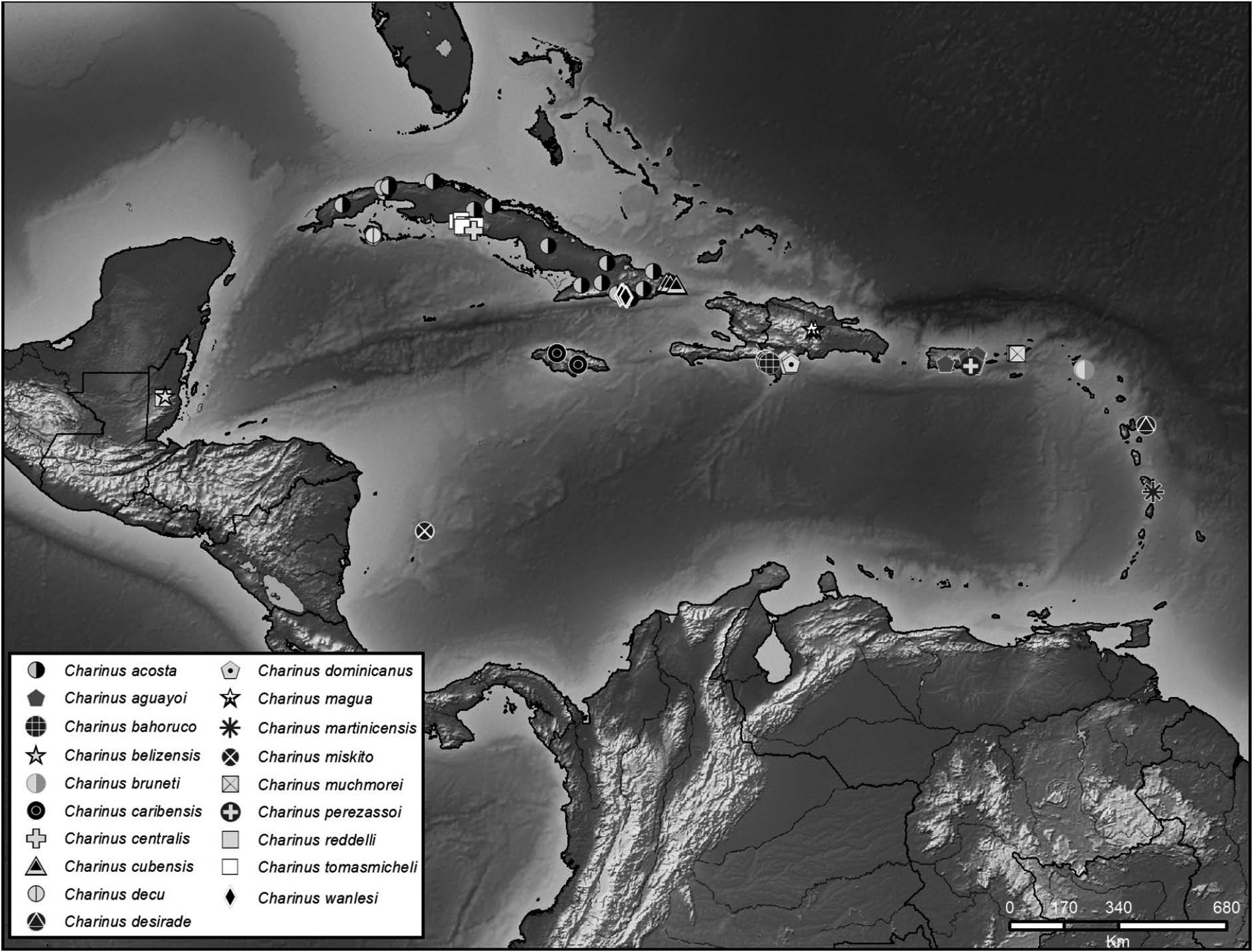
Distribution Distributed across the island of Puerto Rico.
Miranda, Gustavo Silva de, Giupponi, Alessandro P. L., Prendini, Lorenzo, Scharff, Nikolaj (2021): Systematic revision of the pantropical whip spider family Charinidae Quintero, 1986 (Arachnida, Amblypygi). European Journal of Taxonomy 772: 1-409, DOI: 10.5852/ejt.2021.772.1505, URL: http://dx.doi.org/10.5852/ejt.2021.772.1505
Etymology Patronym honoring Dr Carlos Guillermo Aguayo, a Cuban scientist specializing in tropical invertebrates (Moyá-Guzmán 2009).
Miranda, Gustavo Silva de, Giupponi, Alessandro P. L., Prendini, Lorenzo, Scharff, Nikolaj (2021): Systematic revision of the pantropical whip spider family Charinidae Quintero, 1986 (Arachnida, Amblypygi). European Journal of Taxonomy 772: 1-409, DOI: 10.5852/ejt.2021.772.1505, URL: http://dx.doi.org/10.5852/ejt.2021.772.1505
Type material Holotype PUERTO RICO • ♀; Río Grande municipality, 300 m E of El Verde Energy Center Station; 7 Mar. 1999; S. Moyá leg.; tropical rainforest; MEBT [not examined]. Paratypes PUERTO RICO • 3 ♀♀, 3 ♂♂, 2 juv.; same collection data as for holotype; MEBT, EEA [not examined]. Additional material PUERTO RICO • 1 ♀ juv.; Aguas Buenas; 10 Feb. 2012; PRC 059; 012 CAB • 1 ♀; same collection data as for preceding; PRC 060; 013 CAB • 1 ♀; same locality as for preceding; 7 – 17 May 1973; 250 m a. s. l.; S. Peck et al. leg.; forest at Aguas Buenas cave; AMNH • 1 ♀; Route 123, 1.2 mi S of intersection with Route 524, between Utuado and Adjunctas; 18 ° 12.314 ′ N, 66 ° 43.728 ′ W; 15 Oct. 2009; 377 m a. s. l.; L. Prendini, J. Huff, L. Esposito and H. Yamaguti leg.; degraded rainforest scree slope with small stream along roadside; taken under stones; AMCC [LP 10170] • 1 ♂; Bosque Nacional El Verde, El Yunque National Forest; 18 ° 17 ′ 42.09 ″ N, 65 ° 48 ′ 00.34 ″ W; 10 Feb. 2012; USNM ENT 782819 • 1 ♂; Guajonal Yabucoa; 18 ° 03.019 ′ N, 65 ° 52.755 ′ W; 19 Jul. 2012; USNM ENT 782825 • 1 ♀; same collection data as for preceding; USNM ENT 782808 • 1 ♂ juv.; same collection data as for preceding; USNM ENT 783494 • 1 juv.; same collection data as for preceding; USNM ENT 783487 • 1 juv.; same collection data as for preceding; USNM ENT 783483 • 1 ♀; Guajonales Matuyas, Alto Maunabo; 23 Jul. 2012; USNM ENT 785110 • 1 ♂; same collection data as for preceding; USNM ENT 782527 • 1 juv.; same collection data as for preceding; CarBio 2401 A • 1 juv.; same collection data as for preceding; CarBio 541 A • 1 juv.; same locality as for preceding; 10 Feb. 2012; PRC 58; CarBio 2540 A • 1 ♂ juv.; same collection data as for preceding; CarBio 011 CAB • 1 ♀; same locality; 10 Feb. 2012; PRC 057; B 10 AB • 1 ♀; Peñuelas, Cueva Mapancha; 7 Jul. 2012; CarBio • 1 ♂; Rio Grande Rio Yunque, El Verde; 18.321688 ° N, 65.819908 ° W; 16 – 18 Jul. 2011; 100 m. a. s. l.; Agnarsson et al. Team 1 leg.; PR 001; CR-LI / BUR; USNM ENT 392977 • 1 ♂; same collection data as for preceding; USNM ENT 392962 • 1 ♀; same collection data as for preceding; USNM ENT 392752 • 1 ♂; same collection data as for preceding; USNM ENT 392988 • 1 ♀; USNM ENT 00392775 • 1 juv.; same collection data as for preceding; USNM ENT 392904 • 1 juv. ♀; same collection data as for preceding; USNM ENT 392798.
Miranda, Gustavo Silva de, Giupponi, Alessandro P. L., Prendini, Lorenzo, Scharff, Nikolaj (2021): Systematic revision of the pantropical whip spider family Charinidae Quintero, 1986 (Arachnida, Amblypygi). European Journal of Taxonomy 772: 1-409, DOI: 10.5852/ejt.2021.772.1505, URL: http://dx.doi.org/10.5852/ejt.2021.772.1505

Export occurrence data

Darwin Core Archive (ZIP)

CLASSIFICATION

Taxonomic Classification Tree

NOMENCLATURE

Synonyms(1)

MULTIMEDIA

Media Files(5)

Fig. 12. Map plotting known distributions of species of Charinus Simon, 1892 in the Caribbean and Central America.

Imageimage/png© Miranda, Gustavo Silva de;Giupponi, Alessandro P. L.;Prendini, Lorenzo;Scharff, NikolajMiranda, Gustavo Silva de;Giupponi, Alessandro P. L.;Prendini, Lorenzo;Scharff, Nikolaj

Fig. 13. Charinus aguayoi Moyá-Guzman, 2009 (USNM 782825), general morphology, ♂. A. Carapace, dorsal view. B. Sternum, ventral view. C. Pedipalp tarsus, frontal view. D. Pedipalp, dorsal view. E. Pedipalp, ventral view. Scale bars: A, E–F = 1 mm; B = 0.5 mm; C = 0.1 mm.

Imageimage/png© Miranda, Gustavo Silva de;Giupponi, Alessandro P. L.;Prendini, Lorenzo;Scharff, NikolajMiranda, Gustavo Silva de;Giupponi, Alessandro P. L.;Prendini, Lorenzo;Scharff, Nikolaj

Fig. 14. Charinus aguayoi Moyá-Guzman, 2009 (CarBio), female gonopod and genital operculum. A. Gonopod, dorsal view. B. Genital operculum, ventral view. C. Gonopod and genital operculum, posterior view. D. Dextral gonopod, dorsal view. E. Genital operculum between gonopods, dorsal view. F. Gland on genital operculum, ventral view.

Imageimage/png© Miranda, Gustavo Silva de;Giupponi, Alessandro P. L.;Prendini, Lorenzo;Scharff, NikolajMiranda, Gustavo Silva de;Giupponi, Alessandro P. L.;Prendini, Lorenzo;Scharff, Nikolaj

Fig. 15. Charinus aguayoi Moyá-Guzman, 2009 (USNM 392988), male gonopod. A. Ventral view. B. Posterior view. C. Dorsal view. D. Detail of lateral lobe 1. E. Detail of lateral lobe 2. F. Detail of processus internus. G. Detail of apex of dorsal lobe.

Imageimage/png© Miranda, Gustavo Silva de;Giupponi, Alessandro P. L.;Prendini, Lorenzo;Scharff, NikolajMiranda, Gustavo Silva de;Giupponi, Alessandro P. L.;Prendini, Lorenzo;Scharff, Nikolaj

Fig. 16. Charinus aguayoi Moyá-Guzman, 2009 (USNM 785110), antenniform leg I, ♀. A. Apex of distal article. B. Distal segment of tarsus, lateral view. C. Apex of distal article of tarsus showing claw and tarsal organ. D. Detail of tarsal organ. E. Rod sensilla and olfactory setae.

Imageimage/png© Miranda, Gustavo Silva de;Giupponi, Alessandro P. L.;Prendini, Lorenzo;Scharff, NikolajMiranda, Gustavo Silva de;Giupponi, Alessandro P. L.;Prendini, Lorenzo;Scharff, Nikolaj

IMAGES

Gallery(5)

See Gallery

Occurrences with images

Source Information

Systematic revision of the pantropical whip spider family Charinidae Quintero, 1986 (Arachnida, Amblypygi)

checklist

This dataset contains the digitized treatments in Plazi based on the original journal article Miranda, Gustavo Silva de, Giupponi, Alessandro P. L., Prendini, Lorenzo, Scharff, Nikolaj (2021): Systematic revision of the pantropical whip spider family Charinidae Quintero, 1986 (Arachnida, Amblypygi). European Journal of Taxonomy 772: 1-409, DOI: 10.5852/ejt.2021.772.1505, URL: http://dx.doi.org/10.5852/ejt.2021.772.1505

Abstract. The whip spider family Charinidae Quintero, 1986 is the most speciose and widely distributed in the arachnid order Amblypygi Thorell, 1883. It comprises three genera and 95 species distributed across all tropical continents and the eastern Mediterranean. Despite recent advances in the taxonomy of the family, a global revision of all its species, necessary to advance understanding of its systematics, biogeography and evolution, has never been conducted. In the present contribution, the family is revised in its entirety for the first time, including all previous names and 33 new species, 24 in the genus Charinus Simon, 1892: C. alagoanus sp. nov., C. apiaca sp. nov., C. carinae sp. nov., C. carioca sp. nov., C. carvalhoi sp. nov., C. cearensis sp. nov., C. diamantinus sp. nov., C. euclidesi sp. nov., C. goitaca sp. nov., C. guayaquil sp. nov., C. imperialis sp. nov., C. loko sp. nov., C. magalhaesi sp. nov., C. miskito sp. nov., C. mocoa sp. nov., C. monasticus sp. nov., C. palikur sp. nov., C. perquerens sp. nov., C. puri sp. nov., C. renneri sp. nov., C. sooretama sp. nov., C. souzai sp. nov., C. susuwa sp. nov., C. una sp. nov.; eight in the genus Sarax Simon, 1892: S. bilua sp. nov., S. dunni sp. nov., S. gravelyi sp. nov., S. indochinensis sp. nov., S. lembeh sp. nov., S. palau sp. nov., S. rahmadii sp. nov., S. tiomanensis sp. nov.; and one in the genus Weygoldtia Miranda et al., 2018: W. consonensis sp. nov. Taxonomic keys to the 132 species (excluding four nomina dubia) are presented and several taxonomic rearrangements implemented. Four subspecies are elevated to species level: Charinus cavernicolus Weygoldt, 2006, C. elegans Weygoldt, 2006, C. longipes Weygoldt, 2006, and Sarax bispinosus (Nair, 1934). Sarax batuensis Roewer, 1962 is removed from synonymy with Sarax buxtoni (Gravely, 1915) and S. buxtoni newly synonymized with Sarax rimosus (Simon, 1901). Stygophrynus moultoni Gravely, 1915 is transferred to Sarax, resulting in Sarax moultoni (Gravely, 1915) comb. nov. Ten species are transferred from Charinus to Sarax, resulting in new combinations: S. abbatei (Delle Cave, 1986) comb. nov., S. bengalensis (Gravely, 1911) comb. nov., S. dhofarensis (Weygoldt, Pohl & Polak, 2002) comb. nov., S. ioanniticus (Kritscher, 1959) comb. nov., S. israelensis (Miranda et al., 2016) comb. nov., S. omanensis (Delle Cave, Gardner & Weygoldt, 2009) comb. nov., S. pakistanus (Weygoldt, 2005) comb. nov., S. seychellarum (Kraepelin, 1898) comb. nov., S. socotranus (Weygoldt, Pohl & Polak, 2002) comb. nov. and S. stygochthobius (Weygoldt & Van Damme, 2004) comb. nov.

Miranda G S D, Giupponi A P L, Prendini L, Scharff N, felipe (2021). Systematic revision of the pantropical whip spider family Charinidae Quintero, 1986 (Arachnida, Amblypygi). European Journal of Taxonomy. Checklist dataset https://doi.org/10.5852/ejt.2021.772.1505 accessed via GBIF.org on 2026-06-14.

CC0Published 9/24/2021View dataset
GBIF Usage Key
188640202
Dataset Key
b65bb5a9-bbe7-49a4-af44-4b4c03121288
Origin
source
Backbone Key
10896181
Taxon ID
8F431375FF94FFDCA53CFEE7FEADDDE4.taxon
Last Crawled
6/9/2026
Last Interpreted
6/9/2026