
AnimaliaNot EvaluatedacceptedspeciesAccepted
Charinus africanus

Charinus africanus

Hansen, 1921

GBIF:188640231

0year

0

Synonyms

ABOUT

Descriptions(7)

Natural history Found under stones and fallen tree trunks. The courtship behavior of C. africanus was described by Weygoldt (2008).
Miranda, Gustavo Silva de, Giupponi, Alessandro P. L., Prendini, Lorenzo, Scharff, Nikolaj (2021): Systematic revision of the pantropical whip spider family Charinidae Quintero, 1986 (Arachnida, Amblypygi). European Journal of Taxonomy 772: 1-409, DOI: 10.5852/ejt.2021.772.1505, URL: http://dx.doi.org/10.5852/ejt.2021.772.1505
Figs 83 – 88; Table 6
Miranda, Gustavo Silva de, Giupponi, Alessandro P. L., Prendini, Lorenzo, Scharff, Nikolaj (2021): Systematic revision of the pantropical whip spider family Charinidae Quintero, 1986 (Arachnida, Amblypygi). European Journal of Taxonomy 772: 1-409, DOI: 10.5852/ejt.2021.772.1505, URL: http://dx.doi.org/10.5852/ejt.2021.772.1505
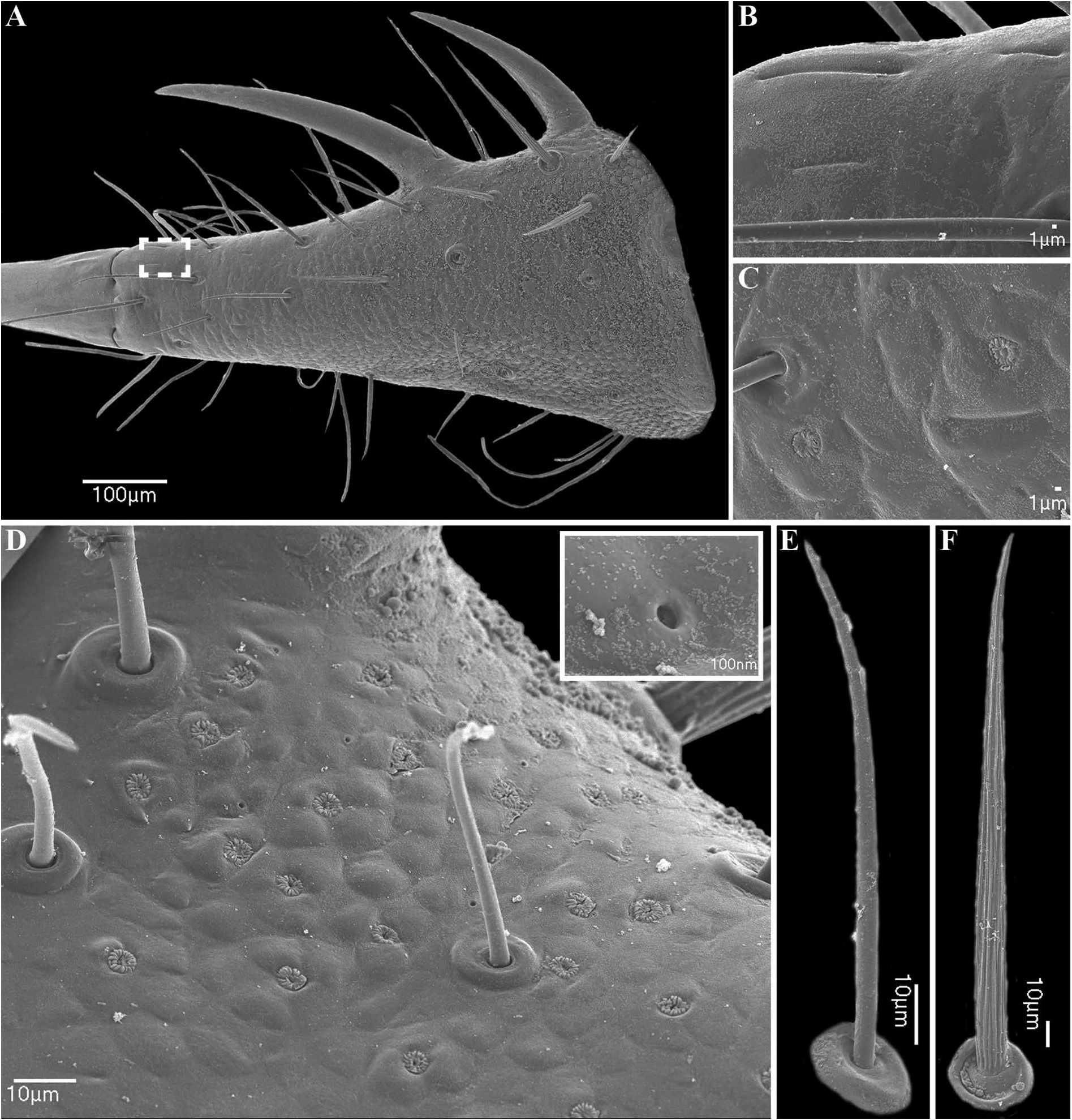
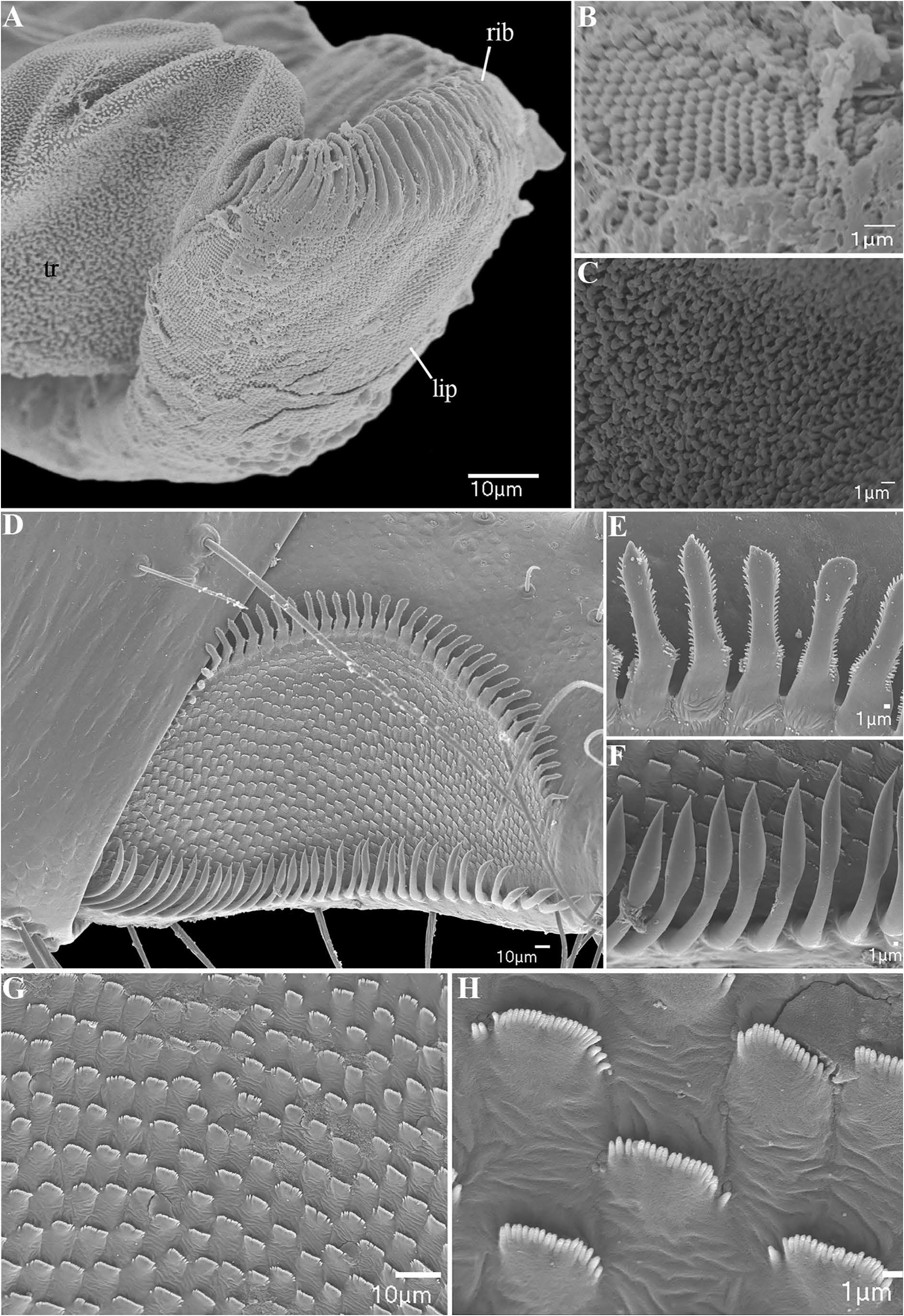
Supplementary description CARAPACE. Median eyes and median ocular tubercle well developed, with pair of setae; lateral eyes well developed, with seta posterior to lateral ocular triad; lateral ocular triad well separated from margin of carapace. STERNUM. Tritosternum projected anteriorly with typical setation; other sternal platelets each forming single small rounded sclerites, with pair of setae anteriorly; pentasternum with four setae anteriorly and without seta in membranous region. CHELICERAE. Small flattened tooth on retrolateral surface of basal segment, opposite to bifid tooth (Fig. 84 A – B); retrolateral surface of claw with small row of setae subdorsally (Fig. 84 C); claw setae with mop-like apex (Fig. 84 I); claw with six teeth (Fig. 84 D); row of thirteen setae on prolateral surface of basal segment; setae on the basal segment serrate from proximal third to apex (Fig. 84 G – H); dorsal setae on basal segment acuminate (Fig. 84 J); bifid tooth on basal segment with dorsal cusp larger than ventral cusp; hinge between basal segment and claw with slit sensilla (Fig. 84 E – F). OPISTHOSOMA. Ventral sacs and ventral sac cover absent. GENITALIA. Female genital operculum with marked transverse ventral flexure and median elongation with prominent setae (Weygoldt 2008: 226, figs 2 c, 3 a); gonopods with two small cones, each terminating in small, narrow, finger-like process (Weygoldt 2008: 227, figs 2 c, 3 b – d); gonopod sclerotized basally, between projections extending to frontal region. Male gonopod with broad sclerotized area on margin of fistula and lateral lobes; gonopod rectangular in dorsal view (Fig. 85 C), with curved median lobes (Figs 85 A – B); LoD and LoL 1 forming shell-like structure with spiny apex (Fig. 85 A – B, F – G); LoL with fimbriate apex (Fig. 85 E); processus internus slightly curved, with spiny apex (Fig. 85 E). Spermatophore minute, scarcely more than 1 mm high; comprising stalk, small foot, and spermatophore head, with two parts: base, bent forward, where structure holding sperm sac is suspended, and apex, bent down; sperm package large, unpaired and held by two thick arm-like processes. PEDIPALPS. Coxal dorsal carina with two or three setae encircled by round carina and four setae on margin. Femur with three or four dorsal spines and four ventral spines; two prominent setae and small setiferous tubercle between dorsal spine 1 and proximal margin. Patella with three dorsal spines and two prominent setiferous tubercles proximal to spine 3; prominent setiferous tubercle distal to spine I, one-third length of spine I; setae on dorsal spines of patella situated on prominent setiferous tubercle; patella with two ventral spines; setiferous tubercle between spine I and distal margin. Tibia with ventral spine distally and three setae between spine and distal margin. Tarsus with two dorsal spines, distal spine curved, long, half length of tarsus, proximal spine half length of distal spine; slit sensillae distally (Fig. 86 A – B); tarsus covered with gland openings (Fig. 86 C – D), and two types of setae, one smooth (Fig. 86 E), other rugose (Fig. 86 F); cleaning organ with 31 – 34 setae in ventral row; dorsal row of modified setae on cleaning organ clavate with serrate margins (Fig. 87 E); ventral row of modified setae on cleaning organ acuminate with smooth margins (Fig. 87 F); surface between dorsal and ventral rows of setae of cleaning organ with multiple projections (Fig. 87 G – H). LEGS. Tibia of leg I with 23 articles (up to 30 on regenerated legs); tarsus I with 41 articles (up to 45 on regenerated legs); first tarsal article 1.7 times as long as second article. Leg IV basitibia with four pseudo-articles; trichobothrium bt situated submedially on pseudo-article; distitibia trichobothrium bc variable in position, closer to bf, equidistant between bf and sbf, or closer to sbf, sc and sf series each with five trichobothria (Fig. 88 B – C). Arolium (Fig. 87 A) with truncus presenting linearly organized microstructures (Fig. 87 B), whereas labium with randomly patterned microstructure (Fig. 87 C). Measurements See Table 6.
Miranda, Gustavo Silva de, Giupponi, Alessandro P. L., Prendini, Lorenzo, Scharff, Nikolaj (2021): Systematic revision of the pantropical whip spider family Charinidae Quintero, 1986 (Arachnida, Amblypygi). European Journal of Taxonomy 772: 1-409, DOI: 10.5852/ejt.2021.772.1505, URL: http://dx.doi.org/10.5852/ejt.2021.772.1505
Diagnosis This species may be separated from C. madagascariensis and other African species of Charinus by means of the following combination of characters: blackish colouration in life; female genital operculum with steep ventral flexure at about two-thirds of its length, covered with many long, prominent setae; posterior margin of genital operculum elongated medially; setae on dorsal spines of pedipalp patella situated on prominent setiferous tubercles. This is the only species of Charinus in which the female gonopod is finger-like. Although the gonopod resembles that of Sarax, the species was placed sister to all other species of Charinus in the phylogeny (Fig. 1). All other morphological characters, as well as its distribution, are consistent with its placement in the genus Charinus.
Miranda, Gustavo Silva de, Giupponi, Alessandro P. L., Prendini, Lorenzo, Scharff, Nikolaj (2021): Systematic revision of the pantropical whip spider family Charinidae Quintero, 1986 (Arachnida, Amblypygi). European Journal of Taxonomy 772: 1-409, DOI: 10.5852/ejt.2021.772.1505, URL: http://dx.doi.org/10.5852/ejt.2021.772.1505
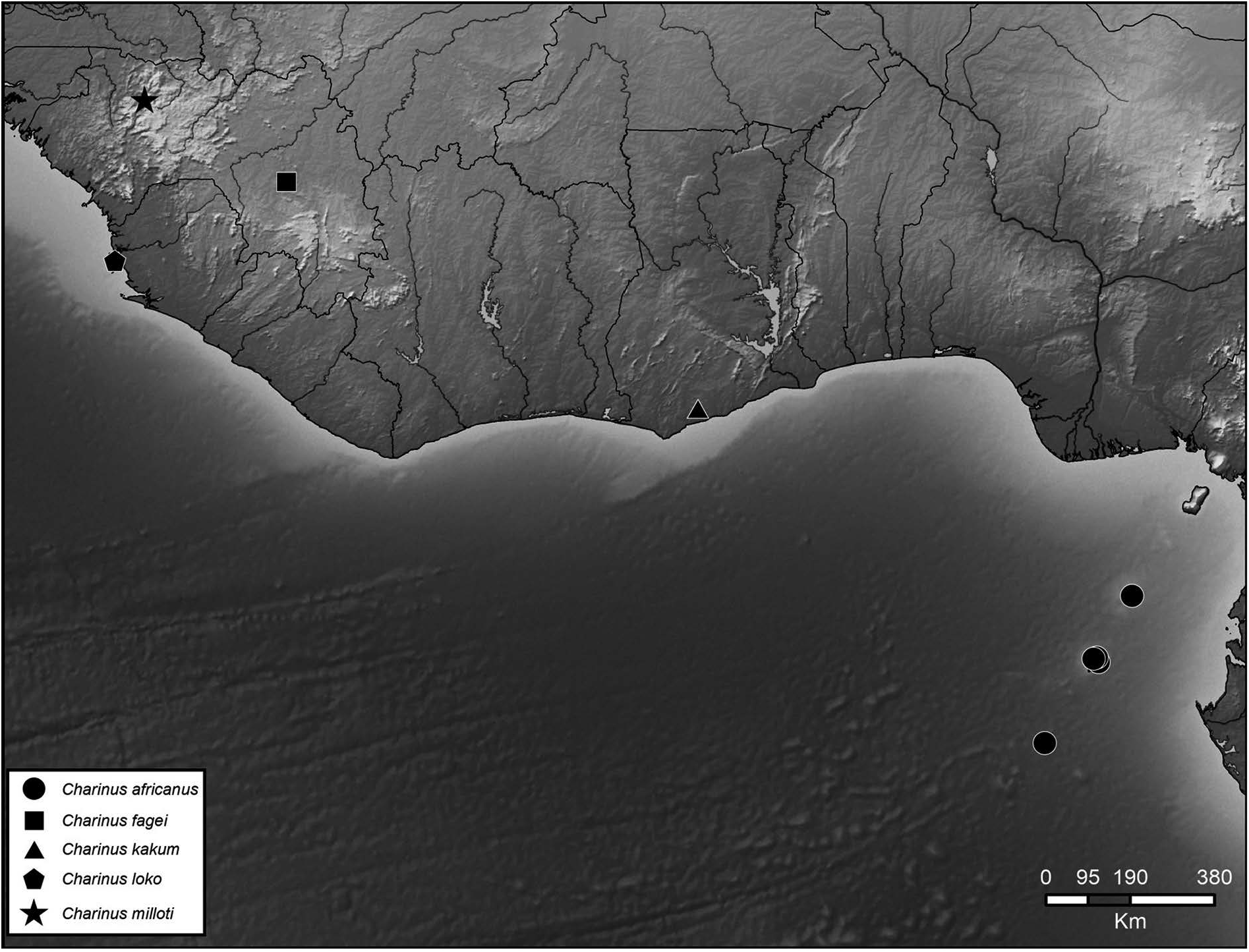
Distribution Known from Equatorial Guinea and São Tomé and Príncipe.
Miranda, Gustavo Silva de, Giupponi, Alessandro P. L., Prendini, Lorenzo, Scharff, Nikolaj (2021): Systematic revision of the pantropical whip spider family Charinidae Quintero, 1986 (Arachnida, Amblypygi). European Journal of Taxonomy 772: 1-409, DOI: 10.5852/ejt.2021.772.1505, URL: http://dx.doi.org/10.5852/ejt.2021.772.1505
Etymology Although unspecified, the species name is evidently an adjective referring to the African continent where the species occurs.
Miranda, Gustavo Silva de, Giupponi, Alessandro P. L., Prendini, Lorenzo, Scharff, Nikolaj (2021): Systematic revision of the pantropical whip spider family Charinidae Quintero, 1986 (Arachnida, Amblypygi). European Journal of Taxonomy 772: 1-409, DOI: 10.5852/ejt.2021.772.1505, URL: http://dx.doi.org/10.5852/ejt.2021.772.1505
Type material Syntypes [four of six specimens mentioned by Hansen (1921) examined, others not located] EQUATORIAL GUINEA • 2 ♀♀; Annobón; [01 ° 24 ′ 59.97 ″ S, 05 ° 37 ′ 59.85 ″ E]; 400 – 500 m a. s. l.; May 1902; L. Fea leg.; ZMUC 24552 • 1 ♂, 1 ex. missing opisthosoma; same collection data as for preceding; MNHN] • [specimen mentioned by Hansen (1921) not located]; same locality as for preceding; Apr. 1902; 0 – 500 m a. s. l.; L. Fea leg. SÃO TOMÉ AND PRÍNCIPE • 1 ♂ [one of three specimens mentioned by Hansen (1921), others not located]; St Thome Agua Izé; [00 ° 13 ′ 05.76 ″ N, 06 ° 43 ′ 37.79 ″ E]; 400 – 700 m a. s. l.; Dec. 1900; L. Fea leg.; MNHN [examined] • [Hansen (1921) mentions two specimens, but vial contains 3 ♀♀]; St Thome, Visto Alegre [as Vista Alegre]; [00 ° 18 ′ 42.96 ″ N, 06 ° 41 ′ 04.60 ″ E]; 200 – 300 m a. s. l.; Sep. – Oct. 1900; ZMUC 24545 • 7 ex. [not located]; Príncipe, Roca Infante Don Henrique; [01 ° 33 ′ 57.52 ″ N, 07 ° 24 ′ 17.31 ″ E]; Jan. – Mar. 1901; 100 – 300 m a. s. l. [not examined]. Additional material SÃO TOMÉ • 2 ♀♀, 2 ♂♂; near São Nicolao Waterfall; [00 ° 17 ′ 08.22 ″ N, 06 ° 37 ′ 31.27 ″ E]; ca 800 m a. s. l.; 8 – 16 Oct. 2006; S. and P. Weygoldt leg.; under stones and wood; AMCC [LP 6943].
Miranda, Gustavo Silva de, Giupponi, Alessandro P. L., Prendini, Lorenzo, Scharff, Nikolaj (2021): Systematic revision of the pantropical whip spider family Charinidae Quintero, 1986 (Arachnida, Amblypygi). European Journal of Taxonomy 772: 1-409, DOI: 10.5852/ejt.2021.772.1505, URL: http://dx.doi.org/10.5852/ejt.2021.772.1505

Export occurrence data

Darwin Core Archive (ZIP)

CLASSIFICATION

Taxonomic Classification Tree

MULTIMEDIA

Media Files(7)

Fig. 1. Phylogeny of the whip spider family Charinidae Quintero, 1986 with proposed group names for major clades, based on Miranda et al. (2021). Bootstrap values above clades.
Imageimage/png© Miranda, Gustavo Silva de;Giupponi, Alessandro P. L.;Prendini, Lorenzo;Scharff, NikolajMiranda, Gustavo Silva de;Giupponi, Alessandro P. L.;Prendini, Lorenzo;Scharff, Nikolaj

Fig. 83. Map plotting known distributions of species of Charinus Simon, 1892 in western Africa.

Imageimage/png© Miranda, Gustavo Silva de;Giupponi, Alessandro P. L.;Prendini, Lorenzo;Scharff, NikolajMiranda, Gustavo Silva de;Giupponi, Alessandro P. L.;Prendini, Lorenzo;Scharff, Nikolaj

Fig. 84. Charinus africanus Hansen, 1921 (AMCC [LP 6943]), chelicera, ♀. A. Prolateral view. B. Retrolateral projection, opposite to bifid tooth. C. Setal row on cheliceral claw. D. Cheliceral claw teeth. E. Position of gland on joint between basal segment and cheliceral claw. F. Gland. G. Seta on cheliceral basal segment. H. Apex of basal segment seta. I. Seta on cheliceral claw. J. Setae on dorsal surface of cheliceral basal segment.

Imageimage/png© Miranda, Gustavo Silva de;Giupponi, Alessandro P. L.;Prendini, Lorenzo;Scharff, NikolajMiranda, Gustavo Silva de;Giupponi, Alessandro P. L.;Prendini, Lorenzo;Scharff, Nikolaj

Fig. 85. Charinus africanus Hansen, 1921 (AMCC [LP 6943]), male gonopod. A. Ventral view. B. Posterior view. C. Dorsal view. D. Lamina medialis. E. Lateral lobe 2. F. Junction between dorsal lobe and lateral lobe 1. G. As F, frontal view.
Imageimage/png© Miranda, Gustavo Silva de;Giupponi, Alessandro P. L.;Prendini, Lorenzo;Scharff, NikolajMiranda, Gustavo Silva de;Giupponi, Alessandro P. L.;Prendini, Lorenzo;Scharff, Nikolaj

Fig. 86. Charinus africanus Hansen, 1921 (AMCC [LP 6943]), pedipalp tarsus, ♀. A. Tarsus. B. Slit sense organs on tarsus. C. Gland openings on tarsus. D. Multiple gland openings on tarsus. E. Type I setae on tarsus. F. Type II setae on tarsus.
Imageimage/png© Miranda, Gustavo Silva de;Giupponi, Alessandro P. L.;Prendini, Lorenzo;Scharff, NikolajMiranda, Gustavo Silva de;Giupponi, Alessandro P. L.;Prendini, Lorenzo;Scharff, Nikolaj

Fig. 87. Charinus africanus Hansen, 1921 (AMCC [LP 6943]), leg IV arolium and pedipalp cleaning brush, ♀. A. Truncus, lip and ribs of arolium, lateral view. B. Aroliar truncus.C. Aroliar lip.D. Cleaning brush of pedipalp tarsus. E. Dorsal row of setae. F. Ventral row of setae. G. Surface between setal rows. H. Small projections on surface between setal rows of cleaning brush on pedipalp tarsus. Abbreviations: lip = distal aroliar lip; rib = ribs of aroliar lip; tr = truncus.

Imageimage/png© Miranda, Gustavo Silva de;Giupponi, Alessandro P. L.;Prendini, Lorenzo;Scharff, NikolajMiranda, Gustavo Silva de;Giupponi, Alessandro P. L.;Prendini, Lorenzo;Scharff, Nikolaj

IMAGES

Gallery(7)

See Gallery

Occurrences with images

Source Information

Systematic revision of the pantropical whip spider family Charinidae Quintero, 1986 (Arachnida, Amblypygi)

checklist

This dataset contains the digitized treatments in Plazi based on the original journal article Miranda, Gustavo Silva de, Giupponi, Alessandro P. L., Prendini, Lorenzo, Scharff, Nikolaj (2021): Systematic revision of the pantropical whip spider family Charinidae Quintero, 1986 (Arachnida, Amblypygi). European Journal of Taxonomy 772: 1-409, DOI: 10.5852/ejt.2021.772.1505, URL: http://dx.doi.org/10.5852/ejt.2021.772.1505

Abstract. The whip spider family Charinidae Quintero, 1986 is the most speciose and widely distributed in the arachnid order Amblypygi Thorell, 1883. It comprises three genera and 95 species distributed across all tropical continents and the eastern Mediterranean. Despite recent advances in the taxonomy of the family, a global revision of all its species, necessary to advance understanding of its systematics, biogeography and evolution, has never been conducted. In the present contribution, the family is revised in its entirety for the first time, including all previous names and 33 new species, 24 in the genus Charinus Simon, 1892: C. alagoanus sp. nov., C. apiaca sp. nov., C. carinae sp. nov., C. carioca sp. nov., C. carvalhoi sp. nov., C. cearensis sp. nov., C. diamantinus sp. nov., C. euclidesi sp. nov., C. goitaca sp. nov., C. guayaquil sp. nov., C. imperialis sp. nov., C. loko sp. nov., C. magalhaesi sp. nov., C. miskito sp. nov., C. mocoa sp. nov., C. monasticus sp. nov., C. palikur sp. nov., C. perquerens sp. nov., C. puri sp. nov., C. renneri sp. nov., C. sooretama sp. nov., C. souzai sp. nov., C. susuwa sp. nov., C. una sp. nov.; eight in the genus Sarax Simon, 1892: S. bilua sp. nov., S. dunni sp. nov., S. gravelyi sp. nov., S. indochinensis sp. nov., S. lembeh sp. nov., S. palau sp. nov., S. rahmadii sp. nov., S. tiomanensis sp. nov.; and one in the genus Weygoldtia Miranda et al., 2018: W. consonensis sp. nov. Taxonomic keys to the 132 species (excluding four nomina dubia) are presented and several taxonomic rearrangements implemented. Four subspecies are elevated to species level: Charinus cavernicolus Weygoldt, 2006, C. elegans Weygoldt, 2006, C. longipes Weygoldt, 2006, and Sarax bispinosus (Nair, 1934). Sarax batuensis Roewer, 1962 is removed from synonymy with Sarax buxtoni (Gravely, 1915) and S. buxtoni newly synonymized with Sarax rimosus (Simon, 1901). Stygophrynus moultoni Gravely, 1915 is transferred to Sarax, resulting in Sarax moultoni (Gravely, 1915) comb. nov. Ten species are transferred from Charinus to Sarax, resulting in new combinations: S. abbatei (Delle Cave, 1986) comb. nov., S. bengalensis (Gravely, 1911) comb. nov., S. dhofarensis (Weygoldt, Pohl & Polak, 2002) comb. nov., S. ioanniticus (Kritscher, 1959) comb. nov., S. israelensis (Miranda et al., 2016) comb. nov., S. omanensis (Delle Cave, Gardner & Weygoldt, 2009) comb. nov., S. pakistanus (Weygoldt, 2005) comb. nov., S. seychellarum (Kraepelin, 1898) comb. nov., S. socotranus (Weygoldt, Pohl & Polak, 2002) comb. nov. and S. stygochthobius (Weygoldt & Van Damme, 2004) comb. nov.

Miranda G S D, Giupponi A P L, Prendini L, Scharff N, felipe (2021). Systematic revision of the pantropical whip spider family Charinidae Quintero, 1986 (Arachnida, Amblypygi). European Journal of Taxonomy. Checklist dataset https://doi.org/10.5852/ejt.2021.772.1505 accessed via GBIF.org on 2026-06-15.

CC0Published 9/24/2021View dataset
GBIF Usage Key
188640231
Dataset Key
b65bb5a9-bbe7-49a4-af44-4b4c03121288
Origin
source
Backbone Key
2181458
Taxon ID
8F431375FF09FF40A55DFEE7FE4DDD79.taxon
Last Crawled
6/9/2026
Last Interpreted
6/9/2026