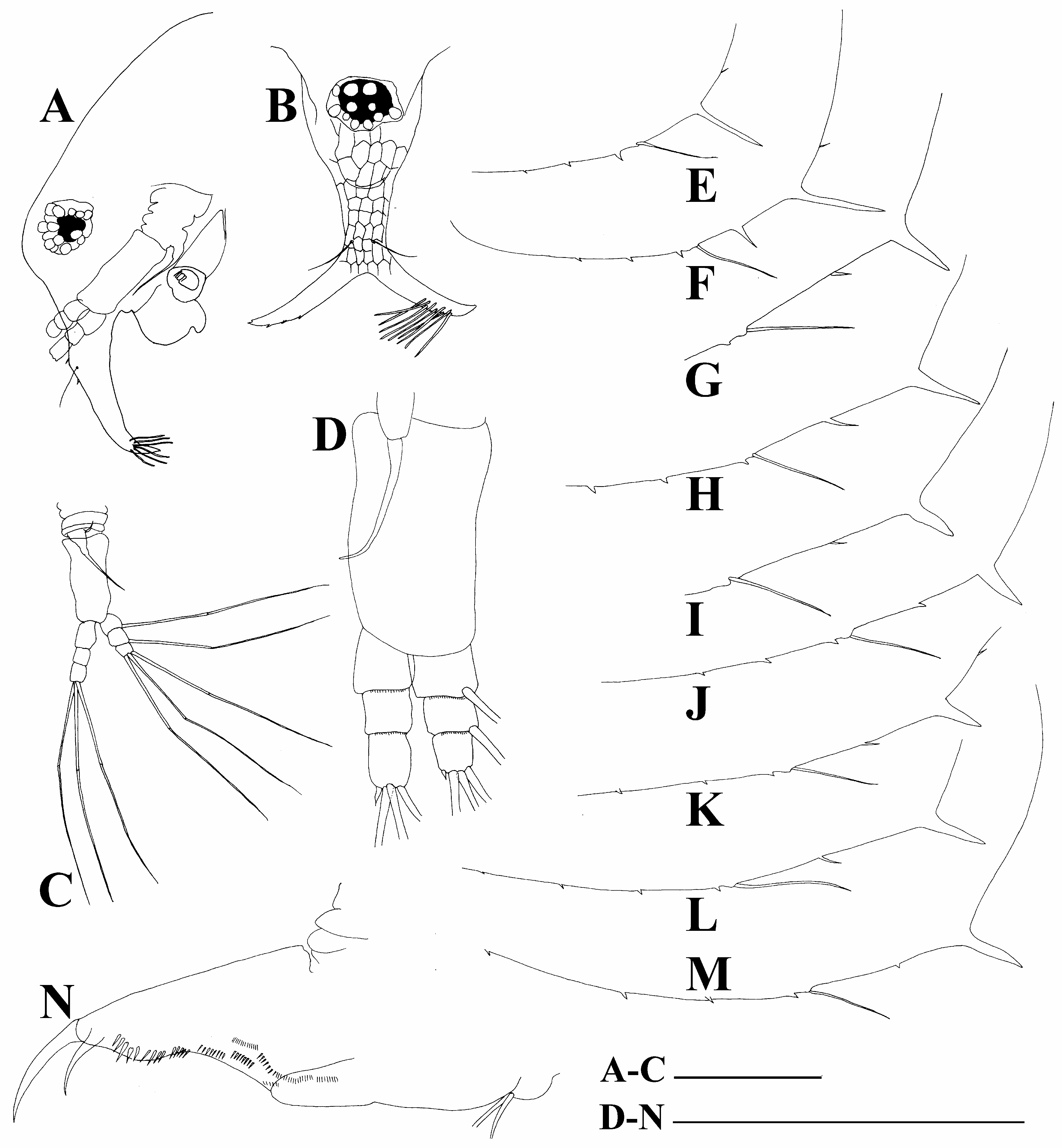
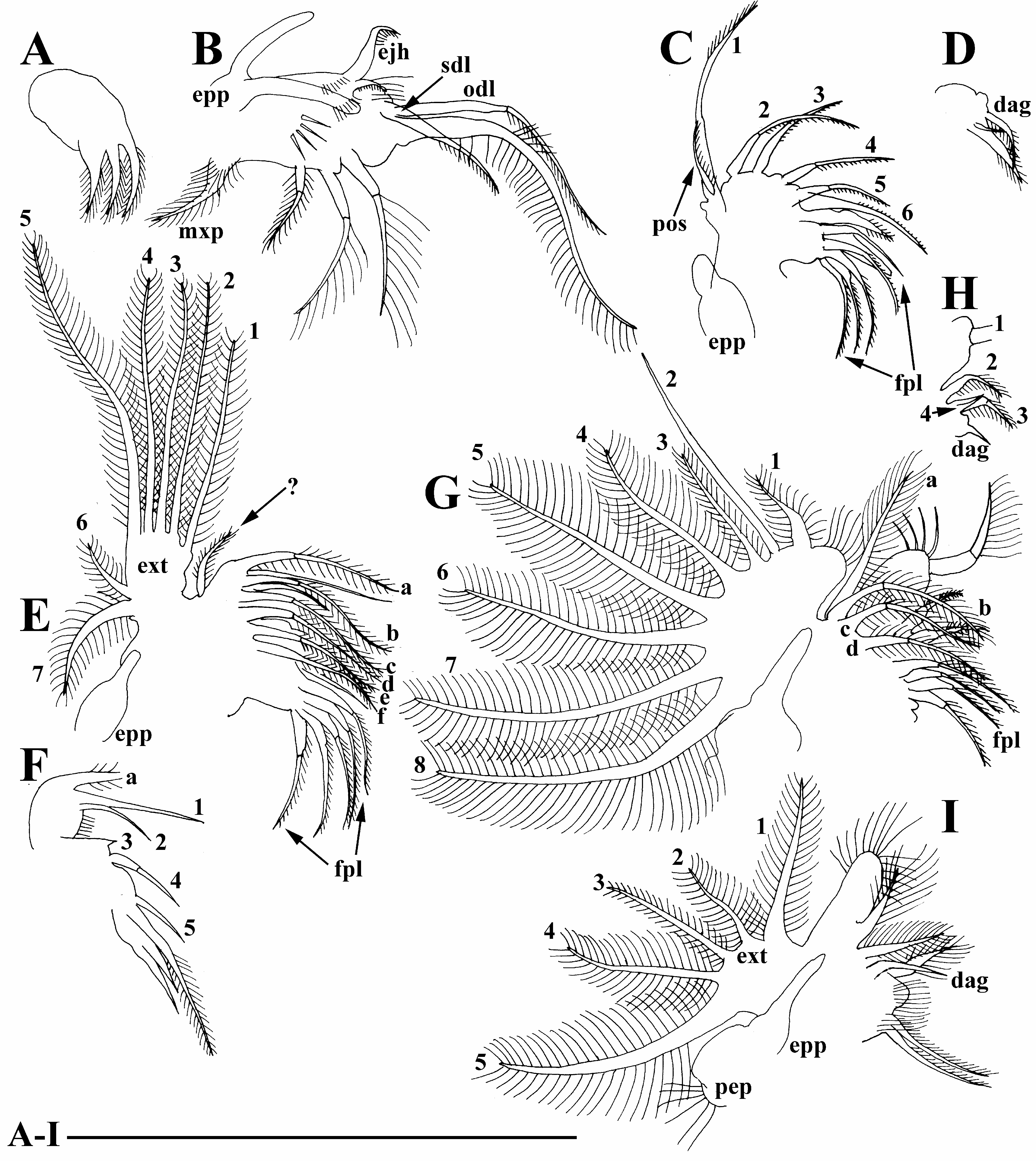
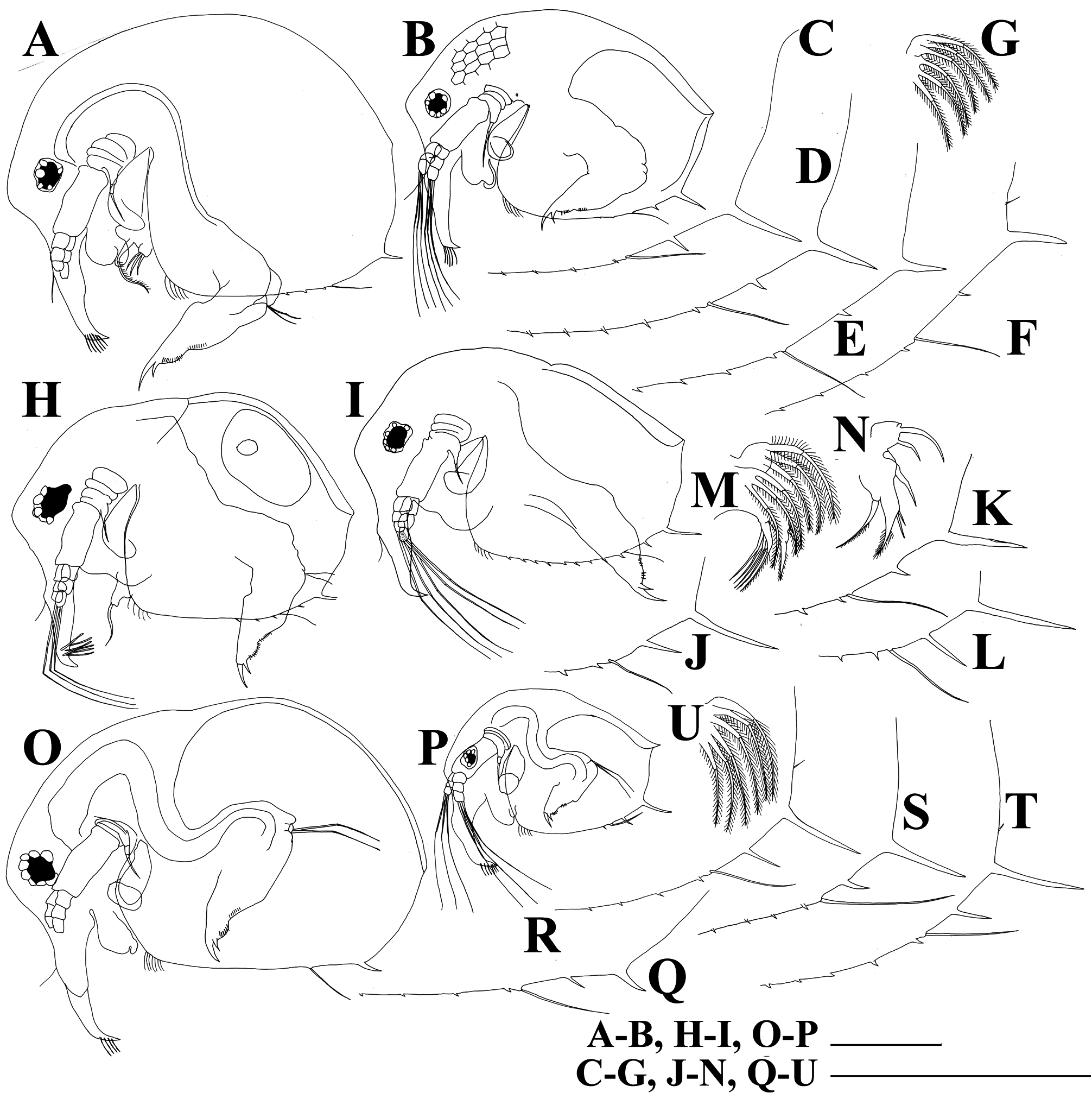
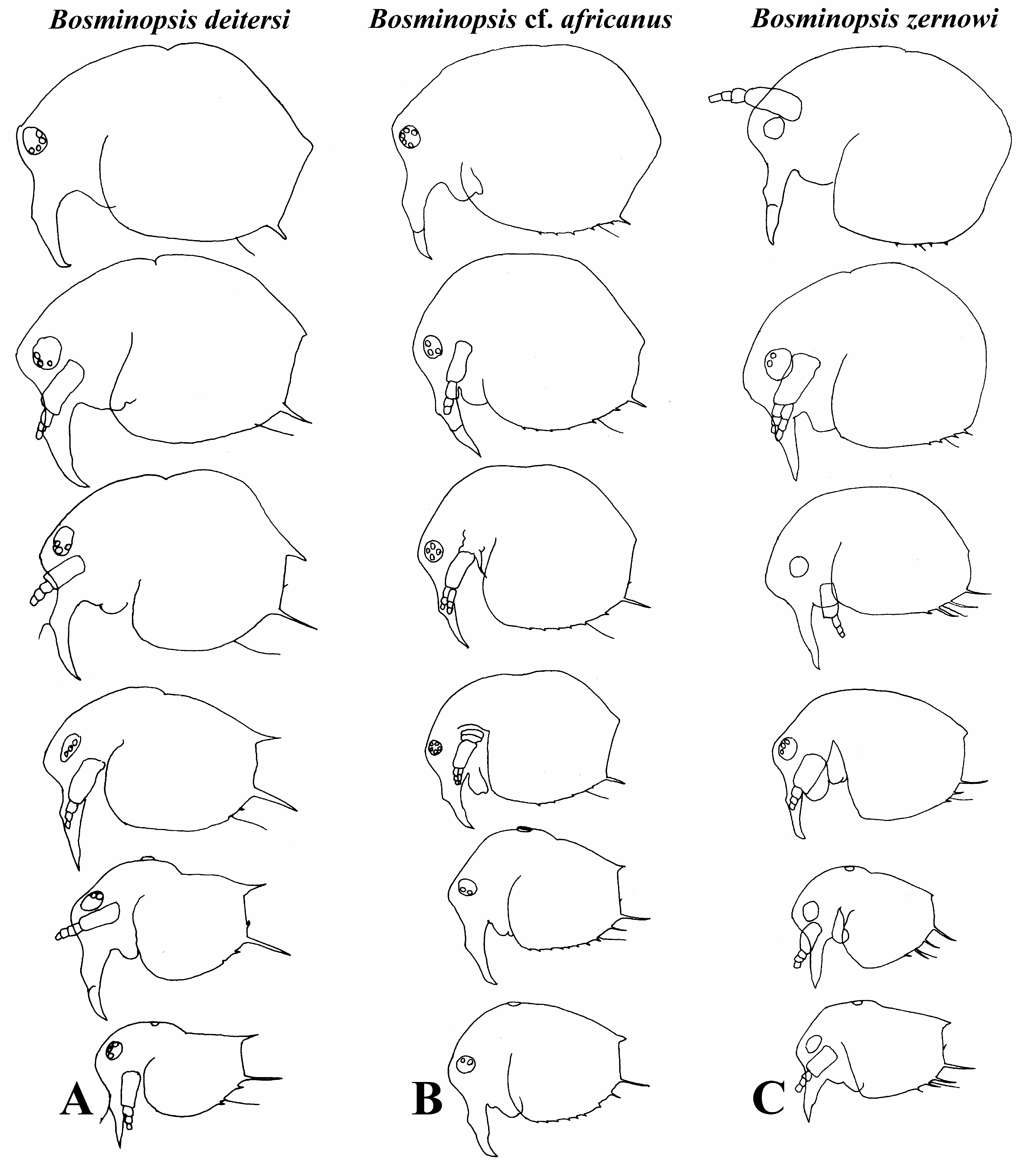
Redescription based on the specimens from Thailand. Parthenogenetic female. Body in lateral view subovoid, depression between head and valves absent (Figs. 2 A, B). Dorsal margin regularly convex, postero-dorsal and postero-ventral angles rounded in old adults (Fig. 2 A), but expressed in smaller adults (Fig. 2 B) and juveniles (Fig. 2 C). Ventral margin from slightly convex to almost straight; anterior margin of valves slightly convex. Head relatively large, with a low ocular dome, reticulation maximally expressed on its anterior face (Fig. 2 B). Compound eye of moderate size, ocellus absent. Lateral and dorsal head pores absent. Labrum with fleshy and round main body (Fig. 2 A). Valve subovoid. Antero-ventral portion of valves with a series of setae (Fig. 2 A). Ventral margin slightly convex, with a series of small spinules and a long seta. Postero-ventral angle of valves with a single short mucro and sometimes with one additional relatively long spinule (Figs. 3 G – M). Antennae I in their proximal portions fused together and with rostrum (Fig. 3 A); lateral portions directed downwards and slightly curved (Fig. 3 B). Fused portion of antennae I with two antennular sensory setae. Distal portion of each antenna I with nine aesthetascs. Antenna II coxal portion bearing a single long seta and a single minute seta on a conical elevation. Both exopod and endopod short, consisting of three segments. Antennal formula: setae 0 - 0 - 3 / 1 - 1 - 3; spines 0 - 0 - 1 / 0 - 0 - 1 (Figs. 3 C, D). All antenna II setae equal in size (Fig. 3 C). Maxilla as a small lobe with three setulated setae (Fig. 4 A). Limb I large, epipodite with two long finger-like projections (Fig. 4 B, epp). Outer distal lobe (Fig. 4 B, odl) with two long setae covered by setules. Inner subdistal lobe (in terms of Kotov, 1997 a) bearing only a single setulated seta (Fig. 4 B, sdl). Inner portion of limb corm with three soft setae, two equal in size and third one short; a bunch of long spinules on limb corm. Two ejector hooks different in size, robust, armed with small denticles (Fig. 4 B, ejh). Maxillar process (Fig. 4 B, mxp) bearing a single setulated seta. Limb II small, epipodite with a single short finger-like projection (Fig. 4 C, epp). Inner portion with six anterior setae (1 – 6) and two posterior setae (Fig. 4 C, pos). Distal armature of gnatobase with three setae of different size (Fig. 4 D, dag), filter plate with five setulated setae (Fig. 4 C, fpl). Limb III epipodite with a single finger-like projection (Fig. 4 E, epp); exopodite rectangular (Fig. 4 E, ext), bearing seven (two lateral and five distal) setae (Fig. 4 E, 1 – 7). Inner-distal portion with three anterior seta, seta 1 long, seta 2 shorter than seta 1 and seta 3 very small (Fig. 4 F, 1 – 3). Proximal endite with two anterior setae of same size (Fig. 4 F, 4 – 5). Posterior face of limb with six long soft setae (Fig 4 E, a – f) plus a seta of unclear homology (?). Distal armature of gnatobase with three setae (Fig. 4 F). Filter plate with five setae of similar size (Fig. 4 E: fpl). Limb IV epipodite supplied with a long finger-like projection. Exopodite semicircular, with eight long soft setae (Fig. 4 G, 1 – 8), seta 2 with very short setulation; inner distal portion with four anterior setae (Fig. 4 H, 1 – 4); distal most setae extra thick; posterior portion with four soft setae (Fig. 4 G, a – d). Distal armature of gnathobase reduced (Fig. 4 H, dag), filter plate with four setae of similar size (Fig. 4 G, fpl). Limb V with a small, ovoid preepipodite (Fig. 4 I, pep) and epipodite with a long finger-like projection (Fig. 4 I, epp). Exopodite (ext) ovoid, with five soft setae (1 – 5) covered by long setules. Inner distal portion of limb as a densely setulated flat lobe bearing two soft setae. Distal armature of gnathobase (Fig. 4 I, dag) with two setae, filter plate with two long setae. Postabdomen compressed laterally, slightly narrow distally, without an especial inflated basis of postabdominal setae (Fig. 3 N), which are shorter than postabdomen (Fig. 2 A). Ventral margin straight. Preanal margin almost straight or slightly concave, without setules. Preanal angle expressed. Anal margin curved and postanal margin convex; both margins with series of a small spines. Postabdominal claw regularly curved, its basal spine long (about 2 / 3 of postabdominal claw length, or longer). Juvenile female. Body with lower posterior portion, head relatively high. Dorsal head pore present only in instar I (Fig. 6). Postero-ventral margin of carapace with a single long mucro-like spine and a single long spinule (Figs. 3 E, F). Ephippial female. Most of the body similar to parthenogenetic female, but dorsal portion of valves modified into ephippium (Figs. 2 D, F). Ephippium ovoid, sculptured with large polygons, with strong medial keel and paired lateral keels (Figs. 2 E, F). Ephippial chamber with a single egg. Adult male. Unfortunately, only a single slide was available making impossible a detailed description. Body elongated, dorsal contour of head humped, dorsal contour of carapace almost straight, a slight depression between head and carapace. Head large, with specially large eye; ocular dam expressed; rostrum smooth (Fig. 2 G). Valve armed as in female; postabdomen similar to that of the female. Antenna I free in proximal portion; frontal seta long, located in middle of antenna I body. Antenna II with a long (as long as endopod), curved additional male seta on endopod apical segment. Limb with a well-developed copulatory hook. Size. Parthenogenetic female 0.19 – 0.4 mm; ephippial female 0.30 – 0.32 mm; male 0.25 mm. Variability. We have compared populations from Thailand with other populations from different regions. All studied populations from Laos, India and Vietnam have same features as populations from Thailand (Fig. 5 A – U). Juvenile stages with a single long mucro or mucro plus an additional relatively long spine on postero-ventral portion of valves; posterior portion of limb III with six soft setae.
Garibian, Petr G., Sanoamuang, La-Orsri, Kotov, Alexey A. (2021): On the taxonomic status of Oriental populations of the genus Bosminopsis Richard 1895 (Crustacea: Cladocera). Zootaxa 5052 (2): 261-279, DOI: 10.11646/zootaxa.5052.2.6