AnimaliaNot EvaluatedacceptedspeciesAccepted
Actinopus apiacas

Actinopus apiacas

GBIF:190123784

ABOUT

Descriptions(6)

Figs 199 – 201, Map 13
Miglio, Laura Tavares, Pérez-Miles, Fernando, Bonaldo, Alexandre B. (2020): Taxonomic Revision of the Spider Genus Actinopus Perty, 1833 (Araneae, Mygalomorphae, Actinopodidae). Megataxa 2 (1): 1-256, DOI: 10.11646/megataxa.2.1.1
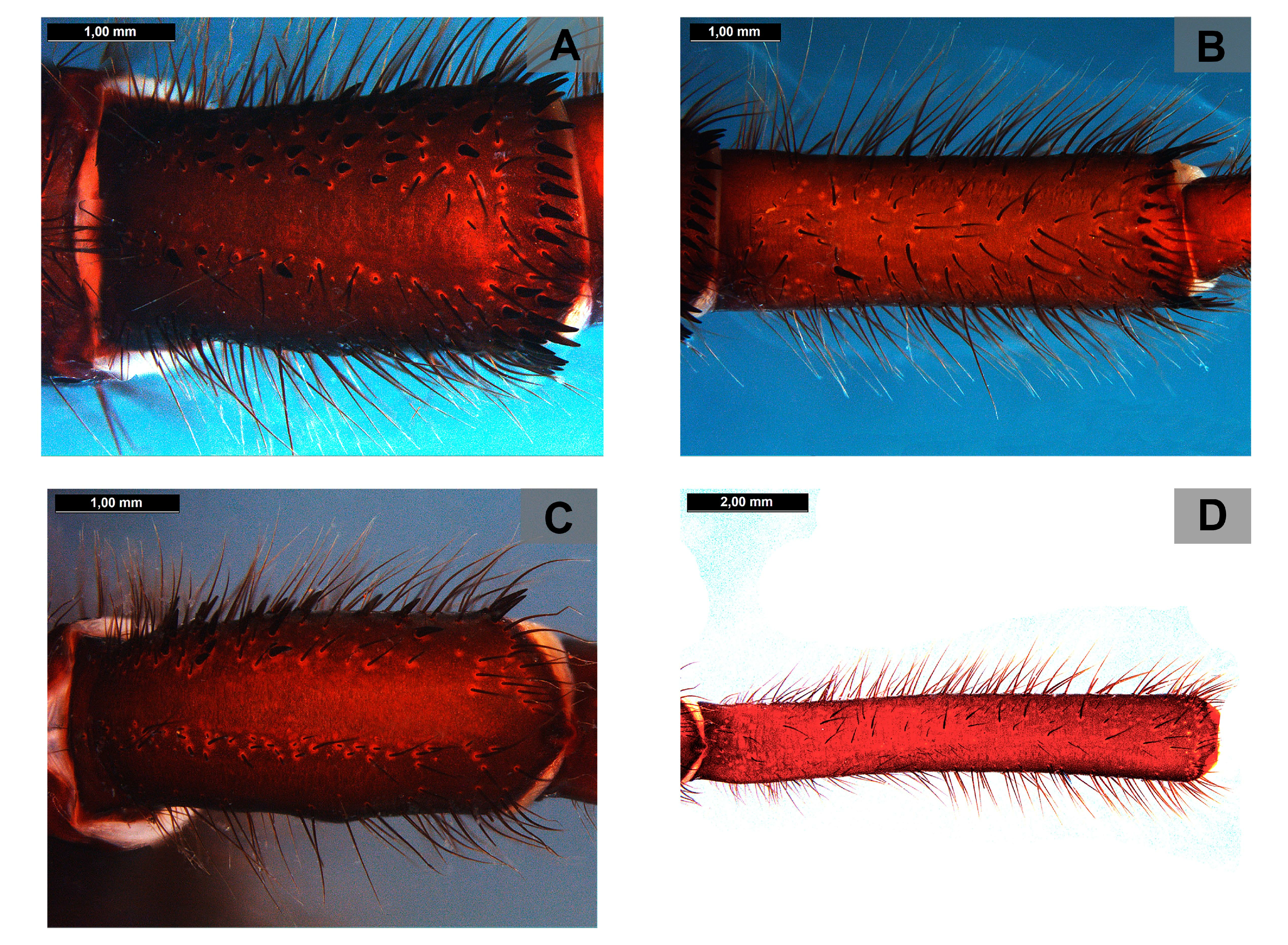
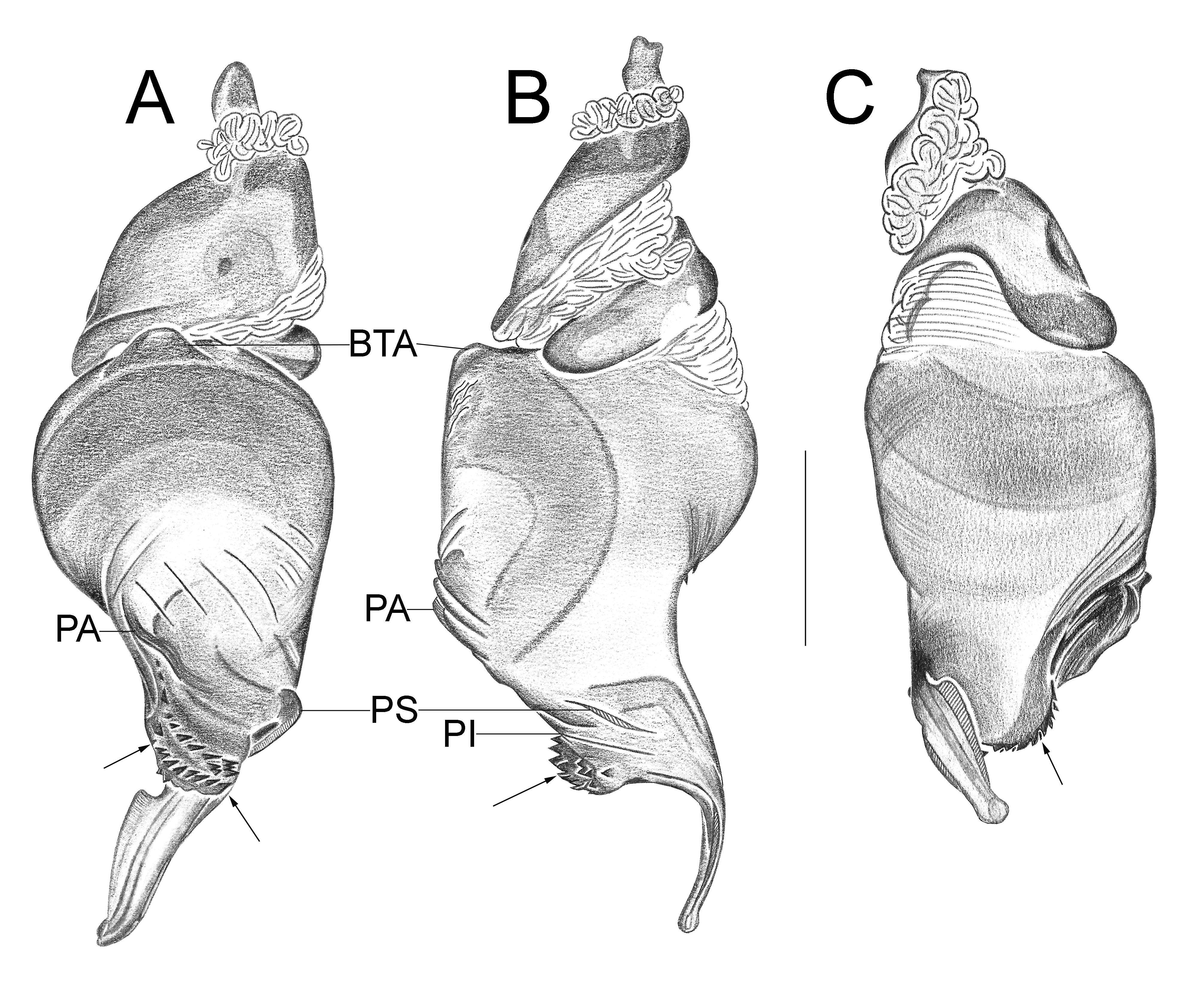
Diagnosis. Males of Actinopus apiacas resemble those of A. paranensis (Fig. 114 A – D) and A. hirsutus (Fig. 37 A – D) by hirsute legs. They differ from those of all species of the genus by the PA displaced dorsally in relation to a middle longitudinal line along prolateral tegular surface and separated from prolateral tegular border; embolar serrated area extremely developed, with three rows of large cusps (Fig. 201 A – C). MALE (IBSP 1105003): Total length 20; Carapace, long 9; wide 8.75. Carapace rounded. Anterior eye row slightly procurved, posterior row recurved (Fig. 199 B). One long bristle between AME-clypeus and row of short and weak bristles on border of clypeus. One long bristle betweenALE – ALP and many short, weak bristles between posterior eyes-fovea and lateral eyes-edge of carapace. Sternum with eight sigilla fused medially, two distal sigilla more fused than others (Fig. 199 C). Rastellum protuberant, inverted V-shaped, hirsute, without spines apically (Fig. 199 E – F). Chelicerae with 25 denticles along prolateral row of teeth. Prolateral row with seven megateeth and two basal teeth. Retrolateral row with six megateeth and two basal teeth (Fig. 199 D). Patella and tibia III with distal crown of well-developed thorns, not interrupted in middle (Fig. 200 A – B). Patellae III and IV with spines on prolaterodorsal face (Fig. 200 A, C). Tibia IV without spines on dorsal surface (Fig. 200 D). Legs and body, hirsute, with many long bristles. Ventral pseudoscopulae occupying 20 % of tarsus I, 60 % of II and 100 % of III and IV. Pseudoscopula of tarsi I and II with setae spaced, forming diffuse group of bristles; On tarsi III and IV, compact. Carapace and chelicerae dark brown; sternum, coxae, trochantera, femora, patellae, tibiae, metatarsi and tarsi reddish brown; Abdomen pale gray, with many spots of unpigmentation on dorsal surface and many long bristles (Fig. 199 A). Eyes: Diameters: PME 0.25, PLE 0.33, ALE 0.5, AME 0.58; MOQ: Length 1.58, front width 3.42, back width 3.33; Interdistances: PME – PME 2.17, PLE – PME 0.17, AME – AME 0.33, ALE – AME 0.67, ALE – PLE 0.83, AME – PME 0.58. Ocular area: OAL 6.25, OAW 5.62, and IF 3.87. Body: Clypeus: 0.37; Fovea: 3.12; Labium: long 2.12; wide 2.2; Chelicerae: long 4.37; wide 2.75; Sternum: long 5.87; wide 5.87. Abdomen: long 9; wide 6.75. Leg measurements: I: Fe 10.25 / Pa 4 / Ti 6 / Me 7.25 / Ta 4.12 / total 31.62. II: 10 / 4.12 / 6.12 / 6.5 / 4.12 / 30.87. III: 7.5 / 4 / 5 / 8.5 / 3.87 / 28.87. IV: 10 / 3.87 / 8.12 / 8.5 / 4.62 / 35.12. Formula 4123. Spination: I — Fe v 0, d 0, p 0, r 0; Pa v 0, d 0, p 0, r 0; ti v 0, d 0, p 0, r 0; Me v 1 - 2 - 1, d 0, p 0, r 0; ta v 0, d 0, p 0 - 1 - 1, r 0. II — Fe v 0, d 0, p 0, r 0; Pa v 0, d 0, p 0, r 0; ti v 0 - 0 - 6, d 1 - 0 - 16, p 0, r 0; Me v 3 - 5 - 6, d 0, p 0 - 0 - 2, r 0; ta v 0 - 0 - 3, d 0, p 1 - 2 - 5, r 0; III — Fe v 0, d 0, p 0, r 0; Pa v 0, d 8 - 13 - 31, p 0, r 0 - 0 - 1; ti v 0, d 1 - 0 - 14, p 0 - 0 - 1, r 0 - 0 - 2; Me v 0 - 0 - 2, d 0, p 1 - 2 - 7, r 0 - 1 - 7; ta v 0, d 0, p 2 - 4 - 5, r 2 - 4 - 3. IV — Fe v 0, d 0, p 0, r 0; Pa v 0, d 8 - 8 - 4, p 0, r 0; ti v 0, d 0, p 0, r 0; Me v 0, d 0, p 0, r 0; ta v 0, d 0, p 0 - 3 - 4, r 0 - 0 - 10. Palp: PA conspicuous, displaced dorsally in relation to a middle longitudinal line along prolateral tegular surface and away from tegular border. Embolus with two keels (PI and PS). BTA developed and displaced dorsally in relation to middle longitudinal line along prolateral tegular surface; serrated area represented by three rows of big notable cusps below PA in prolateral view; PA continuous to PS; Embolar base flattened, large, PI rotating length of embolus from base to apex; several grooves cover prolateral tegular surface, distal third of embolus with prolateral lamelae (Fig. 201 A – C).
Miglio, Laura Tavares, Pérez-Miles, Fernando, Bonaldo, Alexandre B. (2020): Taxonomic Revision of the Spider Genus Actinopus Perty, 1833 (Araneae, Mygalomorphae, Actinopodidae). Megataxa 2 (1): 1-256, DOI: 10.11646/megataxa.2.1.1
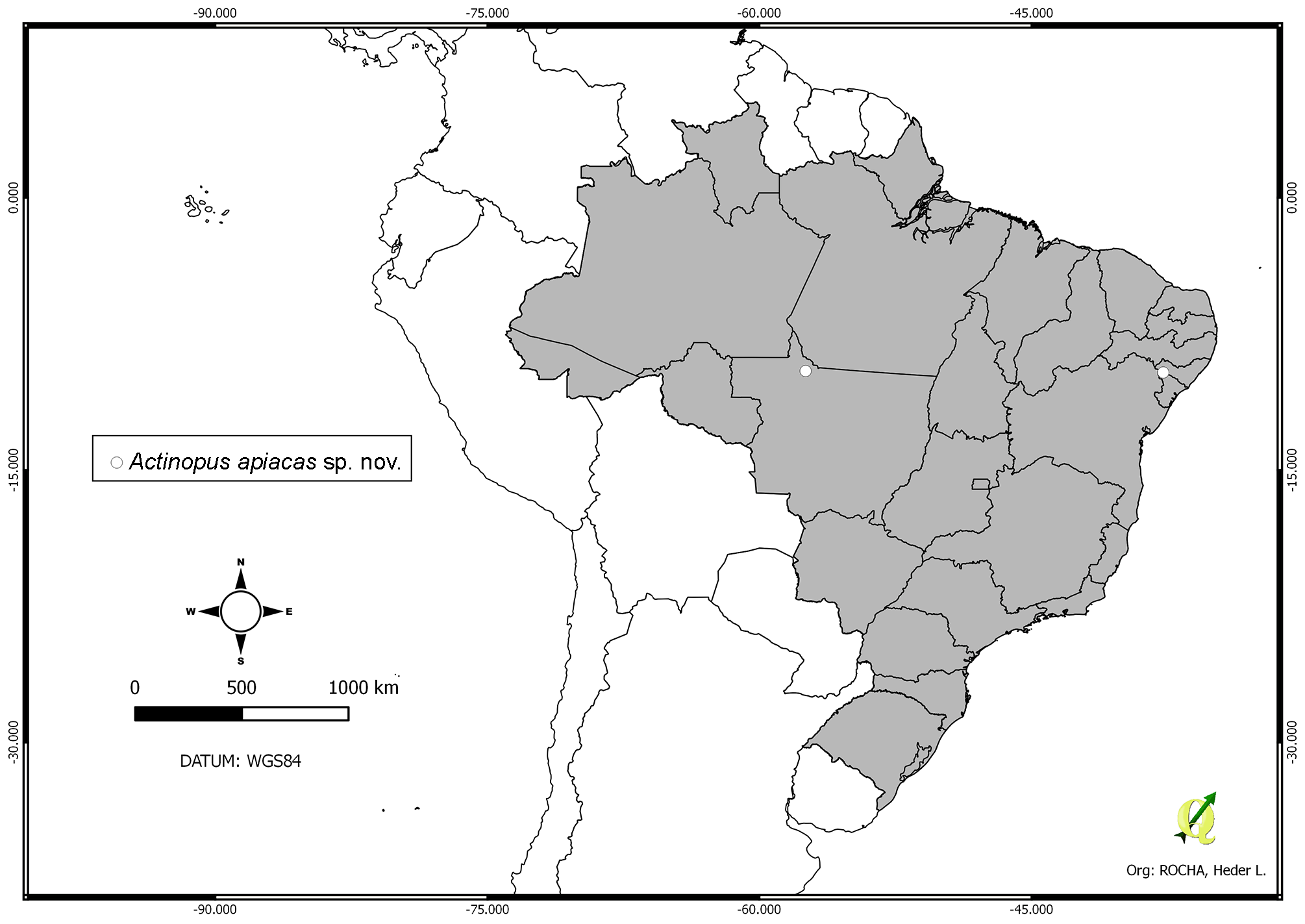
Distribution. BRAZIL. Sergipe: Canindé de S „ o Francisco; Mato Grosso: Apiacás (Map 13).
Miglio, Laura Tavares, Pérez-Miles, Fernando, Bonaldo, Alexandre B. (2020): Taxonomic Revision of the Spider Genus Actinopus Perty, 1833 (Araneae, Mygalomorphae, Actinopodidae). Megataxa 2 (1): 1-256, DOI: 10.11646/megataxa.2.1.1
Etymology. The specific name is a noun in apposition from the type locality name.
Miglio, Laura Tavares, Pérez-Miles, Fernando, Bonaldo, Alexandre B. (2020): Taxonomic Revision of the Spider Genus Actinopus Perty, 1833 (Araneae, Mygalomorphae, Actinopodidae). Megataxa 2 (1): 1-256, DOI: 10.11646/megataxa.2.1.1
Material examined (burned in fire). BRAZIL. Sergipe: Rio S „ o Francisco, Canindé de S „ o Francisco, Usina Hidroelétrica Xingó, 09 º 37 ’ 34 ” S 37 º 45 ’ 22 ” W, 1 ♂, 16. ii. 2000 (IBSP 114465).
Miglio, Laura Tavares, Pérez-Miles, Fernando, Bonaldo, Alexandre B. (2020): Taxonomic Revision of the Spider Genus Actinopus Perty, 1833 (Araneae, Mygalomorphae, Actinopodidae). Megataxa 2 (1): 1-256, DOI: 10.11646/megataxa.2.1.1
Type material. Holotype male from [09 º 32 ’ 39.98 ” S 57 º 27 ’ 03.83 ” W], Apiacás, Mato Grosso, Brazil, ii. 1997, M. Calletto leg. (IBSP 110503). Paratypes: BRAZIL. Mato Grosso: Apiacás, [09 º 32 ’ 39.98 ” S 57 º 27 ’ 03.83 ” W], 2 ♂, ii. 1997, M. Calletto leg. (IBSP 110503).
Miglio, Laura Tavares, Pérez-Miles, Fernando, Bonaldo, Alexandre B. (2020): Taxonomic Revision of the Spider Genus Actinopus Perty, 1833 (Araneae, Mygalomorphae, Actinopodidae). Megataxa 2 (1): 1-256, DOI: 10.11646/megataxa.2.1.1

Export occurrence data

Darwin Core Archive (ZIP)

CLASSIFICATION

Taxonomic Classification Tree

MULTIMEDIA

Media Files(6)

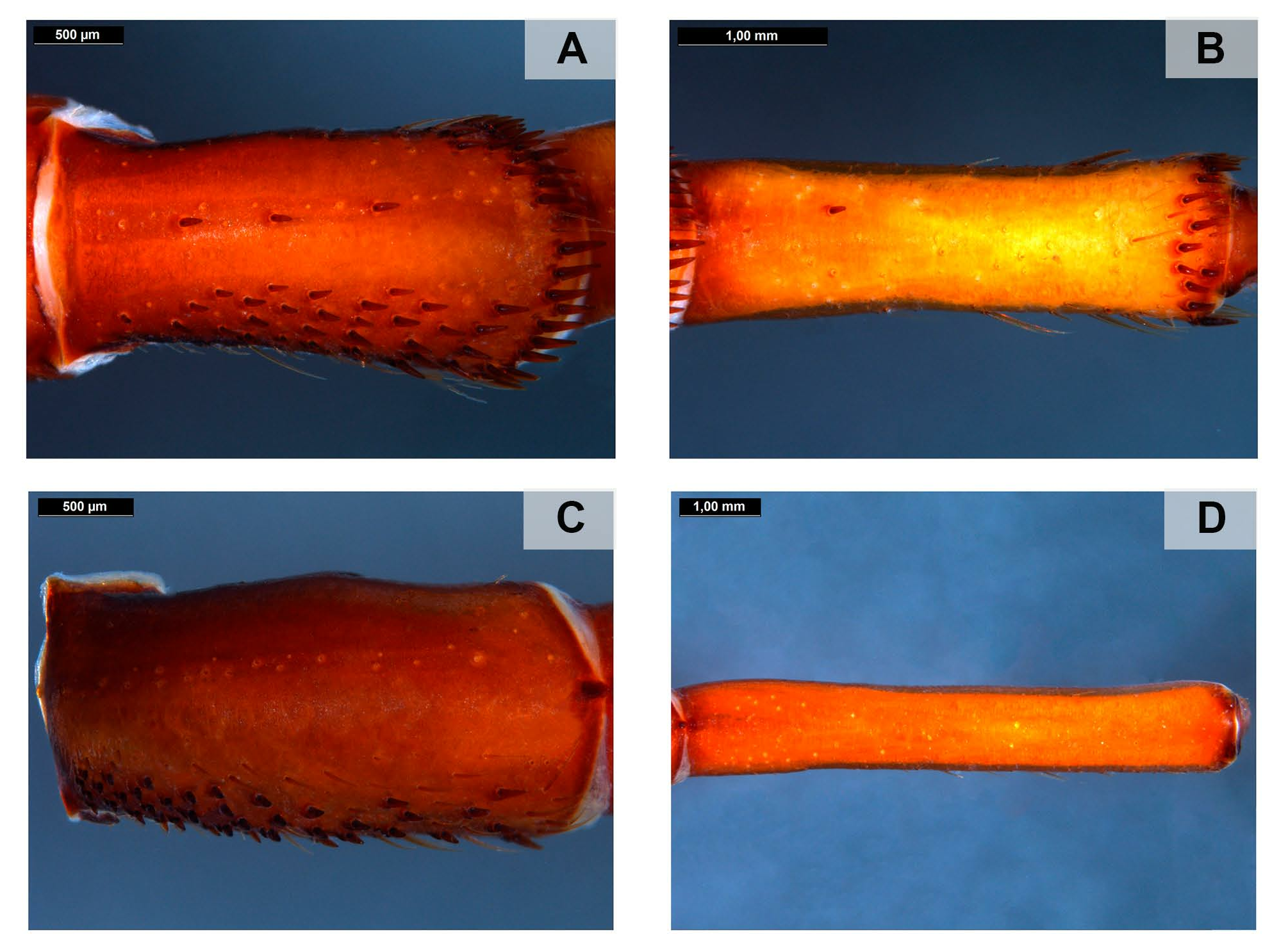
FIGURE 37. Actinopus hirsutus sp. nov., male:A–D MCN:A. Patella III, dorsal; B. Tibia III, dorsal; C. Patella IV, dorsal; D. Tibia IV, dorsal.

Imageimage/png© Miglio, Laura Tavares;Pérez-Miles, Fernando;Bonaldo, Alexandre B.Miglio, Laura Tavares;Pérez-Miles, Fernando;Bonaldo, Alexandre B.

FIGURE 114. Actinopus paranensis Mello-Leit„o, 1920, holotype, male: A–D MNRJ 00002: A. Patella III, dorsal; B. Tibia III, dorsal; C. Patella IV, dorsal; D. Tibia IV, dorsal.

Imageimage/png© Miglio, Laura Tavares;Pérez-Miles, Fernando;Bonaldo, Alexandre B.Miglio, Laura Tavares;Pérez-Miles, Fernando;Bonaldo, Alexandre B.

FIGURE 199. Actinopus apiacas sp. nov., male: A–F IBSP 110503:A. Abdomen, dorsal; B. Carapace, dorsal; C. Sternum, ventral; D. Cheliceral teeth, ventral; E. Rastellum, dorsal; F. Rastellum, ventral.

Imageimage/png© Miglio, Laura Tavares;Pérez-Miles, Fernando;Bonaldo, Alexandre B.Miglio, Laura Tavares;Pérez-Miles, Fernando;Bonaldo, Alexandre B.

FIGURE 200. Actinopus apiacas sp. nov., male:A–D IBSP 110503: A. Patella III, dorsal; B. Tibia III, dorsal; C. Patella IV, dorsal; D. Tibia IV, dorsal.

Imageimage/png© Miglio, Laura Tavares;Pérez-Miles, Fernando;Bonaldo, Alexandre B.Miglio, Laura Tavares;Pérez-Miles, Fernando;Bonaldo, Alexandre B.

FIGURE 201. Actinopus apiacas sp. nov., male: A–C MACN 1105003: A. Copulatory bulb, prolateral; B. Copulatory bulb, dorsal; C. Copulatory bulb, retrolateral. PA-Paraembolic apophysis; BTA-Basal Tegular Apophysis; PI-Prolateral Inferior keel; PS-Prolateral Superior keel; Arrows: Serrated area. Scale line: 0.5 mm.

Imageimage/png© Miglio, Laura Tavares;Pérez-Miles, Fernando;Bonaldo, Alexandre B.Miglio, Laura Tavares;Pérez-Miles, Fernando;Bonaldo, Alexandre B.

MAP 13. Distribution map of Actinopus apiacas sp. nov.

Imageimage/png© Miglio, Laura Tavares;Pérez-Miles, Fernando;Bonaldo, Alexandre B.Miglio, Laura Tavares;Pérez-Miles, Fernando;Bonaldo, Alexandre B.

IMAGES

Gallery(6)

See Gallery

Occurrences with images

Source Information

Taxonomic Revision of the Spider Genus Actinopus Perty, 1833 (Araneae, Mygalomorphae, Actinopodidae)

checklist

This dataset contains the digitized treatments in Plazi based on the original journal article Miglio, Laura Tavares, Pérez-Miles, Fernando, Bonaldo, Alexandre B. (2020): Taxonomic Revision of the Spider Genus Actinopus Perty, 1833 (Araneae, Mygalomorphae, Actinopodidae). Megataxa 2 (1): 1-256, DOI: 10.11646/megataxa.2.1.1

Abstract

Actinopus Perty, 1833 is characterized and redescribed, including 80 species occurring from Panama to Argentina. Eighteen previously known species are redescribed: A. rufipes (Lucas, 1834); A. longipalpis C. L. Koch, 1842; A. nattereri (Doleschall, 1871); A. crassipes (Keyserling, 1891); A. robustus (O. Pickard-Cambridge, 1892); A. wallacei F. O. P.-Cambridge, 1896; A. princeps Chamberlin, 1917; A. xenus Chamberlin, 1917; A. fractus Mello-Leit „o, 1920; A. paranensis Mello-Leit „o, 1920; A. pusillus Mello-Leit „o, 1920; A. dubiomaculatus Mello-Leit „o, 1923; A. trinotatus Mello-Leit„o, 1938; A. cucutaensis Mello-Leit „o, 1941; A. echinus Mello-Leit „o, 1949; A. clavero Ríos-Tamayo & Goloboff, 2018; A. gerschiapelliarum Ríos-Tamayo & Goloboff, 2018; and A. palmar Ríos-Tamayo & Goloboff, 2018. Additionally, A. tarsalis Perty, 1833, the type species, A. insignis (Holmberg, 1881) and other 18 species recently described species from Argentina and Bolivia, are re-evaluated. Forty-two new species are described: Actinopus castelo sp. nov., A. apalai sp. nov., A. mairinquensis sp. nov., A. obidos sp. nov., A. buritiensis sp. nov., A. pinhao sp. nov., A. ducke sp. nov., A. hirsutus sp. nov., A. jaboticatubas sp. nov., A. confusus sp. nov., A. pampulha sp. nov., A. candango sp. nov., A. paraitinga sp. nov., A. cornelli sp. nov., A. vilhena sp. nov., A. harveyi sp. nov., A. itapitocai sp. nov., A. ipioca sp. nov., A. itaqui sp. nov., A. xingu sp. nov., A. mesa sp. nov., A. caxiuana sp. nov., A. utinga sp. nov., A. emas sp. nov., A. bocaina sp. nov., A. osbournei sp. nov., A. dioi sp. nov., A. tutu sp. nov., A. azaghal sp. nov., A. itacolomi sp. nov., A. parafundulus sp. nov., A. urucui sp. nov., A. reznori sp. nov., A. anselmoi sp. nov., A. guajara sp. nov., A. apiacas sp. nov., A. jamari sp. nov. from Brazil; A. laventana sp. nov. from Argentina and Uruguay; A. lomalinda sp. nov. from British Guiana and Colombia; A. concinnus sp. nov. from Venezuela and Brazil; A. pindapoy sp. nov. from Argentina; A. panguana sp. nov. from Peru. The females of A. dubiomaculatus and A. cucutaensis and the males of A. nattereri are described for the first time. New records are presented for A. clavero; A.crassipes; A. dubiomaculatus; A. fractus; A. gerschiapelliarum; A. nattereri; A. palmar; A. paranensis; A. princeps, A. pusillus, A. robustus and A. wallacei. Ten old species names are herein considered species inquirendae: A. caraiba (Simon, 1889); A. harti Pocock, 1895; A. liodon (Ausserer, 1875); A. nigripes (Lucas, 1834); A. pertyi Lucas, 1843; A. piceus (Ausserer, 1871); A. rojasi (Simon, 1889); A. rufibarbis Mello-Leit „o, 1930; A. scalops (Simon, 1889) and A. valencianus (Simon, 1889). Most species presently recognized were included in 11 informal groups based mainly on male palpal characters. A key for these groups plus three species, not included in any group, but known from males, is presented.

Miglio L T, Pérez-Miles F, Bonaldo A B, plazi (2020). Taxonomic Revision of the Spider Genus Actinopus Perty, 1833 (Araneae, Mygalomorphae, Actinopodidae). Plazi.org taxonomic treatments database. Checklist dataset https://doi.org/10.11646/megataxa.2.1.1 accessed via GBIF.org on 2026-06-15.

CC0Published 10/9/2020View dataset
GBIF Usage Key
190123784
Dataset Key
f7793976-e4e9-4562-a9cd-eda910d77fa0
Origin
source
Backbone Key
11373067
Taxon ID
0975136AFF56CE83FCD5FEE2DA8C3A72.taxon
Last Crawled
6/9/2026
Last Interpreted
6/9/2026