AnimaliaacceptedgenusAccepted
Bhawatsonia

Bhawatsonia

Cruz-Gómez, 2021

GBIF:190304373

0year

ABOUT

Descriptions(4)

Diagnosis. Chrysopetalinae with body broad, rectangular and long (to 400 segments). Paleae fan pale maroon to bright golden, partially imbricate dorsally, most specimens exhibiting mid-dorsal line free of paleae in middle segments. Prostomium rectangular, laterally fused with the anterior segments. Pharynx with a pair of thick stylet jaws. Segment 1 reduced and dorsally fused with segment 2, dorsal and ventral cirri present; segment 2 reduced and fused with segment 3, dorsal cirri present, ventral cirri absent; segment 3 reduced, dorsal and ventral cirri present. Posterior segments with dorsal and ventral cirri. Dorsal cirri with cirrophores large, cirrostyle non-retractile. Notochaetae symmetrical with internal ribs and horizontal striae on the paleal surface. Main paleae with raised ribs with denticles. Pygidium bulbous with two anal cirri, with a medial anal cone.
Cruz-Gómez, Christopher (2021): A new genus and seven new species of chrysopetalids (Annelida, Chrysopetalidae) from the Tropical Eastern Pacific. Zootaxa 5068 (1): 1-59, DOI: 10.11646/zootaxa.5068.1.1

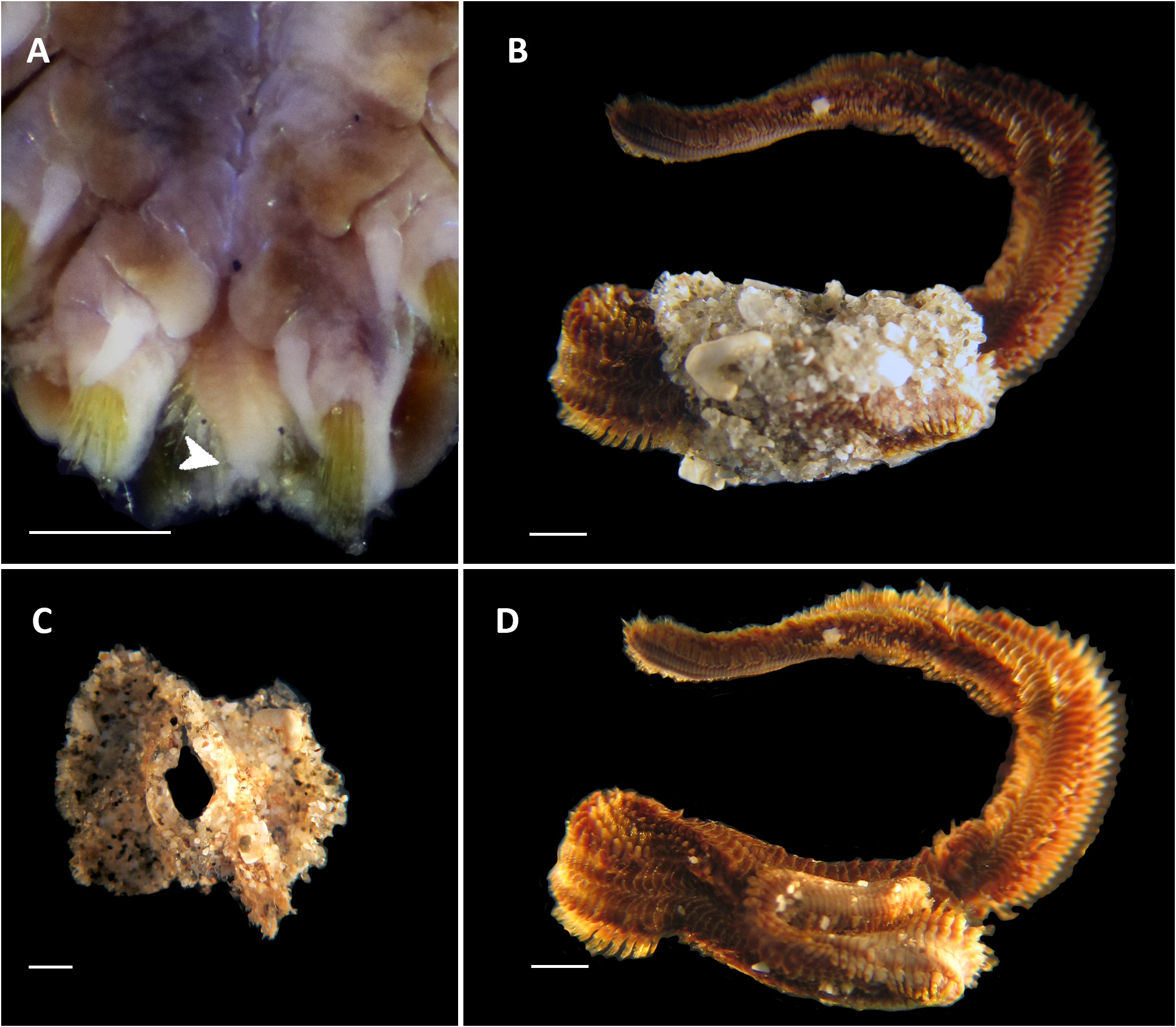
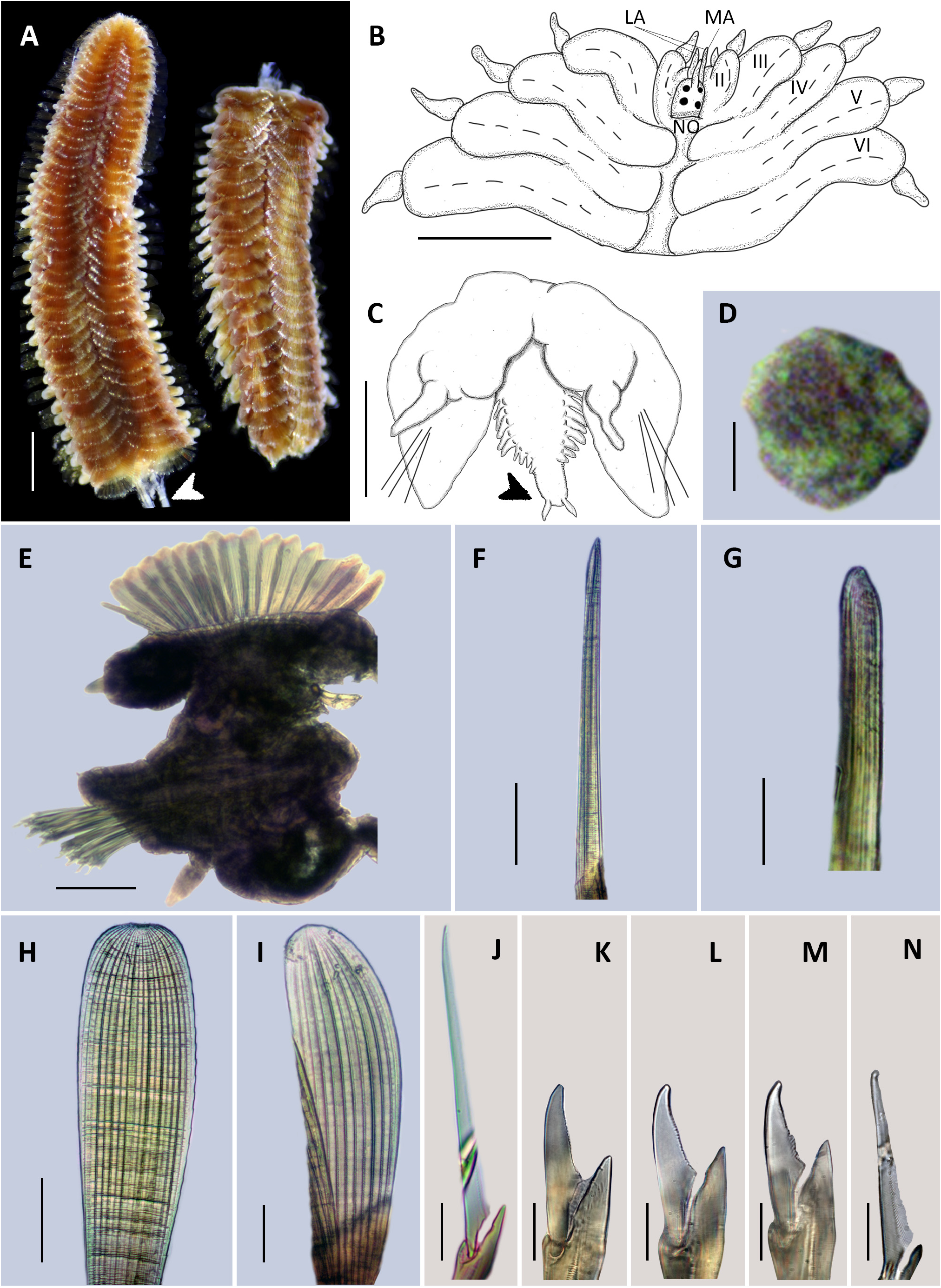
Remarks. Bhawatsonia n. gen. includes species previously known as Paleanotus purpurea Rioja, 1947 and Bhawania riveti Gravier, 1908, and three other new species. The members of the new genus share the following features: maroon to violet body, long body, numerous segments, anterior segments retractile, dorsal cirrophores massive, and symmetrical paleae. Combination of these features could lead to confusion within other related genera such as Bhawania and Paleaequor. Among Chrysopetalinae, Bhawatsonia n. gen. resembles Bhawania and Paleaequor in having long bodies with numerous segments, anterior segments retractile, and symmetrical paleae. However, specimens of Bhawatsonia n. gen. have longer bodies, measuring between 6.7 mm and 120 mm in length, with to 400 segments and rectangular body shape, whereas the largest specimens recorded of Bhawania do not exceed 70 mm in length, with up to 220 segments (Schmarda 1861), and the one of Paleaequor do not exceed 20 mm, with 120 segments (Watson Russell 1986), and in both genera specimens have depressed bodies. Furthermore, specimens of Bhawatsonia n. gen. present non-imbricated paleae fan along the mid-dorsal line in most of the specimens, and notopodia possess a massive dorsal cirrophore with non-retractile cirrostyle, while specimens of Bhawania and Paleaequor exhibit their paleae fan imbricated over the dorsum and their dorsal rami with retractile cirrostyles into reduced cirrophores (Perkins 1985; Watson Russell 1986). Regarding notochaetae, the main difference is found in the tip of the paleae. Members of Bhawatsonia n. gen. have the paleal apex thick and entire, with its internal ribs and horizontal striae extended to it; meanwhile, Bhawania has the apex delicate and often eroded, with its internal ribs and horizontal striae turned into a reticulated surface, and Paleaequor has the paleal apex hyaline and entire, with its internal ribs barely extended in the hyaline section. Moreover, between Bhawania and Bhawatsonia n. gen. the denticulation also differs; denticulation in the paleae of Bhawatsonia n. gen. if present, is fine, barely seen and sharp, while in Bhawania it is obvious and flattened. The new features considered here are stiffness and body color. Chrysopetalins are usually fragile worms with pale orange to bright yellow bodies; but as a novelty, the new genus members are stiff worms with maroon to violet bodies. The former was noticed during the preparation of the slides. Most of Chrysopetalinae members are fragile worms that can break easily, which make easier the dissection of a segment, by only pulling out the segment using a fine needle or fine tweezers. Nevertheless, the fragmentation of specimens of Bhawatsonia n. gen. is rare, and the dissection of a segment required a razor to obtain the complete segment, most likely due to the thickness of the ventral longitudinal muscular fibers (Fig. 16 A). Several authors indicated some species previously assigned to Bhawania, Paleanotus or Chrysopetalum could be regarded as members of a new group. Monro (1933) recognized that “ C. ” riveti shared more features with Bhawania than with Chrysopetalum and suggested the new combination as “ B. ” riveti. Later, Perkins (1985) suggested that Paleanotus purpurea should be transferred to Bhawania because of its retractile prostomium. Watson Russell (1991) discussed the similarities of “ C. ” riveti with Strepternos Watson Russell, 1991 and indicated that this species belonged to a new genus. Now is clear that “ Chrysopetalum ” riveti belong to the new genus, but this must be formalized through the proposal of a neotype and its description and illustration of topotype material, because the type material is lost (CW Pers. Comm. 2020). More recently, Charlotte Watson (Pers. Comm. 2017) suggested that Bhawania goodei and “ Bhawania ” riveti should be considered two different species complexes. Here, these two groups are referred as from two genera, Bhawania sensu stricto, and Bhawatsonia n. gen. Hitherto, the new genus appears to be restricted in the TEP; however, it may also be present in the Grand Caribbean region. Records of B. purpurea n. comb. (as P. purpurea) and “ C. ” riveti (as B. riveti) in the Caribbean (Rullier 1974; Cubit & Williams 1983) could indicate the presence of specimens of Bhawatsonia n. gen. in the Caribbean region. Either way, the revision of specimens identified as Bhawania and Paleaequor deposited in scientific collections in the world could indeed, belong to this new genus. Bhawatsonia n. gen. specimens are found inhabiting rocks, sand, dead and living coral, bivalves and pier piles, or inside of sand tubes of other polychaetes (Fig. 17 B – D) (Monro 1933; Rioja 1945; Fauchald 1997; Cruz-Gómez & Bastia-Zavala 2018).
Cruz-Gómez, Christopher (2021): A new genus and seven new species of chrysopetalids (Annelida, Chrysopetalidae) from the Tropical Eastern Pacific. Zootaxa 5068 (1): 1-59, DOI: 10.11646/zootaxa.5068.1.1
Etymology. The genus is named after Charlotte Watson, a specialist in chrysopetalids, in recognition of her contribution to the study of these marine annelids, and for her valuable comments and support during this research. The name also refers to Bhawania, the genus to which the new genus seems to be closest. The name is a combination of Bhawania, and the last name of Charlotte, but in order to make it more euphonic, the last three letters of the genus-group name were removed and the Latin suffix ‘ ia’, feminine indicative, was added. Gender. Feminine.
Cruz-Gómez, Christopher (2021): A new genus and seven new species of chrysopetalids (Annelida, Chrysopetalidae) from the Tropical Eastern Pacific. Zootaxa 5068 (1): 1-59, DOI: 10.11646/zootaxa.5068.1.1
Type species. Bhawatsonia fusa n. sp.
Cruz-Gómez, Christopher (2021): A new genus and seven new species of chrysopetalids (Annelida, Chrysopetalidae) from the Tropical Eastern Pacific. Zootaxa 5068 (1): 1-59, DOI: 10.11646/zootaxa.5068.1.1

Export occurrence data

Darwin Core Archive (ZIP)

CLASSIFICATION

Taxonomic Classification Tree

MULTIMEDIA

Media Files(2)

FIGURE 16. Bhawatsonia purpurea n. comb., neotype (ECOSUR-265). A) Complete fragmented body, arrow indicates protruding ventral longitudinal muscular fibers. B) Drawing of prostomium, dorsal view. C) Drawing of regenerated posterior segments, ventral view; arrow indicates pygidium. D) Oocyte. E) Parapodium from segment 51. I) Lateral palea. G) Subunit 1. H) Main palea. I) Median palea. J) Unit 1. K) Unit 2. L–M) Unit 3. N) Unit 4. Scales: 5 µm (D), 10 µm (GJKLMN), 20 µm (FI), 50 µm (H), 100 µm (BC), 200 µm (E), 1 mm (A).

Imageimage/png© Cruz-Gómez, ChristopherCruz-Gómez, Christopher

FIGURE 17. Bhawatsonia purpurea n. comb., neotype (ECOSUR-265). A) Regenerated posterior segments, ventral view; arrow indicated pygidium. Non-type specimen (ECOSUR-2992). B) Specimen sheltered inside a sand tube. C) Sand tube from B. D) Complete specimen removed from sand tube. Scales: 100 µm (A), 1 mm (BCD).

Imageimage/png© Cruz-Gómez, ChristopherCruz-Gómez, Christopher

IMAGES

Gallery(2)

See Gallery

Occurrences with images

Source Information

A new genus and seven new species of chrysopetalids (Annelida, Chrysopetalidae) from the Tropical Eastern Pacific

checklist

This dataset contains the digitized treatments in Plazi based on the original journal article Cruz-Gómez, Christopher (2021): A new genus and seven new species of chrysopetalids (Annelida, Chrysopetalidae) from the Tropical Eastern Pacific. Zootaxa 5068 (1): 1-59, DOI: 10.11646/zootaxa.5068.1.1

Abstract

Chrysopetalids annelids have been little studied in the Tropical Eastern Pacific (TEP), with only 24 species recorded in the region. Most records are from northwestern Mexico and Costa Rica, leaving many sites along the Tropical Pacific coast of America unexplored. Furthermore, there are species recorded and described from the region with problems in their status, including questionable records, modest illustrations or descriptions, and lost type material. This paper aims to improve the knowledge of this family in the TEP. Almost 290 specimens were revised, provided from five scientific collections, covering 51 sites along the TEP and nearby. Two subfamilies: Calamyzinae and Chrysopetalinae, nine genera and 20 species were determined. Of these, ten species have been previously recorded, three are indeterminable and seven are new species: Paleanotus karlyae n. sp., Arichlidon mucropaleum n. sp., Bhawania bastidai n. sp., Chrysopetalum mexicanum n. sp., C. tovarae n. sp. A new genus is proposed, Bhawatsonia n. gen. which includes two new species, B. fusa n. sp. as its type species, B. nenoae n. sp. and, the new combination and neotype of B. purpurea n. comb. An updated and revised checklist of all chrysopetalids species recorded in the region is included, currently composed of 16 genera, 30 species, and four morphospecies.

Cruz-Gómez C, plazi (2021). A new genus and seven new species of chrysopetalids (Annelida, Chrysopetalidae) from the Tropical Eastern Pacific. Plazi.org taxonomic treatments database. Checklist dataset https://doi.org/10.11646/zootaxa.5068.1.1 accessed via GBIF.org on 2026-06-17.

CC0Published 11/15/2021View dataset
GBIF Usage Key
190304373
Dataset Key
726fdd32-9199-4ca9-9dcd-2892bc30b2e3
Origin
source
Backbone Key
11374359
Taxon ID
044C3804717CEF21D7D3FF3D21A99112.taxon
Last Crawled
6/9/2026
Last Interpreted
6/9/2026