
AnimaliaNot EvaluatedacceptedspeciesAccepted
Chrysopetalum tovarae

Chrysopetalum tovarae

Cruz-Gómez, 2021

GBIF:190304392

0year

0

Synonyms

ABOUT

Descriptions(6)

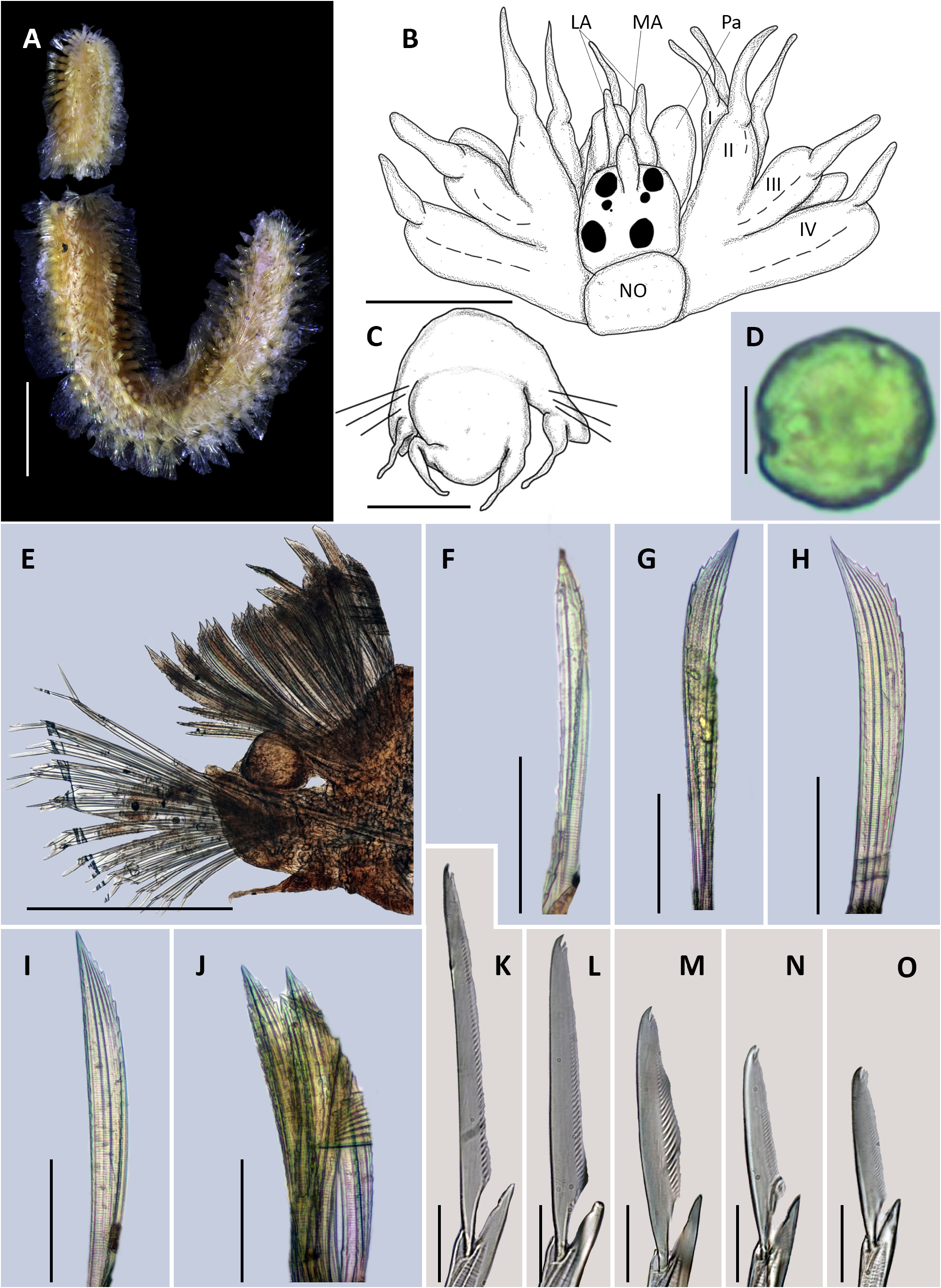
Description. Based on the holotype: complete with 59 segments. TL = 9.3 mm, AT = 2 mm. Body short, tapered posteriorly (Fig. 24 A). Body pale orange to brown. Paleae fan translucent to golden bright, slightly imbricated dorsally. Prostomium visible among first five segments. Lateral antennae long, inserted on antero-ventral prostomial margin, median antenna as long as lateral ones, inserted behind the first pair of eyes. Eyes red violet, two pairs, with a secondary extra pair of eyes. Nuchal organ small, round, non-covering prostomium (Fig. 24 B). Palps short, oval, visible in dorsal view. Mouth fold small, placed between segment 4 and 5. Pharynx eversible, not exposed, stylets slender. Parapodium from segment 20, notochaetae in three main groups (Fig. 24 E). Notochaetae: lateral group inserted below notaciculum, 5 – 6 paleae, slender and narrow, with 2 internal ribs and 1 raised rib (Fig. 24 F); Main group, 11 – 16 paleae; lateral-most, slender, curved and asymmetrical, with 6 internal ribs (Fig. 24 G); mid-most, broader, slightly shorter and symmetrical, with 6 – 7 internal ribs (Fig. 24 H); midline-most, slender and asymmetrical, with 6 internal ribs (Fig. 24 I). Median group, 3 – 5 paleae, short, narrow and asymmetrical; the distal-most (usually, duplicate) with 2 – 3 internal ribs and 1 raised rib; the next proximal palea smaller with 2 – 3 internal ribs and 1 raised rib, and the proximal-most with 2 internal ribs and 1 raised rib (Fig. 24 J). All paleal group with margins markedly serrated, on dorsal paleal surface ornamented with tiny tubercles. Neuropodium leaf-shaped, larger than notopodium. Neurochaetae: unit 1, 2 – 3 falcigers, blades straight and long, 7 – 10 times longer than wide (Fig. 24 K – L). Unit 2, 3 – 4 falcigers, blades straight and medium-sized, 5 – 6 times longer than wide (Fig. 24 M). Unit 3, 6 – 7 falcigers, blades straight and medium-sized, 5 – 6 times longer than wide (Fig. 24 N). Unit 4, 2 – 3 falcigers, blades straight and short, 3 – 4 times longer than wide (Fig. 24 O). Pygidium rounded with two anal cirri (Fig. 24 C). Oocyte size: 11.5 – 21.4 µm (n = 4) (Fig. 24 D). Habitat. Intertidal to subtidal (0.5 – 5 m). Specimens of this species were collected as epibionts of A. fistularis and as members of fouling community.
Cruz-Gómez, Christopher (2021): A new genus and seven new species of chrysopetalids (Annelida, Chrysopetalidae) from the Tropical Eastern Pacific. Zootaxa 5068 (1): 1-59, DOI: 10.11646/zootaxa.5068.1.1
Figs 24, 25, 26 LSID: urn: lsid: zoobank. org: act: CD 6 C 7 D 54 - 6701 - 48 FA- 9885 - AAABFB 63 CC 2 F
Cruz-Gómez, Christopher (2021): A new genus and seven new species of chrysopetalids (Annelida, Chrysopetalidae) from the Tropical Eastern Pacific. Zootaxa 5068 (1): 1-59, DOI: 10.11646/zootaxa.5068.1.1
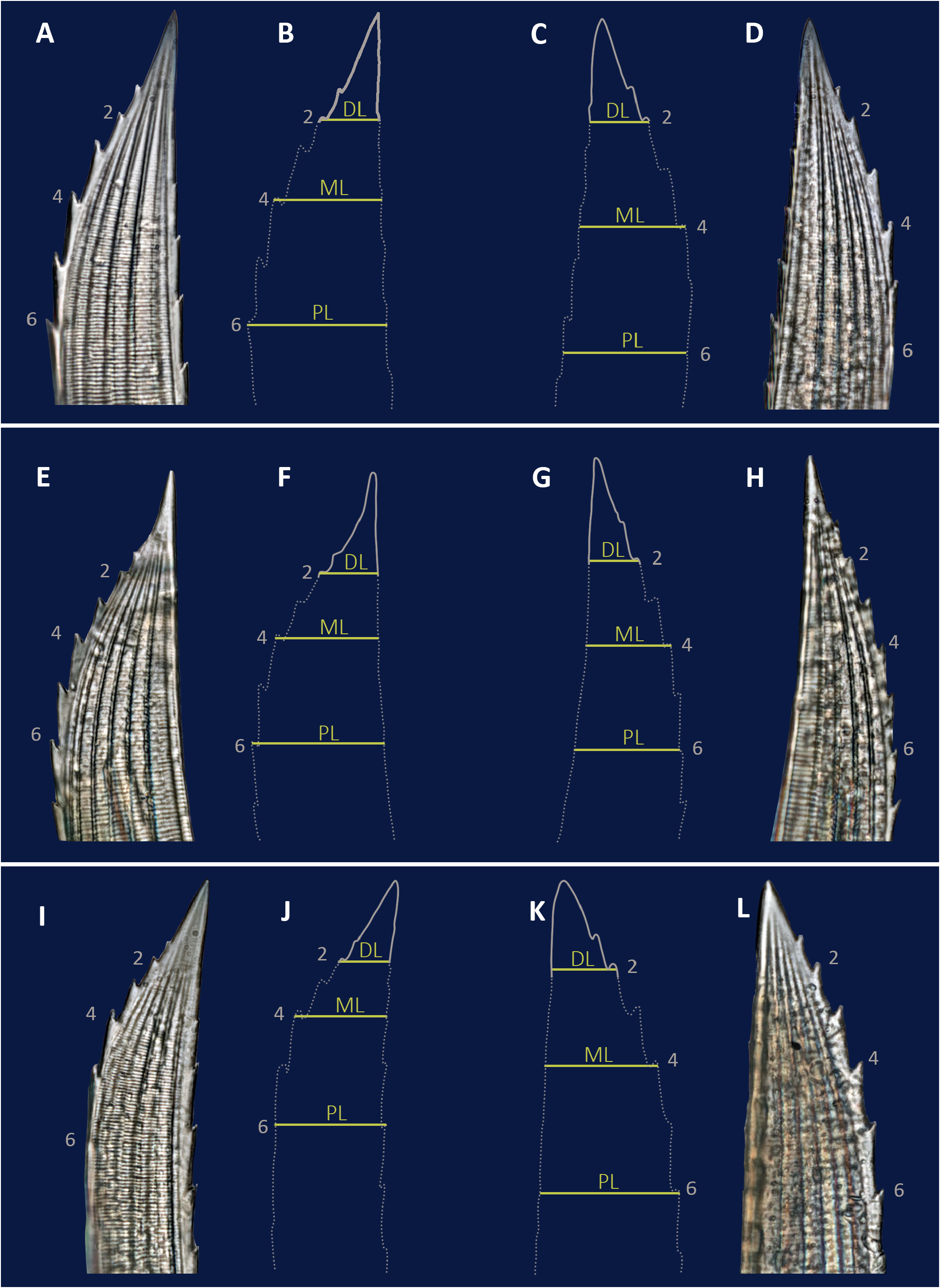
Remarks. Chrysopetalum tovarae n. sp. resembles C. elegans, C. elegantoides and C. mexicanum n. sp., in having slender paleae, however, some features help to separate them from each other. Differences among these species can be summarized as follows: C. tovarae n. sp. has long, slender paleae; C. mexicanum n. sp. and C. elegantoides have long and broader paleae (see C. mexicanum n. sp. remarks), and C. elegans have longer and even more slender paleae (11 times wider than long vs 15 times wider than long). The range of internal ribs of main paleae was discarded as relevant per se, because the range overlapped among the species of Chrysopetalum with slender paleae from the TEP and the TNP. However, the consistency of the number of internal ribs can be used to identify the species. Specimens of C. elegantoides and C. mexicanum n. sp. exhibit a wide range of internal ribs, while specimens of C. tovarae n. sp. have a well delimited range of internal ribs [(4) 5 – 7 (8) vs 6 – 7]. Further, width and shape of the apex of the main paleae were evaluated and appears to be relevant. Main paleae from similar sizes specimens (~ 6 mm length) of C. elegantoides (n = 5), C. mexicanum n. sp. (n = 5) and C. tovarae n. sp. (n = 3) were revised. Differences were found in the lateral-most main palea, and midlinemost main palea; the mid-most palea did not show an evident difference among species. On the other hand, and in order to observe the paleal proportions, imaginary lines were drawn using marginal teeth as reference. The distal line (DL) was traced from the second distal-most left tooth to the right one, the medium line (ML) from the fourth distal-most left tooth to the right one, and the proximal line (PL) from the sixth distal-most left tooth to the right one; the treatment was repeated in all the evaluated main paleae (Fig. 25). Specimens of C. tovarae n. sp. share with C. elegantoides the paleal apex broad and rounded, with the internal ribs extended into the apex (Fig. 25 A – D; 25 E – H), while specimens of C. mexicanum n. sp. have the paleal apex slender and acute, with the internal ribs not extended into the apex (Fig. 25 C – D). Specimens of C. tovarae n. sp. have lateral-most main palea with the PL short, 2 1 / 2 longer than DL, and about the same length of the ML, which provides the palea with slender appearance (Fig. 25 I – J); whereas specimens of C. elegantoides and C. mexicanum n. sp. have the same type of palea with the PL wide, 2 1 / 2 as long as the DL, and longer than the ML, which provides the palea with broad appearance (Fig. 25 A – B, E – F). About the midline-most main palea, specimens of C. tovarae n. sp. have the PL long, twice as long as DL, and about the same length of ML, which provides the palea with slender appearance (Fig. 25 K – L); whereas C. elegantoides and C. mexicanum n. sp. the PL long, twice as long as DL, and slightly longer than ML, which provides the palea with broad appearance (Fig. 25 C – D, G – H). Regarding neurochaetae, specimens of C. tovarae n. sp. have the blades of unit 1 slender, slightly curved, and long, about 1 1 / 2 times longer than unit 2; while specimens of C. elegantoides and C. mexicanum have the blades of unit 1 broad, straight and long, and about the same length of unit 2. This kind of peculiar long blades has been previously seen in another species of the genus. Specimens of Chrysopetalum hernancortezae Perkins, 1985 described from Florida, have the blade from the superior spiniger (unit 1) slender, slightly curved, and long, about 2 1 / 2 times longer than unit 2, much longer than those in C. tovarae n. sp.
Cruz-Gómez, Christopher (2021): A new genus and seven new species of chrysopetalids (Annelida, Chrysopetalidae) from the Tropical Eastern Pacific. Zootaxa 5068 (1): 1-59, DOI: 10.11646/zootaxa.5068.1.1
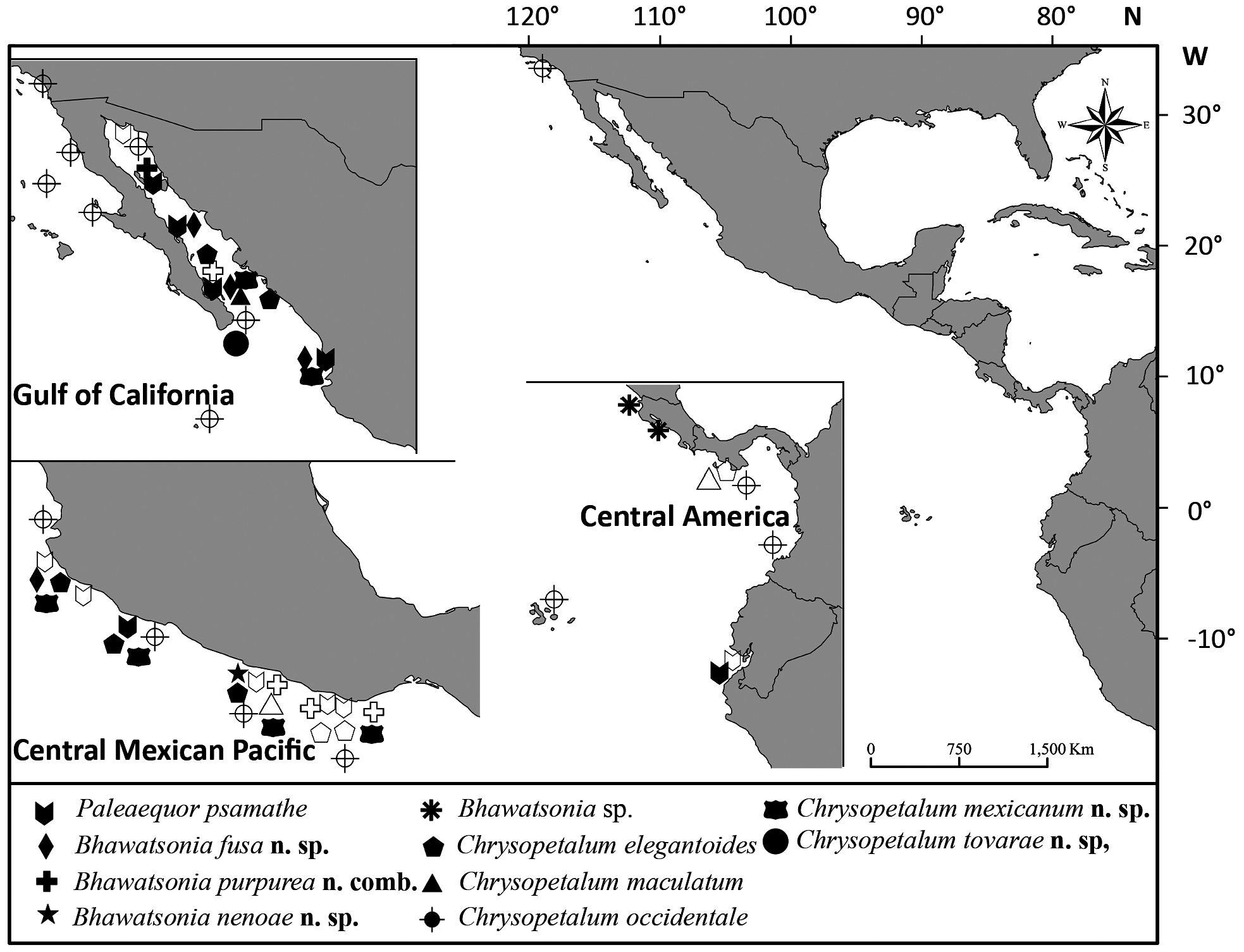
Distribution. Only known from La Paz Bay, Baja California Sur, Mexico (Fig. 26).
Cruz-Gómez, Christopher (2021): A new genus and seven new species of chrysopetalids (Annelida, Chrysopetalidae) from the Tropical Eastern Pacific. Zootaxa 5068 (1): 1-59, DOI: 10.11646/zootaxa.5068.1.1
Etymology. This species is named after María Ana Tovar-Hernández, in recognition of her contribution to the knowledge of polychaetes, especially on sabellids; further, and her studies on exotic marine invertebrates. Also, she kindly provided material for this study and collected this new species. The epithet is a noun in the genitive case (ICZN 1999, Art. 31.1.2).
Cruz-Gómez, Christopher (2021): A new genus and seven new species of chrysopetalids (Annelida, Chrysopetalidae) from the Tropical Eastern Pacific. Zootaxa 5068 (1): 1-59, DOI: 10.11646/zootaxa.5068.1.1
Type locality: La Marina, La Paz Bay, Baja California Sur, México. Type material. Holotype. ECOSUR- 273, Marina Palmira, 24 º 10.992´N, 110 º 18.185´W, La Paz Bay, pier piles, 0.5 m, 1 spec. / 250 cm 2, August 15, 2011, coll. TVG & ADL; Paratype: ECOSUR- 274, La Marina, 24 º 09.319´N, 110 º 19.630´W, La Paz Bay, pier piles, 0.5 m, 1 spec. / 250 cm 2, August 14, 2011, coll. TVG & ADL. Other material examined. One specimen. Baja California Sur: UMAR-Poly 947, La Paz Bay, on sponge Aplysina fistularis (Pallas, 1766), 5 m, November 1989, coll. MAB et al.
Cruz-Gómez, Christopher (2021): A new genus and seven new species of chrysopetalids (Annelida, Chrysopetalidae) from the Tropical Eastern Pacific. Zootaxa 5068 (1): 1-59, DOI: 10.11646/zootaxa.5068.1.1

Export occurrence data

Darwin Core Archive (ZIP)

CLASSIFICATION

Taxonomic Classification Tree

NOMENCLATURE

Synonyms(1)

MULTIMEDIA

Media Files(4)

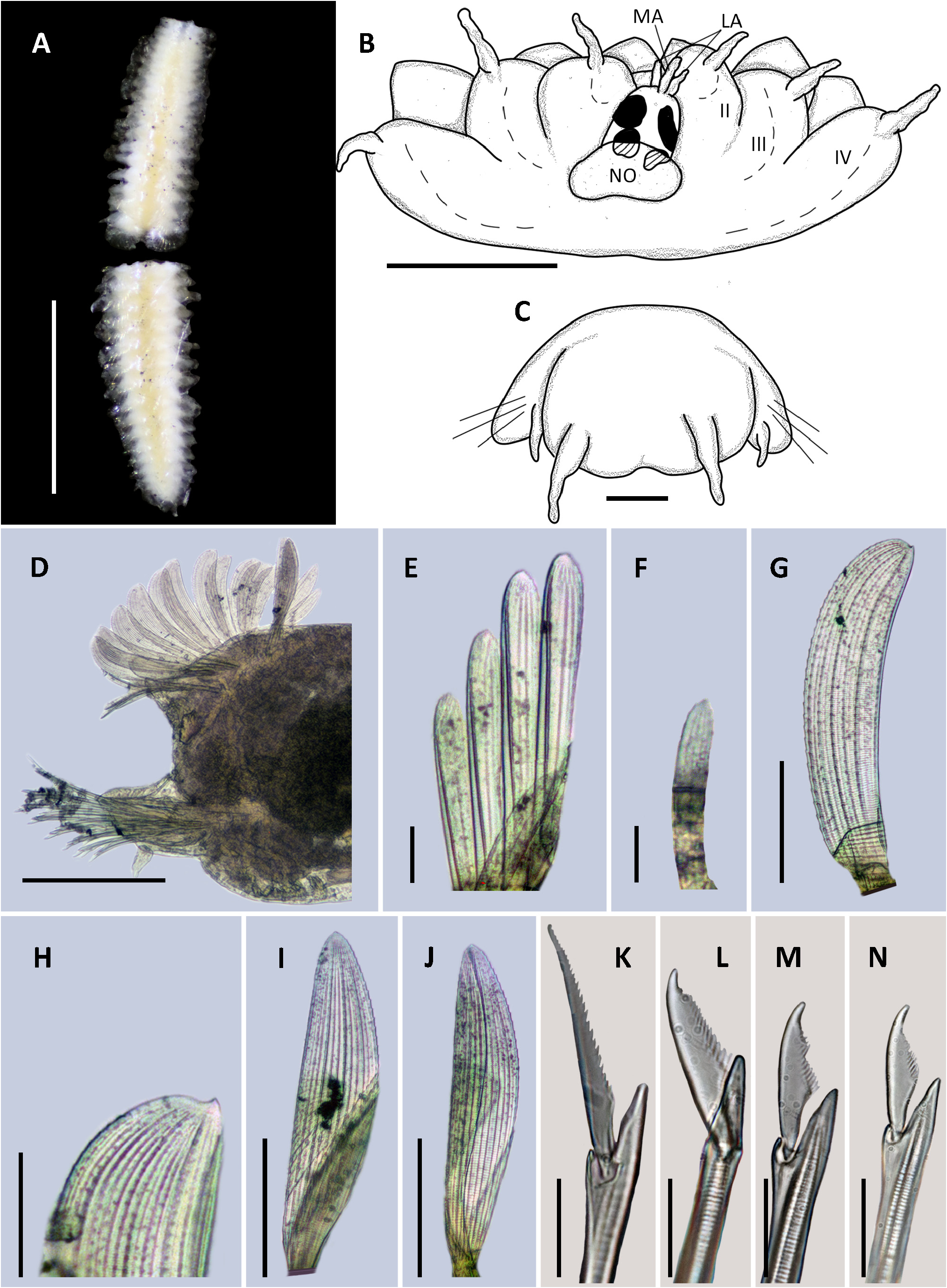
FIGURE 5. Paleanotus karlyae n. sp., holotype (ECOSUR-258). A) Complete fragmented body. B) Drawing of prostomium, dorsal view. C) Drawing of pygidium, ventral view. D) Parapodium from segment 23. E) Lateral paleae. F) Subunit 1. G) Main palea. H) Apex of G. I–J) Median paleae. K) Unit 1. L) Unit 2. M) Unit 3. N) Unit 4. Scales: 10 µm (KLMN), 20 µm (CEFH), 50 µm (IJ), 100 µm (B), 200 µm (D), 500 µm (A).
Imageimage/png© Cruz-Gómez, ChristopherCruz-Gómez, Christopher

FIGURE 24. Chrysopetalum tovarae n. sp., holotype (ECOSUR-273). A) Complete fragmented body. B) Drawing of prostomium, dorsal view. C) Drawing of pygidium, ventral view. D) Oocyte. E) Parapodium from segment 20. F) Lateral palea. G) Main palea, lateral-most. H) Main palea, mid-most. I) Main palea, midline-most. J) Median paleae. K–L) Unit 1. M) Unit 2. N) Unit 3. O) Unit 4. Scales: 10 µm (KLMNO), 20 µm (FGHIJ), 50 µm (CD), 100 µm (BE), 1 mm (A).
Imageimage/png© Cruz-Gómez, ChristopherCruz-Gómez, Christopher

FIGURE 25. Apex of main paleae of some Chrysopetalum species from the Tropical Eastern Pacific, and the southernmost part of Warm Temperate Northeast Pacific. Chrysopetalum elegantoides Aguado, Capa & San Martín, 2003 (ECOSUR-3001). A) Main palea, lateral-most. B) Schematic of A. C) Schematic of D. D) Main paleae, midline-most. Chrysopetalum mexicanum n. sp. (ECOSUR-270). E) Main palea, lateral-most. F) Schematic of E. G) Schematic of H. H) Main paleae, midline-most. Chrysopetalum tovarae n. sp. (ECOSUR-273). I) Main palea, lateral-most. J) Schematic of I. K) Schematic of L. L) Main paleae, midline-most.
Imageimage/png© Cruz-Gómez, ChristopherCruz-Gómez, Christopher

FIGURE 26. Previous and new records of chrysopetalids in the Tropical Eastern Pacific. Empty symbols indicate historic records.

Imageimage/png© Cruz-Gómez, ChristopherCruz-Gómez, Christopher

IMAGES

Gallery(4)

See Gallery

Occurrences with images

Source Information

A new genus and seven new species of chrysopetalids (Annelida, Chrysopetalidae) from the Tropical Eastern Pacific

checklist

This dataset contains the digitized treatments in Plazi based on the original journal article Cruz-Gómez, Christopher (2021): A new genus and seven new species of chrysopetalids (Annelida, Chrysopetalidae) from the Tropical Eastern Pacific. Zootaxa 5068 (1): 1-59, DOI: 10.11646/zootaxa.5068.1.1

Abstract

Chrysopetalids annelids have been little studied in the Tropical Eastern Pacific (TEP), with only 24 species recorded in the region. Most records are from northwestern Mexico and Costa Rica, leaving many sites along the Tropical Pacific coast of America unexplored. Furthermore, there are species recorded and described from the region with problems in their status, including questionable records, modest illustrations or descriptions, and lost type material. This paper aims to improve the knowledge of this family in the TEP. Almost 290 specimens were revised, provided from five scientific collections, covering 51 sites along the TEP and nearby. Two subfamilies: Calamyzinae and Chrysopetalinae, nine genera and 20 species were determined. Of these, ten species have been previously recorded, three are indeterminable and seven are new species: Paleanotus karlyae n. sp., Arichlidon mucropaleum n. sp., Bhawania bastidai n. sp., Chrysopetalum mexicanum n. sp., C. tovarae n. sp. A new genus is proposed, Bhawatsonia n. gen. which includes two new species, B. fusa n. sp. as its type species, B. nenoae n. sp. and, the new combination and neotype of B. purpurea n. comb. An updated and revised checklist of all chrysopetalids species recorded in the region is included, currently composed of 16 genera, 30 species, and four morphospecies.

Cruz-Gómez C, plazi (2021). A new genus and seven new species of chrysopetalids (Annelida, Chrysopetalidae) from the Tropical Eastern Pacific. Plazi.org taxonomic treatments database. Checklist dataset https://doi.org/10.11646/zootaxa.5068.1.1 accessed via GBIF.org on 2026-06-15.

CC0Published 11/15/2021View dataset
GBIF Usage Key
190304392
Dataset Key
726fdd32-9199-4ca9-9dcd-2892bc30b2e3
Origin
source
Backbone Key
11376043
Taxon ID
044C3804714EEF0DD7D3FF3D218E9056.taxon
Last Crawled
6/9/2026
Last Interpreted
6/9/2026