
AnimaliaNot EvaluatedacceptedspeciesAccepted
Olindias tenuis
(Fewkes, 1882)
GBIF:190510728
0year
ABOUT
Descriptions(5)
16 S Data: A blastn search in GenBank to find matching sequences to the 16 S sequence gave a very close match with MG 979369, a sequence from a O. tenuis originating from the U. S. Virgin Islands (A. G. Collins, pers. comm.). The sequence divergence was only 0.5 %.
Schuchert, Peter, Collins, Richard (2021): Hydromedusae observed during night dives in the Gulf Stream. Revue suisse de Zoologie 128 (2): 237-356, DOI: 10.35929/RSZ.0049
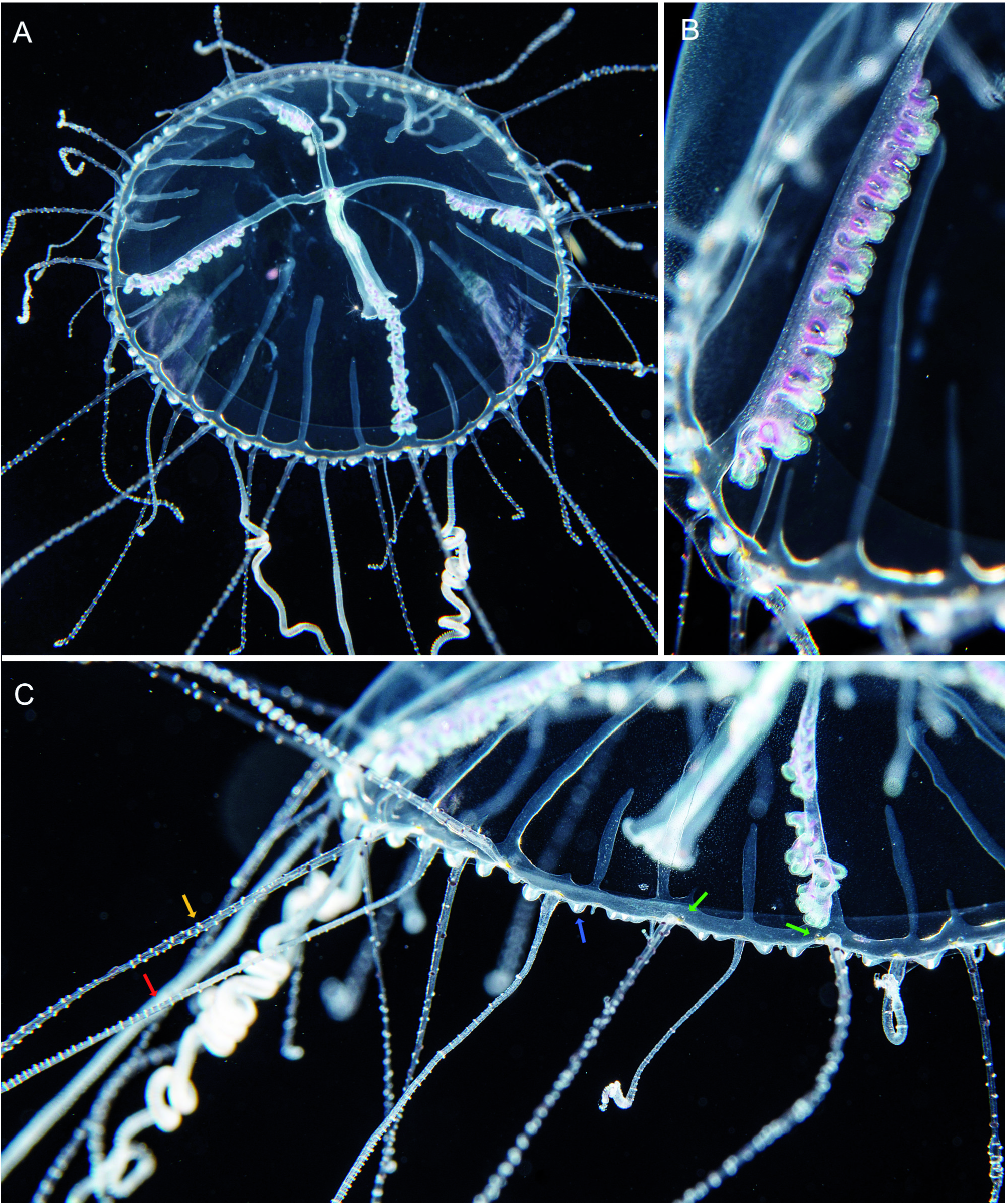
Fig. 63 A-C
Schuchert, Peter, Collins, Richard (2021): Hydromedusae observed during night dives in the Gulf Stream. Revue suisse de Zoologie 128 (2): 237-356, DOI: 10.35929/RSZ.0049
Remarks: The present medusa was identified as O. tenuis primarily based on it geographic occurrence, but its traits matched the diagnosis of Kramp (1959 a) reasonably well [see Table 5 in Toshino et al. (2019)]. The species statuses of O. tenuis and O. sambaquinensis Müller, 1861 have been questioned by e. g. Bigelow (1938) and Kramp (1959 a, 1961), considering them either a subspecies or potentially conspecific with Olindias muelleri Haeckel, 1879 (using the incorrect name Olindias phosphorica, see footnote). The 16 S phylogenetic tree presented in Toshino et al. (2019) suggests that the three species are distinct.
Schuchert, Peter, Collins, Richard (2021): Hydromedusae observed during night dives in the Gulf Stream. Revue suisse de Zoologie 128 (2): 237-356, DOI: 10.35929/RSZ.0049
Distribution: Florida, Bermudas, Bahamas, Puerto Rico (Mayer, 1910; Kramp, 1959 a; Larson, 1986). Type locality: USA, Florida, Key West.
Schuchert, Peter, Collins, Richard (2021): Hydromedusae observed during night dives in the Gulf Stream. Revue suisse de Zoologie 128 (2): 237-356, DOI: 10.35929/RSZ.0049
Examined material: BFLA 4232; 1 specimen, 21 - OCT- 2019; size 23 mm; part preserved in formalin (UF- 013845) and part in alcohol for DNA extraction; 16 S sequence MW 528688. Observations: Olindias medusa with bell flatter than hemisphere; diameter 23 mm. No exumbrellar pigment bands. Manubrium as long as subumbrellar height, width uniform, cruciform cross-section, mouth with four simple lips. Four radial canals with gonads along distal half to 2 / 3. Gonads in development with numerous small oogonia, gonads reaching nearly to circular canal, forming numerous diverticula-like outgrowths along entire length of the gonad (Fig. 63 A-C), along the windings of the diverticula runs a purple-pinkish stripe (Fig. 63 B). 6 to 8 centripetal canals of different lengths per quadrant (Fig. 63 A). Tentacles originating from bell margin without distinct bulb formation, two types present (Fig. 63 C): about 34 primary tentacles with scattered nematocyst clusters, part of the clusters with characteristic dark pigment; few secondary tentacles with transverse nematocysts rings (some of these tentacles likely broken off), lacking dark pigment, usually pendant. No exumbrellar tentacles. No adhesive pads on tentacles. Bell margin with about 90 bulbs lacking tentacles, with radial band of nematocysts on abaxial side. One to two round statocysts next to primary tentacles (Fig. 63 C). Colours: none except for pink stripes on gonad diverticules.
Schuchert, Peter, Collins, Richard (2021): Hydromedusae observed during night dives in the Gulf Stream. Revue suisse de Zoologie 128 (2): 237-356, DOI: 10.35929/RSZ.0049
Export occurrence data
Darwin Core Archive (ZIP)
CLASSIFICATION
Taxonomic Classification Tree

MULTIMEDIA
Media Files(1)
Fig. 63. Olindias tenuis, BFLA4232, bell diameter 23 mm. (A) Oblique aboral view of whole animal. (B) Lateral view of radial canal with gonad diverticula. (C) Bell margin with primary tentacles (yellow arrow) and secondary tentacles (red arrow), green arrows point to statocysts. Note the absence of tentacle bulbs, but numerous bulbs without tentacles (blue arrow).
Imageimage/png© Schuchert, Peter;Collins, RichardSchuchert, Peter;Collins, Richard
IMAGES