
AnimaliaNot EvaluatedacceptedspeciesAccepted
Aequorea neocyanea

Aequorea neocyanea

GBIF:190510757

ABOUT

Descriptions(7)

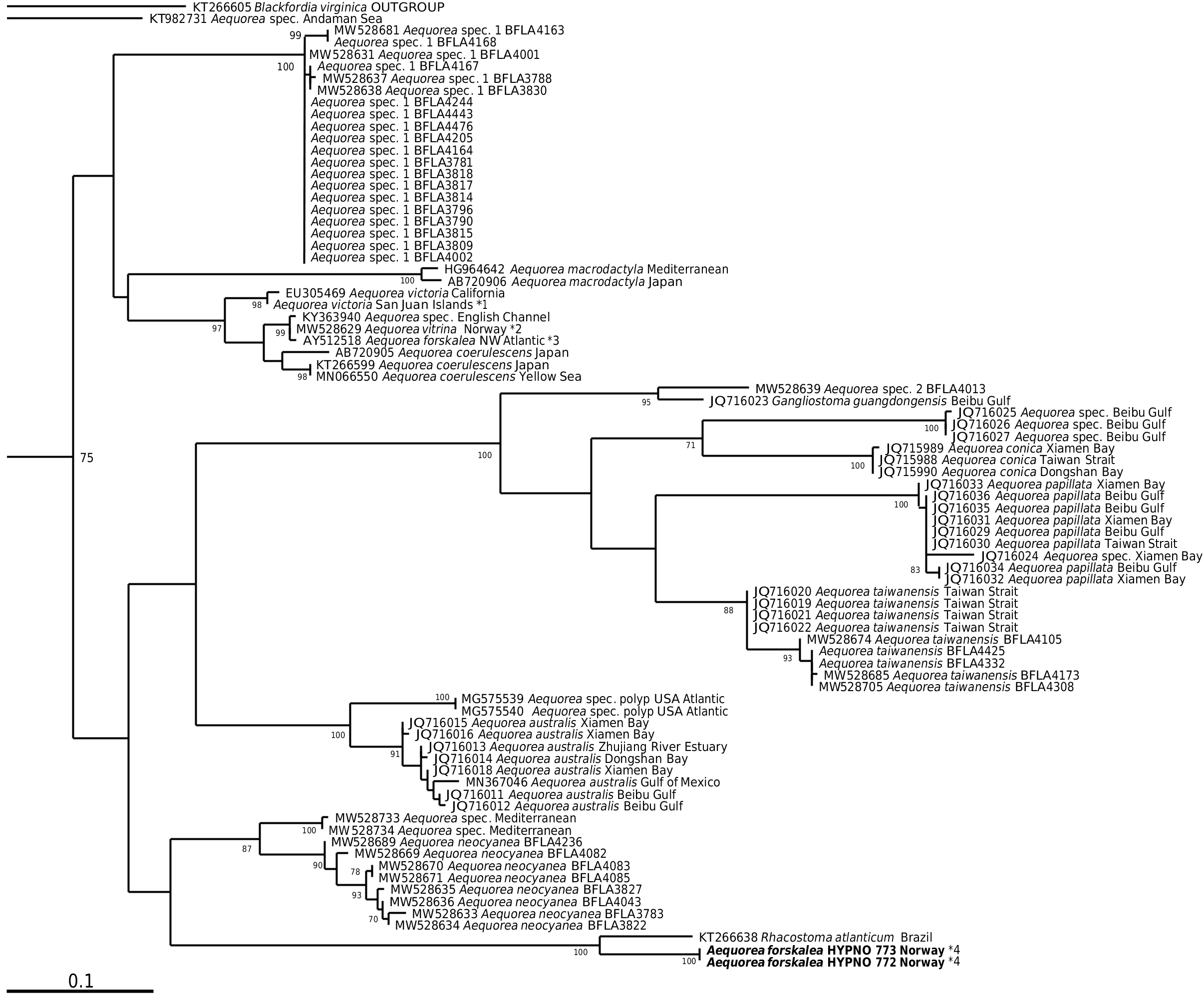
16 S data: The eight haplotypes had a range of divergences of 0.3 - 2.1 % (Table 1, intrapopulation variation). A maximum likelihood tree of the partial 16 S sequence (Fig. 37) yielded a diverse but welldefined clade for this species. Its sister clade comprises two samples from the Mediterranean diverging in 3.7 - 5.2 % of their aligned bases (see discussion below). No relationship to A. forskalea nor to A. macrodactyla is evident though.
Schuchert, Peter, Collins, Richard (2021): Hydromedusae observed during night dives in the Gulf Stream. Revue suisse de Zoologie 128 (2): 237-356, DOI: 10.35929/RSZ.0049
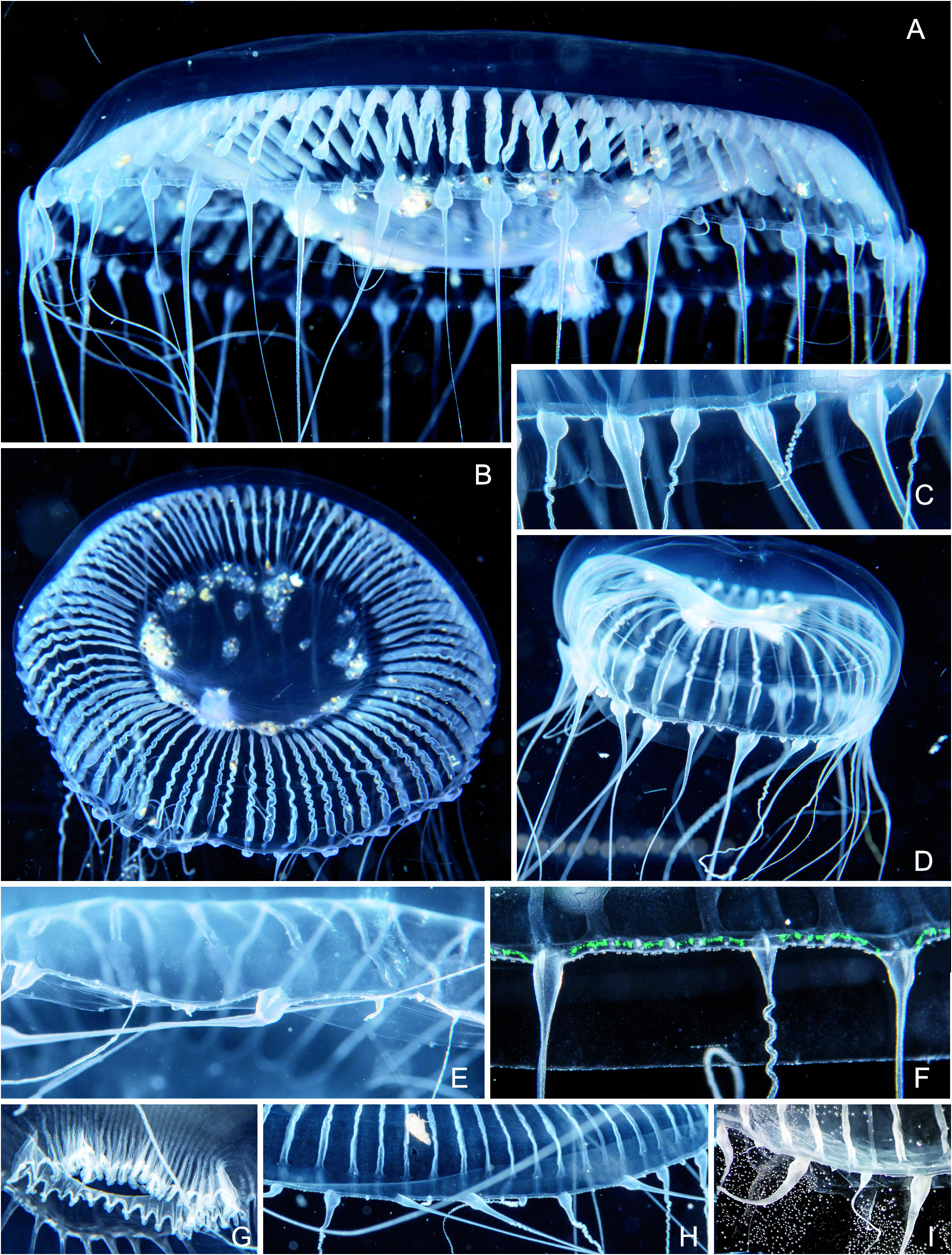
Fig. 38 A-I
Schuchert, Peter, Collins, Richard (2021): Hydromedusae observed during night dives in the Gulf Stream. Revue suisse de Zoologie 128 (2): 237-356, DOI: 10.35929/RSZ.0049
Observations: Typical Aequorea medusae, diameters of animals with well developed gonads 50 to 100 mm, sizes of animals without gonads (juveniles) up to 30 - 40 mm. Umbrella in fully grown animals relatively flat (Fig. 38 A), about 1 / 4 of diameter, in younger ones more spherical. Stomach large, diameter 1 / 2 of bell diameter, with shallow jelly cone inside. Mouth rim with short fimbriae only (Fig. 38 G), same number as radial canals, continued centrifugally as fine rib or streak on stomach and then as radial canal. Radial canals in mature animals 25 to 100, more commonly 60 to 80, lower number might also be due to regeneration from fragments. A few (2 - 4) incomplete radial canals growing centrifugally can be present, also irregularities like fusions or branching, but these likely of traumatic origin. Gonads along radial canals, spanning from almost the beginning to a short distance from circular canal (Fig. 38 A-B), bilamellar, when fully developed large and hanging into subumbrella like a curtain, walls much folded or undulated (Fig. 38 A). Fully formed tentacles 21 to 50, additionally some small ones or mere bulbs that will likely later also develop into tentacles. Observed ratios of radial canals to fully formed tentacles 1.0 - 3.0. Tentacles in life nearly always with a swollen base (Fig. 38 C, E, F, H) degree of swelling is apparently modifiable and could depend on environment or physiological state as once the animal is preserved the swelling is much reduced (Fig. 38 I). Regularly there is a faint abaxial keel, often emphasized or feigned by a whitish line on median of abaxial side (Fig. 38 E, F, H) caused by an accumulation of nematocysts, this line only visible in living animals. In swollen bulbs abaxial side or keel often elongated into abaxial spur (Fig. 38 A- D), in preserved material much less visible or absent. Excretory papillae absent, excretory pores could not be found reliably in the preserved material. Four or more statocysts (up to 14) between two tentacles or bulbs, 2 - 3 statoliths per statocyst. Colours: unpigmented, very well grown specimens with a pink hue.
Schuchert, Peter, Collins, Richard (2021): Hydromedusae observed during night dives in the Gulf Stream. Revue suisse de Zoologie 128 (2): 237-356, DOI: 10.35929/RSZ.0049
Remarks: We think that the present material most likely belongs to the same species identified by Mayer (1900, 1904) as Zygodactyla cyanea, although there are some differences. Zygodactyla cyanea was first described by L. Agassiz (1862) based on animals from Key West, Florida. His brief description was later expanded (A. Agassiz, 1865) and a figure of a fully-grown animal provided. Agassiz (1865) reported it in great numbers along the Florida Reef. Mayer (1900, 1904) then added more details using material from Florida and the Bahamas, notably also figures of the tentacle bulbs and of younger stages. As Mayer was a collaborator of A. Agassiz, his identification was certainly discussed with the latter. In his 1910 monograph, Mayer then synonymized Z. cyanea with Aequorea forskalea Péron & Lesueur, 1810 without further discussion. Our material matches more Z. cyanea of Mayer (1900, 1904) and not A. forskalea for the following reasons: 1) Mayer found it as very common off the coast of Florida and in our study it was likewise a frequent medusa. 2) The type locality is in the same region and connected by the Gulf stream. 3) Mayer describes and depicts the tentacle bulbs with an abaxial spur, but incorrectly identified it as an exumbrellar excretory papilla (which is unknown in hydromedusae). This corresponds to the bulbs we found (Fig. 38), although this trait is not a unique diagnostic feature for the species as it occurs also in Aequora spec. 1 (see below) and others, e. g. A. krampi Bouillon, 1984. Aequorea forskalea in current understanding has evenly tapering, not much swollen tentacle bases (Fig. 39). 4) The mature animals examined genetically had diameters of 5 to 6 cm, a stomach width of 1 / 2 the bell diameter, and up to 100 radial canals, thus matching Agassiz’ and Mayer’s values. There are also traits that do not match. Notably our maximum tentacle number was about 50 and the ratio of radial canals to tentacles usually in the region of 2. Mayer gives up to 100 tentacles and a ratio of 1. These traits are known to be very variable in this genus and should be used with caution to separate species. Moreover, we found that Aequorea medusae often get fragmented and then reconstituted themselves. This vegetative reproduction via fission could account for much of the variation seen in the Aequorea (see Stretch & King, 1980). Contrary to Mayer (1910), we think that Agassiz’ medusa should be kept distinct from A. forskalea. The 16 S sequences of our material were different from A. forskalea of the NE Atlantic (Fig. 37), the bell sizes were smaller than for typical A. forskalea, and tentacles bases are usually swollen and may have an abaxial keel and spur. The name Aequorea forskalea was introduced by Péron & Lesueur, 1810 to replace the preoccupied name Medusa aequorea Forsskål, 1775 and they formally also restricted the type locality to the Mediterranean Sea. Forsskål (1775) provided a good illustration of his medusa which he had seen in the NE Atlantic or the Mediterranean and which we must assume to represent the type specimen. Forsskål’s medusa was quite large with a diameter of 23 cm [in his Latin description he states “ Diameter spithamalis ”, a spithame being an ancient Greek / Byzantine length unit corresponding to 0.231 m]. Our current scope of the species was outlined by Russell (1953) and Kramp (1959 a) who give sizes of up to 175 mm and 60 - 80 radial canals. The bases of the tentacles are almost invariably given as evenly tapering and not swollen (Fig. 39, see also Kramp, 1959 a: fig. 234 b). This is clearly different to the ones observed here (Fig. 38) but some cautionary remarks are necessary. The degree of inflation of the tentacle base, the keel formation, and the abaxial spur seem to be variable and a partly transient feature. The swelling depends perhaps on the activity of the animal, the osmotic situation, or the digestive cycle. In preserved animals it is much less pronounced (Fig. 38 I), but still apparently different from A. forskalea. The status of the closely related Mediterranean Aequorea samples (Fig. 37, MW 528733 and MW 528734, see Material & Methods) is not clear. They were immature and 4 to 5 cm in size and their tentacle bases resembled the ones shown in Fig. 38 E and not Fig. 39 B. It could be that they also belong to the present species. The A. forskalea of the Mediterranean also differentiate into two morphotypes when examined alive (unpublished observations): one with slender, evenly tapering tentacles as shown in Fig. 39 B and another with much swollen bases of the bulbs resembling the ones shown in Fig. 38 A-B. The Brazilian medusae identified as A. macrodactyla by Nogueira et al. (2016) do not match well the latter species (see Kramp, 1968; Schuchert, 2017 a) but conform much better with the scope of A. neocyanea as documented here. The status of the Mediterranean Aequorea morphotypes as well as many other populations should be examined using genetic techniques.
Schuchert, Peter, Collins, Richard (2021): Hydromedusae observed during night dives in the Gulf Stream. Revue suisse de Zoologie 128 (2): 237-356, DOI: 10.35929/RSZ.0049
Taxonomy: In order to avoid a secondary homonymy with Aequorea cyanea de Blainville, 1834, we propose here the replacement name Aequorea neocyanea for Zygodactyla cyanea L. Agassiz, 1862. Zygonema Brandt, 1838 is a synonym of Aequorea Péron & Lesueur, 1810 (Ranson, 1949) and Agassiz’ Z. cyanea must be transferred to Aequorea.
Schuchert, Peter, Collins, Richard (2021): Hydromedusae observed during night dives in the Gulf Stream. Revue suisse de Zoologie 128 (2): 237-356, DOI: 10.35929/RSZ.0049
Distribution: Florida, Bermuda, perhaps also Brazil and even Mediterranean (see below). Type locality: Atlantic Ocean, USA, Florida, Key West.
Schuchert, Peter, Collins, Richard (2021): Hydromedusae observed during night dives in the Gulf Stream. Revue suisse de Zoologie 128 (2): 237-356, DOI: 10.35929/RSZ.0049
Material examined: BFLA 3783; 1 specimen; 18 - SEP- 2018; size 50 mm, with gonads; part preserved in formalin and deposited as UF- 013449, part in alcohol for DNA extraction; 16 S sequence MW 528633 – BFLA 3822; 1 specimen; 25 - OCT- 2018; size 40 mm, with gonads; part preserved in formalin and deposited as UF- 013427, part in alcohol for DNA extraction; 16 S sequence MW 528634. – BFLA 3827; 1 specimen; 14 - NOV- 2018; size 50 mm, with gonads; part preserved in formalin and deposited as UF- 013435, part in alcohol for DNA extraction; 16 S sequence MW 528635. – BFLA 4043; 1 specimen; 01 - APR- 2019; size 50 mm, with gonads; part preserved in formalin and deposited as UF- 013436, part in alcohol for DNA extraction; 16 S sequence MW 528636. – BFLA 4082; 1 specimen; 07 - MAY- 2019; size 55 mm, with gonads; part preserved in formalin and deposited as UF- 013787, part in alcohol for DNA extraction; 16 S sequence MW 528669. – BFLA 4083; 1 specimen; 07 - MAY- 2019; size 42 mm, with gonads; part preserved in formalin and deposited as UF- 013788, part in alcohol for DNA extraction; 16 S sequence MW 528670. – BFLA 4085; 1 specimen; 07 - MAY- 2019; size 60 mm, with gonads; part preserved in formalin and deposited as UF- 013789, part in alcohol for DNA extraction; 16 S sequence MW 528671. – BFLA 4236; 1 specimen; 21 - OCT- 2019; size 30 mm, with gonads; part preserved in formalin and deposited as UF- 013844, part in alcohol for DNA extraction; 16 S sequence MW 528689. – BFLA 4304; 1 specimen; 15 - JAN- 2020; size 90 mm, with gonads; part preserved in formalin and deposited as UF- 013881, no tissue sample. – 1 specimen photographed 08 - FEB- 2017, not collected; size 100 mm, with developed gonads. – 1 specimen photographed 06 - JUN- 2020, not collected; size 70 mm, with developed gonads. The formalin samples are mostly strongly fragmented and damaged.
Schuchert, Peter, Collins, Richard (2021): Hydromedusae observed during night dives in the Gulf Stream. Revue suisse de Zoologie 128 (2): 237-356, DOI: 10.35929/RSZ.0049

Export occurrence data

Darwin Core Archive (ZIP)

CLASSIFICATION

Taxonomic Classification Tree

MULTIMEDIA

Media Files(3)

Fig. 38. Aequorea neocyanea new name. (A-C) BFLA4085, bell diameter 60 mm. (A) Oblique view from below. (B) Aboral view. (C) Bell margin with tentacles and their bulbs. (D) BFLA4083, bell diameter 42 mm, young animal with beginning gonad development. (E) BFLA4043, bell margin. (F) BFLA4236, bell margin, the green dots are not a pigment but likely due interference effects. (G) BFLA4236, mouth region with short fimbria. (H) BFLA3783, bell margin. (I) BFLA3783, tentacles after fixation in formalin.

Imageimage/png© Schuchert, Peter;Collins, RichardSchuchert, Peter;Collins, Richard

Fig. 39. Aequorea forskalea. (A) Living medusa from Norway, bell margin seen from oral side. Photo courtesy of Luis Martell, sample HYPNO 772. (B) Preserved sample from the Mediterranean, MHNG-INVE-0055261.
Imageimage/png© Schuchert, Peter;Collins, RichardSchuchert, Peter;Collins, Richard

Fig. 37. 16S maximum likelihood phylogenetic tree of the genus Aequorea and related genera obtained with PhyML (GTR+G+I model) using about 600 bp positions of the mitochondrial 16S gene. Node-support values are bootstrap values of 100 pseudoreplicates (shown only if> 70%). Sequence labels start with the GenBank numbers (except for identical haplotypes) permitting the retrieval of more information. Red labels are new sequences from this study, for the taxa in bold either a voucher specimen or photos of it have been examined. Notes: *1) Unpublished, L. Leclère, pers. comm. *2) See Material & Methods. *3) Could be a misidentification. *4) Unpublished, A. Hosia & L. Martell, pers. comm., see Fig. 39A.

Imageimage/png© Schuchert, Peter;Collins, RichardSchuchert, Peter;Collins, Richard

IMAGES

Gallery(3)

See Gallery

Occurrences with images

Source Information

Hydromedusae observed during night dives in the Gulf Stream

checklist

This dataset contains the digitized treatments in Plazi based on the original journal article Schuchert, Peter, Collins, Richard (2021): Hydromedusae observed during night dives in the Gulf Stream. Revue suisse de Zoologie 128 (2): 237-356, DOI: 10.35929/RSZ.0049

Abstract: Hydromedusae were photographed and collected during 75 night-time dives in the Gulfstream off Florida. Most of the collected material was used to obtain DNA extracts and subsequently to determine part of the mitochondrial 16S rRNA gene, a barcode marker preferentially used for hydrozoans. The morphological data and the 16S barcodes permitted us to identify 46 species and 6 additional species nameable only to the genus level. Photos and descriptions are provided for all of them and the taxonomy and species status discussed. Six new species are described: Pandeopsis prolifera n. spec., Zanclea mayeri n. spec., Corymorpha floridana n. spec., Staurodiscus luteus n. spec., Octophialucium irregularis n. spec., Solmaris flavofinis n. spec. The new family Wuvulidae is proposed for the genus Wuvula Bouillon, Seghers & Boero, 1988. The new name Aequorea neocyanea is introduced for Zygodactyla cyanea L. Agassiz, 1862 to avoid a secondary homonymy with Aequorea cyanea de Blainville, 1834. Zygodactyla cyanea was considered to be a synonym of Aequorea forskalea Péron & Lesueur, 1810 for most of the 20th century, but we present arguments that it should be kept distinct from the latter and it must be transferred to the genus Aequorea. The genus Otoporpa Xu & Zhang, 1978 is regarded here as congeneric with Pegantha Haeckel, 1879 and its type species Otoporpa polystriata Xu & Zhang, 1978 is therefore changed to Pegantha polystriata (Xu & Zhang, 1978) new comb. Dipleurosoma brooksii Mayer, 1910 is recognized as a new synonym of Staurodiscus kellneri (Mayer, 1910); Staurodiscus heterosceles Haeckel, 1879 as a new synonym of Staurodiscus tetrastaurus Haeckel, 1879; Orchistoma agariciforme Keller, 1884 and Tetracannota collapsum Mayer, 1900 both as new synonyms of Orchistoma pileus (Lesson, 1843). The following Indo-Pacific species are newly recorded for the Atlantic Ocean: Pandeopsis ikarii (Uchida, 1927), Aequorea taiwanensis Zheng et al., 2009; Zygocanna apapillatus Xu, Huang & Guo, 2014; Gastroblasta timida Keller, 1883; Cunina becki Bouillon, 1985; and Pegantha polystriata (Xu & Zhang, 1978). The 16S sequences also permitted us to discover several new links with polyp stages, this for Cirrhitiara superba (Mayer, 1900), Euphysilla pyramidata Kramp, 1955, Zancleopsis dichotoma, and Melicertissa mayeri Kramp, 1959. Detailed, high resolution photos of living medusae were found to be very useful for taxonomic purposes and are mostly preferable to preserved, damaged specimens obtained with plankton nets. Photos of living animals also permit us to better document material used to determine 16S barcodes and make the latter useable for taxonomic revisions.

Schuchert P, Collins R, felipe (2021). Hydromedusae observed during night dives in the Gulf Stream. Plazi.org taxonomic treatments database. Checklist dataset https://doi.org/10.35929/rsz.0049 accessed via GBIF.org on 2026-06-16.

CC0Published 10/21/2021View dataset
GBIF Usage Key
190510757
Dataset Key
172fa5c5-c0c4-4bd7-b710-d608237b8458
Origin
source
Backbone Key
11370535
Taxon ID
D0118A7C5B310055FED9FA09FE7E7F0B.taxon
Last Crawled
6/9/2026
Last Interpreted
6/9/2026