
AnimaliaNot EvaluatedacceptedspeciesAccepted
Zygocanna apapillatus
Xu, Huang & Guo, 2014
GBIF:190510759
0year
ABOUT
Descriptions(5)
16 S Data: The single haplotype (MW 528704) was used in a blastn search in GenBank and gave as best match with 94 % identity Cyclocanna producta (KY 570308) followed by several Mitrocomidae and Tiaropsidae with similar scores. A maximum likelihood phylogeny using a wide selection of leptomedusae also associated the sequence with the same families, but with insufficient bootstrap support (tree not shown).
Schuchert, Peter, Collins, Richard (2021): Hydromedusae observed during night dives in the Gulf Stream. Revue suisse de Zoologie 128 (2): 237-356, DOI: 10.35929/RSZ.0049
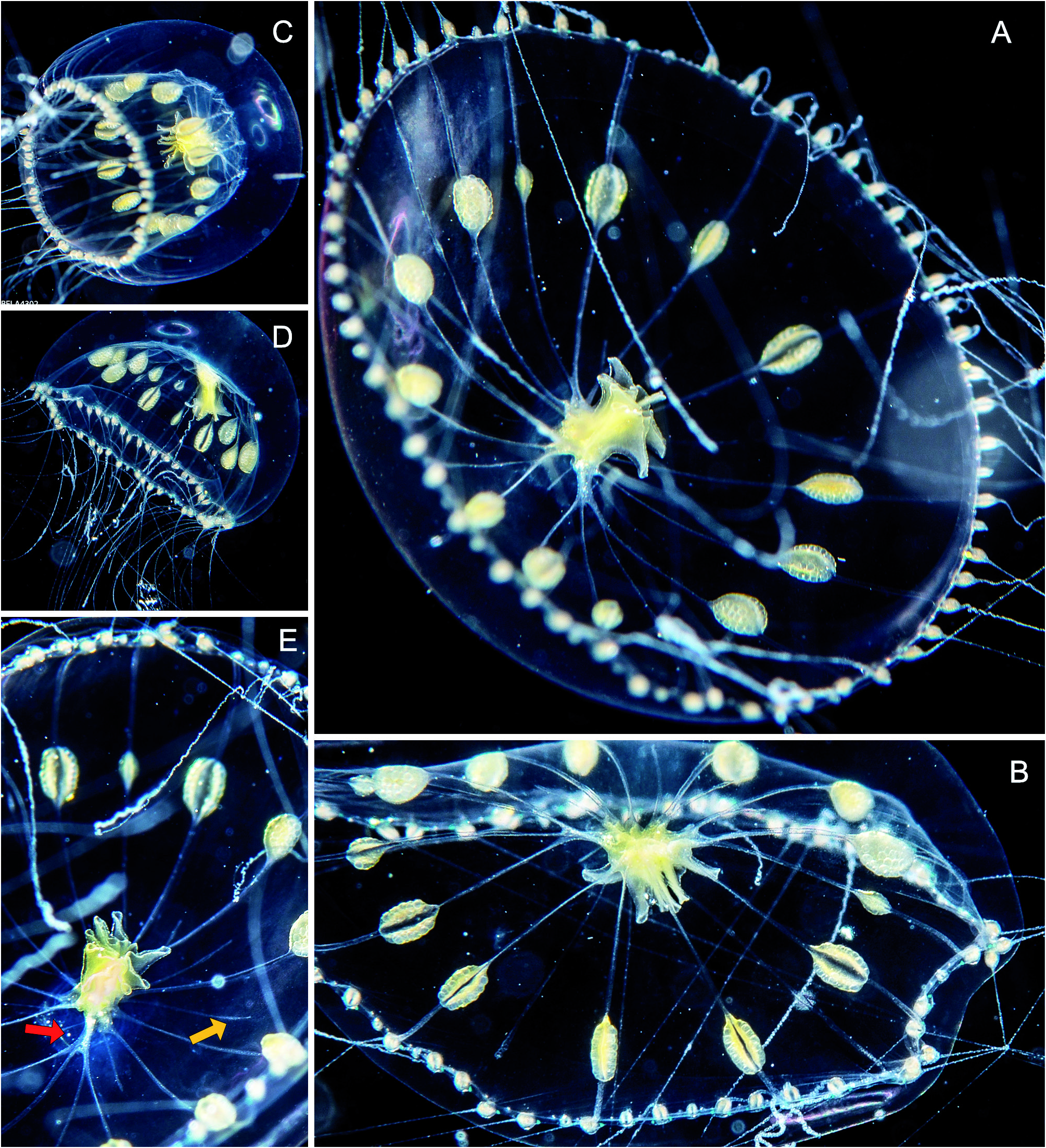
Fig. 43 A-E
Schuchert, Peter, Collins, Richard (2021): Hydromedusae observed during night dives in the Gulf Stream. Revue suisse de Zoologie 128 (2): 237-356, DOI: 10.35929/RSZ.0049
Observations: Bell diameter 5 mm, in relaxed state wider than high, relatively flat, apical jelly about 1 / 3 of height thinning to bell margin. Manubrium relatively small, diameter> 1 / 10 bell diameter, base irregularly star-shaped, wall with radiating vertical folds, these changing into the corners of 7 (9?) simple mouth lips (Fig. 43 E). About 10 radial canals originate at manubrium base and some immediately branch once or twice so that about 16 radial canals reach the circular canal. In addition to the complete radial canals about 5 developing centrifugal canals that originate from manubrium or complete radial canal (Fig. 43 E). 14 ovoid gonads in about middle of complete radial canals, each with up to 50 oocytes, colour bright yellow with a median colourless, transparent line. 61 long, thin tentacles arising from ovoid bulbs, bulbs bright yellow, few atentaculate, small bulbs also present. One statocyst between pairs of marginal bulbs.
Schuchert, Peter, Collins, Richard (2021): Hydromedusae observed during night dives in the Gulf Stream. Revue suisse de Zoologie 128 (2): 237-356, DOI: 10.35929/RSZ.0049
Remarks: This medusa resembles closely Zygocanna apapillatus Xu, Huang & Guo, 2014 and it could be conspecific. We were nevertheless reluctant to attribute it to this species for reasons given below. Zygocanna apapillatus is a very rare medusa only known from two specimens collected off the coast of Vietnam. The first description is only available in Chinese (Xu et al., 2014), but an English translation and the figures are given in the WoRMS database (Schuchert, 2020; urn: lsid: marinespecies. org: taxname: 828546). Our specimen differs only minimally, having a smaller manubrium diameter, less radial canals, and a higher number of gonads. However, some incomplete, developing radial canals suggest that the final number of radial canals could be higher than observed in the only specimen we had. Based on morphology alone, traditional morphology-based systematics would have treated them as conspecific. With its small stomach, Zygocanna apapillatus is an atypical member of the genus Zygocanna and the Aequoridae (comp. Kramp, 1968) and it likely belongs to another family. The comparison of the 16 S sequence obtained from our specimen indicated a similarity and possible relationship with several Mitrocomidae and Tiaropsidae but without sufficient bootstrap support due to the poor resolving power of the 16 S marker for relationships above the genus level. There was clearly no relationship with Aequoreidae (tree not shown). Mitrocomidae and Tiaropsidae are both characterized by open statocysts, an important taxonomic trait that distinguishes them from most other leptomedusae which have either closed or no statocysts (comp. Bouillon et al., 2006). Unfortunately, we were unable to determine if it had open statocysts (a microscopic examination of living tissue or of histologic sections is needed for this). Without this information a correct identification of the species is impossible. This also holds true for the original description of Zygocanna apapillatus. Because of this uncertainty we identified our specimen only as Zygocanna cf. apapillatus.
Schuchert, Peter, Collins, Richard (2021): Hydromedusae observed during night dives in the Gulf Stream. Revue suisse de Zoologie 128 (2): 237-356, DOI: 10.35929/RSZ.0049
Examined material: BFLA 4302; 1 specimen; 15 - JAN- 2020; preserved in alcohol for DNA extraction; 16 S sequence MW 528704.
Schuchert, Peter, Collins, Richard (2021): Hydromedusae observed during night dives in the Gulf Stream. Revue suisse de Zoologie 128 (2): 237-356, DOI: 10.35929/RSZ.0049
Export occurrence data
Darwin Core Archive (ZIP)
CLASSIFICATION
Taxonomic Classification Tree

MULTIMEDIA
Media Files(1)
IMAGES