
AnimaliaNot EvaluatedacceptedspeciesAccepted
Octophialucium aphrodite
(Bigelow, 1928)
GBIF:190510771
0year
ABOUT
Descriptions(6)
16 S Data: Searching GenBank for sequences similar to the obtained 16 S sequences indicated a relationship to other leptomedusae, but gave no matches with more than 92 % sequence identity. A maximum likelihood analysis of a wide selection of leptomedusae did not identify relationships with sufficient bootstrap support (results not shown). The two haplotypes differed in 0.8 % of their base pairs.
Schuchert, Peter, Collins, Richard (2021): Hydromedusae observed during night dives in the Gulf Stream. Revue suisse de Zoologie 128 (2): 237-356, DOI: 10.35929/RSZ.0049
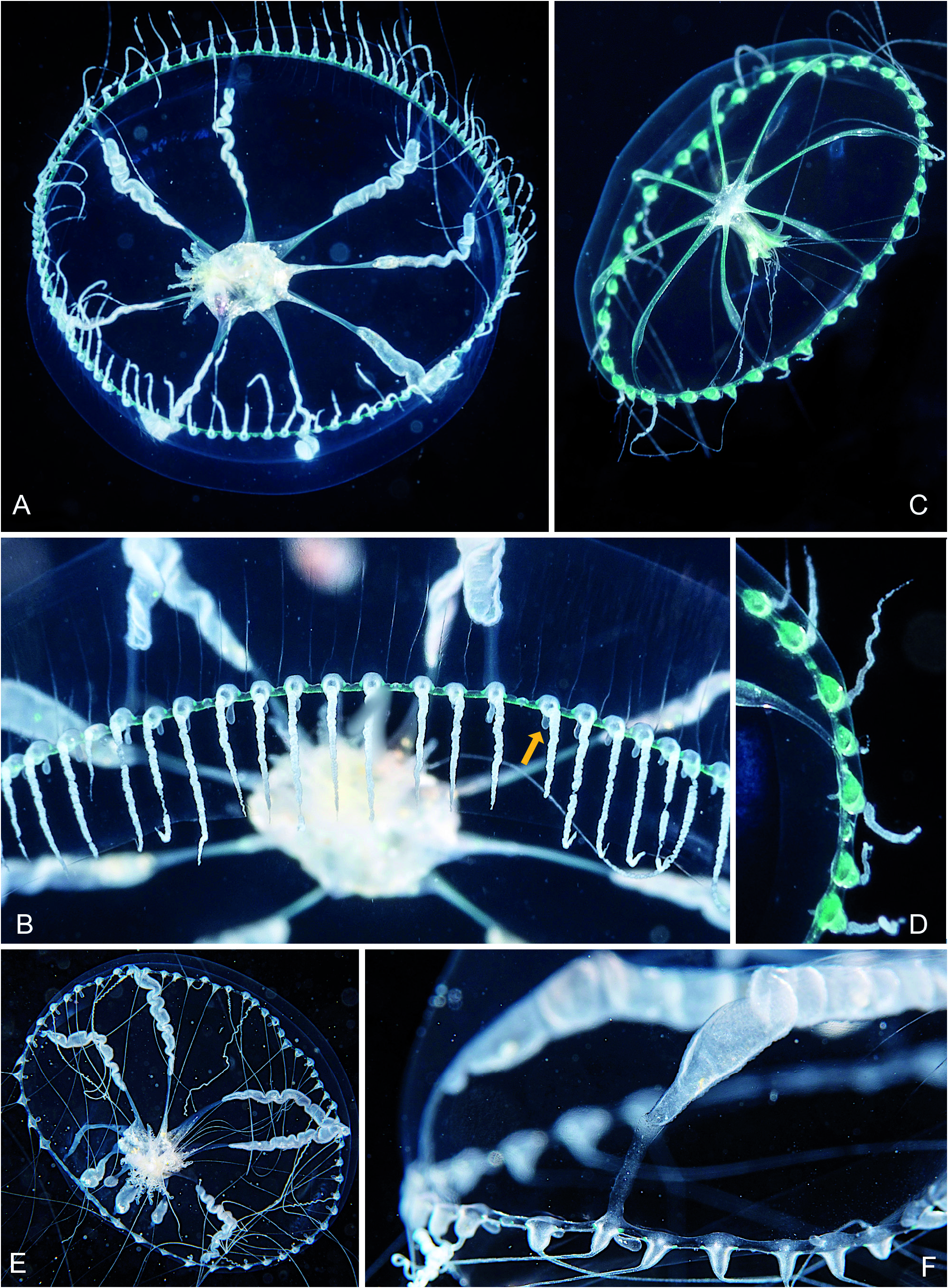
Fig. 44 A-F
Schuchert, Peter, Collins, Richard (2021): Hydromedusae observed during night dives in the Gulf Stream. Revue suisse de Zoologie 128 (2): 237-356, DOI: 10.35929/RSZ.0049
Observations on Florida specimens: Mature medusa diameter up to 26 mm, height about 10 mm, umbrella rather flat, apical jelly about half the height of the umbrella, lateral wall thin. Stomach large, tubular, base an eight-rayed star, mouth with eight long perradial lips, rim crenulated (Fig. 44 A, E). Eight to 10 radial canals, tapering somewhat from manubrium to circular canal. Gonads along distal half of radial canals but not reaching to junction with circular canal, serpentine outline (Fig. 44 A), in females with numerous small eggs. Tentacles about 90, tentacle-bulbs elongate conical, abruptly tapering into tentacle; most bulbs with a very large excretory papilla protruding into subumbrella from abaxial side above velum (Fig. 44 B, arrow), excretory papilla in preserved animals much shrunken and rather small. Left and right of tentacle bulb base often a green spot (Fig. 44 B), but which is not due to pigments. Very few incipient bulbs present. Tentacles thin, extensible to long size. One or two statocysts between tentacle pairs (Fig. 44 B). Colour: circular canal with a light green tint, green spots flanking tentacle bulbs in living animals, otherwise colourless. Immature medusa (BFLA 3833, Fig. 44 C) 10 mm in diameter; radial canals, circular canal, and bulbs green, incipient development of gonads, otherwise similar to adult.
Schuchert, Peter, Collins, Richard (2021): Hydromedusae observed during night dives in the Gulf Stream. Revue suisse de Zoologie 128 (2): 237-356, DOI: 10.35929/RSZ.0049
Remarks: Morphologically, the adult specimen BFLA 3823 matches very well the existing descriptions and figures (Bigelow, 1928; Kramp, 1968; Bouillon, 1984 b) of O. aphrodite. Also the comparison material from the Moluccas agreed well [specimens described by Maas (1906) as O. polynema, later referred to O. aphrodite by Bigelow (1928)]. The 16 S sequence divergence of 0.8 % for sample BFLA 3823 and BFLA 3833 was interpreted as intraspecific variation (see Table 1, and Schuchert et al., 2017). BFLA 3833 is a subadult specimen and it was thus attributed to Octophialucium aphrodite mainly based on 16 S sequence similarity. It is somewhat surprising to find this Indo-Pacific medusa in the NW Atlantic Ocean, but it has already been recorded in the Gulf of Mexico by Canudas Gonzàlez (1979). However, the small size (11 mm), the low tentacle numbers (23 - 53), and the high number or radial canals (up to 15) given by Canudas Gonzàlez (1979) make this record somewhat doubtful. No illustration was provided. The animal depicted in Van der Spoel & Bleeker (1988) is unlikely O. octophialucium as it has only 24 tentacles. It is more likely O. medium Kramp, 1955 b which has only 16 tentacles, but otherwise resembles O. aphrodite very much. Octophialucium aphrodite resembles also closely O. funerarium (Quoy & Gaimard, 1827). The latter occurs in the NE Atlantic and the Mediterranean (Cornelius, 1995) and it appears more probable to be found in the westernAtlantic than the Indo-Pacific O. aphrodite. Wang et al. (2018) have recently discussed some differences of the two species, mostly using the shape of the tentacular bulbs and the average number of statocysts between two fully developed tentacles (1 versus 2). However, there are more differences. Most importantly, the manubrium and the tentacle bulbs of O. funerarium are characteristically dark coloured by a black pigment (Quoy & Gaimard, 1827; Kramp & Damas, 1925; Russell, 1953; Cornelius, 1995). Moreover, the jelly is thicker and lentil-shaped, the subumbrella very shallow, the diameter is usually larger (up to 50 mm), and rudimentary bulbs are frequent (rare in O. aphrodite). Bouillon (1984 b) remarked that some published illustrations of O. aphrodite are based on altered specimens and he provided an excellent figure. Based on the references given in the synonymy above, the following updated consensus diagnosis for O. aphrodite can thus be provided: Medusa 15 - 40 mm in diameter when mature, bell flatter than hemisphere, apical jelly about half the height of the bell, lateral wall thin. Manubrium large, tubular, base an eight-rayed star, mouth with eight perradial lips. Eight radial canals, rarely 7, 9, or 10. Gonads spindle-shaped, along distal 1 / 5 to 1 / 2 of radial canals, not reaching to junction with circular canal. 80 - 120 tentacles and as many bulbs, bulbs distinctly separated from tentacles, only few small bulbs without tentacles present. Excretory papillae tubular, large, in life reaching the same length as the bulbs. One or two statocysts between tentacle pairs, statocysts with two concretions. Colours: colourless or greenish circular canal, without black pigment in manubrium and bulbs. Hydroid colony stolonal; hydrotheca pedicellate, with a conical operculum formed by numerous convergent segments that are not clearly demarcated from hydrothecal wall; hydranth with intertentacular web; gonothecae claviform, arising from stolons.
Schuchert, Peter, Collins, Richard (2021): Hydromedusae observed during night dives in the Gulf Stream. Revue suisse de Zoologie 128 (2): 237-356, DOI: 10.35929/RSZ.0049
Distribution: In the Pacific Ocean known from Indonesia, Philippines, Papua New Guinea, and the South China Sea (Kramp, 1968; Bouillon, 1984 b; Wang et al., 2018); in the Indian Ocean from the Mozambique Channel (Kramp, 1957); in the Atlantic Ocean perhaps in the Gulf of Mexico (Canudas Gonzàlez, 1979) and off Florida (this study). Type locality: Sulu Sea.
Schuchert, Peter, Collins, Richard (2021): Hydromedusae observed during night dives in the Gulf Stream. Revue suisse de Zoologie 128 (2): 237-356, DOI: 10.35929/RSZ.0049
Examined material: BFLA 3823; 1 specimen; 14 - NOV- 2018; size 24 mm; part preserved in formalin and deposited as UF- 013428, part in alcohol for DNA extraction; 16 S sequence MW 528632. – BFLA 3833; 1 specimen; 15 - NOV- 2018; size 10 mm; preserved in alcohol for DNA extraction; 16 S sequence MW 528630. – BFLA 4130; 1 specimen; 11 - JUN- 2019; size 26 mm, 10 radial canals; part preserved in formalin and deposited as UF- 013806, part preserved in alcohol for DNA extraction; 16 S sequence identical to MW 528630. MHNG-INVE- 0055283; 2 specimens, badly preserved; Indonesia, Moluccas, Bay of Ambon; collected 27.06.1890 - 02.09.1890; material described and figured in Maas (1906).
Schuchert, Peter, Collins, Richard (2021): Hydromedusae observed during night dives in the Gulf Stream. Revue suisse de Zoologie 128 (2): 237-356, DOI: 10.35929/RSZ.0049
Export occurrence data
Darwin Core Archive (ZIP)
CLASSIFICATION
Taxonomic Classification Tree

MULTIMEDIA
Media Files(1)
Fig. 44. Octophialucium aphrodite, living animals from Florida. (A) Oral view of whole animal BFLA3823, diameter 24 mm. (B) Close up of the bell margin of same animal as shown inA, bell opening facing down. Note the large excretory papillae (arrow) and the green dots flanking the marginal bulbs visible only in life. (C) BFLA3833, oblique aboral, bell diameter 10 mm. (D) Bell margin of medusa shown in C, seen from aboral side. (E) BFLA4130, bell diameter 26 mm, oblique view from oral side. (F) Bell margin of medusa shown in E.
Imageimage/png© Schuchert, Peter;Collins, RichardSchuchert, Peter;Collins, Richard
IMAGES