
AnimaliaNot EvaluatedacceptedspeciesAccepted

Gastroblasta timida
Keller, 1883
GBIF:190510778
0year
ABOUT
Descriptions(5)
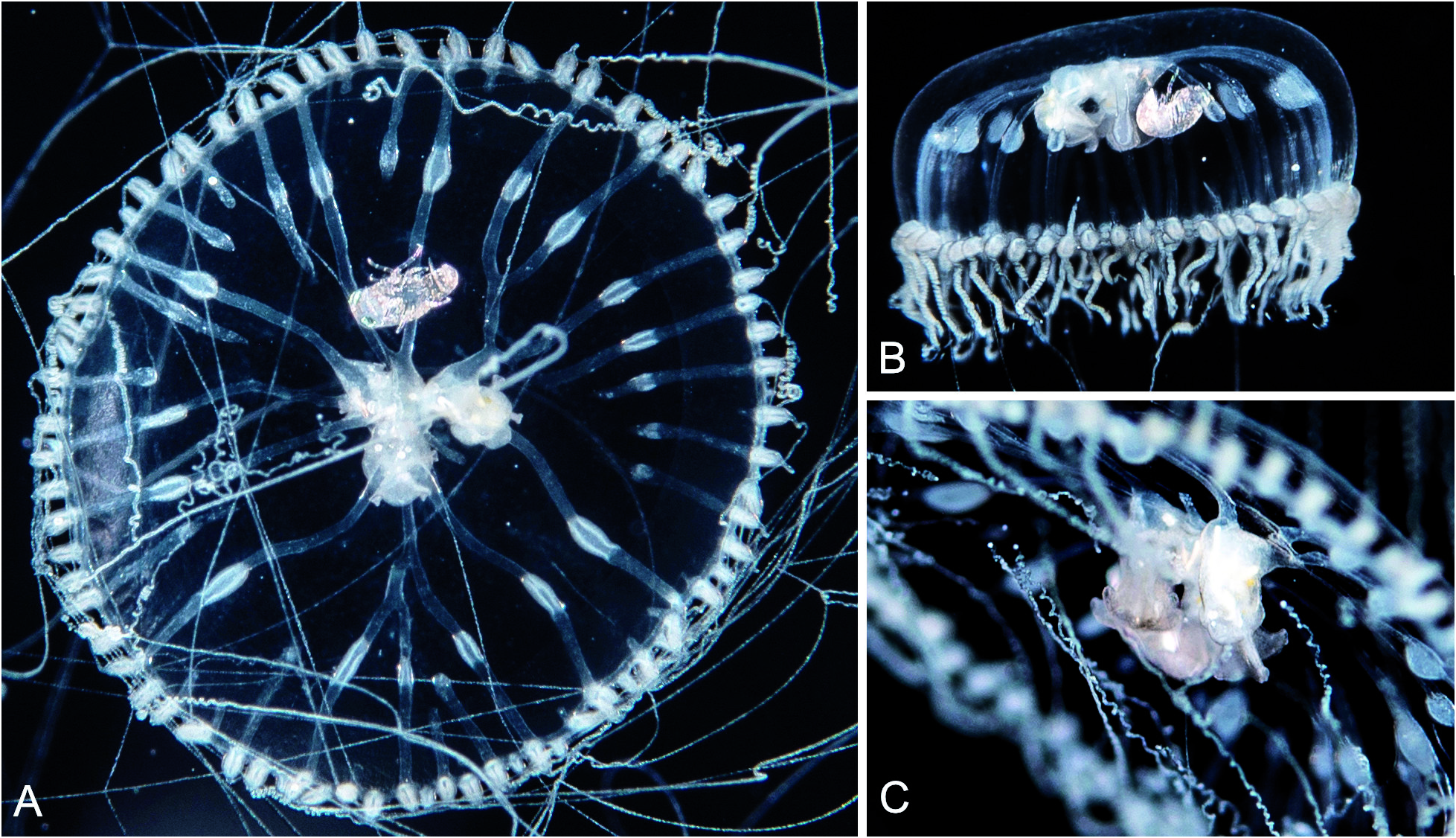
Fig. 47 A-C
Schuchert, Peter, Collins, Richard (2021): Hydromedusae observed during night dives in the Gulf Stream. Revue suisse de Zoologie 128 (2): 237-356, DOI: 10.35929/RSZ.0049
Observations: Bell diameter 6 mm, circular circumference, flatter than hemisphere, apex rather flat, jelly moderately thick, thickness rather even. Three manubria in middle region of bell, connected by the radiating corners of their bases, urn-shaped, mouth cruciform with four simple lips, not crenulated. 15 broad, band-like radial canals reaching circular canal, 12 incomplete centripetal canals originating from circular canal at the position of bulbs, reaching to variable height but not joined to manubrium. 70 large marginal bulbs with tentacles, tentacles long. About as many statocysts as bulbs. Gonads oval thickenings on radial- and centripetal canals, all about in middle of bell.
Schuchert, Peter, Collins, Richard (2021): Hydromedusae observed during night dives in the Gulf Stream. Revue suisse de Zoologie 128 (2): 237-356, DOI: 10.35929/RSZ.0049
Remarks: This medusa matched rather well the description and figures of Gastroblasta timida given by Keller (1883) or Mayer (1910). The species was originally described from a number of specimens caught in the Red Sea, but has never been reported subsequently (Gravili et al., 2007). A closely related and better-known Gastroblasta species is the Mediterranean G. raffaelei Lang, 1886 (see Gravili et al., 2007). It differs from G. timida in having a distinctly elliptical bell. Multioralis ovalis Mayer, 1910 is the only known medusa species from the western Atlantic having multiple manubria. It has an oval bell and only a single radial canal, even when gonads begin to mature. Although it has been reported several times from different localities (Gravili et al., 2007; Wang et al., 2019), some authors like Kramp (1968) thought it to be an abnormal Clytia. Moreover, its structure corresponds to a stage in the development of Gastroblasta raffaelei (Gravili et al., 2007). Although structurally similar to the above described Clytia spec. 2 (Fig. 46 D-G), the broad radial canals distinguish it immediately from it. Additionally, the general aspect and the tentacle number are different. Both share the presence of centripetal canals originating from tentacle bulbs. Some of them might later join the manubrium. In Gastroblasta raffaelei all but two opposite radial canals develop from centripetal canals (Gravili et al., 2007). We therefore hesitatingly attributed the present sample to Gastroblasta timida, despite the wide separation of the occurrences and the somewhat doubtful status of the species.
Schuchert, Peter, Collins, Richard (2021): Hydromedusae observed during night dives in the Gulf Stream. Revue suisse de Zoologie 128 (2): 237-356, DOI: 10.35929/RSZ.0049
Distribution: Red Sea, Florida (this study). Type locality: Red Sea, Sudan, Suakin Harbour.
Schuchert, Peter, Collins, Richard (2021): Hydromedusae observed during night dives in the Gulf Stream. Revue suisse de Zoologie 128 (2): 237-356, DOI: 10.35929/RSZ.0049
Examined material: 04 - MAR- 2019; 1 specimen photographed, not collected.
Schuchert, Peter, Collins, Richard (2021): Hydromedusae observed during night dives in the Gulf Stream. Revue suisse de Zoologie 128 (2): 237-356, DOI: 10.35929/RSZ.0049
Export occurrence data
Darwin Core Archive (ZIP)
CLASSIFICATION
Taxonomic Classification Tree

MULTIMEDIA
Media Files(2)
Fig. 46. Clytia ssp. (A-B) Clytia linearis, BFLA4077, bell dimeter 3.5 mm. (C) Clytia spec. 1, BFLA4283, bell diameter 10 mm. (D)? Clytia spec. 2, BFLA4274, 3 mm; arrow points to incomplete centripetal canal. (E)? Clytia spec. 2, BFLA4269, 4 mm. (F)? Clytia spec. 2, BFLA4253, 3 mm, has 5 complete radial canals. (G)? Clytia spec. 2, doubled manubrium of animal photographed 06-DEC-2019, 6 mm bell, not collected.
Imageimage/png© Schuchert, Peter;Collins, RichardSchuchert, Peter;Collins, Richard
IMAGES