
AnimaliaNot EvaluatedacceptedspeciesAccepted
Wuvula ochracea
(Mayer, 1910)
GBIF:190510785
0year
ABOUT
Descriptions(6)
16 S data: The partial 16 S gene sequence obtained was used to search for similar sequences in GenBank using the blastn function. The results were mostly thecate hydroids, but only with a maximal identity of 83 %.
Schuchert, Peter, Collins, Richard (2021): Hydromedusae observed during night dives in the Gulf Stream. Revue suisse de Zoologie 128 (2): 237-356, DOI: 10.35929/RSZ.0049
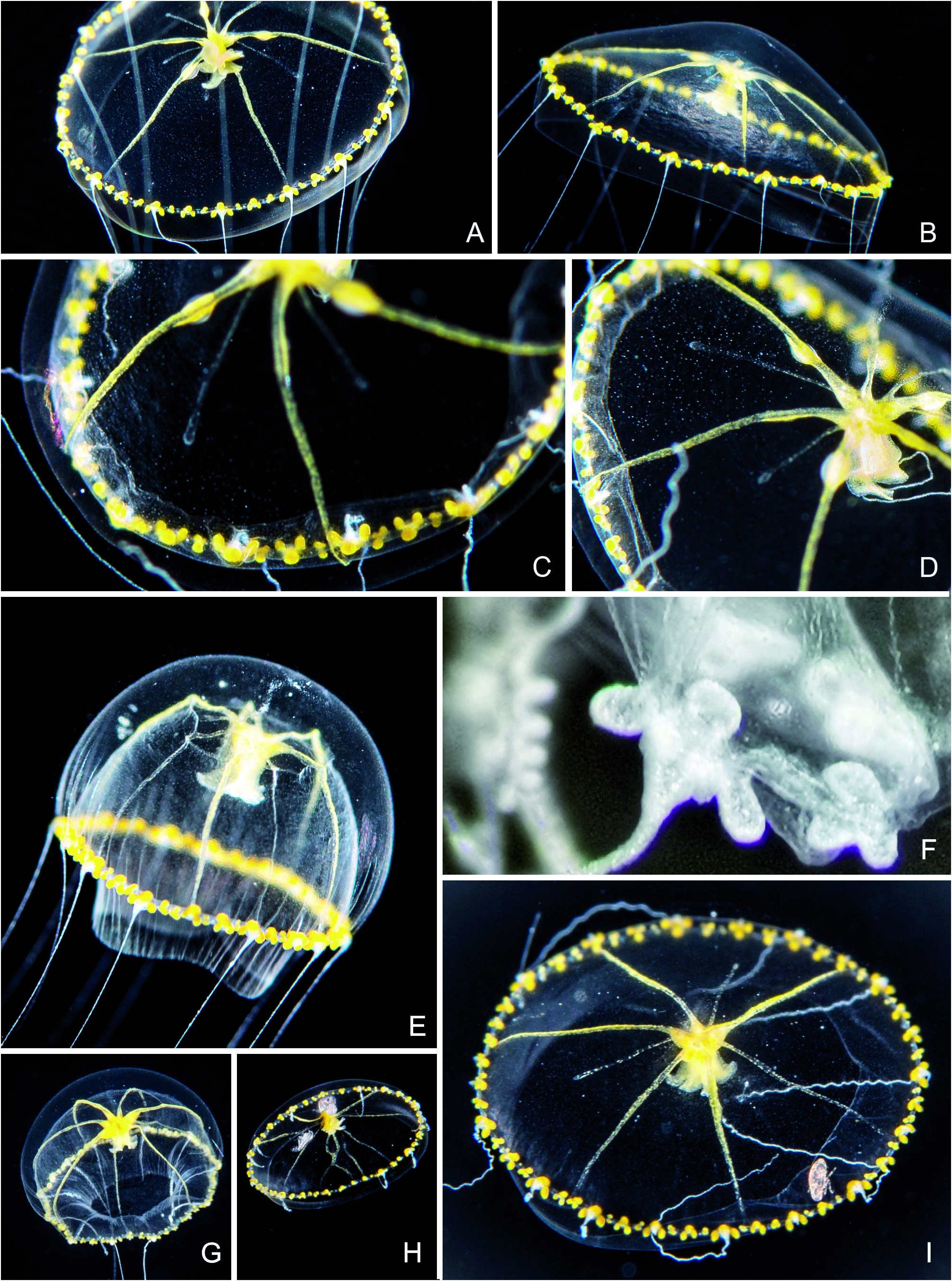
Fig. 36 A-I
Schuchert, Peter, Collins, Richard (2021): Hydromedusae observed during night dives in the Gulf Stream. Revue suisse de Zoologie 128 (2): 237-356, DOI: 10.35929/RSZ.0049
Observations: Medusa 2.5 to 4 mm in diameter, bell flatter than hemisphere when relaxed, jelly relatively thin, velum very broad. Manubrium rather small, star-shaped in cross-section, mouth with about 6 corners drawn out into lips, mouth rim with no or only few folds. Six radial canals reaching circular canal, in addition up to 5 incomplete, thin radial canals originating from manubrium which do not reach circular canal. Complete radial canals with swelling at about 1 / 3 distance from manubrium, presumably the place where gonads will develop. Up to 14 relatively short and thin tentacles, all with a small, whitish marginal bulb; additionally up to 55 small, rudimentary bulbs without tentacles. All marginal bulbs with a laterally attached pair of large, club-shaped diverticula and a third sac-diverticulum above the bulb, the latter being a big excretory papilla, all these diverticula with intense yellow colour. Stomach and radial canals also yellow, but less intense than diverticula.
Schuchert, Peter, Collins, Richard (2021): Hydromedusae observed during night dives in the Gulf Stream. Revue suisse de Zoologie 128 (2): 237-356, DOI: 10.35929/RSZ.0049
Remarks: The observed medusae were smaller (2.5 - 4 mm) than given in Mayer (1910, 8 mm), but Vanhöffen reported also animals of this size and two of our specimens were actually the result of a fragmentation and regeneration. Mayer (1910) had seen only immature animals. One of ours had bulges on the radial canals that we interpreted as the beginning of the gonad formation (Fig. 36 A-D). The small size and vigorous swimming style made it difficult to get good photographs in the sea and the resulting images are unfortunately not so suitable for seeing more details of the bell margin in the living animals. However, the unique, yellow, lateral appendages of the marginal bulbs are unmistakable and the species is unambiguously identifiable. According to Mayer (1910) the appendages contain symbiotic algae (zooxanthellae). Although Mayer (1910) observed large swarms of this medusa, it is a very rare species. To our knowledge, it was only recorded after its first description by Vanhöffen (1913 a), this from near the type locality. Neither searches in GenBank nor sequence comparisons with a number of Leptothecata gave any hint for relationships with other families (results not shown).
Schuchert, Peter, Collins, Richard (2021): Hydromedusae observed during night dives in the Gulf Stream. Revue suisse de Zoologie 128 (2): 237-356, DOI: 10.35929/RSZ.0049
Distribution: Florida. Type locality: USA, Florida, Dry Tortugas archipelago.
Schuchert, Peter, Collins, Richard (2021): Hydromedusae observed during night dives in the Gulf Stream. Revue suisse de Zoologie 128 (2): 237-356, DOI: 10.35929/RSZ.0049
Examined material: BFLA 4361; 1 specimen; 13 - MAR- 2020; size 3.5 mm; preserved in alcohol for DNA extraction; 16 S sequence MW 528713. – BFLA 4372 and BFLA 4373; 16 - MAR- 2020; 1 specimen that split into 4 individuals of 3 mm, and some fragments; preserved in formalin and deposited as UF- 014027 and UF- 014028, fragments in alcohol for DNA extraction; 16 S sequence identical MW 528713. – BFLA 4392; 1 specimen; 17 - MAY- 2020; size 4 mm; preserved in alcohol for DNA extraction; 16 S sequence identical MW 528713. – BFLA 4470; 1 specimen; 17 - JUN- 2020; size 3.5 mm; preserved in alcohol for DNA extraction; 16 S sequence identical MW 528713. – 1 specimen photographed 04 - JUN- 2019, not collected; size 2.5 mm. – 1 specimen photographed 16 - MAR- 2020, not collected; size 4 mm.
Schuchert, Peter, Collins, Richard (2021): Hydromedusae observed during night dives in the Gulf Stream. Revue suisse de Zoologie 128 (2): 237-356, DOI: 10.35929/RSZ.0049
Export occurrence data
Darwin Core Archive (ZIP)
CLASSIFICATION
Taxonomic Classification Tree

MULTIMEDIA
Media Files(1)
Fig. 36. Wuvula ochracea. (A-D) Animal observed 04-JUN-2019, ca. 2.5 mm, different views of the same animal, note beginning gonad development on radial canals. (E) BFLA4392, size 4 mm. (F) BFLA4372, preserved sample, view from adaxial side on a bulb with its appendages. (G) BFLA4470, size 3.5 mm. (H) BFLA4361, size 3.5 mm. (I) Animal observed 16-MAR-2020, not collected, size 4 mm.
Imageimage/png© Schuchert, Peter;Collins, RichardSchuchert, Peter;Collins, Richard
IMAGES