
AnimaliaNot EvaluatedacceptedspeciesAccepted
Pegantha polystriata

Pegantha polystriata

(Xu & Zhang, 1978) Peter, 2021

GBIF:190510798

0year

ABOUT

Descriptions(6)

16 S data: The single sequence obtained clustered in a clade comprising other Pegantha as well as Cunina and Pseudaegina species, but without resolved internal relationships (Fig. 48).
Schuchert, Peter, Collins, Richard (2021): Hydromedusae observed during night dives in the Gulf Stream. Revue suisse de Zoologie 128 (2): 237-356, DOI: 10.35929/RSZ.0049
Fig. 54 A-G
Schuchert, Peter, Collins, Richard (2021): Hydromedusae observed during night dives in the Gulf Stream. Revue suisse de Zoologie 128 (2): 237-356, DOI: 10.35929/RSZ.0049
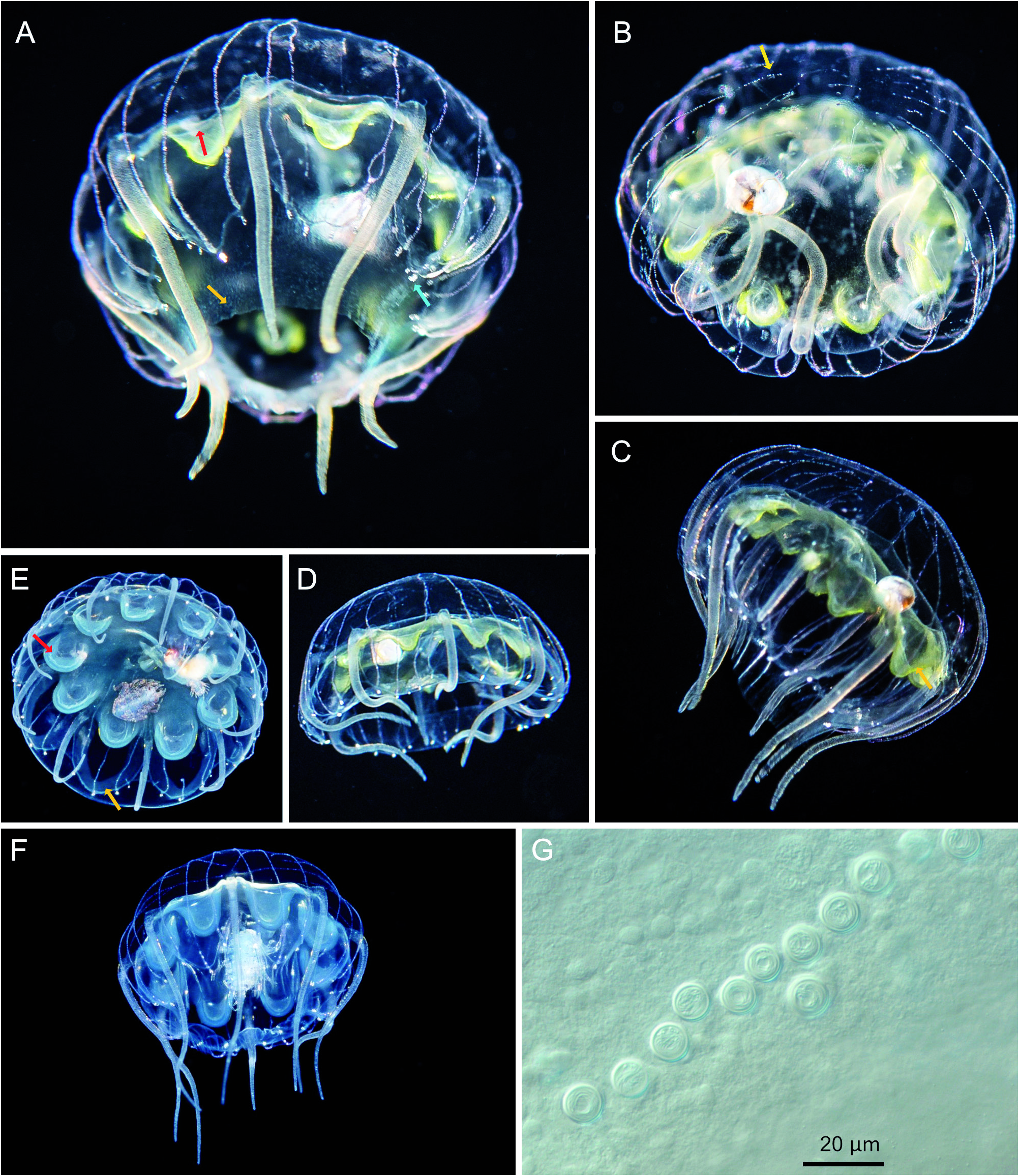
Observations: Bell diameter 5 mm, solid jelly, thickened aborally, margin subdivided in 8 to 9 U-shaped lappets (Fig. 54 A, E), at margin of lappets 3 to 5 statocysts from which originate otoporpae (tracks of thickened epidermis with nematocysts, Fig. 54 B, G) that extend almost to bell apex (Fig. 54 B), otoporpae sometimes irregular, branching, or not straight. Exumbrella apart of the nematocyst tracks smooth, without radiating keels or furrows. Velum broad (Fig. 54 A). Stomach large, circular; near its periphery and positioned interradially 8 to 9 diverticula for the gonads (Fig. 54 A-F), originating from stomach floor, in younger animals shallow, in older ones hanging into subumbrella (Fig. 54 E); diverticula with thickened walls, dense tissue, sometimes yellow-green tint. Lappets of bell margin apparently with broad peripheral canal, difficult to see and observed only in one animal (Fig. 54 E). Eight or nine thick, tapering tentacles originating in about middle of bell height in the bays between adjacent lappets (peronia), tentacles continued at right angles into the jelly as a pointed tentacle-root, tentacles held mostly in oral direction. Statocysts pendant, club shaped, with 2 to 5, usually 3, statoliths in a row, these increasing in size distally. Exumbrellar nematocysts: spherical isorhizas, ca. 10 µm (Fig. 54 G).
Schuchert, Peter, Collins, Richard (2021): Hydromedusae observed during night dives in the Gulf Stream. Revue suisse de Zoologie 128 (2): 237-356, DOI: 10.35929/RSZ.0049
Remarks: Our medusae, especially the younger ones (Fig. 54 C-D), appear indistinguishable from figures of Otoporpa polystriata given in Xu & Zhang (1978) and we are convinced that they are the same, despite this species is so far only known from the South China Sea. However, we think that this species was not classified in the correct family. The genus Otoporpa Xu & Zhang, 1978 was originally placed in the family Aeginidae (sensu Bouillon et al., 2006) because it had apparently interradial manubrial pouches. The pouches of Otoporpa are atypical for Aeginidae as they are rather shallow and most importantly they are not sub-divided by a medium septum (see Fig. 51 C, G). Likewise unusual for genera of the former Aeginidae (sensu Bouillon et al., 2006), Otoporpa has otoporpae (thickenings clasping the bell margin and usually continued as nematocyst tracks on the exumbrella, comp. Figs 50 C-D, 53 B, D). We think that Xu & Zhang (1978) misinterpreted the developing gonad diverticula typical of the genus Pegantha as manubrial pouches. This is understandable as younger stages of these diverticula resemble indeed interradial manubrial pouches (Fig. 54 C-D, F). It is possible that some of the Brazilian specimens described by Tosetto et al. (2018) as Pegantha triloba Haeckel, 1879 belong to the present species. Tosetto’s material lacked the diagnostic radial exumbrellar keels and furrows as shown in Bigelow (1909), it had 8 to 9 lappets and tentacles instead of 12 to 16 (Kramp, 1959 a), and the otoporpae continued as nematocyst tracks to almost the top of the umbrella. The otoporpae in P. triloba are usually much shorter, but Kramp (1957) found also very long ones like in the present species in young P. triloba.
Schuchert, Peter, Collins, Richard (2021): Hydromedusae observed during night dives in the Gulf Stream. Revue suisse de Zoologie 128 (2): 237-356, DOI: 10.35929/RSZ.0049
Distribution: South China Sea, Taiwan Strait (Xu et al., 2014), Florida (this study). Type locality: Southern end of Taiwan Strait, 22.5 ° N, 118.5 ° E.
Schuchert, Peter, Collins, Richard (2021): Hydromedusae observed during night dives in the Gulf Stream. Revue suisse de Zoologie 128 (2): 237-356, DOI: 10.35929/RSZ.0049
Examined material: BFL 4450; 1 specimen; 08 - JUN- 2020; size 5 mm; preserved in alcohol for DNA extraction; 16 S sequence MW 528728. – 02 - SEP- 2020; 1 specimen photographed, not collected, 2 mm. – Photos of two specimens kindly provided by Linda Ianniello, taken 21 - MAR- 2020 and 15 - SEP- 2020 during the same series of dives as for the other medusae of this study.
Schuchert, Peter, Collins, Richard (2021): Hydromedusae observed during night dives in the Gulf Stream. Revue suisse de Zoologie 128 (2): 237-356, DOI: 10.35929/RSZ.0049

Export occurrence data

Darwin Core Archive (ZIP)

CLASSIFICATION

Taxonomic Classification Tree

MULTIMEDIA

Media Files(4)

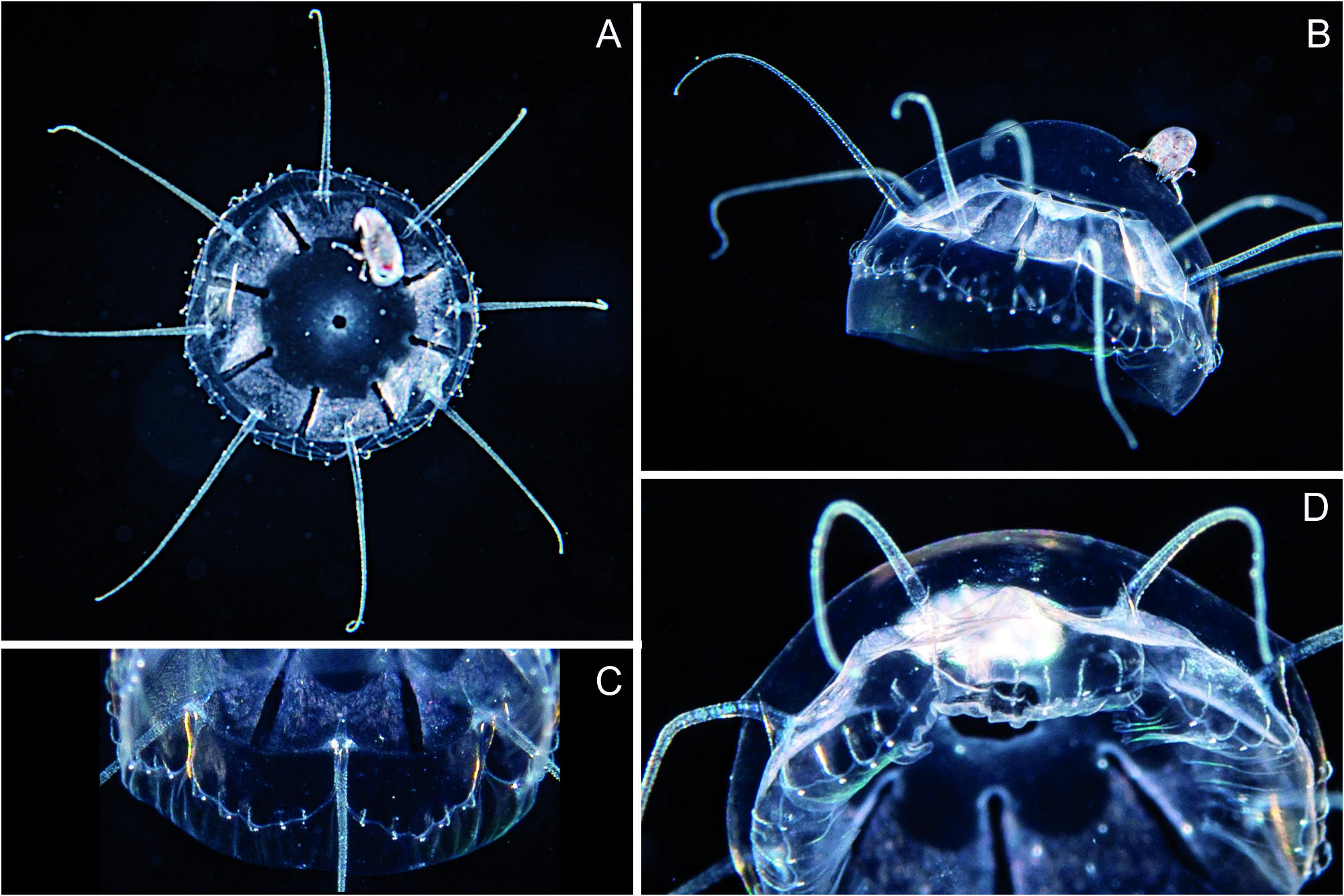
Fig. 50. Cunina octonaria, diameter 7 mm. (A) Aboral view of whole animal, with a crustacean on exumbrella. (B) Lateral view. (C) Close up of bell margin, note otoporpae and root of tentacle in middle, the velum is hanging downwards. (D) Oblique view from oral side. The bright spots below the otoporpae are the statocysts.
Imageimage/png© Schuchert, Peter;Collins, RichardSchuchert, Peter;Collins, Richard

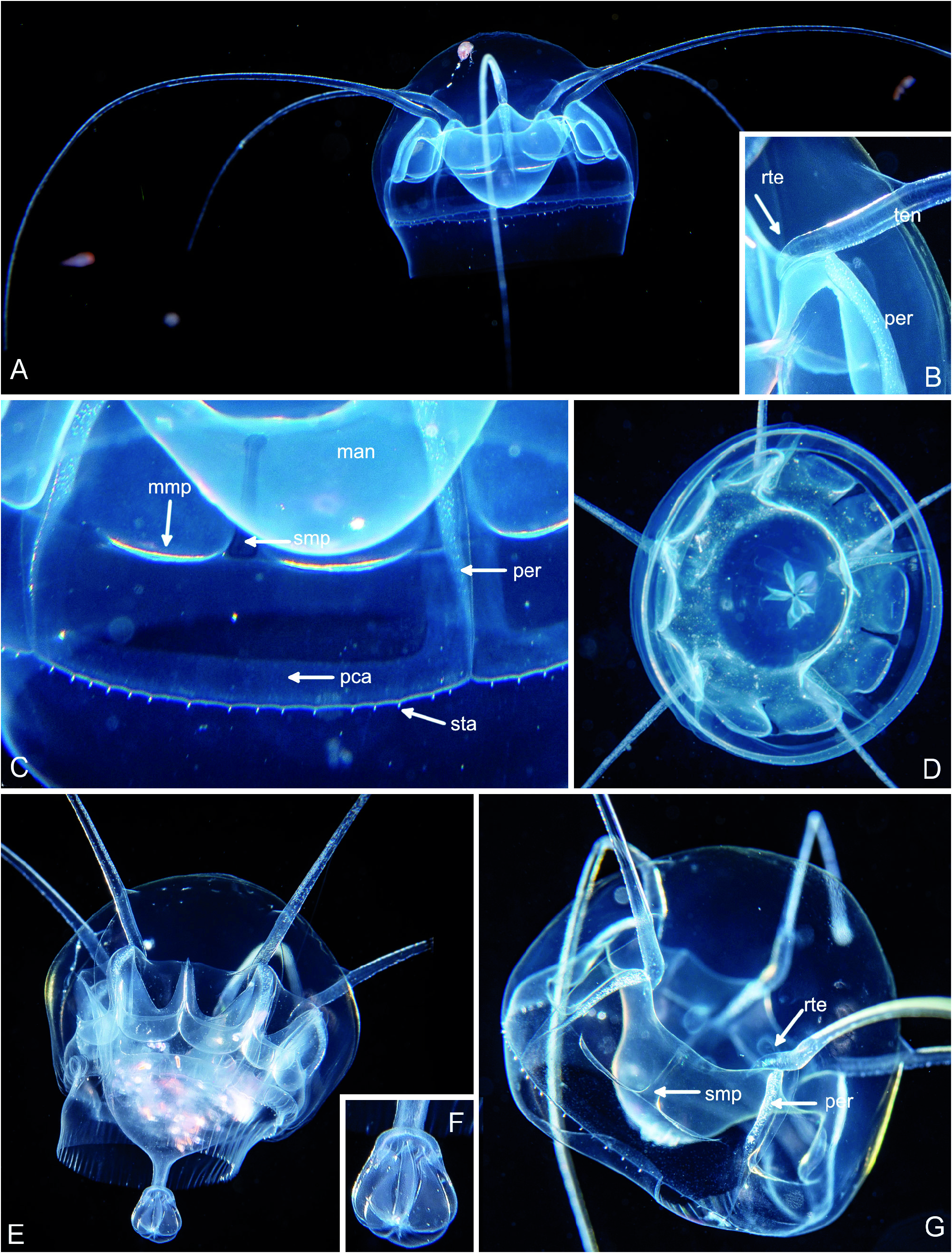
Fig. 51. Pseudaegina rhodina with 5 tentacles. (A-C) BFLA4015, size 18 mm. (D) BFLA4047, size 16 mm. (E-F) BFLA4067, size 20 mm. (G) BFLA4322, size 15 mm. (A) Lateral view. (B) Higher magnification of tentacle root (rte, arrow), note inflection towards below (= oral). (C) Details of bell margin. (D) Aboral view, note the (temporary) folding of mouth margin. (E-F) Medusa which has recently fed and its stomach is full of prey. Note the particular, most likely transitory, formation of a mouth tube and folded mouth margin, shown at higher magnification in F. (G). Lateral view. Abbreviations: man – manubrium/ stomach covering conical jelly cone, mmp – distal margin of manubrial pouch, pca – peripheral canal, per – peronium, rte – tentacle root, smp – septum in middle of manubrial pouch, sta – statocyst.
Imageimage/png© Schuchert, Peter;Collins, RichardSchuchert, Peter;Collins, Richard

Fig. 54. Pegantha polystriata. (A-D) BFLA4450, bell diameter 5 mm. (A) Oblique view from oral side, the blue arrow points to a statocyst, the yellow one to the velum, the red one to the outer margin of the stomach. (B) Oblique view on bell top, arrow indicates otoporpae reaching almost to top of bell. (C-D) Lateral views, the arrow indicates the outer margin of the stomach. (E-F) Photos taken by Linda Ianniello, reproduced with the kind permission of the author. (E) Animal observed 21-Mar-2020 with nine tentacles, yellow arrow indicates peripheral canals, red arrow a gonad diverticulum hanging into subumbrella. (F) Animal observed 15-SEP-2020, the gonad diverticula appear like manubrial pocket. (G) BFLA4450, alcohol preserved, isorhiza nematocysts from exumbrellar otoporpae.

Imageimage/png© Schuchert, Peter;Collins, RichardSchuchert, Peter;Collins, Richard

Fig. 48. Maximum likelihood phylogenetic tree of Narcomedusae obtained with PhyML (GTR+G+I model) and based on about 600 bp positions of the mitochondrial 16S gene. Node-support values are bootstrap values of 100 pseudoreplicates (shown only if> 70%). Sequence labels start with the GenBank numbers (except for identical haplotypes) permitting the retrieval of more information. Some proveniences were obtained from Lindsay et al. (2017) or through personal communications. Red ODEHOV DUH QHZ VHTXHQFHV IURP WKLV VWXG\. &RORXUHG ER[HV LQGLFDWH IDPLO\ DI¿OLDWLRQV DFFRUGLQJ WR WKH FXUUHQWO\ XVHG V\VWHP. (") 'HQRWHV SRVVLEOH PLVLGHQWL¿FDWLRQV.

Imageimage/png© Schuchert, Peter;Collins, RichardSchuchert, Peter;Collins, Richard

IMAGES

Gallery(4)

See Gallery

Occurrences with images

Source Information

Hydromedusae observed during night dives in the Gulf Stream

checklist

This dataset contains the digitized treatments in Plazi based on the original journal article Schuchert, Peter, Collins, Richard (2021): Hydromedusae observed during night dives in the Gulf Stream. Revue suisse de Zoologie 128 (2): 237-356, DOI: 10.35929/RSZ.0049

Abstract: Hydromedusae were photographed and collected during 75 night-time dives in the Gulfstream off Florida. Most of the collected material was used to obtain DNA extracts and subsequently to determine part of the mitochondrial 16S rRNA gene, a barcode marker preferentially used for hydrozoans. The morphological data and the 16S barcodes permitted us to identify 46 species and 6 additional species nameable only to the genus level. Photos and descriptions are provided for all of them and the taxonomy and species status discussed. Six new species are described: Pandeopsis prolifera n. spec., Zanclea mayeri n. spec., Corymorpha floridana n. spec., Staurodiscus luteus n. spec., Octophialucium irregularis n. spec., Solmaris flavofinis n. spec. The new family Wuvulidae is proposed for the genus Wuvula Bouillon, Seghers & Boero, 1988. The new name Aequorea neocyanea is introduced for Zygodactyla cyanea L. Agassiz, 1862 to avoid a secondary homonymy with Aequorea cyanea de Blainville, 1834. Zygodactyla cyanea was considered to be a synonym of Aequorea forskalea Péron & Lesueur, 1810 for most of the 20th century, but we present arguments that it should be kept distinct from the latter and it must be transferred to the genus Aequorea. The genus Otoporpa Xu & Zhang, 1978 is regarded here as congeneric with Pegantha Haeckel, 1879 and its type species Otoporpa polystriata Xu & Zhang, 1978 is therefore changed to Pegantha polystriata (Xu & Zhang, 1978) new comb. Dipleurosoma brooksii Mayer, 1910 is recognized as a new synonym of Staurodiscus kellneri (Mayer, 1910); Staurodiscus heterosceles Haeckel, 1879 as a new synonym of Staurodiscus tetrastaurus Haeckel, 1879; Orchistoma agariciforme Keller, 1884 and Tetracannota collapsum Mayer, 1900 both as new synonyms of Orchistoma pileus (Lesson, 1843). The following Indo-Pacific species are newly recorded for the Atlantic Ocean: Pandeopsis ikarii (Uchida, 1927), Aequorea taiwanensis Zheng et al., 2009; Zygocanna apapillatus Xu, Huang & Guo, 2014; Gastroblasta timida Keller, 1883; Cunina becki Bouillon, 1985; and Pegantha polystriata (Xu & Zhang, 1978). The 16S sequences also permitted us to discover several new links with polyp stages, this for Cirrhitiara superba (Mayer, 1900), Euphysilla pyramidata Kramp, 1955, Zancleopsis dichotoma, and Melicertissa mayeri Kramp, 1959. Detailed, high resolution photos of living medusae were found to be very useful for taxonomic purposes and are mostly preferable to preserved, damaged specimens obtained with plankton nets. Photos of living animals also permit us to better document material used to determine 16S barcodes and make the latter useable for taxonomic revisions.

Schuchert P, Collins R, felipe (2021). Hydromedusae observed during night dives in the Gulf Stream. Plazi.org taxonomic treatments database. Checklist dataset https://doi.org/10.35929/rsz.0049 accessed via GBIF.org on 2026-06-18.

CC0Published 10/21/2021View dataset
GBIF Usage Key
190510798
Dataset Key
172fa5c5-c0c4-4bd7-b710-d608237b8458
Origin
source
Backbone Key
11378585
Taxon ID
D0118A7C5B54004EFC88FA45FC2879BB.taxon
Last Crawled
6/9/2026
Last Interpreted
6/9/2026