AnimaliaNot EvaluatedacceptedspeciesAccepted
Pegantha martagon

Pegantha martagon

Haeckel, 1879

GBIF:190510799

0year

ABOUT

Descriptions(6)

16 S Data: The three obtained haplotypes have only low sequence divergences (Table 1, Fig. 48), but there was no significant relationship to a sequence of P. martagon from the Eastern Pacific (GenBank MG 979374, Fig. 48).
Schuchert, Peter, Collins, Richard (2021): Hydromedusae observed during night dives in the Gulf Stream. Revue suisse de Zoologie 128 (2): 237-356, DOI: 10.35929/RSZ.0049
Fig. 53 A-C
Schuchert, Peter, Collins, Richard (2021): Hydromedusae observed during night dives in the Gulf Stream. Revue suisse de Zoologie 128 (2): 237-356, DOI: 10.35929/RSZ.0049
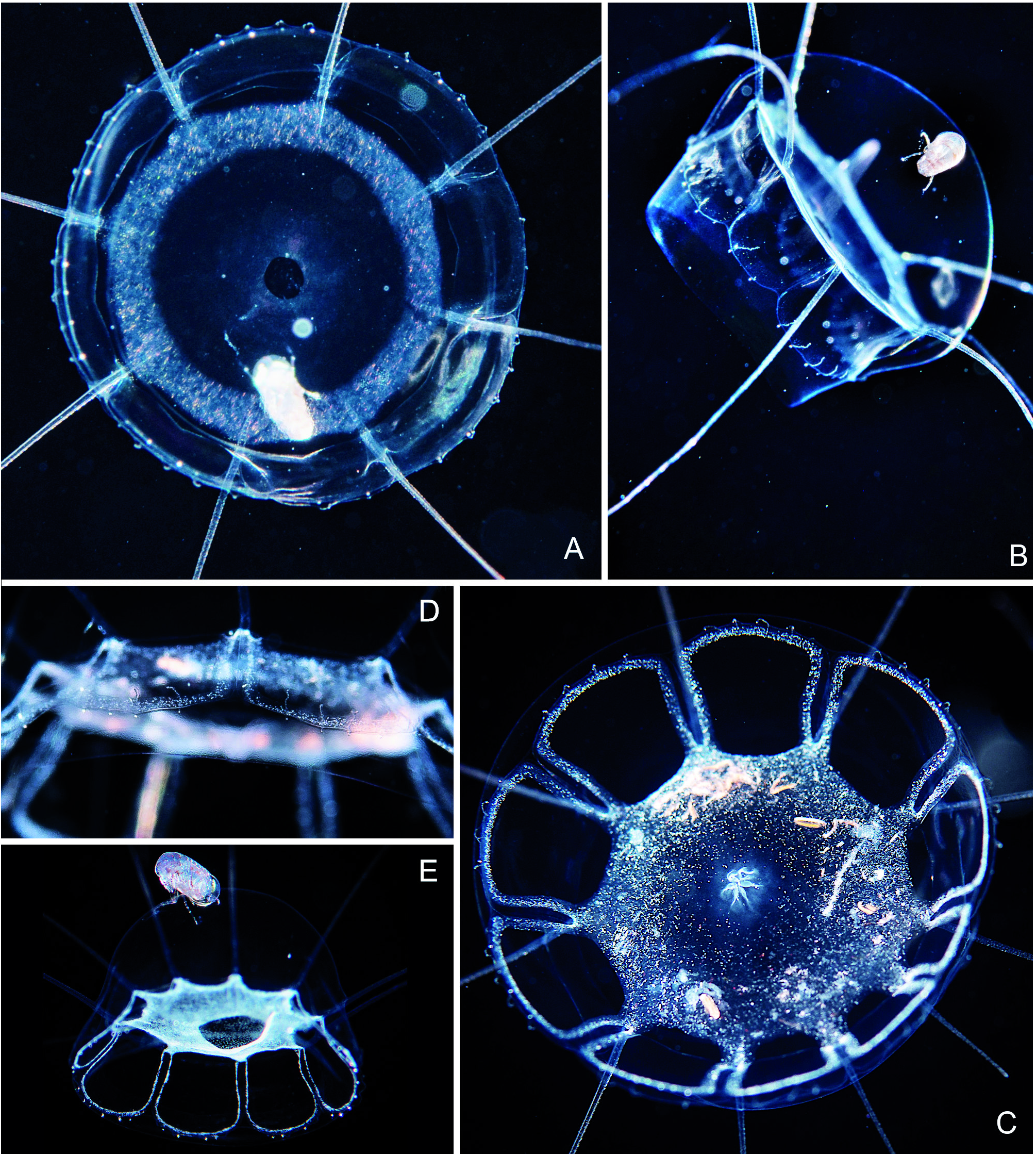
Observations: Medusae hemispherical or slightly wider than high, diameter 6 - 10 mm, 8 - 10 tentacles and marginal lappets (Fig. 53 A, C, E), stomach wide, up to 2 / 3 of bell diameter, no gastric jelly cone (Fig. 53 B, E), without manubrial pockets, peripheral canals originating below tentacles (Fig. 53 C), first descending parallel along the peronial fold, then along lappet periphery, rather thin (1 / 6 of lappet width), width constant. Marginal lappets rectangular to rounded, with 4 - 5 otoporpae (Fig. 53 B), these short, max. twice the size of the width of the peripheral canals. Statocysts near otoporpae, about as many as otoporpae. Tentacles curved, tapering, held at approximately 45 ° upwards, proximal end pointed and horizontal; below tentacles a slight furrow in the exumbrella with the peronium (Fig. 53 A).
Schuchert, Peter, Collins, Richard (2021): Hydromedusae observed during night dives in the Gulf Stream. Revue suisse de Zoologie 128 (2): 237-356, DOI: 10.35929/RSZ.0049
Remarks: Our samples had apparently not yet developed gonads, being thus not fully mature. The observed tentacle numbers of 8 - 10 were lower than the 16 given in Kramp (1959 a, 1968), but this is a maximal number and most animals have actually only 10 - 13 tentacles and lappets (Bigelow, 1909; Kramp, 1957, 1959 a). According to Bigelow (1909) and Kramp (1959 a: 64), the final tentacle number (10 - 11) is attained early in development, though during further growth some few tentacles and lappets may occasionally be added. Kramp (1957) observed that the lateral portions of peripheral canal in the lappets are broader than the transverse portions along the bell margin. This was not seen in the present material (Fig. 53 C-E). Pegantha simplex Bigelow, 1904 – a nominal species based on a type specimen from the Maldive Islands – was later synonymized with Pegantha martagon by Bigelow himself (Bigelow, 1909, 1918). We think that Bigelow’s specimen from the Maldives nevertheless deviates quite strongly from the scope of P. martagon as described by later authors (see synonymy above). It was a small (3 mm) medusa but with fully developed, pendant-saclike gonads. It had 8 tentacles / lappets and reportedly 25 statocysts per lappet, more than twice the number usually seen in P. martagon. Later, Bigelow (1909) reexamined this material and had to revise this number. The contraction of the alcohol preserved material feigned the presence of more statocysts. Actually, also Haeckel (1879) in his first description reported 13 - 15 statocysts per lappet. Because he also had preserved material, Bigelow (1909) assumed that he was likewise mistaken. The gonads of P. martagon are variably described as a simple ring at the periphery of the stomach, or as irregularly lobed, pendant sacs. While it is possible that these two stages are only different developmental stages, we nevertheless suspect that the wide variation of the current concept of P. martagon indicates that it comprises several species. Our 16 S sequences are very different from a tentatively identified P. martagon from California found parasitizing a planktonic polychaete Tomopteris (Bentlage et al., 2018).
Schuchert, Peter, Collins, Richard (2021): Hydromedusae observed during night dives in the Gulf Stream. Revue suisse de Zoologie 128 (2): 237-356, DOI: 10.35929/RSZ.0049
Distribution: Widely distributed in the tropical and subtropical parts of the Atlantic and Indo-Pacific Ocean (Bigelow, 1909; Kramp, 1959 a; Bouillon, 1978 c; Bleeker & Van der Spoel, 1988; Navas-Pereira & Vannuci, 1991; Bouillon & Barnett, 1999; Segura Puerta et al., 2003, 2009; Oliveira et al., 2016), surprisingly also in the cold waters around South Georgia and in Antarctic waters (Kramp, 1959 a; Toda et al., 2008). Occurs in shallow waters, occasionally from 100 to 300 m depth (Kramp, 1957). Type locality: China Sea.
Schuchert, Peter, Collins, Richard (2021): Hydromedusae observed during night dives in the Gulf Stream. Revue suisse de Zoologie 128 (2): 237-356, DOI: 10.35929/RSZ.0049
Examined material: BFLA 4070; 1 specimen; 11 - APR- 2019; size 10 mm, 10 tentacles; preserved in alcohol for DNA extraction; 16 S sequence MW 528666. – BFLA 4109; 1 specimen; 03 - JUN- 2019; size 8 mm, 8 tentacles; part preserved in formalin and deposited as UF- 013796, small part in alcohol for DNA extraction; 16 S sequence MW 528676. – BFLA 4336; 1 specimen; 07 - FEB- 2020; size 6 mm, 9 tentacles; preserved in alcohol for DNA extraction; 16 S sequence MW 528708. – 26 - FEB- 2018; 1 specimen photographed, not collected, 9 tentacles.
Schuchert, Peter, Collins, Richard (2021): Hydromedusae observed during night dives in the Gulf Stream. Revue suisse de Zoologie 128 (2): 237-356, DOI: 10.35929/RSZ.0049

Export occurrence data

Darwin Core Archive (ZIP)

CLASSIFICATION

Taxonomic Classification Tree

MULTIMEDIA

Media Files(2)

Fig. 53. Pegantha martagon. (A-B) Sample BFLA4109, diameter 8 mm. (A) Aboral view, the annular, more opaque structure was interpreted as food debris at the periphery of the stomach, the bright oval element is an out of focus crustacean. (B) Lateral view, note the clearly visible otoporpae and crustacean on the exumbrella. (C-D) BFLA4070, 10 mm. (C) Oral view. The bright, granular material is interpreted as partially digested food which fills the stomach and also the peripheral canal. Note also the closed mouth and the folds of the mouth margin. (D) Lateral view of bell margin. (E) BFLA4336, 6 mm, lateral view, the white matter in the gastric system is likely digested food.

Imageimage/png© Schuchert, Peter;Collins, RichardSchuchert, Peter;Collins, Richard

Fig. 48. Maximum likelihood phylogenetic tree of Narcomedusae obtained with PhyML (GTR+G+I model) and based on about 600 bp positions of the mitochondrial 16S gene. Node-support values are bootstrap values of 100 pseudoreplicates (shown only if> 70%). Sequence labels start with the GenBank numbers (except for identical haplotypes) permitting the retrieval of more information. Some proveniences were obtained from Lindsay et al. (2017) or through personal communications. Red ODEHOV DUH QHZ VHTXHQFHV IURP WKLV VWXG\. &RORXUHG ER[HV LQGLFDWH IDPLO\ DI¿OLDWLRQV DFFRUGLQJ WR WKH FXUUHQWO\ XVHG V\VWHP. (") 'HQRWHV SRVVLEOH PLVLGHQWL¿FDWLRQV.

Imageimage/png© Schuchert, Peter;Collins, RichardSchuchert, Peter;Collins, Richard

IMAGES

Gallery(2)

See Gallery

Occurrences with images

Source Information

Hydromedusae observed during night dives in the Gulf Stream

checklist

This dataset contains the digitized treatments in Plazi based on the original journal article Schuchert, Peter, Collins, Richard (2021): Hydromedusae observed during night dives in the Gulf Stream. Revue suisse de Zoologie 128 (2): 237-356, DOI: 10.35929/RSZ.0049

Abstract: Hydromedusae were photographed and collected during 75 night-time dives in the Gulfstream off Florida. Most of the collected material was used to obtain DNA extracts and subsequently to determine part of the mitochondrial 16S rRNA gene, a barcode marker preferentially used for hydrozoans. The morphological data and the 16S barcodes permitted us to identify 46 species and 6 additional species nameable only to the genus level. Photos and descriptions are provided for all of them and the taxonomy and species status discussed. Six new species are described: Pandeopsis prolifera n. spec., Zanclea mayeri n. spec., Corymorpha floridana n. spec., Staurodiscus luteus n. spec., Octophialucium irregularis n. spec., Solmaris flavofinis n. spec. The new family Wuvulidae is proposed for the genus Wuvula Bouillon, Seghers & Boero, 1988. The new name Aequorea neocyanea is introduced for Zygodactyla cyanea L. Agassiz, 1862 to avoid a secondary homonymy with Aequorea cyanea de Blainville, 1834. Zygodactyla cyanea was considered to be a synonym of Aequorea forskalea Péron & Lesueur, 1810 for most of the 20th century, but we present arguments that it should be kept distinct from the latter and it must be transferred to the genus Aequorea. The genus Otoporpa Xu & Zhang, 1978 is regarded here as congeneric with Pegantha Haeckel, 1879 and its type species Otoporpa polystriata Xu & Zhang, 1978 is therefore changed to Pegantha polystriata (Xu & Zhang, 1978) new comb. Dipleurosoma brooksii Mayer, 1910 is recognized as a new synonym of Staurodiscus kellneri (Mayer, 1910); Staurodiscus heterosceles Haeckel, 1879 as a new synonym of Staurodiscus tetrastaurus Haeckel, 1879; Orchistoma agariciforme Keller, 1884 and Tetracannota collapsum Mayer, 1900 both as new synonyms of Orchistoma pileus (Lesson, 1843). The following Indo-Pacific species are newly recorded for the Atlantic Ocean: Pandeopsis ikarii (Uchida, 1927), Aequorea taiwanensis Zheng et al., 2009; Zygocanna apapillatus Xu, Huang & Guo, 2014; Gastroblasta timida Keller, 1883; Cunina becki Bouillon, 1985; and Pegantha polystriata (Xu & Zhang, 1978). The 16S sequences also permitted us to discover several new links with polyp stages, this for Cirrhitiara superba (Mayer, 1900), Euphysilla pyramidata Kramp, 1955, Zancleopsis dichotoma, and Melicertissa mayeri Kramp, 1959. Detailed, high resolution photos of living medusae were found to be very useful for taxonomic purposes and are mostly preferable to preserved, damaged specimens obtained with plankton nets. Photos of living animals also permit us to better document material used to determine 16S barcodes and make the latter useable for taxonomic revisions.

Schuchert P, Collins R, felipe (2021). Hydromedusae observed during night dives in the Gulf Stream. Plazi.org taxonomic treatments database. Checklist dataset https://doi.org/10.35929/rsz.0049 accessed via GBIF.org on 2026-06-17.

CC0Published 10/21/2021View dataset
GBIF Usage Key
190510799
Dataset Key
172fa5c5-c0c4-4bd7-b710-d608237b8458
Origin
source
Backbone Key
2269415
Taxon ID
D0118A7C5B5A004CFC61F8D5FBED7DAA.taxon
Last Crawled
6/9/2026
Last Interpreted
6/9/2026
