
AnimaliaNot EvaluatedacceptedspeciesAccepted
Corymorpha forbesii

Corymorpha forbesii

(Mayer, 1894)

GBIF:190510821

0year

ABOUT

Descriptions(5)

16 S Data: A blastn search in GenBank using the sole 16 S indicated Corymorpha glacialis as best match, although with only 84 % identity. This species was followed by other Corymorpha and Aplanulata species with similar low identify scores.
Schuchert, Peter, Collins, Richard (2021): Hydromedusae observed during night dives in the Gulf Stream. Revue suisse de Zoologie 128 (2): 237-356, DOI: 10.35929/RSZ.0049
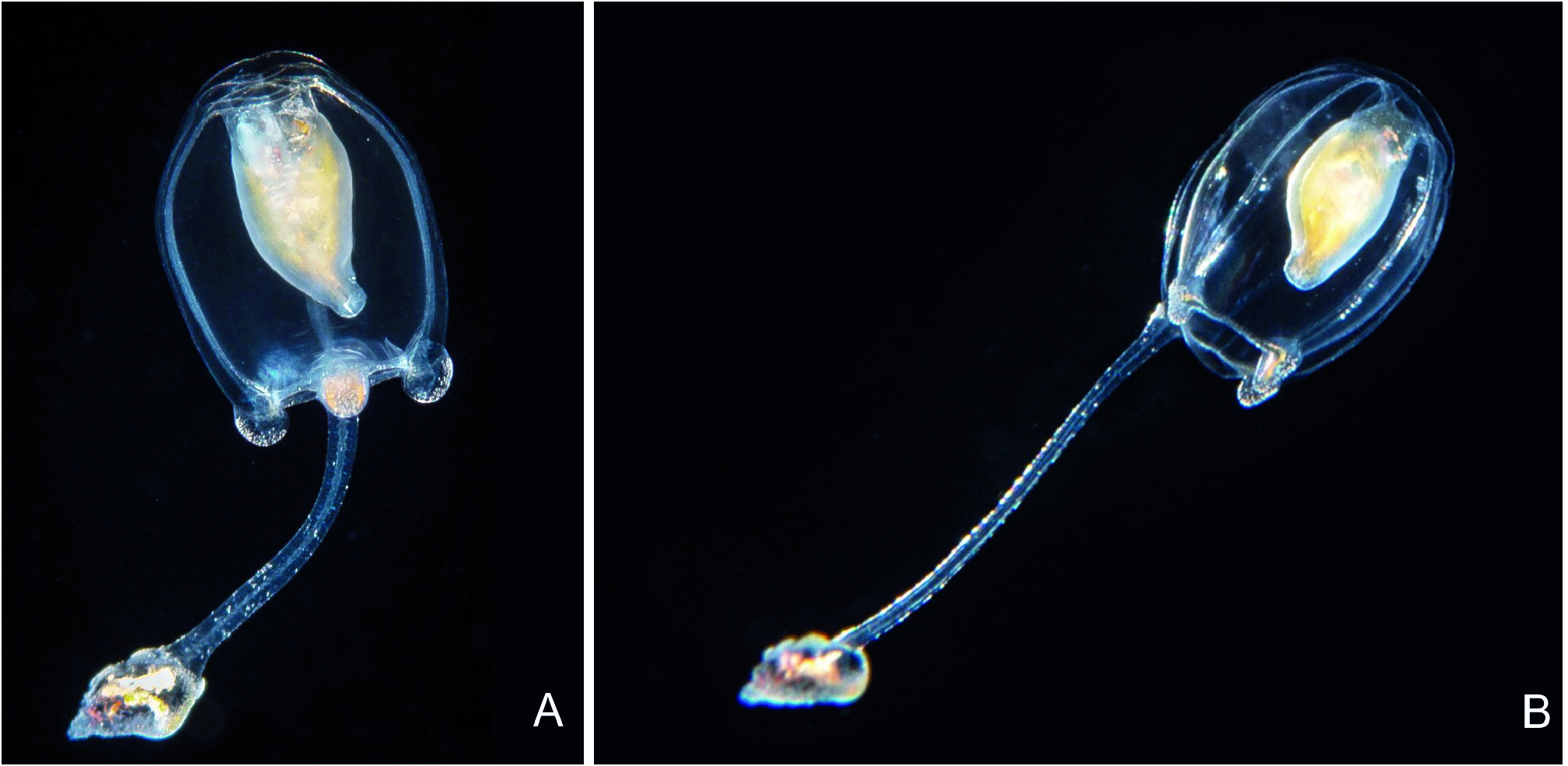
Fig. 24 A-B
Schuchert, Peter, Collins, Richard (2021): Hydromedusae observed during night dives in the Gulf Stream. Revue suisse de Zoologie 128 (2): 237-356, DOI: 10.35929/RSZ.0049
Observations: Umbrella bell-shaped, height size 2 mm, higher than wide, no apical process or a slight apical thickening, no exumbrellar nematocysts. Manubrium spindle-shaped, length about 2 / 3 of subumbrellar height, simple mouth, gonads encircle manubrium without interruption. Four large marginal bulbs, all of similar size or bulb opposite tentacle larger than the two other atentacular bulbs, bulb surface covered with nematocysts. Only one single tentacle, rather stiff, length 1.5 the bell height, 2 / 3 of length isodiametric and with only few nematocysts, distal third a club-shaped terminal swelling with numerous nematocysts.
Schuchert, Peter, Collins, Richard (2021): Hydromedusae observed during night dives in the Gulf Stream. Revue suisse de Zoologie 128 (2): 237-356, DOI: 10.35929/RSZ.0049
Distribution: Florida, Bahamas, Brazil, Mediterranean, Red Sea, Seychelles, India, Vietnam, Papua New Guinea, southern Japan, and New Zealand (Schuchert, 2010). Type locality: Bahamas; Nassau Harbour.
Schuchert, Peter, Collins, Richard (2021): Hydromedusae observed during night dives in the Gulf Stream. Revue suisse de Zoologie 128 (2): 237-356, DOI: 10.35929/RSZ.0049
Examined material: BFLA 4045; 1 specimen; 01 - APR- 2019; preserved in ethanol for DNA extraction; 16 S sequence MW 528642. – 24 - JUN- 2019; 1 specimen photographed, with male gonads, not collected.
Schuchert, Peter, Collins, Richard (2021): Hydromedusae observed during night dives in the Gulf Stream. Revue suisse de Zoologie 128 (2): 237-356, DOI: 10.35929/RSZ.0049

Export occurrence data

Darwin Core Archive (ZIP)

CLASSIFICATION

Taxonomic Classification Tree

MULTIMEDIA

Media Files(1)

Fig. 24. Corymorpha forbesii, bell size ca. 2 mm (A) BFLA4045. (B) Specimen photographed in 24-JUN-2019.

Imageimage/png© Schuchert, Peter;Collins, RichardSchuchert, Peter;Collins, Richard

IMAGES

Gallery(1)

See Gallery

Occurrences with images

Source Information

Hydromedusae observed during night dives in the Gulf Stream

checklist

This dataset contains the digitized treatments in Plazi based on the original journal article Schuchert, Peter, Collins, Richard (2021): Hydromedusae observed during night dives in the Gulf Stream. Revue suisse de Zoologie 128 (2): 237-356, DOI: 10.35929/RSZ.0049

Abstract: Hydromedusae were photographed and collected during 75 night-time dives in the Gulfstream off Florida. Most of the collected material was used to obtain DNA extracts and subsequently to determine part of the mitochondrial 16S rRNA gene, a barcode marker preferentially used for hydrozoans. The morphological data and the 16S barcodes permitted us to identify 46 species and 6 additional species nameable only to the genus level. Photos and descriptions are provided for all of them and the taxonomy and species status discussed. Six new species are described: Pandeopsis prolifera n. spec., Zanclea mayeri n. spec., Corymorpha floridana n. spec., Staurodiscus luteus n. spec., Octophialucium irregularis n. spec., Solmaris flavofinis n. spec. The new family Wuvulidae is proposed for the genus Wuvula Bouillon, Seghers & Boero, 1988. The new name Aequorea neocyanea is introduced for Zygodactyla cyanea L. Agassiz, 1862 to avoid a secondary homonymy with Aequorea cyanea de Blainville, 1834. Zygodactyla cyanea was considered to be a synonym of Aequorea forskalea Péron & Lesueur, 1810 for most of the 20th century, but we present arguments that it should be kept distinct from the latter and it must be transferred to the genus Aequorea. The genus Otoporpa Xu & Zhang, 1978 is regarded here as congeneric with Pegantha Haeckel, 1879 and its type species Otoporpa polystriata Xu & Zhang, 1978 is therefore changed to Pegantha polystriata (Xu & Zhang, 1978) new comb. Dipleurosoma brooksii Mayer, 1910 is recognized as a new synonym of Staurodiscus kellneri (Mayer, 1910); Staurodiscus heterosceles Haeckel, 1879 as a new synonym of Staurodiscus tetrastaurus Haeckel, 1879; Orchistoma agariciforme Keller, 1884 and Tetracannota collapsum Mayer, 1900 both as new synonyms of Orchistoma pileus (Lesson, 1843). The following Indo-Pacific species are newly recorded for the Atlantic Ocean: Pandeopsis ikarii (Uchida, 1927), Aequorea taiwanensis Zheng et al., 2009; Zygocanna apapillatus Xu, Huang & Guo, 2014; Gastroblasta timida Keller, 1883; Cunina becki Bouillon, 1985; and Pegantha polystriata (Xu & Zhang, 1978). The 16S sequences also permitted us to discover several new links with polyp stages, this for Cirrhitiara superba (Mayer, 1900), Euphysilla pyramidata Kramp, 1955, Zancleopsis dichotoma, and Melicertissa mayeri Kramp, 1959. Detailed, high resolution photos of living medusae were found to be very useful for taxonomic purposes and are mostly preferable to preserved, damaged specimens obtained with plankton nets. Photos of living animals also permit us to better document material used to determine 16S barcodes and make the latter useable for taxonomic revisions.

Schuchert P, Collins R, felipe (2021). Hydromedusae observed during night dives in the Gulf Stream. Plazi.org taxonomic treatments database. Checklist dataset https://doi.org/10.35929/rsz.0049 accessed via GBIF.org on 2026-06-17.

CC0Published 10/21/2021View dataset
GBIF Usage Key
190510821
Dataset Key
172fa5c5-c0c4-4bd7-b710-d608237b8458
Origin
source
Backbone Key
4878627
Taxon ID
D0118A7C5B24003DFC66FE33FD457AE0.taxon
Last Crawled
6/9/2026
Last Interpreted
6/9/2026