
AnimaliaNot EvaluatedacceptedspeciesAccepted
Corymorpha floridana
Peter, 2021
GBIF:190510823
0year
ABOUT
Descriptions(6)
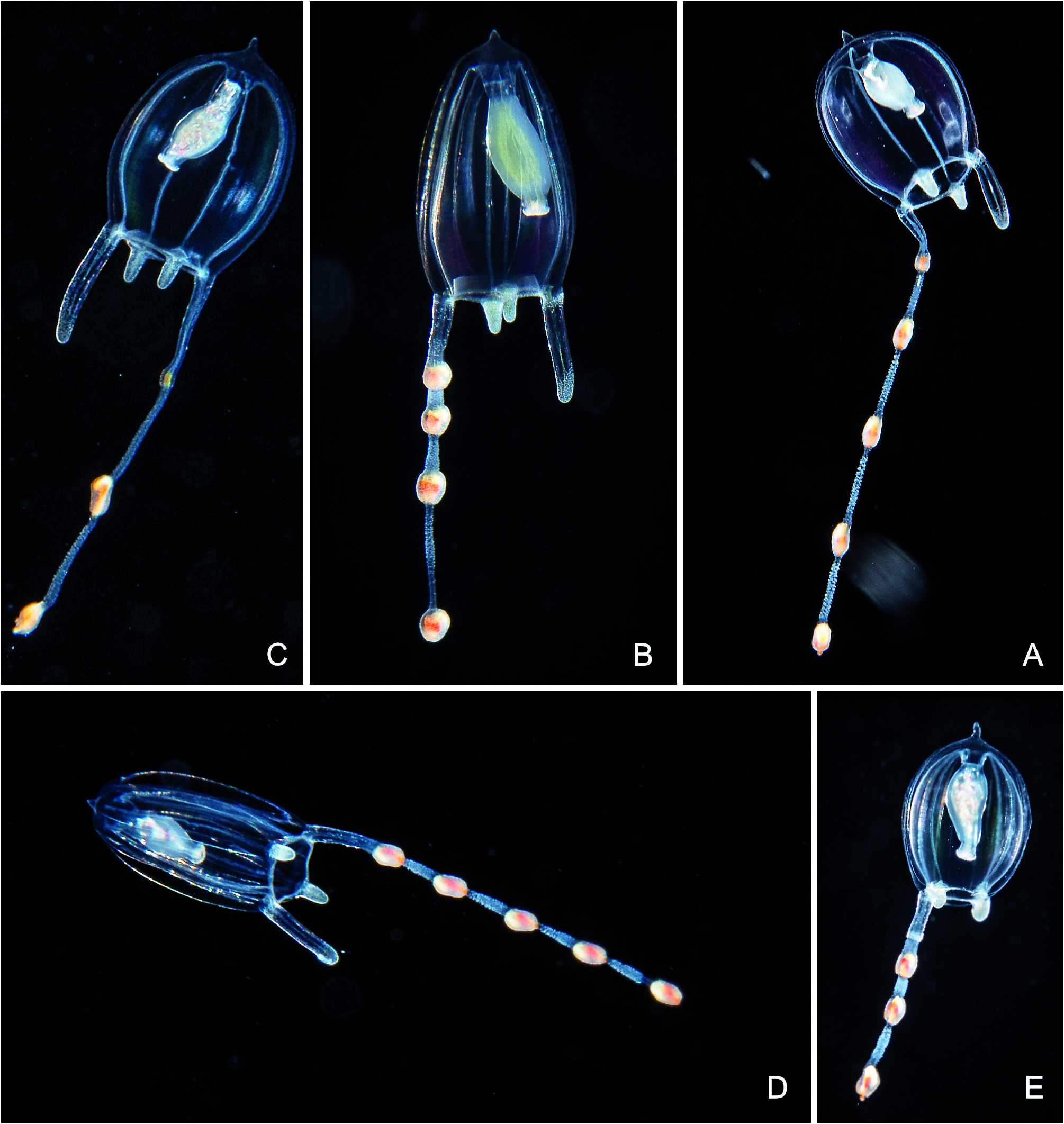
Description: Medusa with umbrella 2 - 3 mm high and about 1.6 mm wide (Fig. 26 A-E), evenly bell-shaped, jelly relatively thin, not much thickened at apex, regularly with a small, pointed projection, not much varied in size. Manubrium on short gastric peduncle, spindle shaped, about half or somewhat more of the height of the subumbrella, mouth circular, with white rim. Gonads encircle nearly whole manubrium as relatively thin layer, without folds or perradial interruption. Four radial canals and circular canal thin, smooth. No tentacle bulbs or ocelli. Four tentacles of three types. One long tentacle, much extensible, contracted about two bell heights long, thick, only slightly tapering; nematocysts concentrated in three to five nematocyst rings, one knob in terminal position, rings more or less equidistant and well separated, shape round to oblong when tentacle extended, colour orange. Tentacle opposite the long tentacle about half the length of the bell-height, evenly thick, end rounded, without nematocyst buttons, with some nematocysts at base and at end. Other two tentacles short, length about 1 / 3 of filiform tentacle, conical, with scattered nematocysts. Variation: the mid-length tentacle was missing in one specimen (Fig. 26 E), otherwise morphology rather uniform. Corymorpha floridana, like other Corymorpha species, has a rather distinctive zigzag swimming style due to its unbalanced tentacle arrangement. 16 S Data: A blastn search in GenBank using the sole 16 S indicated Corymorpha nutans as best match, although with only 88 % identity. This species was followed by other Corymorpha and other Aplanulata species with similar low identify scores.
Schuchert, Peter, Collins, Richard (2021): Hydromedusae observed during night dives in the Gulf Stream. Revue suisse de Zoologie 128 (2): 237-356, DOI: 10.35929/RSZ.0049
Fig. 26 A-E
Schuchert, Peter, Collins, Richard (2021): Hydromedusae observed during night dives in the Gulf Stream. Revue suisse de Zoologie 128 (2): 237-356, DOI: 10.35929/RSZ.0049
Diagnosis: Corymorpha species with one long moniliform tentacle, one much shorter filiform tentacle opposite, and two tentacle stumps. Long tentacle with up to five orange, round to oblong nematocyst rings, including a terminal button. Bell with very small, pointed apical projection, no apical canal. Manubrium simple, on short gastric peduncle.
Schuchert, Peter, Collins, Richard (2021): Hydromedusae observed during night dives in the Gulf Stream. Revue suisse de Zoologie 128 (2): 237-356, DOI: 10.35929/RSZ.0049
Remarks: We were unable to identify our material with any of the described Corymorpha species (Schuchert, 2020) and therefore introduce it here as a new nominal species. With its tentacle configuration it conforms with the scope Euphysora Maas, 1905, a genus synonymized with Corymorpha M. Sars, 1835 by Petersen (1990). Some authors continue to regard it as valid, e. g. Bouillon et al. (2006). Corymorpha floridana n. spec. resembles three other species, but can easily be distinguished from them: – Corymorpha bigelowi (Maas, 1905): has a long tentacle with adaxial nematocyst clasps and not in rings, also larger apical projection; Indo-Pacific distribution (Schuchert, 2010; Madkour et al., 2019). – Corymorpha annulata (Kramp, 1928): has a distinct apical canal, a larger apical projection, many more (up to 17) nematocyst rings and these much narrower and not round or oval; Indo-Pacific distribution (Kramp, 1968). – Corymorpha crassocanalis (Xu & Huang, 2003): has a long tentacle with adaxial nematocyst clasps and not in rings, no apical canal, broad and indistinct apical projection, broad radial canals (coasts of China). Although distinct, Corymorpha floridana n. spec. is a rather simple medusa from a genus with a much more complex polyp stage. There is thus a danger that more than one polyp could be found that produce the same medusa (e. g. as for many Clytia species) and the species will thus become unrecognizable. However, through the available 16 S sequence data this problem is likely resolved. To our knowledge, there is only one polyp- based Corymorpha species that is endemic to the NW Atlantic, namely Corymorpha pendula L. Agassiz, 1862, but this species does not produce free medusae. The polyp of the medusa Corymorpha bigelowi was described by Sassaman & Rees (1978).
Schuchert, Peter, Collins, Richard (2021): Hydromedusae observed during night dives in the Gulf Stream. Revue suisse de Zoologie 128 (2): 237-356, DOI: 10.35929/RSZ.0049
Etymology: The name refers to the Florida Peninsula were the species was found.
Schuchert, Peter, Collins, Richard (2021): Hydromedusae observed during night dives in the Gulf Stream. Revue suisse de Zoologie 128 (2): 237-356, DOI: 10.35929/RSZ.0049
Holotype: BFLU 4371; 1 formalin preserved male medusa deposited as FU- 014026; collected 16 - MAR- 2020; bell height 3 mm. Other examined material: BFLA 4362; 1 specimen; 13 - MAR- 2020; preserved in ethanol for DNA extraction; 2 mm bell; 16 S sequence MW 528714. – BFLA 4363; 1 specimen; 13 - MAR- 2020; preserved in ethanol for DNA extraction; 2 mm bell; 16 S sequence identical to MW 528714. – BFLA 4364; 1 specimen; 13 - MAR- 2020; preserved in ethanol for DNA extraction; 2 mm bell; 16 S sequence identical to MW 528714. – BFLA 4365; 1 specimen; 13 - MAR- 2020; preserved in ethanol for DNA extraction; 2 mm bell; 16 S sequence identical to MW 528714. – BFLA 4437; 1 specimen; 07 - JUN- 2020; preserved formalin and submitted as FU- 014055; 4 mm bell. – 13 - MAR- 2020; 1 specimen photographed, not collected; 2 mm. – 16 - MAR- 2020; 2 specimens photographed, not collected; 2 mm. Type locality: USA, Florida, 5.5 - 12 km east of Palm Beach; WGS 84 26.70, - 79.94 to 26.78, - 79.94; depth 10 m.
Schuchert, Peter, Collins, Richard (2021): Hydromedusae observed during night dives in the Gulf Stream. Revue suisse de Zoologie 128 (2): 237-356, DOI: 10.35929/RSZ.0049
Export occurrence data
Darwin Core Archive (ZIP)
CLASSIFICATION
Taxonomic Classification Tree

MULTIMEDIA
Media Files(1)
Fig. 26. Corymorpha floridana n. spec (A) Holotype, BFLA4371, bell height 3 mm. (B) 01-APR-2019; photographed but not collected; mature male, 2 mm. (C) 11-MAR-2020; photographed but not collected; 2 mm. (D) BFLA4363; bell height 2 mm. (E) BFLA4362; 2 mm; note that part of the long tentacle and the entire intermediate length tentacle are missing.
Imageimage/png© Schuchert, Peter;Collins, RichardSchuchert, Peter;Collins, Richard
IMAGES