
AnimaliaNot EvaluatedacceptedspeciesAccepted
Cytaeis tetrastyla
Eschscholtz, 1829
GBIF:190510847
0year
ABOUT
Descriptions(6)
16 S Data: The three obtained 16 S haplotypes have a maximal divergence of 2.2 % and are thought to represent intraspecific variation (Table 1). Blastn searches in GenBank did not yield matches at specieslevel identities. The closest matches were with several samples of Cytaeis uchidae Rees, 1962 from Japan (about 95 % identity), followed by other Cytaeis species, though with lower identity values.
Schuchert, Peter, Collins, Richard (2021): Hydromedusae observed during night dives in the Gulf Stream. Revue suisse de Zoologie 128 (2): 237-356, DOI: 10.35929/RSZ.0049
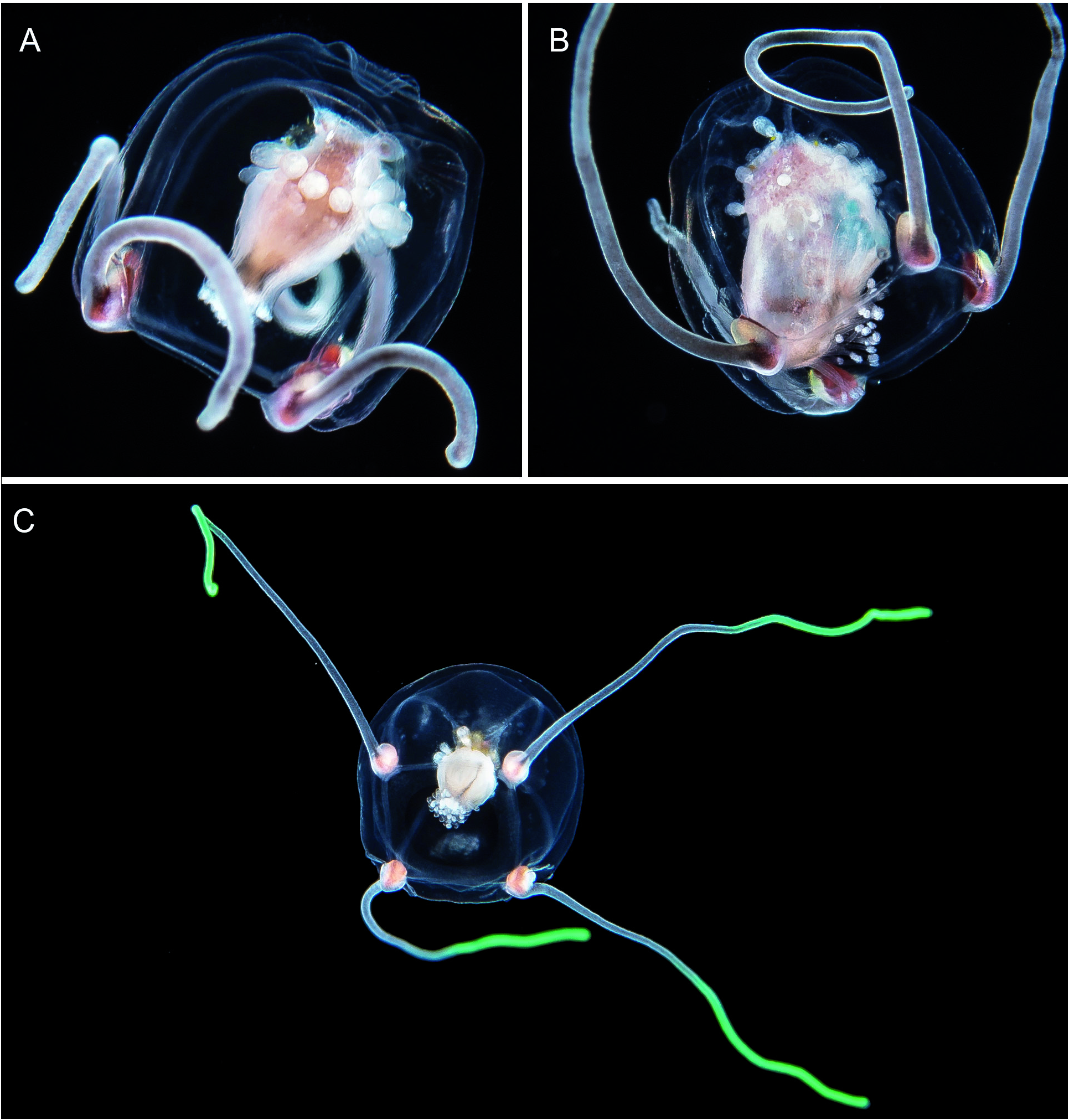
Fig. 2 A-C
Schuchert, Peter, Collins, Richard (2021): Hydromedusae observed during night dives in the Gulf Stream. Revue suisse de Zoologie 128 (2): 237-356, DOI: 10.35929/RSZ.0049
Observations: Cytaeis medusa with bell height 1.5 - 2 mm, apical jelly not much thickened and without apical process, but often with apical funnellike depression; subumbrella with shallow gastric peduncle. Manubrium spindle-shaped, reaching to velum level, with more than 10 capitate tentacles originating distinctly above mouth margin; in upper third of manubrium several medusa buds, in lower two thirds apparently with developing gonad. Four perradial tentacles, fully contracted about as long as bell height, solid, bases widened to ovoid bulbs which adhere just above bell margin, giving the impression of the tentacles being connected by a flared end (Fig. 2 B); the tentacle arises at an acute angle to the bulb and curve towards aboral.
Schuchert, Peter, Collins, Richard (2021): Hydromedusae observed during night dives in the Gulf Stream. Revue suisse de Zoologie 128 (2): 237-356, DOI: 10.35929/RSZ.0049
Remarks: The taxonomic situation and identification of Cytaeis medusae is currently not resolved (see discussion in Schuchert, 2007). The opinion of Bouillon et al. (2004) that the “ Cytaeis tetrastyla - like ” medusae should not be given a specific name until the taxonomy has been sorted out properly is still valid, in particular if they do not come from the tropical Atlantic Ocean. However, the current material does come from the same tropical waters of the Atlantic Ocean as the type material and no named or distinct Cytaeis polyps are known from this region. We can thus be reasonably sure that Cytaeis tetrastyla is most likely the correct name. The taxonomic ambiguity relating to C. tetrastyla needs to be resolved using DNA sequence data of several populations and the present samples will hopefully contribute to this end. Many cytaeidid medusae have a quite characteristic connection of the tentacles to the bell margin. The proximal ends of the tentacles are widened to an ovoid bulb which adheres along its long axis to the exumbrella just above bell margin, giving the impression of the tentacle being connected to the exumbrella by a flattened end (Fig. 2 B). The hydroid stage of this species is not known. A potential candidate is the Cytaeis hydroid from Bermuda Island described by Calder (1988).
Schuchert, Peter, Collins, Richard (2021): Hydromedusae observed during night dives in the Gulf Stream. Revue suisse de Zoologie 128 (2): 237-356, DOI: 10.35929/RSZ.0049
Distribution: Circumglobally in tropical to subtropical seas, partly oceanic (Schuchert, 2007). Type locality: Atlantic Ocean, south of Equator.
Schuchert, Peter, Collins, Richard (2021): Hydromedusae observed during night dives in the Gulf Stream. Revue suisse de Zoologie 128 (2): 237-356, DOI: 10.35929/RSZ.0049
Examined material: BFLA 4066; 1 specimen; 10 - APR- 2019; size 2 mm; preserved in ethanol for DNA extraction; 16 S sequence MW 528664. – BFLA 4069; 1 specimen; 11 - APR- 2019; size 1.5 mm; photographed and preserved in formalin and deposited as UF- 013780. – BFLA 4073; 1 specimen; 11 - APR- 2019; 2 mm; preserved in ethanol for DNA extraction; 16 S sequence MW 528667. – BFLA 4418; 1 specimen; 28 - MAY- 2020; size 4 mm; preserved in ethanol for DNA extraction; 16 S sequence MW 528725. – 16 - NOV- 2017; 1 specimen photographed, not collected.
Schuchert, Peter, Collins, Richard (2021): Hydromedusae observed during night dives in the Gulf Stream. Revue suisse de Zoologie 128 (2): 237-356, DOI: 10.35929/RSZ.0049
Export occurrence data
Darwin Core Archive (ZIP)
CLASSIFICATION
Taxonomic Classification Tree

MULTIMEDIA
Media Files(1)
Fig. 2. Cytaeis tetrastyla, bell height 2 mm. (A) Lateral view, note medusa buds on upper part of manubrium, BFLA4066. (B) Lateral view with focus on the frontal exumbrella showing the typical flared tentacle bases of Cytaeis medusae, BFLA4073. (C) BFLA4069, note green tentacle tips, a colour likely due to interference effects and not pigments.
Imageimage/png© Schuchert, Peter;Collins, RichardSchuchert, Peter;Collins, Richard
IMAGES