
AnimaliaNot EvaluatedacceptedspeciesAccepted
Mecophilus carioca

Mecophilus carioca

Calvanese & Brescovit, 2022

GBIF:192444276

0year

ABOUT

Descriptions(6)

(Figs 1 – 6)
Calvanese, Victor C., Brescovit, Antonio D. (2022): A new species of Mecophilus (Geophilidae: Aphilodontinae), with the first report of the genus from the state of Rio de Janeiro, Brazil. Zootaxa 5092 (1): 134-142, DOI: 10.11646/zootaxa.5092.1.8
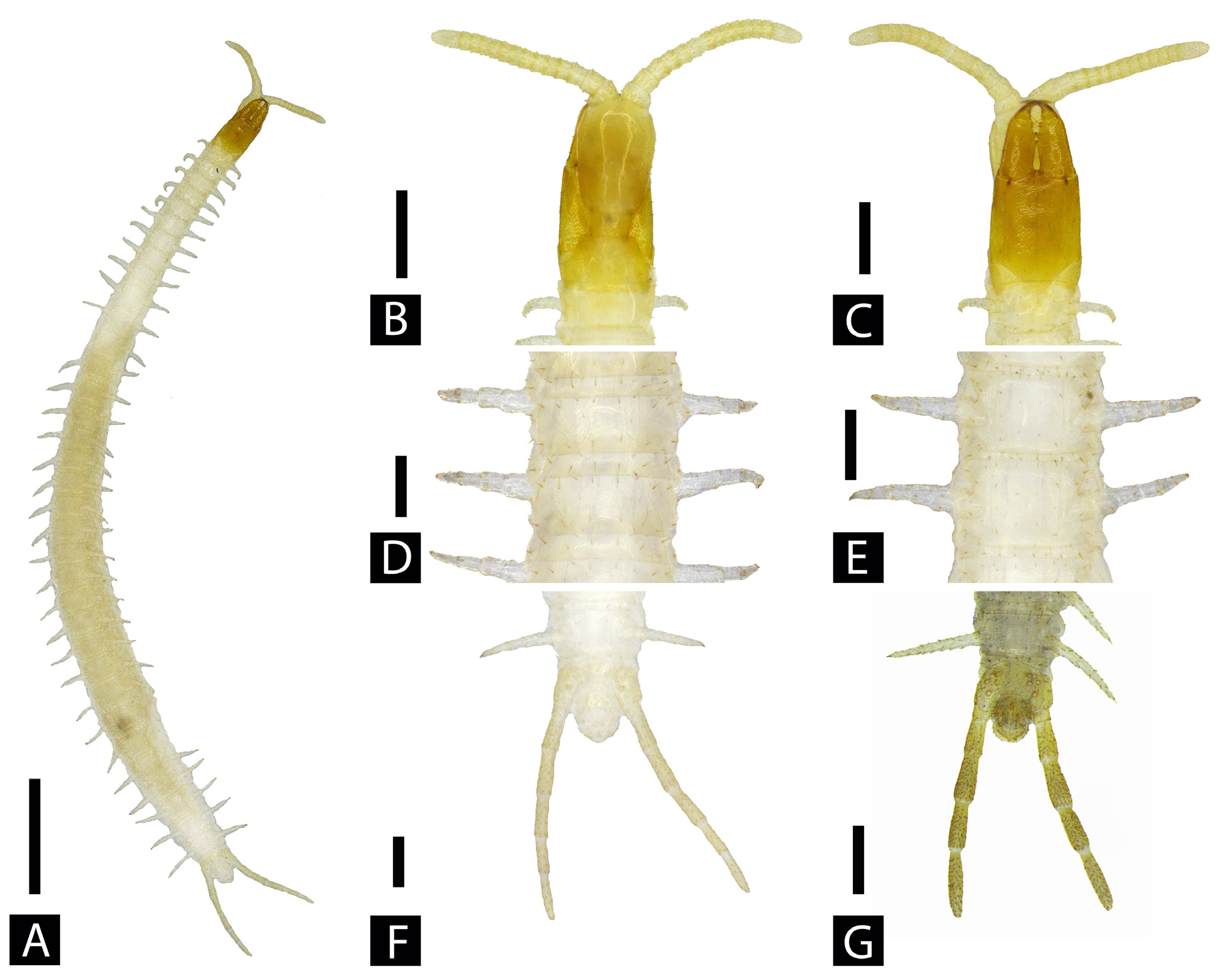
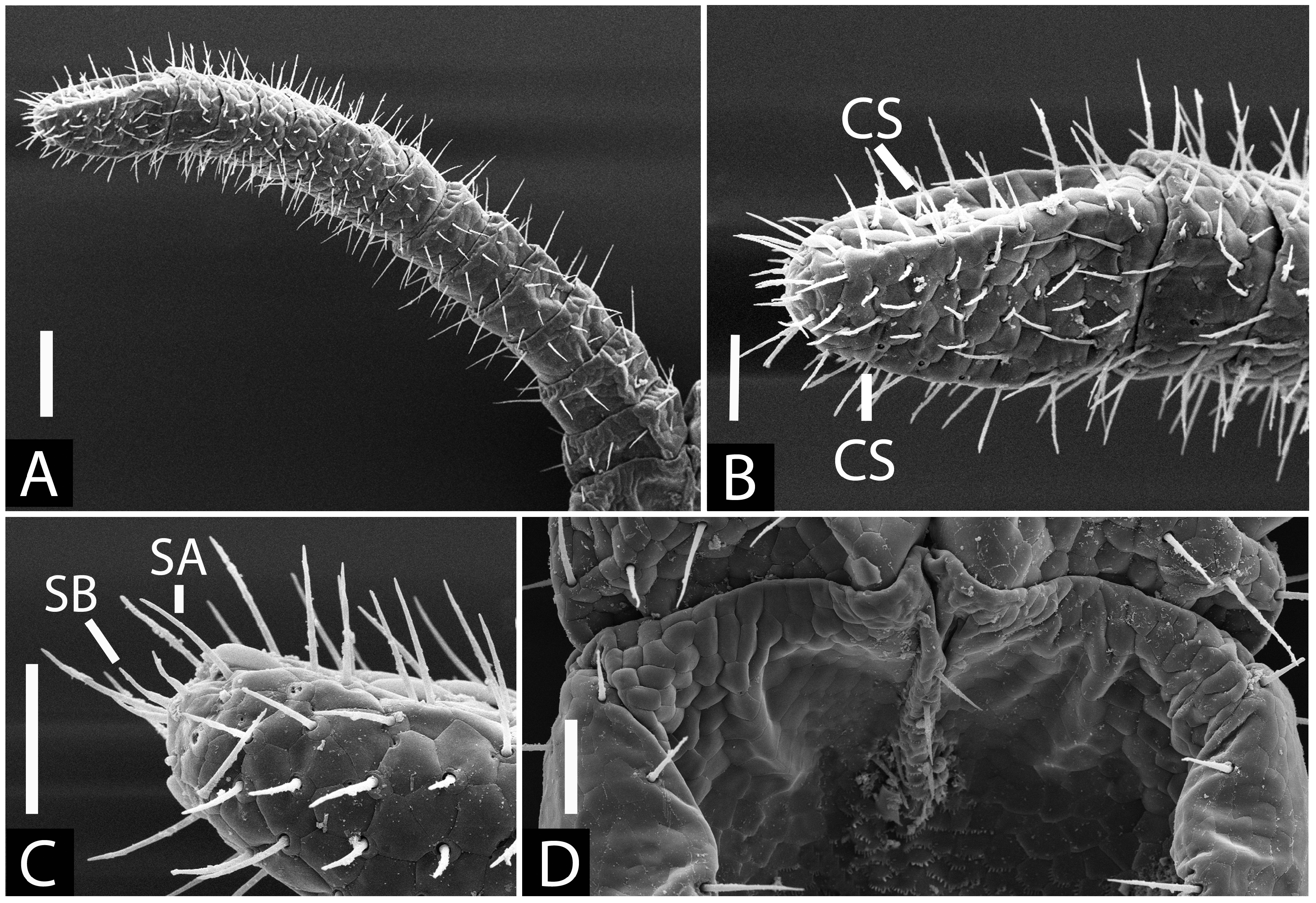
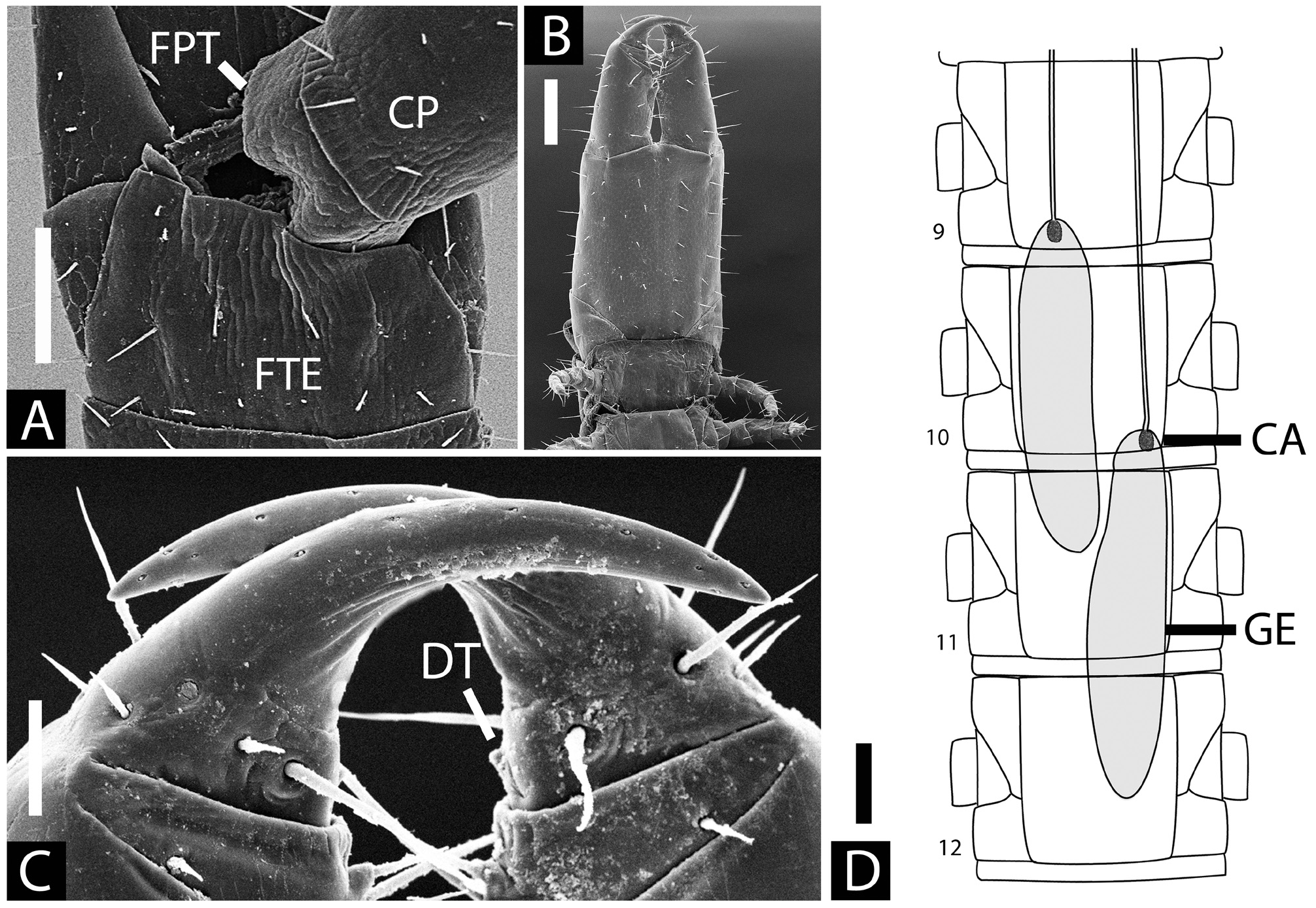
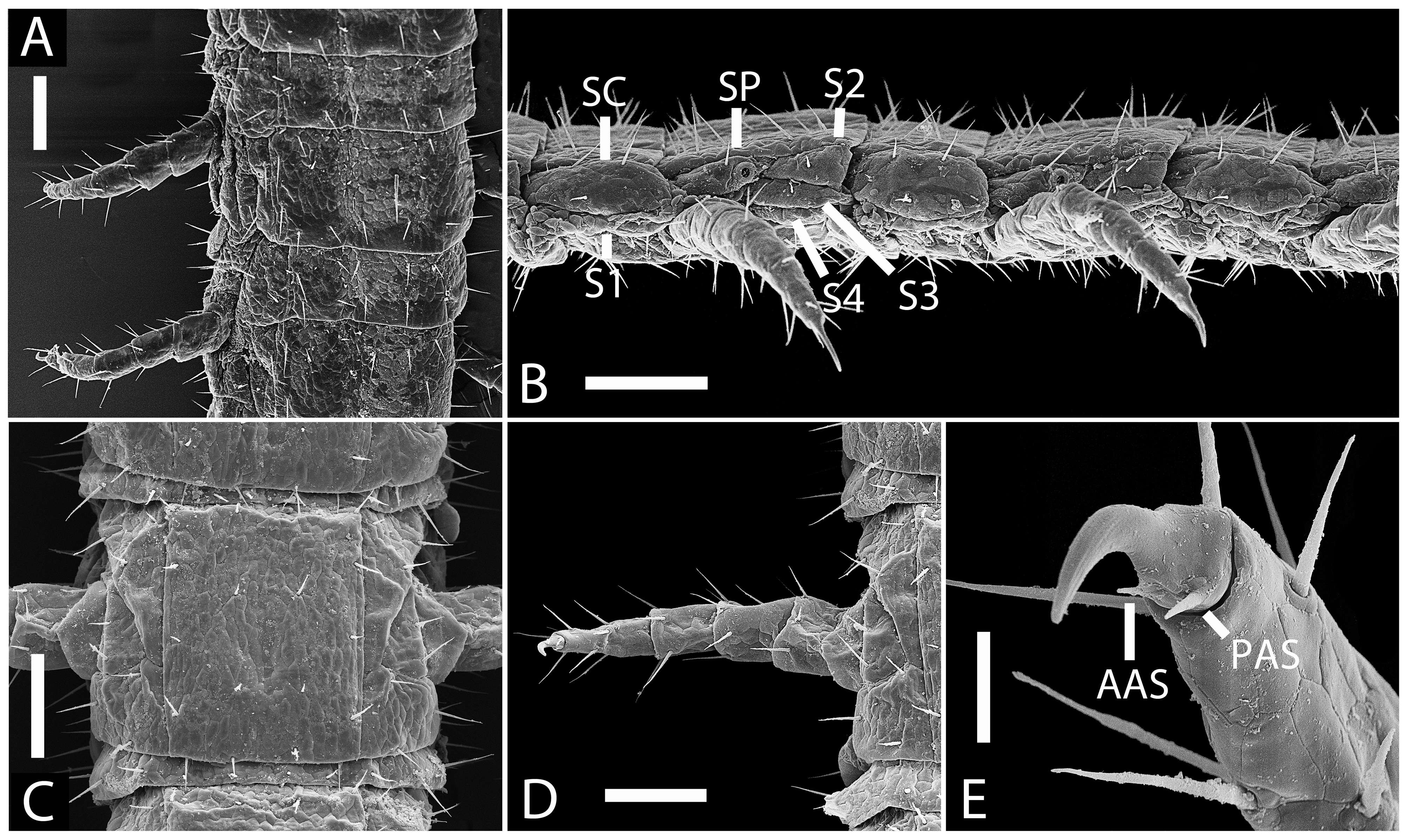
Description of holotype. Female (IBSP 6470). General aspect: thirty five pairs of legs. Body 6.6 long and 0.26 of maximum width (middle part of trunk). Color (preserved specimen in alcohol): head and forcipular segment ferrugineous, leg-bearing segments and postpedal segments whitish (Fig. 1 A−G). Cephalic plate: longer than wide, 0.3 long and 0.2 wide (length / width ratio 1.5), with sparse setae. General morphology as in Fig. 1 B. Antennae: left antenna 0.52 long (ca. 1.75 times as long as the cephalic plate); length / width ratio of articles II−XIII 0.3 – 0.95; length / width ratio of last article 1.9. Last article with 6 dorsal and 4 ventral claviform specialized setae. Morphology and chaetotaxy as in Figs 1 A – C, 2 A – C. Clypeus: 1 + 1 lateral setae; 1 + 1 post-antennal setae; 3 + 3 subclypeal setae (Fig. 2 D). Mandible: pectinate lamellae with ca. 20 elongated hyaline denticles (Fig. 3 B). First maxillae: left telopodite, length 0.016, width 0.018; distal article with 2 apical and 1 subapical sensilla; each medial projection of coxosternite with 3 subapical sensilla (Fig. 3 A – B). Second maxillae: coxosternite rectangular, concave in the middle of posterior margin (ca. 0.3 times as long as the lateral margins), length / width ratio 0.6; left telopodite, length 0.018 (1.1 times as long as the telopodite of first maxillae), maximum width (basal margin) 0.01; both telopodites with 2 little lateral sensilla on article 1, and 1 short apical and 2 most basal setae on article 3 (Fig. 3 A – D). Forcipular segment: tergite trapezoidal, length 0.14 (0.45 times as long as the cephalic plate), width 0.23 (length / width ratio 0.6), with one row of 6 setae and short sparse setae; pretergite length 0.066 (0.22 times as long as the cephalic plate), width 0.10 (length / width ratio 0.66); coxosternite length 0.3, width 0.24 (length / width ratio 1.25); telopodite length 0.25, reaching but not surpassing the anterior margin of the cephalic plate, trochanteropr efemur + femur with 2 well developed denticles, tibia with 1 small denticle; denticle of trochanteroprefemur with 1 short apical seta, denticle corresponding to the vestigial femur with bilobed shape and with 2 subapical and one apical setae, denticle of tibia with 1 apical and 2 subapical setae; tarsungulum 0.6 times as long as trochanteroprefe mur + femur, with a reduced denticle. Right calyx inside the leg-bearing segment 9, left calyx inside the leg-bearing segment 10 (Figs 1 C, 4 A – D). Tergites from the first to penultimate leg-bearing segment: rectangular metatergites, with two rows of 8 setae and short sparse setae; metatergite 15 length 0.095, width 0.23 (length / width ratio 0.4); pretergite 15 with 0.4 times as long as previous metatergite, with one row of 8 setae. (Figs 1 D, 5 A). Walking legs: first leg 0.9 times as long as second leg, procoxae not extended to the middle of the body; leg 15 length 0.26 (Figs 1 A – G, 5 A – B, D – E). Sternites from the first to penultimate leg-bearing segment: rectangular first metasternite (length / width ratio 1.2), other metasternites also rectangular, with a few large scattered setae; metasternite 16 length 0.15, width 0.12 (length / width ratio 1.25); most part of presternites exposed throughout the body, presternite of segment 16 with 0.12 times as long as previous metasternite, with one row of 8 setae (Figs 1 E, 5 C). Ultimate leg-bearing segment: metatergite in a semicircle shape, with two rows of 4 setae each, rectangular pretergite with one row of 6 setae; metasternite wider than long, trapezoidal, length 0.078, maximum width 0.113 (length / width ratio 0.7); presternite visible and concave in the middle part (Figs 1 F, 6 A). Ultimate legs straight, length 0.8 (2.8 times as long as penultimate leg), with seven articles (tarsus 2 present); each coxopleuron with 4 – 5 large coxal pores, most part opening close to the metasternite; tarsus 1 measuring 0.9 times as long as tibia (Figs 1 F, 6 A); terminal claw absent. Postpedal segments: membranous gonopods, without setae (Fig. 6 D). Sexual dimorphism. Males with ultimate legs just a little thickened (Fig. 1 G), with six articles (without tarsus 2, Figs 1 G, 6 C), ca. 2.3 times as long as the penultimate legs. Post pedal segments with many setae. Gonopods biarticulated, article 1 with 5 – 6 scattered setae, article 2 with 5 – 7 scattered setae. General morphology of the terminal part of the body as in Fig. 1 G. Variation. N = 6, including 3 ♀ and 3 ♂ (from a single locality): total body length: 6.5 − 7 mm. Leg-bearing segments: 33 or 35 (only one male with 33, all others specimens with 35). Coxal pores in each coxopleuron: 4 – 6. Natural history. The specimens were manually collected in forest soil in the Atlantic Forest biome (Fig. 7 B – E), usually found between the roots of trees, buried at about 4 − 10 cm deep, accessed for sampling mainly in ravines or recent landslides. Mecophilus carioca n. sp. is known only from the Parque Nacional de Itatiaia, where the specimens were sampled in the lowest part of the park.
Calvanese, Victor C., Brescovit, Antonio D. (2022): A new species of Mecophilus (Geophilidae: Aphilodontinae), with the first report of the genus from the state of Rio de Janeiro, Brazil. Zootaxa 5092 (1): 134-142, DOI: 10.11646/zootaxa.5092.1.8
Diagnosis. Mecophilus carioca n. sp. resemble M. tupiniquim by the position of the forcipular denticle of tarsungulum, close to the basal margin of the structure (Fig. 4 C) (in M. neotropicus the denticle is positioned in the middle of the article) and subrectangular cephalic plate (Fig. 1 B) (trapezoidal in M. neotropicus). Mecophilus carioca n. sp. differs from M. tupiniquim by the smaller length of the tarsungulum denticle (Fig. 4 C); distal denticle of trochanteroprefemur and denticle of femur are positioned not close to each other (Figs 1 C, 4 B) (close together in M. tupiniquim); and the ultimate legs in females without terminal claw (Figs 1 A, F, 6 A – B) (with a well developed terminal claw in M. tupiniquim).
Calvanese, Victor C., Brescovit, Antonio D. (2022): A new species of Mecophilus (Geophilidae: Aphilodontinae), with the first report of the genus from the state of Rio de Janeiro, Brazil. Zootaxa 5092 (1): 134-142, DOI: 10.11646/zootaxa.5092.1.8
Distribution. Brazil, state of Rio de Janeiro (Fig. 7 A).
Calvanese, Victor C., Brescovit, Antonio D. (2022): A new species of Mecophilus (Geophilidae: Aphilodontinae), with the first report of the genus from the state of Rio de Janeiro, Brazil. Zootaxa 5092 (1): 134-142, DOI: 10.11646/zootaxa.5092.1.8
Etymology. The epithet is an adjective, and is a tribute to the capital of the state of Rio de Janeiro, the wonderful city. “ Carioca ” comes from two Tupi words: kara'iwa (white man) and oka (house), which together mean “ house of the white man ”. The local indigenous people used the name after the foundation of Rio de Janeiro to refer to the inhabitants of the city.
Calvanese, Victor C., Brescovit, Antonio D. (2022): A new species of Mecophilus (Geophilidae: Aphilodontinae), with the first report of the genus from the state of Rio de Janeiro, Brazil. Zootaxa 5092 (1): 134-142, DOI: 10.11646/zootaxa.5092.1.8
Type specimens. Holotype: ♀, from Parque Nacional de Itatiaia, Itatiaia, Rio de Janeiro, Brazil, 12 / 2017, V. Calvanese & A. Silva col., deposited in IBSP 6470. Paratypes: 1 ♀ (IBSP 6471) and 1 ♂ (IBSP 6472), same data as holotype. Other material analyzed. 1 ♀ 2 ♂ (IBSP 6473; 1 ♂ 1 ♀ used for SEM), with the same data as types.
Calvanese, Victor C., Brescovit, Antonio D. (2022): A new species of Mecophilus (Geophilidae: Aphilodontinae), with the first report of the genus from the state of Rio de Janeiro, Brazil. Zootaxa 5092 (1): 134-142, DOI: 10.11646/zootaxa.5092.1.8

Export occurrence data

Darwin Core Archive (ZIP)

CLASSIFICATION

Taxonomic Classification Tree

MULTIMEDIA

Media Files(7)

FIGURE 1. A−G, Mecophilus carioca n. sp. Holotype, female (IBSP 6470): A, habitus, ventral; B, anterior part of body, dorsal; C, same, ventral; D, leg-bearing segments 15−16, dorsal; E, same, ventral; F, terminal part of body, ventral. Paratype, male (IBSP 6472): G, terminal part of body, ventral. Scale bars: 1 (A), 0.2 (B−C, F−G), 0.1 (D−E) mm.
Imageimage/png© Calvanese, Victor C.;Brescovit, Antonio D.Calvanese, Victor C.;Brescovit, Antonio D.

FIGURE 2. A−D, Mecophilus carioca n. sp. Female (IBSP 6473): A, right antenna, ventral; B, terminal part of the right antenna, ventral; C, terminal part of the last article of left antenna, lateral; D, clypeus, ventral. Abbreviations: CS: claviform setae. SA: type “A” seta. SB: type “B” seta. Scale bars: 0.05 (A), 0.02 (B−D) mm.

Imageimage/png© Calvanese, Victor C.;Brescovit, Antonio D.Calvanese, Victor C.;Brescovit, Antonio D.

FIGURE 3. A−D, Mecophilus carioca n. sp. Female (IBSP 6473): A, first and second maxillae, ventral; B, maxillary complex and mandibles, dorsal; C, middle of the second maxillae coxosternite, ventral; D, left telopodite of second maxillae, ventral. Abbreviations:CXP:medialprojectionsofcoxosternite.FMT:telopoditeoffirstmaxillae.FP:foraminalprocess.MAL:leftmandible. MP: membranous part. QP: most sclerotized part. SMT: telopodite of second maxillae. Scale bars: 0.02 (A−B), 0.01 (C−D) mm.
Imageimage/png© Calvanese, Victor C.;Brescovit, Antonio D.Calvanese, Victor C.;Brescovit, Antonio D.

FIGURE 4. A−D, Mecophilus carioca n. sp. Female (IBSP 6473): A, forcipular tergite and pretergite, dorsal; B, forcipular segment and first pair of legs, ventral; C, tarsungula, ventral; D, leg-bearing segments 9−12 and venom glands, ventral. Abbreviations: CA: calyx of venom gland. CP: cephalic plate. DT: denticle of tarsungulum. GE: glandular epithelium. FPT: forcipular pretergite. FTE: forcipular tergite. Scale bars: 0.05 (A), 0.1 (B, D), 0.02 (C) mm.
Imageimage/png© Calvanese, Victor C.;Brescovit, Antonio D.Calvanese, Victor C.;Brescovit, Antonio D.

FIGURE 5. A−E, Mecophilus carioca n. sp. Female (IBSP 6473): A, leg-bearing segments 13−14, dorsal; B, leg-bearing segments 22−23, lateral; C, leg-bearing segment 8, ventral; D, right leg 18, ventral; E, apex of left leg 25, latero-ventral. Abbreviations: AAS: anterior accessory spine. PAS: posterior accessory spine. SC: scutellum. SP: stigmatopleurite. S1: sclerite “1”. S2: sclerite “2”. S3: sclerite “3”. S4: sclerite “4”. Scale bars: 0.05 (A−D), 0.01 (E) mm.
Imageimage/png© Calvanese, Victor C.;Brescovit, Antonio D.Calvanese, Victor C.;Brescovit, Antonio D.

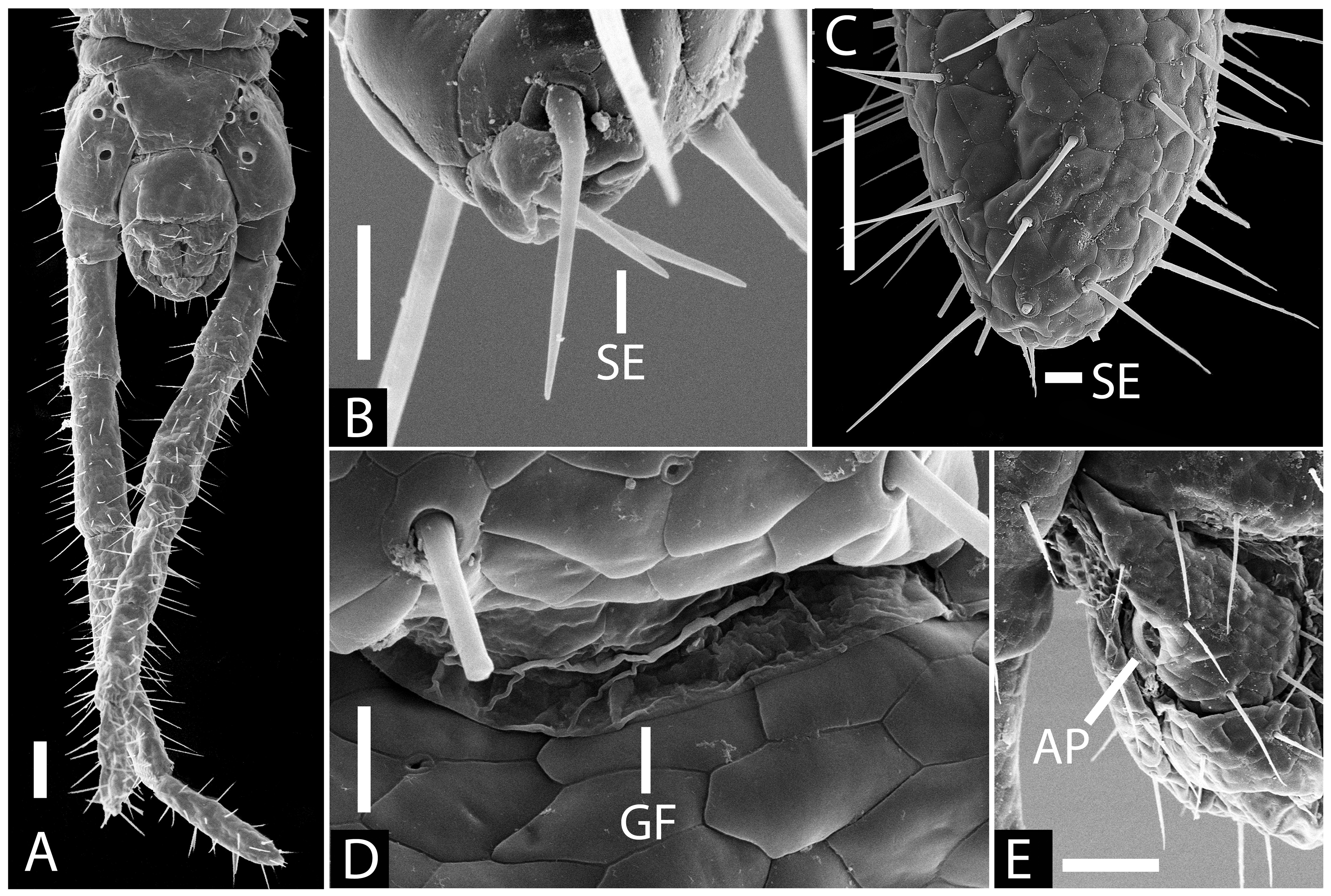
FIGURE 6. A−E, Mecophilus carioca n. sp. Female (IBSP 6473): A, terminal part of the body, ventral; B, terminal part of the left ultimate leg, ventral; D, right gonopod, ventral; E, right part of the post pedal segments, ventral. Male (IBSP 6473): C, terminal part of the left ultimate leg, ventral. Abbreviations: AP: anal pore. GF: female gonopod. SE: seta. Scale bars: 0.05 (A), 0.005 (B, D), 0.02 (C, E) mm.

Imageimage/png© Calvanese, Victor C.;Brescovit, Antonio D.Calvanese, Victor C.;Brescovit, Antonio D.

IMAGES

Gallery(7)

See Gallery

Occurrences with images

Source Information

A new species of Mecophilus (Geophilidae: Aphilodontinae), with the first report of the genus from the state of Rio de Janeiro, Brazil

checklist

This dataset contains the digitized treatments in Plazi based on the original journal article Calvanese, Victor C., Brescovit, Antonio D. (2022): A new species of Mecophilus (Geophilidae: Aphilodontinae), with the first report of the genus from the state of Rio de Janeiro, Brazil. Zootaxa 5092 (1): 134-142, DOI: 10.11646/zootaxa.5092.1.8

Abstract

Mecophilus carioca n. sp. is described based on males and females recently sampled in the Parque Nacional de Itatiaia, and is the first record of the genus from the state of Rio de Janeiro, Brazil. The specimens were analyzed in both light microscopy and scanning electron microscopy, and photos and schematic illustrations are provided. The known distribution of the three species of Mecophilus are presented in a map.

Calvanese V C, Brescovit A D, plazi (2022). A new species of Mecophilus (Geophilidae: Aphilodontinae), with the first report of the genus from the state of Rio de Janeiro, Brazil. Plazi.org taxonomic treatments database. Checklist dataset https://doi.org/10.15468/nak7kg accessed via GBIF.org on 2026-06-15.

CC0Published 1/18/2022View dataset
GBIF Usage Key
192444276
Dataset Key
2ce1e31f-7fab-4f7d-9d4f-c41eab63011b
Origin
source
Backbone Key
11626156
Taxon ID
0F2F87973A7C9356FF4B203E2D34F8CF.taxon
Last Crawled
6/9/2026
Last Interpreted
6/9/2026