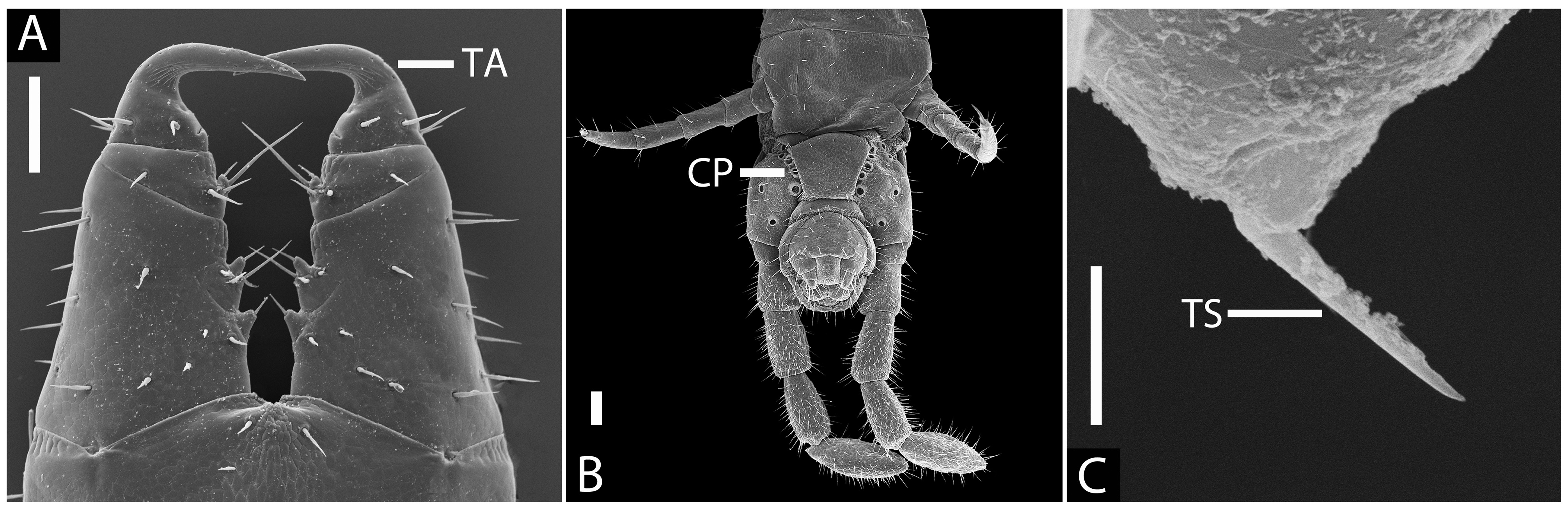
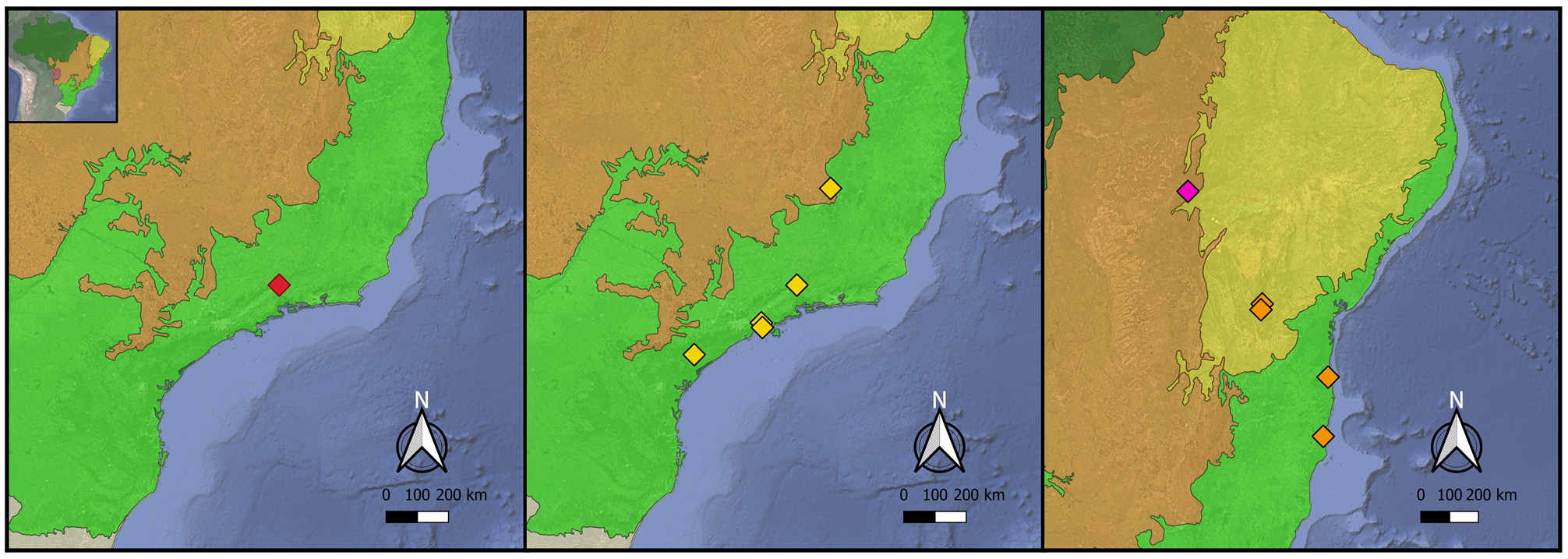
Description of holotype. Female (IBSP 6460). General aspect: 65 leg-bearing segments; body 18 long, maximum width (middle part of trunk) 0.34. Color (preserved specimen in alcohol): head and forcipular segment ferruginous, leg-bearing segments and post-pedal segments yellowish (Fig. 12 A – G). Cephalic plate: longer than wide, 0.32 long, 0.29 wide (length / width ratio 1.1), without transverse suture, with short scattered setae (Fig. 12 B). Antennae: left antenna 0.93 long (2.9 times as long as cephalic plate); length / width ratio of articles II – XIII 0.4 – 0.7; length / width ratio of last article 1.9. Last article with ca. 6 claviform specialized setae on the external margin and ca. 4 on the internal margin. Morphology and chaetotaxy as in Fig. 12 B – C. Clypeus: 2 + 2 lateral setae; 2 + 2 post-antennal setae; 6 + 5 subclypeal setae. Mandible: pectinate lamellae with ca. 20 denticles. First maxillae: left telopodite length 0.029, width 0.018; distal article with one subapical sensillum; each medial projection of coxosternite with one apical and 2 subapical sensilla. Second maxillae: 12 short setae distributed in a row along the anterior margin between the telopodites; coxosternite rectangular, not distinctly shorter in the middle part (length / width ratio 0.55), left telopodite length 0.054 (1.8 times as long as the telopodite of first maxillae), maximum width (basal margin) 0.023; each telopodite with one apical sensillum and two subapical setae on article 3. Forcipular segment: metatergite trapezoidal, length 0.09 (0.3 times as long as cephalic plate), width 0.29 (length / width ratio 0.3), with ca. 10 scattered setae; coxosternite length 0.30 and width 0.32 (length / width ratio 0.93); telopodite length 0.18, not reaching the anterior margin of the cephalic plate, with 2 denticles in the trochanteroprefemur + femur and 1 denticle in the tibia, all well developed; denticle distal of trochanteroprefemur with 1 apical seta, denticle corresponding to the vestigial femur bilobed and with 1 apical and 3 subapical setae, denticle of tibia with 2 apical and 2 subapical setae; tarsungulum 0.75 times as long as trochanteroprefemur + femur, without a visible denticle (Figs 11 A, 12 B – C). Tergites from the first to penultimate leg-bearing segment: metatergites rectangular, with two rows of 6 – 6 setae and short scattered setae; in segment 35 metatergite length 0.16, width 0.33 (length / width ratio 0.5); in segment 35 pretergite 0.3 times as long as previous metatergite and with a row of 6 setae (Fig. 12 D). Walking legs: first leg 0.95 times as long as second leg, with procoxae extended to the midline of the body; leg of segment 32 length 0.4 (Fig. 12 A – G). Sternites from the first to penultimate leg-bearing segment: first metasternite semicircular, the other metasternites rectangular and elongated with scattered setae; in segment 35 metasternite length 0.2, width 0.12 (length / width ratio 1.6); presternite present throughout body, in segment 35 presternite 0.15 times as long as the previous metasternite and with one row of 7 setae (Fig. 12 C, E). Ultimate leg-bearing segment: metasternite wider than long, trapezoidal, length 0.14, maximum width 0.18 (length / width ratio 0.77); presternite evident only in the sides of the metasternite (Fig. 12 G). Ultimate legs straight, length 0.9, about 2 times as long as penultimate leg; each coxopleuron with ca. 7 scattered coxal pores; tarsus 1.7 times as long as tibia (Fig. 12 G). Postpedal segments: gonopods with 3 + 3 distal setae. Sexual dimorphism. Males with ultimate legs thickened (Figs 11 B, 12 F). Male gonopods biarticulated, article 1 with 3 – 6 setae, article 2 with 2 – 4 scattered setae. Variation. N = 22, including 12 ♀ and 10 ♂ (from four localities): total body length: 16 – 21 mm. Leg-bearing segments: ♀ 63, 65; ♂ 63, 65. Coxal pores in each coxopleuron: 6 – 9. Natural history. The specimens were sampled at about 5 – 10 cm deep or just below rotten logs, in large forests or in small forest fragments in open areas.
Calvanese, Victor C., Brescovit, Antonio D. (2022): Six new species of Aphilodon centipedes (Geophilidae: Aphilodontinae) from Brazil. Zootaxa 5105 (4): 539-558, DOI: 10.11646/zootaxa.5105.4.4