AnimaliaNot EvaluatedacceptedspeciesAccepted
Aphilodon aiuruocae

Aphilodon aiuruocae

Calvanese & Brescovit, 2022

GBIF:193892708

0year

ABOUT

Descriptions(6)

(Figs 3 – 4) Types. Holotype: ♀, from Parque Nacional de Itatiaia, Itatiaia, Rio de Janeiro, Brazil, 03 – 17 / 12 / 2017, V. Calvanese & A. Silva leg., deposited in IBSP 6447. Paratypes: 2 ♀ (IBSP 6449) and 3 ♂ (IBSP 6448), same data as holotype.
Calvanese, Victor C., Brescovit, Antonio D. (2022): Six new species of Aphilodon centipedes (Geophilidae: Aphilodontinae) from Brazil. Zootaxa 5105 (4): 539-558, DOI: 10.11646/zootaxa.5105.4.4

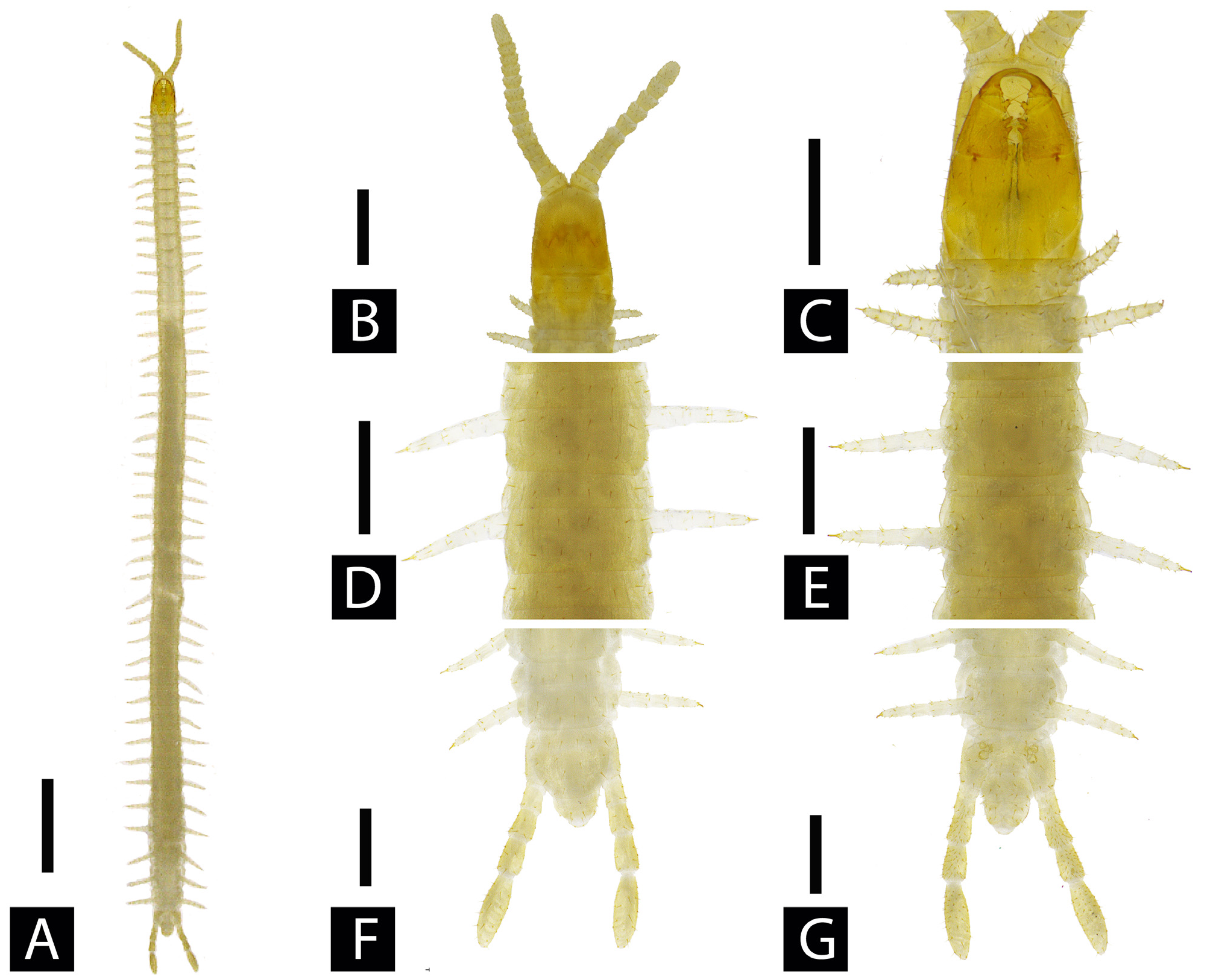
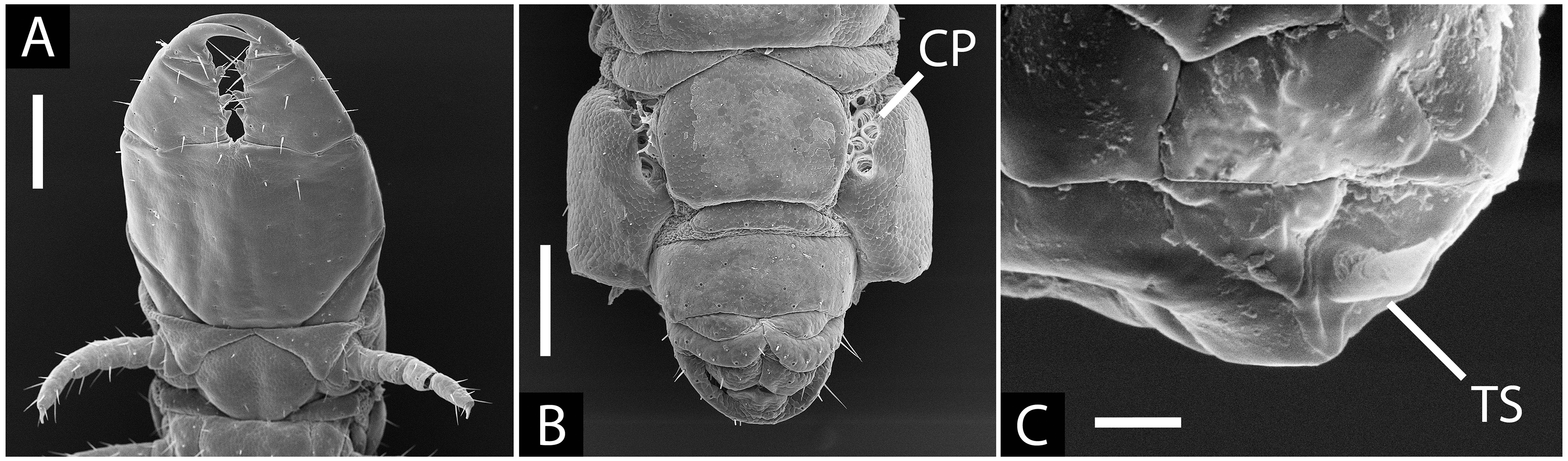
Description of holotype. Female (IBSP 6447). General aspect: 43 leg-bearing segments; body 8 long, maximum width (middle part of trunk) 0.25. Color (preserved specimen in alcohol): head and forcipular segment yellow, leg-bearing segments and post-pedal segments pale yellow (Fig. 4 A – G). Cephalic plate: longer than wide, 0.24 long, 0.2 wide (length / width ratio 1.2), without transverse suture, with setae scattered all over its surface (Fig. 4 B). Antennae: 0.45 long (1.9 times as long as cephalic plate); length / width ratio of articles II – XIII 0.4 – 0.7; length / width ratio of last article 2.5. Last article with ca. 12 claviform specialized setae on the external margin and ca. 8 on the internal margin. Morphology and chaetotaxy as in Fig. 4 A – B. Clypeus: 3 + 3 lateral setae; 2 + 2 post-antennal setae; 4 + 4 subclypeal setae. Mandible: pectinate lamellae with ca. 10 denticles. First maxillae: left telopodite length 0.034, width 0.024; distal article with 2 subapical sensilla; each medial projection of coxosternite with 4 apical and 1 subapical sensilla. Second maxillae: 8 little setae distributed in a row along the anterior margin between the telopodites; coxosternite subrectangular, not distinctly shorter in the middle part, length / width ratio 0.6; left telopodite length 0.05 (1.5 times as long as the telopodite of first maxillae), maximum width (basal margin) 0.02; each telopodite with one apical sensillum and two subapical setae on article 3. Forcipular segment: metatergite subrectangular, slightly wider at the base, length 0.04 (0.16 times as long as cephalic plate), width 0.19 (length / width ratio 0.2), with a row of 10 setae; coxosternite length 0.18, width 0.21 (length / width ratio 0.85); telopodites length 0.14, not reaching the anterior margin of the cephalic plate; trochanteroprefemur + femur with 2 denticles, tibia with 1 denticle, all relatively large; denticle distal of trochanteroprefemur with 1 apical seta, denticle corresponding to the vestigial femur bilobed, with 2 apical setae, denticle of tibia bilobed, with 4 setae; tarsungulum 0.85 times as long as the trochanteroprefemur + femur, with a short denticle (Figs 3 A, 4 B – C). Tergites from the first to penultimate leg-bearing segment: metatergites rectangular, with two rows of 6 setae; in segment 18 metatergite length 0.1, width 0.24 (length / width ratio 0.4); in segment 18 pretergite 0.6 times as long as the previous metatergite, with one row of 6 setae (Fig. 4 D). Walking legs: first leg 0.8 times as long as second leg, procoxae extended to the body midline; leg of segment 34 length 0.24 (Figs 3 A, 4 A – G). Sternites from the first to penultimate leg-bearing segment: first metasternite oval, other metasternites elongated, with scattered setae; metasternite of segment 27 length 0.12, width 0.11 (length / width ratio 1.1); presternite present throughout body, in segment 27 presternite 0.25 times as long as previous metasternite (Fig. 4 E). Ultimate leg-bearing segment: metasternite wider than long, pentagonal, length 0.11, maximum width 0.14 (length / width ratio 0.8); presternite apparently divided in the middle part (Figs 3 B, 4 G). Ultimate legs conical, tapering to the anterior part, length 0.56 (2.05 times as long as penultimate leg); each coxopleuron with ca. 8 coxal pores all grouped close to the lateral membranes between the coxopleuron and metasternite; tarsus 2.1 times as long as tibia (Figs 3 B, 4 F – G). Postpedal segments: gonopods with 3 + 3 distal setae (Figs 3 B, 4 G). Sexual dimorphism. Male ultimate legs a little thickened, gonopods biarticulated, article 1 with 3 – 6 setae, article 2 with 6 – 9 scattered setae. Variation. N = 8, including 5 ♀ and 3 ♂ (from a single locality): total body length: 7 – 10 mm. Leg-bearing segments: ♀ 41, 43; ♂ 41. Coxal pores in each coxopleuron: 5 – 10. Natural history. The specimens were sampled at about 5 – 10 cm deep, near tree roots, besides streams or in the humid microhabitats of the environment, in high forests, in the low part of the Parque Nacional de Itatiaia.
Calvanese, Victor C., Brescovit, Antonio D. (2022): Six new species of Aphilodon centipedes (Geophilidae: Aphilodontinae) from Brazil. Zootaxa 5105 (4): 539-558, DOI: 10.11646/zootaxa.5105.4.4
Diagnosis. Aphilodon aiuruocae n. sp. resembles A. cangaceiro n. sp. by the presence of coxal pores all grouped along the lateral membranes between the coxopleuron and metasternite (Figs 3 B, 4 G), but differ from it by having body 7 – 10 mm long (20 – 30 mm long in A. cangaceiro n. sp.), 41 – 43 leg-bearing segments (Fig. 4 A) (87 – 93 in A. cangaceiro n. sp.), and metatergites, pretergites, metasternites and presternites of the walking leg-bearing segments with shape not elongated (Fig. 4 D – E) (elongated in A. cangaceiro n. sp.).
Calvanese, Victor C., Brescovit, Antonio D. (2022): Six new species of Aphilodon centipedes (Geophilidae: Aphilodontinae) from Brazil. Zootaxa 5105 (4): 539-558, DOI: 10.11646/zootaxa.5105.4.4
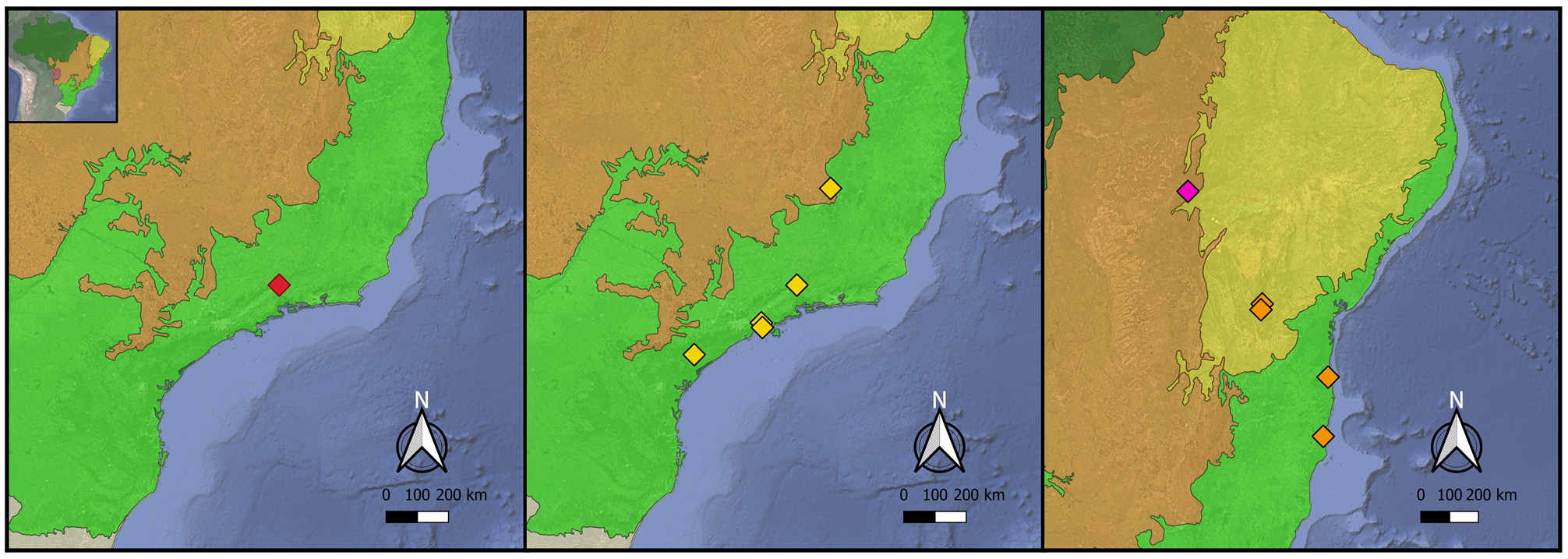
Distribution. Brazil, state of Rio de Janeiro (Fig. 13).
Calvanese, Victor C., Brescovit, Antonio D. (2022): Six new species of Aphilodon centipedes (Geophilidae: Aphilodontinae) from Brazil. Zootaxa 5105 (4): 539-558, DOI: 10.11646/zootaxa.5105.4.4
Etymology. The specific epithet aiuruocae refers to the Aiuruoca river (the genitive form of the Latinized version of the river’s name), that springs in the Serra da Mantiqueira in the Parque Nacional de Itatiaia, the type locality. Aiuruoca, in Tupi language, means “ house of parrots ”.
Calvanese, Victor C., Brescovit, Antonio D. (2022): Six new species of Aphilodon centipedes (Geophilidae: Aphilodontinae) from Brazil. Zootaxa 5105 (4): 539-558, DOI: 10.11646/zootaxa.5105.4.4
Other material examined. 2 ♀ (IBSP 6450), same data as types.
Calvanese, Victor C., Brescovit, Antonio D. (2022): Six new species of Aphilodon centipedes (Geophilidae: Aphilodontinae) from Brazil. Zootaxa 5105 (4): 539-558, DOI: 10.11646/zootaxa.5105.4.4

Export occurrence data

Darwin Core Archive (ZIP)

CLASSIFICATION

Taxonomic Classification Tree

MULTIMEDIA

Media Files(3)

FIGURE 3. A–C, Aphilodon aiuruocae n. sp. Female (IBSP 6450): A, forcipular segment and first leg-bearing segment, ventral; B, terminal part of body, except ultimate telopodites, ventral; C, terminal part of the left ultimate leg, ventral. Abbreviations: CP: coxal pores. TS: terminal spine. Scale bars: 0.1 (A–B), 0.002 (C) mm.

Imageimage/png© Calvanese, Victor C.;Brescovit, Antonio D.Calvanese, Victor C.;Brescovit, Antonio D.

FIGURE 4. A–G, Aphilodon aiuruocae n. sp. Holotype, female (IBSP 6447): A, habitus, ventral; B, anterior part of body, dorsal; C, same, ventral; D, leg-bearing segments 15–16, dorsal; E, same, ventral; F, terminal part of body, dorsal; G, same, ventral. Scale bars: 1 (A), 0.2 (B–G) mm.

Imageimage/png© Calvanese, Victor C.;Brescovit, Antonio D.Calvanese, Victor C.;Brescovit, Antonio D.

FIGURE 13. Biomes of Brazil and the known occurrence of the new species of Aphilodon: on the map of Brazil, dark green indicates the biome of Amazonia; orange Cerrado; yellow Caatinga; purple Pantanal; light green Atlantic Forest; beige Pampas. Red diamond: Aphilodon foraminis n. sp., Aphilodon aiuruocae n. sp. and Aphilodon acutus n. sp., yellow diamond: Aphilodon rectitibia n. sp., purple diamond: Aphilodon cangaceiro n. sp., and orange diamond: Aphilodon bahianus n. sp.

Imageimage/png© Calvanese, Victor C.;Brescovit, Antonio D.Calvanese, Victor C.;Brescovit, Antonio D.

IMAGES

Gallery(3)

See Gallery

Occurrences with images

Source Information

Six new species of Aphilodon centipedes (Geophilidae: Aphilodontinae) from Brazil

checklist

This dataset contains the digitized treatments in Plazi based on the original journal article Calvanese, Victor C., Brescovit, Antonio D. (2022): Six new species of Aphilodon centipedes (Geophilidae: Aphilodontinae) from Brazil. Zootaxa 5105 (4): 539-558, DOI: 10.11646/zootaxa.5105.4.4

Abstract

After recent sampling in the Southeast and Northeast of Brazil, six new species of Aphilodon are described and illustrated based on males and females. From the Atlantic Forest biome, Aphilodon foraminis n. sp., A. aiuruocae n. sp., A. acutus n. sp. and A. rectitibia n. sp. were registered in the state of Rio de Janeiro. Aphilodon cangaceiro n. sp. is the first record of Aphilodontinae for the state of Piauí and was sampled in the Caatinga biome. Aphilodon bahianus n. sp. is the first species of Aphilodontinae known for the state of Bahia, being registered from the Atlantic Forest and in the Caatinga biomes. Additionally, some morphological characteristics of all known species of Aphilodon and their distributions are compared.

Calvanese V C, Brescovit A D, plazi (2022). Six new species of Aphilodon centipedes (Geophilidae: Aphilodontinae) from Brazil. Plazi.org taxonomic treatments database. Checklist dataset https://doi.org/10.15468/7dgg5d accessed via GBIF.org on 2026-06-14.

CC0Published 3/7/2022View dataset
GBIF Usage Key
193892708
Dataset Key
fa7fafa4-c47d-4be1-9e28-870475c0b570
Origin
source
Backbone Key
11874426
Taxon ID
8D7C87DC042E0160FF157061FCE4F915.taxon
Last Crawled
6/9/2026
Last Interpreted
6/9/2026