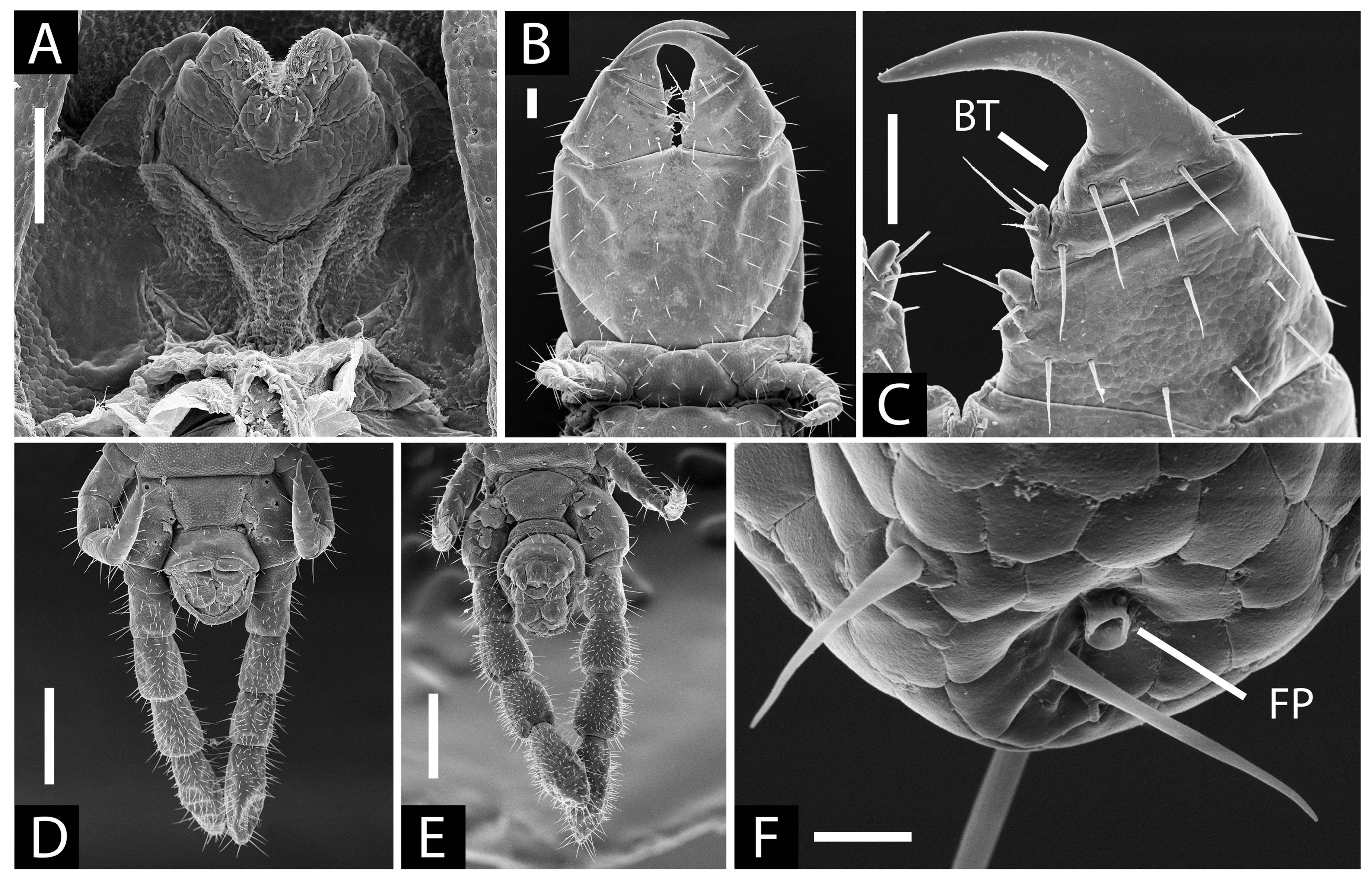
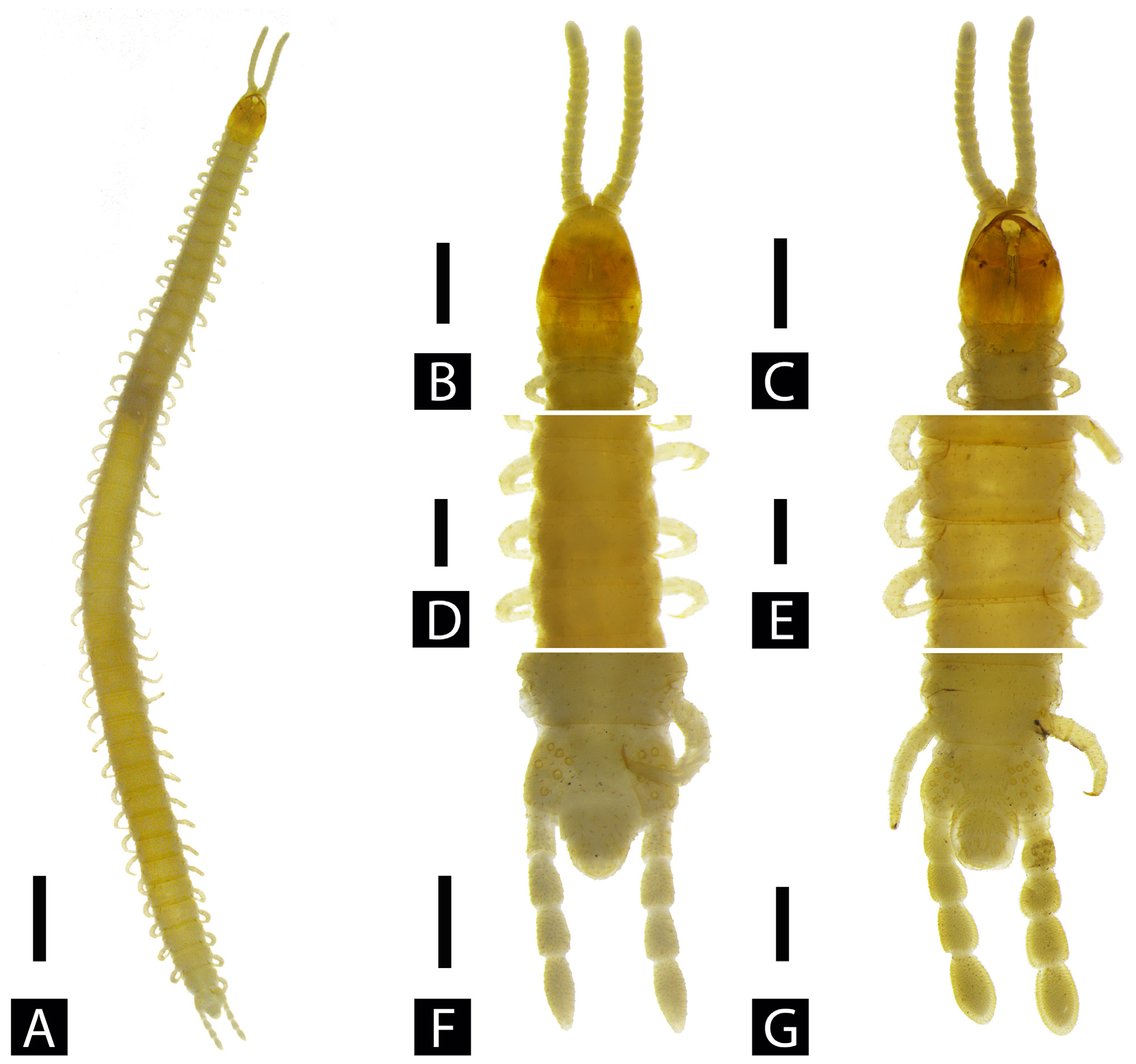
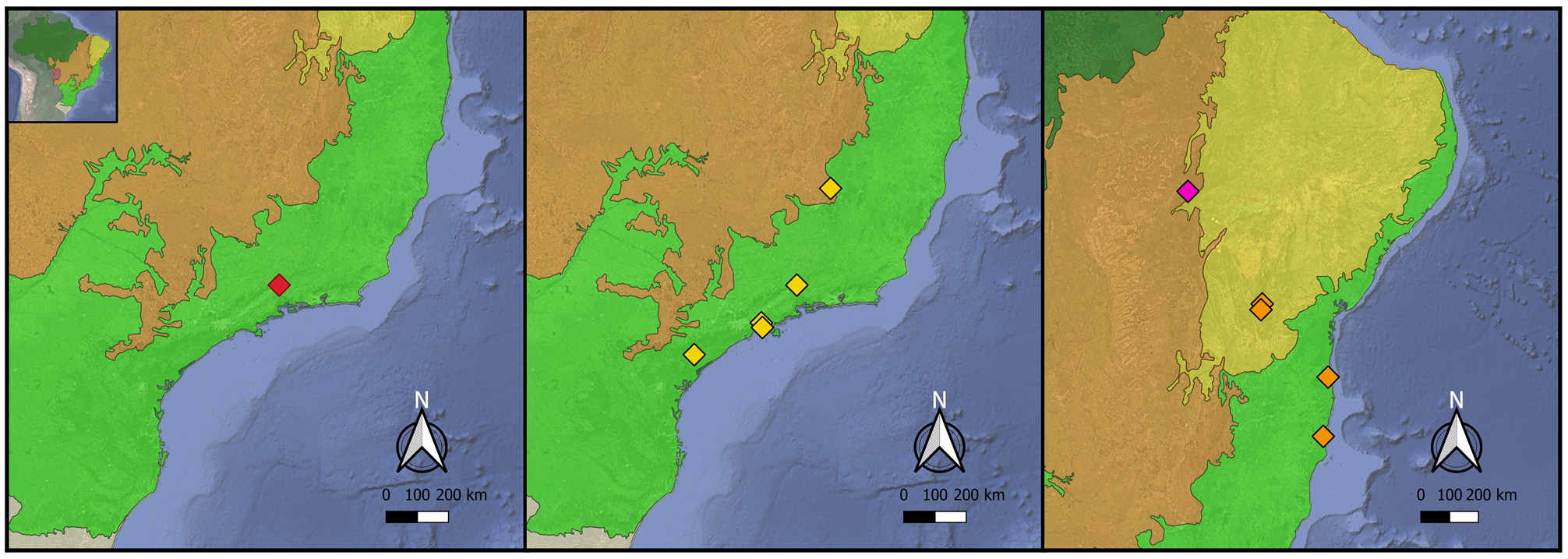
Description of holotype. Female (IBSP 6442). General aspect: 41 leg-bearing segments; body 12 long, maximum width (middle part of trunk) 0.5. Color (preserved specimen in alcohol): head and forcipular segment ferruginous, leg-bearing segments and post-pedal segments dark yellow (Fig. 2 A – G). Cephalic plate: wider than long, 0.43 long, 0.47 wide (length / width ratio 0.9), with a basal row of 8 setae and a row of 8 setae in the middle (in the position corresponding to the transverse suture, which can be observed as vestigial). Other scattered setae also are present, mainly in the distal part (Fig. 2 B). Antennae: 0.84 long (1.95 times as long as cephalic plate); length / width ratio of articles II – XIII 0.5 – 0.7; length / width ratio of last article 1.4. Last article with ca. 16 claviform specialized setae on the external margin and ca. 12 on the internal margin. Morphology and chaetotaxy as in Fig. 2 A – C. Clypeus: 3 + 3 lateral setae; 2 + 2 post-antennal setae; 7 + 7 subclypeal setae. Mandible: pectinate lamellae with ca. 25 denticles. First maxillae: left telopodite, length 0.05, width 0.03; distal article with 3 subapical sensilla; each medial projection of coxosternite with 2 apical and 2 subapical sensilla (Fig. 1 A). Second maxillae: 6 short setae distributed in a row along the anterior margin between the telopodites; coxosternite rectangular, not distinctly shorter in the middle part, maximum length / maximum width ratio 0.6; left telopodite length 0.08 (1.55 times as long as the telopodite of first maxillae), maximum width (basal margin) 0.03; each telopodite with one apical sensillum and two subapical setae on article 3 (Fig. 1 A). Forcipular segment: metatergite subrectangular, slightly wider at the base, length 0.11 (0.25 times as long as cephalic plate), width 0.46 (length / width ratio 0.25), with many scattered setae; coxosternite length 0.3, width 0.48 (length / width ratio 0.6); telopodite length 0.32, not reaching the anterior margin of cephalic plate, trochanteroprefe mur + femur with 2 denticles and tibia with 1 denticle, all relatively large; denticle distal of trochanteroprefemur with 1 apical seta, denticle corresponding to the vestigial femur bilobed, with 2 apical and one subapical setae, denticle of tibia bilobed and with 5 setae; tarsungulum 1.35 times as long as the trochanteroprefemur + femur, without denticle (Figs 1 B – C, 2 B – C). Tergites from the first to penultimate leg-bearing segment: metatergites rectangular, with two rows of ca. 10 setae and short scattered setae; in segment 15 metatergite length 0.21, width 0.45 (length / width ratio 0.45); in segment 15 pretergite 0.3 times as long as previous metatergite, with one row of 10 setae and short scattered setae (Fig. 2 D). Walking legs: first leg 0.75 times as long as second leg; procoxae extended to the midline of the body; leg of segment 15 length 0.67 (Fig. 2 A – G). Sternites from the first to penultimate leg-bearing segment: first metasternite trapezoidal, other metasternites subquadratic, with scattered setae; in segment 19 metasternite length 0.28, width 0.31 (length / width ratio 0.9); presternite present throughout body, in segment 19 presternite 0.2 times as long as the previous metasternite (Fig. 2 C, E). Ultimate leg-bearing segment: metasternite wider than long, trapezoidal, length 0.16, maximum width 0.19 (length / width ratio 0.85); presternite evident only in the sides of the metasternite (Figs 1 D, 2 F). Ultimate legs straight and slightly thickened compared to the previous ones, length 0.81 (1.4 times as long as penultimate leg); each coxopleuron with ca. 6 scattered coxal pores; tarsus approximately as long as the tibia (Figs 1 D, 2 F). Postpedal segments: gonopods with 2 + 2 distal setae. Sexual dimorphism. Males with ultimate legs thickened (Figs 1 E, 2 G), and gonopods biarticulated, article 1 with 3 – 4 setae, article 2 with 4 – 5 scattered setae. Variation. N = 25, including 15 ♀ and 10 ♂ (from a single locality): total body length: 11 – 15 mm. Leg-bearing segments: ♀ 41, 43; ♂ 39, 41. Coxal pores in each coxopleuron: 5 – 8. Natural history. The specimens were sampled in ravines or near roots, at about 5 – 10 cm deep, in high forests or in small forest fragments in open areas, in the high and low part of the Parque Nacional de Itatiaia.
Calvanese, Victor C., Brescovit, Antonio D. (2022): Six new species of Aphilodon centipedes (Geophilidae: Aphilodontinae) from Brazil. Zootaxa 5105 (4): 539-558, DOI: 10.11646/zootaxa.5105.4.4