
AnimaliaNot EvaluatedacceptedspeciesAccepted
Otostigmus consonensis

Otostigmus consonensis

Vu, Eguchi, Le, Nguyen & Nguyen, 2022

GBIF:194854720

0year

ABOUT

Descriptions(7)

(Figs. 1, 2 – 4)
Vu, Ha T., Eguchi, Katsuyuki, Le, Son X., Nguyen, Thu-Anh T., Nguyen, Anh D. (2022): A new species and a new record of the genus Otostigmus Porat, 1876 (Chilopoda Scolopendromorpha: Scolopendridae) in Vietnam. Zootaxa 5129 (1): 60-76, DOI: 10.11646/zootaxa.5129.1.3
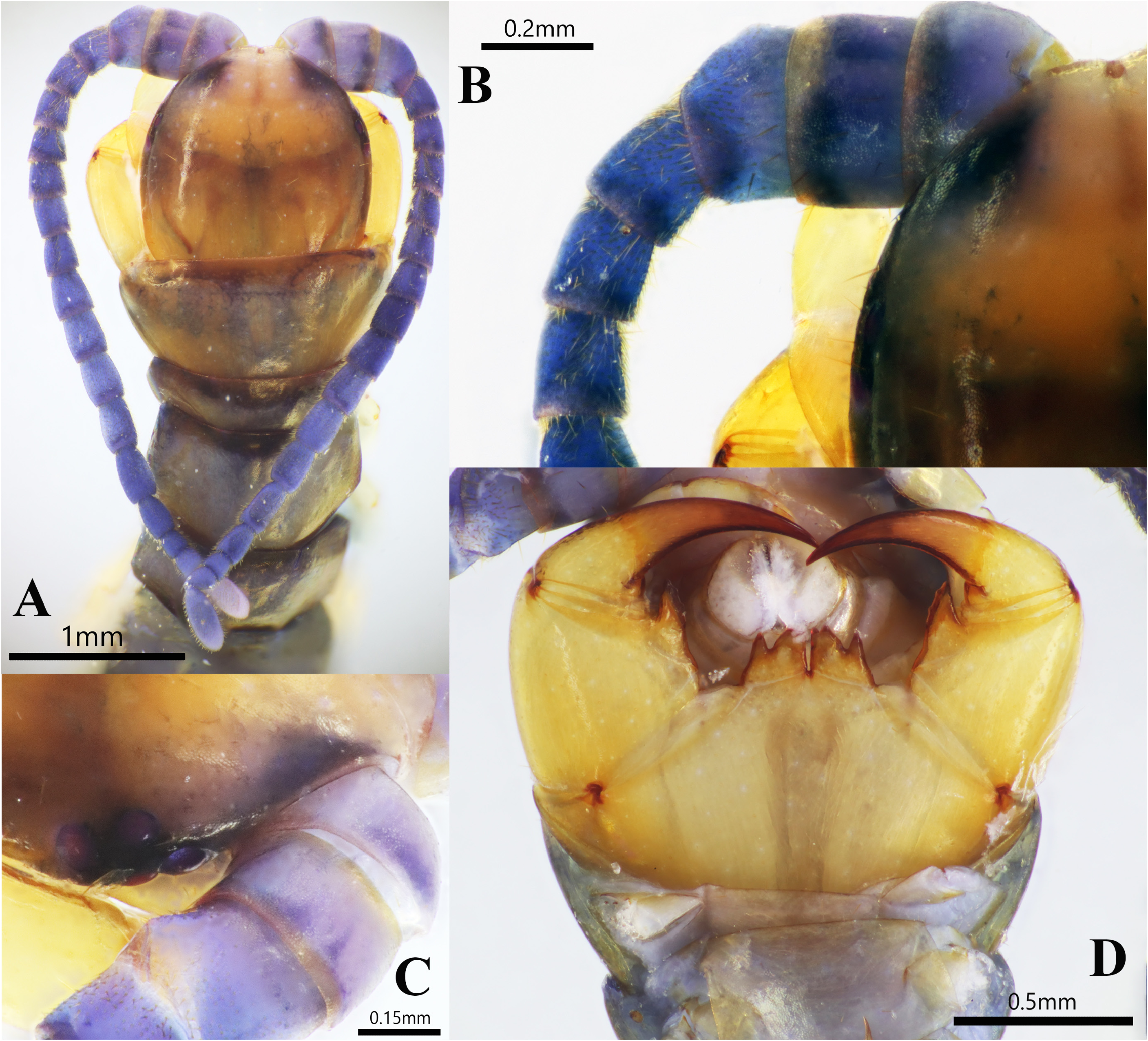
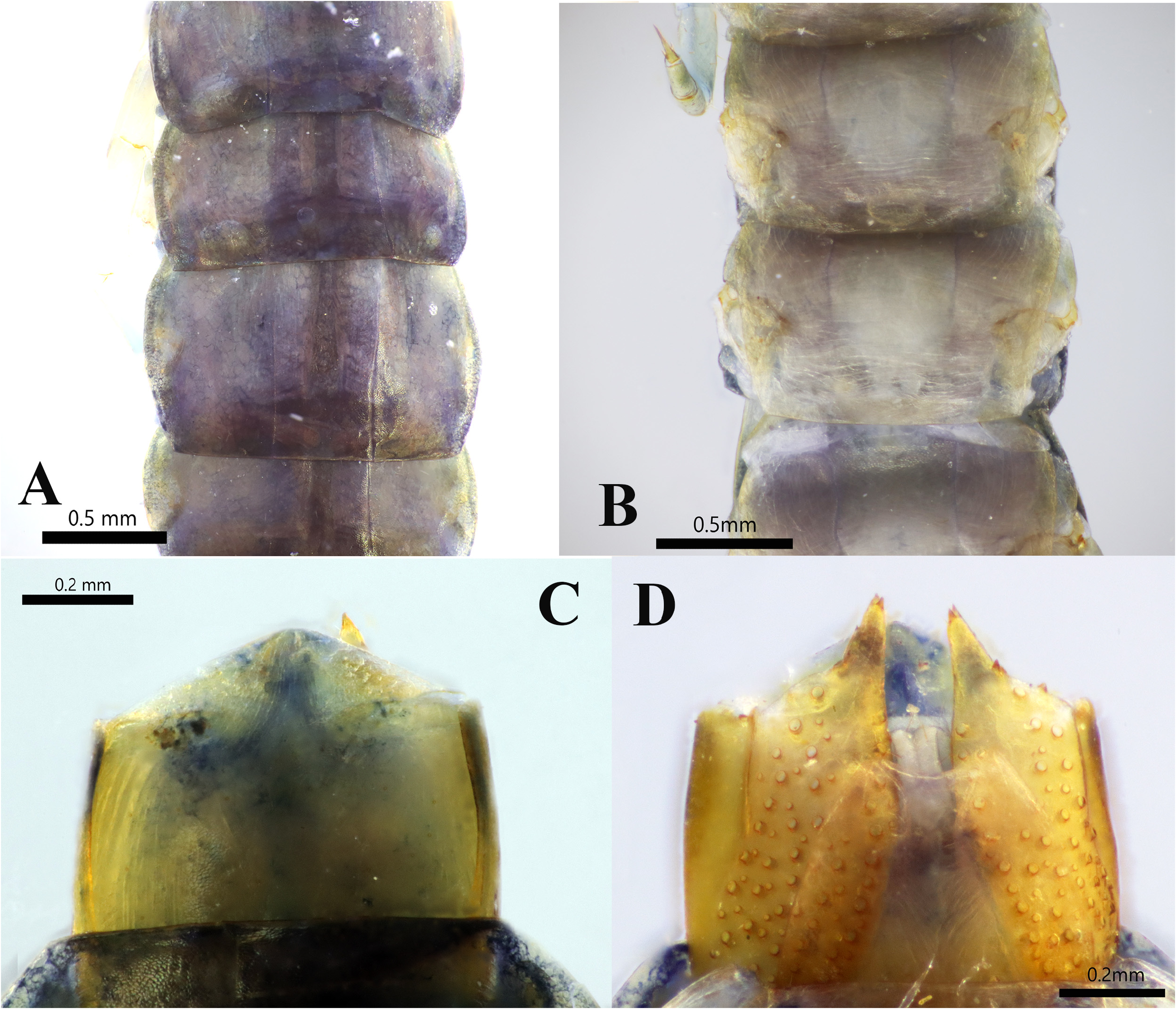
Description Color: Antennae, head and tergites blackish blue, whereas other parts yellow. Body length, ca. 30 mm; width, LBS 10 сa. 1.2 mm. Head: Cephalic plate with an incomplete median longitudinal sulcus, puncta and setae, and lateral marginations (Fig. 1 A). Antennae with 18 antennomeres, 2.3 – 2.5 glabrous basal ones (Fig. 2 A – B). Forcipular segment: coxosternite not setose; tooth plates well-developed, completely separated; each plate with three teeth: a larger and two smaller. Trochanteroprefemur processes with two tiny or only traces of teeth (Fig. 2 D). Tergites 1 – 4 without sutures or keels; tergites 5 – 20 with complete paramedian sutures (Fig. 3 A presents the paramedian structure on tergites 9 – 10). The last tergite without sulcus (Fig. 3 C). Spiracles oval, on LBS 3, 5, 8, 10, 12, 14, 16, 18, 20 (Fig. 4 A presents the spiracle on segment 10). Sternites not setose; paramedian sutures incomplete; marginations absent (Fig. 3 B). Ultimate sternite subtrapeziform with concave posterior margin (Fig. 3 D). Ultimate LBS: coxopleuron with many large pores covering nearly all its surface (Fig. 3 D); coxopleural process short, with 2 apical, 1 subapical, and 1 lateral spines (Fig. 3 D). Legs long and slender. Leg 1 with 2 tarsal spurs (Fig. 4 B), 1 tibial and 1 femoral spur; legs 2 – 20 with only 1 tarsal spur, without tibial and femoral spurs. The ultimate leg very long and slender, with 14 relatively thin prefemoral spines: 1 located on the corner, 2 dorsomedial, 7 medial and 4 ventromedial ones (Fig. 4 C-D). Variability The number of prefemoral spines varies from 11 to 15, including 1 – 2 dorsomedial spines, 4 – 7 medial spines, and 2 – 5 ventromedial spines. The number of coxopleural spines also varies from 2 (1 apical, 1 subapical) to 4 (2 apical, 1 subapical, and 1 lateral).
Vu, Ha T., Eguchi, Katsuyuki, Le, Son X., Nguyen, Thu-Anh T., Nguyen, Anh D. (2022): A new species and a new record of the genus Otostigmus Porat, 1876 (Chilopoda Scolopendromorpha: Scolopendridae) in Vietnam. Zootaxa 5129 (1): 60-76, DOI: 10.11646/zootaxa.5129.1.3
Diagnosis Otostigmus consonensis sp. nov. differs from its congeners by 18 antennomeres (of them, 2.3 – 2.5 basal ones are glabrous); forcipular tooth plates with 3 + 3 teeth; tergites 5 – 20 with complete paramedian sutures; sternites with incomplete paramedian sutures; the ultimate leg with 11 – 15 prefemoral spines.
Vu, Ha T., Eguchi, Katsuyuki, Le, Son X., Nguyen, Thu-Anh T., Nguyen, Anh D. (2022): A new species and a new record of the genus Otostigmus Porat, 1876 (Chilopoda Scolopendromorpha: Scolopendridae) in Vietnam. Zootaxa 5129 (1): 60-76, DOI: 10.11646/zootaxa.5129.1.3
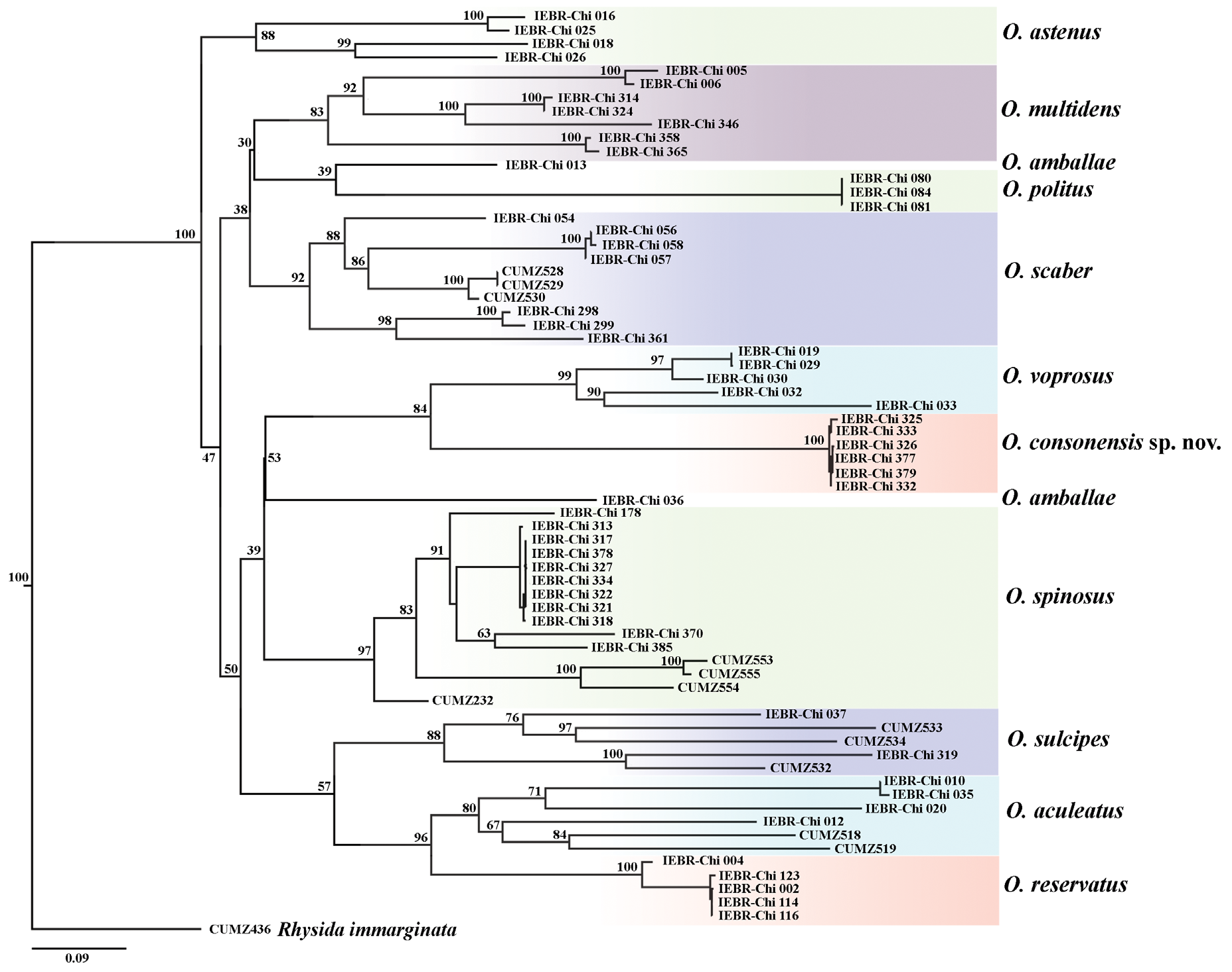
Remarks The number of glabrous basal antennomeres is systematically important (Schileyko 1995). By having 2 – 2.5 ones, the new species is close to O. astenus, O. multidens, O. scaber, and O. spinosus. The new species is different from O. scaber in the absence of longitudinal tergal keels and sternites lacking (or poorly developed) paramedian sutures. Otostigmus consonensis readily differs from all the aforementioned species (except for O. astenus) in having 3 + 3 (vs. 4 + 4 or even more) teeth of forcipular tooth plates. Two other diagnostic characters are the number of antennomeres (18 vs. 17 or 19 – 24) and the number of coxopleural spines (3 – 4 vs. more than 4), but both of them may be a subject in individual variability in Otostigmus s. str. and should not be used alone for distinguishing species in this taxon (as suggested by Schileyko et al., 2020) The new species is closely related to O. voprosus. Both have 18 antennomeres, a tooth plate with three distinct teeth, and tergites with paramedian sutures, but they can be distinguished by the number of glabrous basal antennomeres (2.3 – 2.5 in the new species vs. 2.5 – 3 in O. voprosus), the number of coxopleural spines (3 – 4 vs. 5), and the number of tarsal spurs on legs 2 and 3 (2 vs. 1). The phylogenetic analysis also revealed that O. voprosus is a sister species of the new one (Fig. 9). A detailed comparison between the new species and Otostigmus species recorded in Vietnam is presented in Table 2.
Vu, Ha T., Eguchi, Katsuyuki, Le, Son X., Nguyen, Thu-Anh T., Nguyen, Anh D. (2022): A new species and a new record of the genus Otostigmus Porat, 1876 (Chilopoda Scolopendromorpha: Scolopendridae) in Vietnam. Zootaxa 5129 (1): 60-76, DOI: 10.11646/zootaxa.5129.1.3
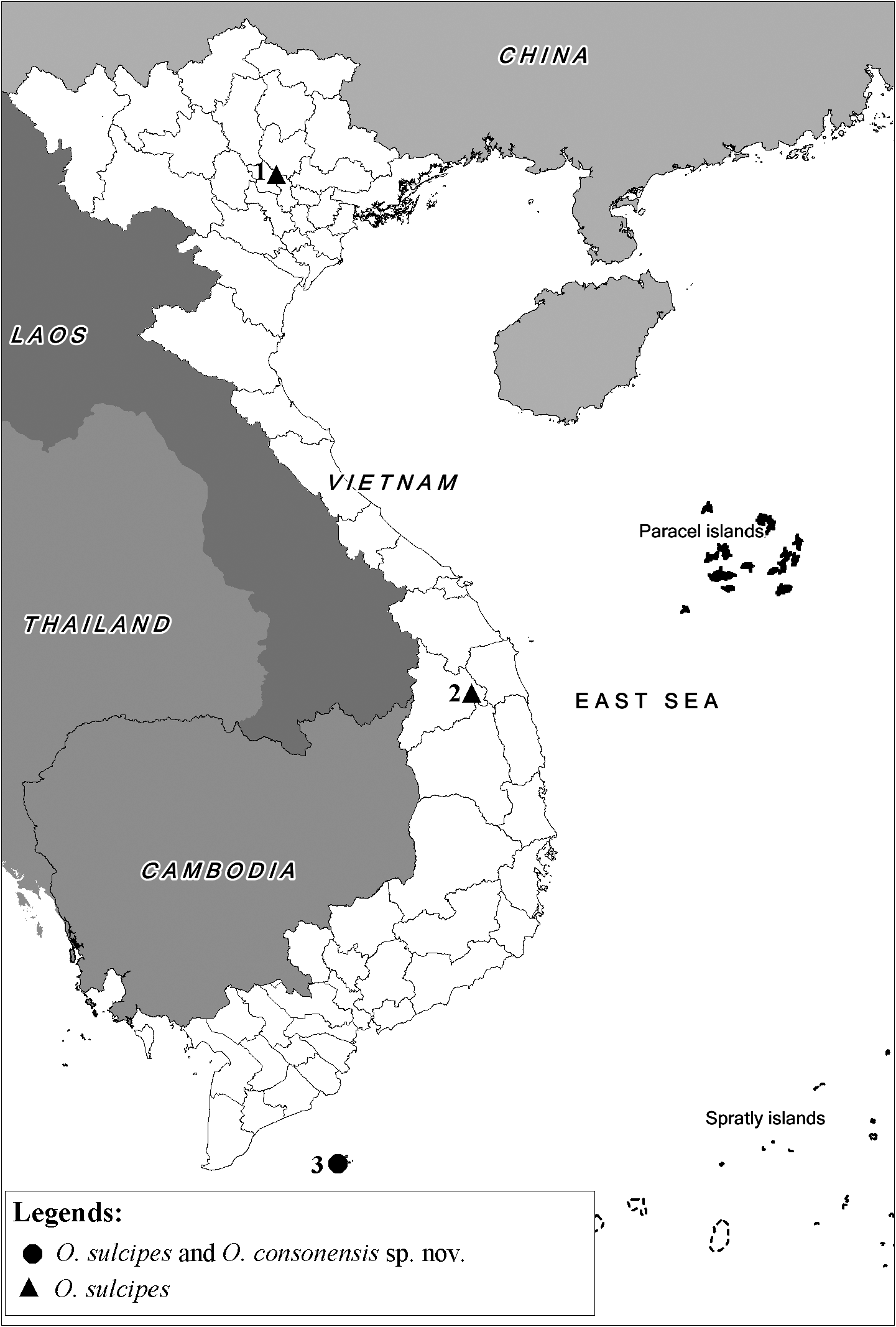
Distribution The new species was found only in the Con Son Island, which is about 80 km from the mainland of southern Vietnam.
Vu, Ha T., Eguchi, Katsuyuki, Le, Son X., Nguyen, Thu-Anh T., Nguyen, Anh D. (2022): A new species and a new record of the genus Otostigmus Porat, 1876 (Chilopoda Scolopendromorpha: Scolopendridae) in Vietnam. Zootaxa 5129 (1): 60-76, DOI: 10.11646/zootaxa.5129.1.3
Etymology Named after the “ Con Son ” Island, the largest island of Con Dao National Park, where type series were collected.
Vu, Ha T., Eguchi, Katsuyuki, Le, Son X., Nguyen, Thu-Anh T., Nguyen, Anh D. (2022): A new species and a new record of the genus Otostigmus Porat, 1876 (Chilopoda Scolopendromorpha: Scolopendridae) in Vietnam. Zootaxa 5129 (1): 60-76, DOI: 10.11646/zootaxa.5129.1.3
Material examined Holotype. Ba Ria - Vung Tau Province, Con Dao National Park, Hon Ba trail; 08.65026 N, 106.55683 E; 35 m a. s. l.; 09 Nov. 2019; Vu Thi Ha leg.; natural forest; IEBR-Chi 326. Paratypes. Six specimens; the same data as for holotype; IEBR-Chi 325, IEBR-Chi 331, IEBR-Chi 332, IEBR- Chi 333, IEBR-Chi 377, IEBR-Chi 379.
Vu, Ha T., Eguchi, Katsuyuki, Le, Son X., Nguyen, Thu-Anh T., Nguyen, Anh D. (2022): A new species and a new record of the genus Otostigmus Porat, 1876 (Chilopoda Scolopendromorpha: Scolopendridae) in Vietnam. Zootaxa 5129 (1): 60-76, DOI: 10.11646/zootaxa.5129.1.3

Export occurrence data

Darwin Core Archive (ZIP)

CLASSIFICATION

Taxonomic Classification Tree

MULTIMEDIA

Media Files(5)

FIGURE 1. Distribution localities of Otostigmus consonensis sp.nov. and O. sulcipes Verhoeff, 1937 in Vietnam. 1: Me Linh; 2: Thach Nham; 3: Con Dao
Imageimage/png© Vu, Ha T.;Eguchi, Katsuyuki;Le, Son X.;Nguyen, Thu-Anh T.;Nguyen, Anh D.Vu, Ha T.;Eguchi, Katsuyuki;Le, Son X.;Nguyen, Thu-Anh T.;Nguyen, Anh D.

FIGURE 2. Otostigmus consonensis sp. nov. Holotype (IEBR-Chi326) A: Cephalic plate and antennae, dorsal view; B: Two and half glabrous basal antennomeres, dorsal view; C: Ocelli, D: Coxosternal teeth.
Imageimage/png© Vu, Ha T.;Eguchi, Katsuyuki;Le, Son X.;Nguyen, Thu-Anh T.;Nguyen, Anh D.Vu, Ha T.;Eguchi, Katsuyuki;Le, Son X.;Nguyen, Thu-Anh T.;Nguyen, Anh D.

FIGURE 3. Otostigmus consonensis sp. nov. Holotype (IEBR-Chi326) A: Paramedian sutures on tergites 9–10; B: Sternites 9–10; C: The last tergite, dorsal view; D: Coxopleuron.

Imageimage/png© Vu, Ha T.;Eguchi, Katsuyuki;Le, Son X.;Nguyen, Thu-Anh T.;Nguyen, Anh D.Vu, Ha T.;Eguchi, Katsuyuki;Le, Son X.;Nguyen, Thu-Anh T.;Nguyen, Anh D.

FIGURE 4. Otostigmus consonensis sp. nov. Holotype (IEBR-Chi326) A: Spiracle on segment 10; B: Leg 1 with setae and tarsal spur; C: Right ultimate leg, dorsal view; D: prefemoral spines of right ultimate leg, ventral view.
Imageimage/png© Vu, Ha T.;Eguchi, Katsuyuki;Le, Son X.;Nguyen, Thu-Anh T.;Nguyen, Anh D.Vu, Ha T.;Eguchi, Katsuyuki;Le, Son X.;Nguyen, Thu-Anh T.;Nguyen, Anh D.

FIGURE 9. Phylogenetic diagram inferred from the 611 bp COI dataset using Maximum Likelihood analysis. Numbers shown at nodes are bootstrap values.

Imageimage/png© Vu, Ha T.;Eguchi, Katsuyuki;Le, Son X.;Nguyen, Thu-Anh T.;Nguyen, Anh D.Vu, Ha T.;Eguchi, Katsuyuki;Le, Son X.;Nguyen, Thu-Anh T.;Nguyen, Anh D.

IMAGES

Gallery(5)

See Gallery

Occurrences with images

Source Information

A new species and a new record of the genus Otostigmus Porat, 1876 (Chilopoda Scolopendromorpha: Scolopendridae) in Vietnam

checklist

This dataset contains the digitized treatments in Plazi based on the original journal article Vu, Ha T., Eguchi, Katsuyuki, Le, Son X., Nguyen, Thu-Anh T., Nguyen, Anh D. (2022): A new species and a new record of the genus Otostigmus Porat, 1876 (Chilopoda Scolopendromorpha: Scolopendridae) in Vietnam. Zootaxa 5129 (1): 60-76, DOI: 10.11646/zootaxa.5129.1.3

Abstract

Otostigmus consonensis sp. nov. was described from Vietnam, and O. sulcipes Verhoeff, 1937 was recorded for the first time in this country. The new species can be recognized by having 18 antennomeres including 2.3–2.5 glabrous basal ones, three coxosternal teeth, tergites 5–20 with complete paramedia sutures, sternites with incomplete paramedian sutures, and the ultimate leg with 11–15 prefemoral spines. The fragment of the COI gene was extracted for each species; thus, a new species and a record of O. sulcipes were supported by the COI genetic distances and the corresponding phylogenetic analysis.

Vu H T, Eguchi K, Le S X, Nguyen T T, Nguyen A D, plazi (2022). A new species and a new record of the genus Otostigmus Porat, 1876 (Chilopoda Scolopendromorpha: Scolopendridae) in Vietnam. Plazi.org taxonomic treatments database. Checklist dataset https://doi.org/10.15468/4rhvx4 accessed via GBIF.org on 2026-06-15.

CC0Published 4/26/2022View dataset
GBIF Usage Key
194854720
Dataset Key
04e05d43-e9d9-48cf-9f4c-13897ea2b935
Origin
source
Backbone Key
11713753
Taxon ID
284DFD62570CFFC1AB8422FF9FF4F825.taxon
Last Crawled
6/9/2026
Last Interpreted
6/9/2026