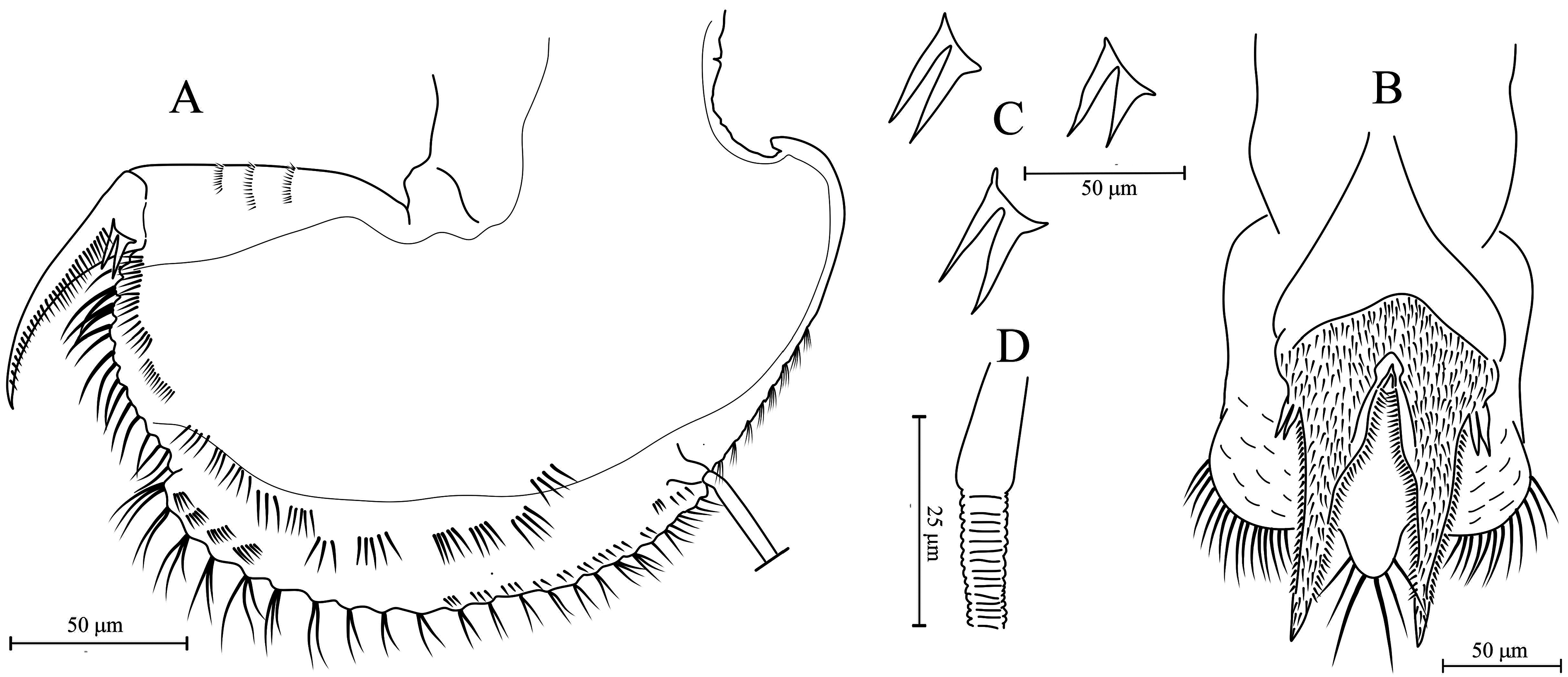
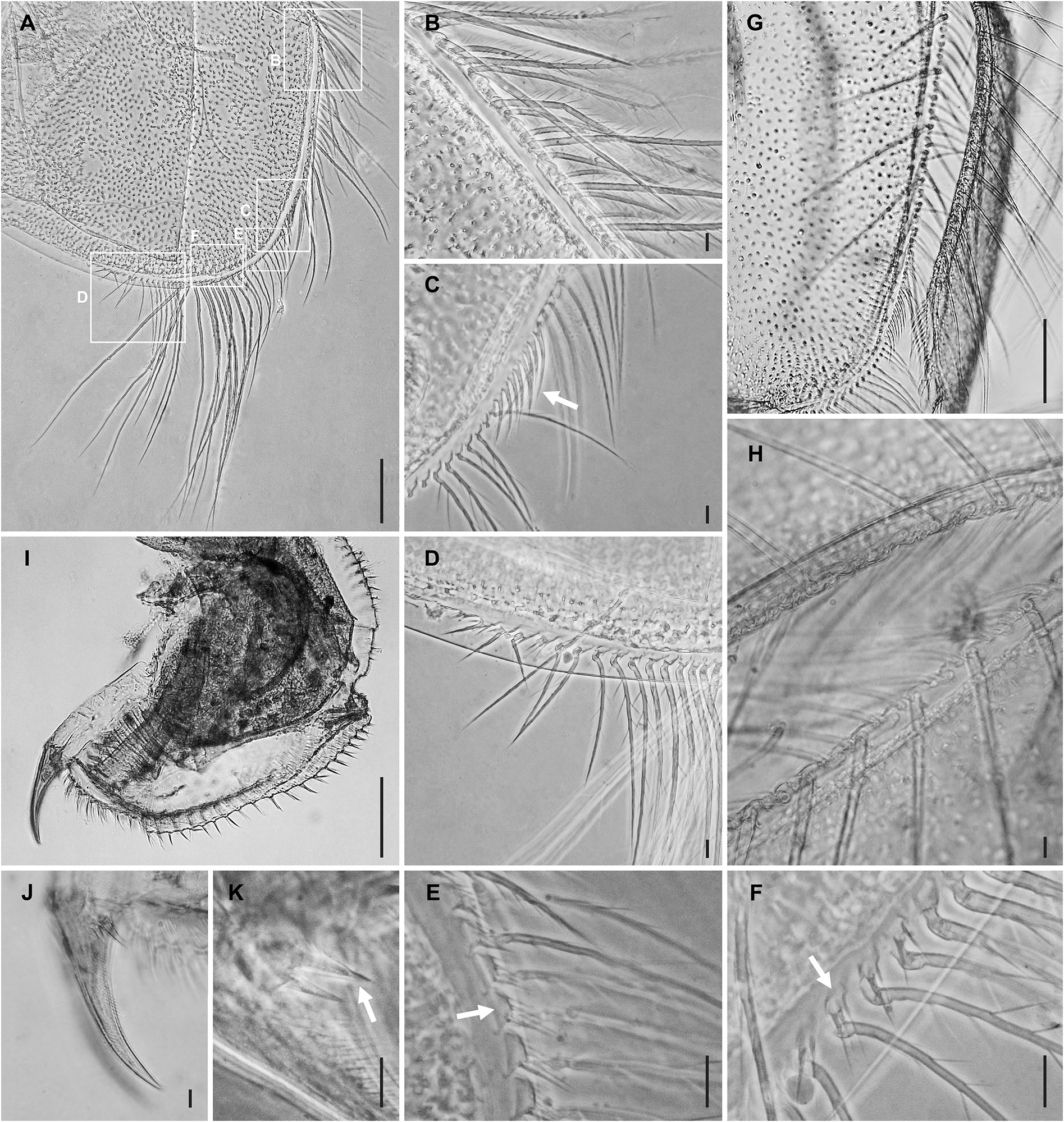
Description (adult parthenogenetic females) GENERAL HABITUS (Figs 2 A – E, 5 A – B). Body elongated, sub-rectangular in lateral view, oblong in ventral and dorsal views, length 0.7 – 1.5 mm, height / length ratio about 0.45 – 0.75; posterodorsal and posteroventral angles prominent. Dorsal margin regularly arched and interrupted by a shallow cervical sinus. Ventral margin clearly arched in anterior part, posterior part slightly curved inwards giving a straight aspect in lateral view. Posterior margin concave near posterodorsal angle. In dorsal and ventral views body not laterally compressed, without lateral projection. CARAPACE (Figs 2 A – G, 6 A – H). Brownish; dorsal and ventral margins smooth; ventral margin with thick rim (more evident towards anterior part of carapace). Setae on ventral margin organized in three groups: first one set with 8 – 10 outwardly directed setae and 40 – 50 plumose and ventrally directed setae (Figs 2 A, D, F – G, 6 G – H); second one set of short naked setae (Fig. 6 C); third one armed with long setae bearing protuberances armed with spinulae at the basis (Fig. 6 E). Setae on posterior margin organized in two groups: first one has up to eight long setae with slightly curved proximal part and basis armed with spinulae (Fig. 6 D), second one armed with setae decreasing in length towards posterodorsal angle and bases armed with spinulae (Fig. 6 F). CEPHALIC STRUCTURES (Figs 2, 5). Head (Figs 2 A – E, 5 A – B). Elongated, triangular, about 0.4 times as long as body. Dorsal margin smooth and slightly arched, a shallow cervical sinus present. Ventral margin with two inflated parts, the first one slight and positioned near base of antennule, the second one relatively robust, sometimes folded or truncated and positioned above labrum; marginal line between inflated parts straight. Ocellus markedly smaller than compound eye. Dorsal organ shorter than compound eye, rounded, with fine ring, positioned near cervical sinus (Fig. 2 I). Rostrum not developed. Labrum (Fig. 2 A, H) with a long horn armed with five rows of minute setulae. Antennule (Figs 2 J – K, 5 C – H). Slightly shorter than head length and dilated in distal part. Ventrolateral basal sensory seta about 0.2 times length of antennular body. Antennular body armed with up to eleven transverse rows of spinules, distal part armed with several teeth surrounding insertion of aesthetascs; inner face with teeth organized in up to eight groups (Figs 2 K, 5 C – F). Nine aesthetascs with forked apex, four of them markedly longer than others. Antenna (Figs 2 L – P, 5 I – O). Coxal region folded; basal segment robust, covered with transverse rows of fine spines and spinules, apical spine of similar length to spine of second segment of exopodite, sensory setae about two times as long as first segment of exopodite (Figs 2 M, 5 J – K). Branches markedly different in length, with cylindrical segments covered with rows of spinules; endopodite about 0.8 times as long as exopodite. Exopodite with four segments: first segment shorter than rest, armed with robust spines laterally (Figs 2 M, 5 J); second segment elongated, spine about middle length of segment itself; third segment without apical setae; fourth segment elongated with spine and three apical bisegmented setae armed with lateral spines and long setulae, spine about 0.5 times as long as segment itself. Endopodite with three segments: first segment armed with exceptionally long sclerotized and bisegmented seta which bears, on proximal part, thin lateral spines, distal part armed with 10 – 13 robust spines reducing in size distally (Figs 2 N, 5 N); second segment with long (but shorter than seta on first segment) and bisegmented seta which bears, on proximal part, short setulae, distal part with short and fine spines and setulae (Fig. 5 O); third segment with spine and three apical bisegmented setae (Figs 2 O – P, 5 L – M), spine about 0.5 times as long as segment itself. Antennal formula: spines 0101 / 001, setae 0003 / 113. Maxilla (Figs 2 Q – R, 5 P – Q). Well developed, with three setulated setae and one short stout protuberance resembling crown-like seta. THORACIC LIMBS (Figs 3, 7). Six pairs of thoracic limbs. Limb I (Figs 3 A – D, 7 A – C). Accessory seta plumose, ODL armed with two apical setae; first seta short and naked, about 0.2 times as long as second seta; second seta bisegmented, armed with short spinule on distal part, markedly long, about 2.6 times as long as accessory seta. IDL (en 4) with two rows of short setulae on posterior surface and three apical setae; first seta about two times as short as second seta; second seta bisegmented and armed with short setulae on distal part about, 1.8 times as short as third seta; third seta bisegmented, markedly long and armed with short setulae on distal part. Endite 3 armed with a anterior seta (1), three posterior setae (a – c) which bears short setulae and a stiff seta, setae (a – b) similar in length and slightly longer than seta (c), stiff setae denticulated, shorter than setae (a – c). Endite 2 armed with three posterior setae (d – f) and a denticulated stiff seta, setae (d – f) bisegmented with proximal part armed with short spinulae, distal part plumose. Endite 1 with three posterior setae (g – i) and a denticulated stiff seta; setae (g – i) bisegmented and armed with short spinulae. Two ejector hooks of different lengths armed with short spinulae on distal part. Gnathobase with four setulated setae. Limb II (Figs 3 E – G, 7 D – G). Exopodite elongated, armed with three setae (a – c); setae (a) and (c) of similar length; seta (b) about 1.8 times as long as others. Inner lobe with eight bisegmented scrapers and nine setulated soft setae; scrapers 1 – 4 armed with short and fine spinulae on distal part, scrapers 5 and 6 armed with thin denticles, scraper 6 armed with short spines, scraper 8 armed with up to five thick denticles; scraper 6 markedly longer than scrapers 5, 7 and 8 which are similar in length. Gnathobase with naked proximal portion, distal portion armed with five elements; filter comb with eight setulated setae. Limb III (Figs 3 H – K, 7 H – K). Epipodite with short finger-like projection. Exopodite rectangular about 2.4 times as high as wide, with five distal (1 – 5) and three plumose lateral setae (6 – 8); seta 1 slightly shorter than seta 8; seta 3 about 0.8 times as long as seta 4; seta 4 about 0.7 times as long as exopodite; seta 6 about 0.4 times as long as seta 7; seta 8 about 0.7 times as long as exopodite. Distal endite armed with one posterior and three anterior setae (1 – 3) and two elements (Fig. 7 H – J); setae 1 with spinulae on distal part, about 1.8 times as long as setae 2 – 3 which are setulated on distal part and have similar length. Basal endite with four setae (4 – 7) increasing in length distally, seta 7 markedly longer than seta 6. Eight long and setulated posterior setae increasing in length towards gnathobase (a – h). Gnathobase armed with four elements (1 ’ – 4 ’), bottle-shaped sensillum on proximal part (1 ’), distal part with element of sharp apex (2 ’) and two naked elements (3 ’ – 4 ’). Filter comb with nine setae. Limb IV (Figs 3 L – M, 7 L – N). Exopodite subquadrangular with portion between distal and lateral setae densely setulated; five distal (1 – 5) and three lateral setae (6 – 8); seta 1 geniculated and unilaterally armed with short spinulae, about two times as long as seta 2; seta 5 about 0.6 times as long as seta 1 and about 1.8 times as long as seta 4; lateral setae plumose, seta 8 longer than setae 7 and 6. Distal endite with four setae (1 – 4), seta 1 scraper-like and with thin spine at distal portion, flaming-torch-like setae (3 – 4) armed with long setulae, seta 3 is shorter than setae 2 and 4. Basal endite armed with five setulated setae increasing in length towards gnathobase (a – e). Gnathobase thick, with three elements and curved setulated seta; filter plate with eight setae. Limb V (Figs 3 N – O, 7 O – P). Pre-epipodite rounded and densely setulated, epipodite oval with short projection. Exopodite wide and lobed, armed with five (1 – 5) distal and two (6 – 7) lateral plumose setae; setae 1 – 2 of similar length and longer than seta 3; seta 4 slightly longer than seta 5; setae 6 and 7 of similar length. Inner lobe wide and densely setulated, armed with two long setae (1 – 2) and element; seta 2 armed with up 9 stiff setae followed by setulae, about 0.6 times as long as seta 1; setae 2 setulated. Gnathobasic filter plate with eight long setae. Limb VI (Figs 3 P, 7 Q). Epipodite with short projection. Limb as elongated lobe, unilaterally setulated, with curved apex and wide base. POSTABDMOMINAL STRUCTURES. Abdomen (Figs 4 A, 6 I). Elongated regularly arched, armed with up to ten rows of setulae of similar length, about 0.6 times as long as postabdomen. Postabdomen (Figs 4 A – B, 6 I). In frontal view clearly trilobed and massive. In lateral view wide, height / length ratio about 0.7. Ventral margin slightly straight and armed with up to five rows of short setulae. Dorsal margin separated in anal and preanal parts; preanal margin armed with up to twenty-four groups organized in 2 – 3 long setulae; anal margin about 0.3 of preanal margin length, armed with 10 – 12 groups of setulae. Postabdominal setae longer than postabdomen length, bisegmented, proximal part of distal segment folded and densely setulated (Fig. 4 D). Postabdominal claws (Figs 4 A – B, 6 I). About 0.4 times as long as postabdomen, with lateral and ventral surfaces completely covered with short and thin spines, pecten armed with thin spines. Basal spines (Figs 4 C, 6 K). Cluster with two robust spines of variable length inserted laterally on postabdominal claws. Ephippial females and males Not studied.
Sousa, Francisco Diogo R., Elmoor-Loureiro, Lourdes Maria A., Freiry, Raquel Fontoura, Álvarez-Silva, Juan Pablo, Stenert, Cristina, Maltchik, Leonardo, Lopes, Paloma M., Bozelli, Reinaldo Luiz (2022): A new species of Acantholeberis (Crustacea, Branchiopoda) suggests an ancient geographic distribution of the genus in South America. European Journal of Taxonomy 821: 40-56, DOI: 10.5852/ejt.2022.821.1797, URL: http://zoobank.org/afbbdb50-5e56-4bf2-995b-29350f579d07