AnimaliaNot EvaluatedacceptedspeciesAccepted
Neotegorhynchus cyprini

Neotegorhynchus cyprini

(Yin & Wu, 1984) Lisitsyna, Xi, Orosová, Barčák & Oros, 2022

GBIF:195730521

0year

ABOUT

Descriptions(4)

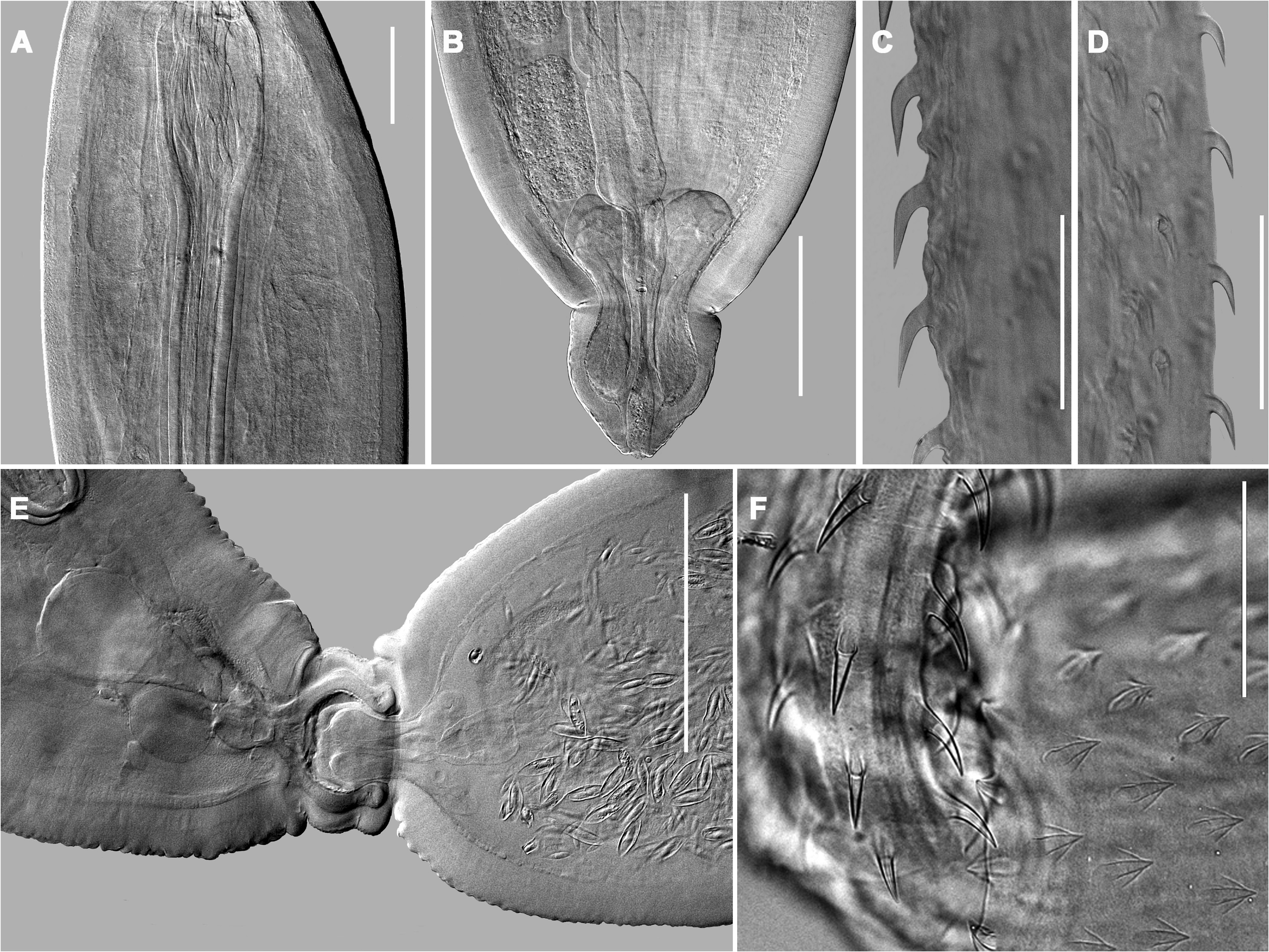
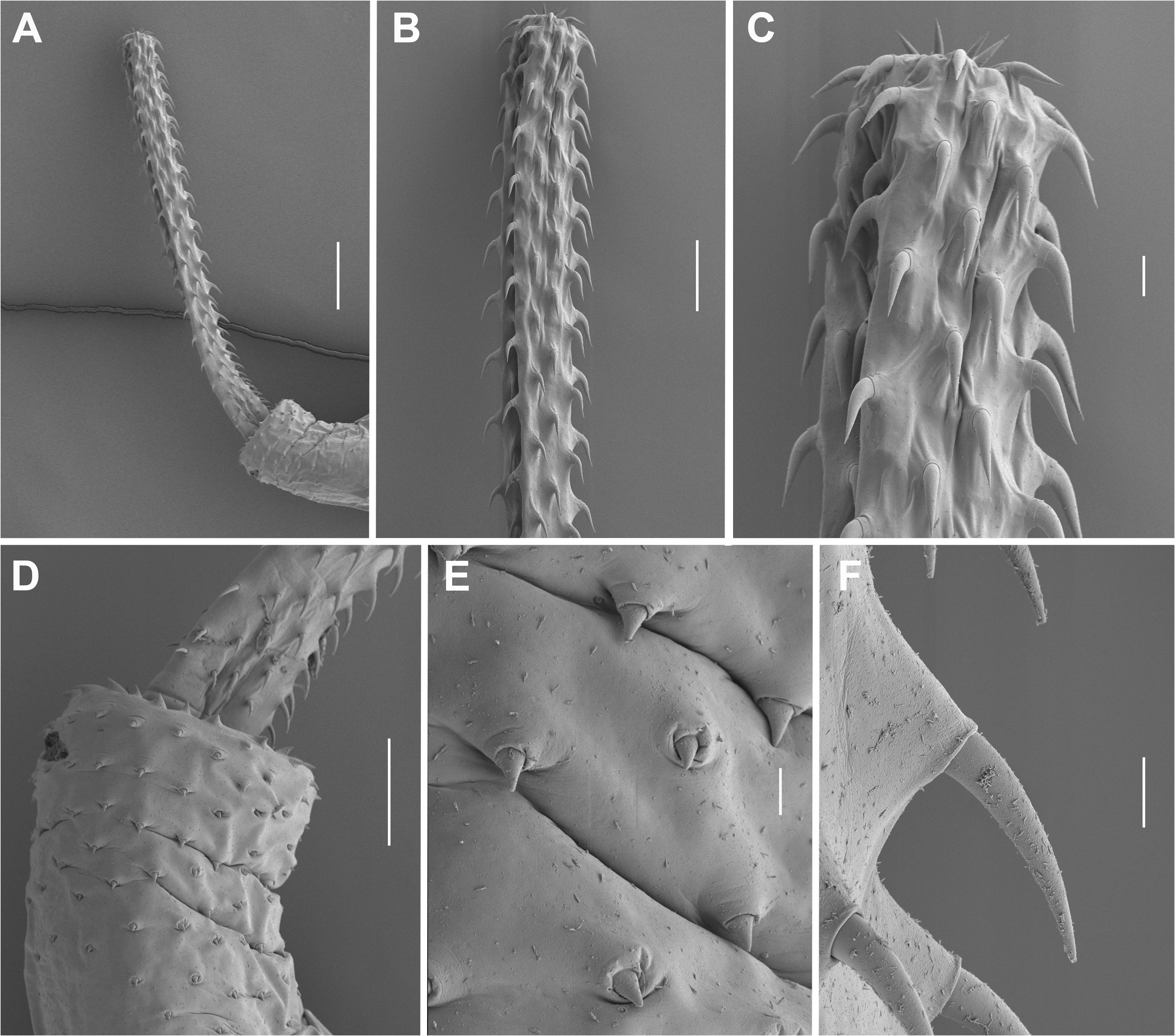
Description: Male. Trunk fusiform, 3,750 - 6,900 (5,320) long, in anterior part covered with tegumental spines arranged in single field 280 – 350 long, the same width on ventral and dorsal sides, posterior end rounded (Figs. 1 A, 3 D, E). Maximum width of trunk at level of testes, 600 – 880 (804). Spines in 24 longitudinal rows, 6 – 8 in each row (Fig. 1 B). Length of spines 25 – 30 (27). Proboscis cylindrical, at an obtuse angle to axis of trunk ventrally, 900 – 1,800 (1218) × 120 – 190 (170), armed with 14 longitudinal hook row of 19 – 21 (20) hooks each (Figs. 1 B – D, 3 A). Ventral hooks larger than dorsal. Size of hooks and roots decrease from anterior to posterior, 11 – 15 anterior hooks on ventral side and 10 – 13 with dorsal have simple roots directed to base of proboscis, other hooks without roots (Figs. 1 C, D, 2 C, D, 3 A – C, F). Size of hook blades giving in Table. 2. Proboscis receptacle with bi-layered muscular walls, 1,530 - 1,860 (1,730) long, goblet-shaped widened to 170 – 280 (218) in anterior third, its rear cylindrical part 80 – 220 (153) wide. The thickness of the outer muscular layer of the proboscis receptacle, 35 – 63, exceeds that of the inner, 20 – 30. Cerebral ganglion, 130 – 150 (140) × 45 – 100 (78), in anterior third of proboscis receptacle, more precisely, in posterior part of its goblet widening. Neck short, 110 – 200 (163). Lemnisci ribbon-like, long, 2,700 – 2,750 (2,717) × 100 – 115 (112), form loops to the level of the anterior testis (Fig. 1 A). The organs of the reproductive system occupy slightly more than half the body in its posterior part. Testes oval, one after another without interval, large, 800 – 1,800 (1,117) × 390 – 560 (458), extended longitudinally (Fig. 1 A). Thin seminal ducts extending from testes to penis. Penis oval, 115 × 92, divided into a head and a body, covered with a thin membrane. Eight cement glands clavate, tender, in two groups of four in each (Fig. 1 A). Two cement channels flow into a spherical cement reservoir with a diameter 140. Saefftigen’s pouch clavate, 410 – 560 (543) long. Reproductive system supported by four pairs of muscles attached to walls of trunk. Shape of muscular part of bursa in the invaginated state repeats shape of females tail end. Genital pore terminal. Female. Trunk 8,730 – 17,700 (12,310) long at maximum width in middle part 1,030 – 1,600 (1,299). Spine zone only in anterior part of trunk. Length of spines 28 – 33 (28). Proboscis 1,000 – 1,800 (1,289) long, 190 – 270 (228) wide, armed with 14 longitudinal hook row of 21 – 23 (21) hooks each. Size of hooks and roots decrease from anterior to posterior, 15 – 18 anterior hooks on ventral side and 12 – 15 with dorsal have simple roots directed to base of proboscis, other hooks without roots. Size of hook blades giving in Table. 2. Proboscis receptacle 2,110 – 3,500 (2,580) long, width in its anterior, goblet-shaped part 300 – 500 (415), in posterior cylindrical part 170 – 250 (222). The thickness of the outer muscular layer of the proboscis receptacle, 43 – 80, exceeds that of the inner, 28 – 63. Neck short, retracted and not visible in all specimens. Lemnisci ribbon-like, long, 6,800 × 180 and 7,300 × 160. Genital tract 720 – 830 (800) long. Vagina without muscular sphincter. In posterior part of trunk, around vagina and partly in the copulatory caudal process, there are fan-shaped muscular genital cells with large nuclei (Fig. 1 J). Eggs spindle-shaped, with polar prolongations of the middle shell, 95 – 103 (98) × 23 – 33 (28) (Figs. 1 F, 2 E). Acanthor 60 – 73 (65) × 15 – 20 (17), with 6 lanceolate embryonic hooks in anterior part (Fig. 1 F). In body cavity of all free mature females fully formed eggs not differing in shape and size from eggs from body cavity of the females that has completed mating. At posterior end of females that completed mating, there were no residues of cement secretions remnants. Caudal end of female pointed, in form of a dome on muscular base, 190 – 220 (200) long, with cement cover that remains from muscular part of male bursa of the complementary form. Genital pore terminal.
Lisitsyna, Olga, Xi, Bing-Wen, Orosová, Martina, Barčák, Daniel, Oros, Mikuláš (2022): The erection of a new genus, Neotegorhynchus n. g. (Palaeacanthocephala Illiosentidae), with a redescription of Neotegorhynchus cyprini n. comb. from Cyprinus carpio from the Yangtze River basin, China. Zootaxa 5150 (1): 83-96, DOI: 10.11646/zootaxa.5150.1.4

Figures 1 ‒ 3, Table 2
Lisitsyna, Olga, Xi, Bing-Wen, Orosová, Martina, Barčák, Daniel, Oros, Mikuláš (2022): The erection of a new genus, Neotegorhynchus n. g. (Palaeacanthocephala Illiosentidae), with a redescription of Neotegorhynchus cyprini n. comb. from Cyprinus carpio from the Yangtze River basin, China. Zootaxa 5150 (1): 83-96, DOI: 10.11646/zootaxa.5150.1.4
Remarks: The specimens in the present study are somewhat smaller than those in the type series (Yin & Wu 1984). However, Yu & Wu (1989) noted that worms can reach different sizes in different hosts; in particular, in the intestine of Coreius heterodon the worms were mature, but their size was much smaller. Furthermore, according to the original description, the hooks on the proboscis of the acanthocephalans of this species are arranged in 12 longitudinal rows, whereas in our material all 21 specimens had 14 longitudinal rows of hooks. In all other characteristics, our material agrees with the original description. The detail of the type specimens were not mentioned in the original description, nor was their deposition indicated. Therefore, we designate one of the specimens collected from Cyprinus carpio from Taihu Hu Lake, Yangtze River basin, Wuxi, China, as the neotype of Neotegorhynchus cyprini n. comb.
Lisitsyna, Olga, Xi, Bing-Wen, Orosová, Martina, Barčák, Daniel, Oros, Mikuláš (2022): The erection of a new genus, Neotegorhynchus n. g. (Palaeacanthocephala Illiosentidae), with a redescription of Neotegorhynchus cyprini n. comb. from Cyprinus carpio from the Yangtze River basin, China. Zootaxa 5150 (1): 83-96, DOI: 10.11646/zootaxa.5150.1.4
Type host: common carp Cyprinus carpio L. (Cypriniformes: Cyprinidae). Type locality: Taihu Lake in Wuxi, Jiangsu Province, China (120 ° 13 ' 50 '' E; 31 ° 32 ' 30 '' N). Site of infection: Intestine. Infection rates: Prevalence, 35 %, intensity, 1 – 14 worms per host. Type-material: Neotype ♂ — deposited in the Helminthological Collection of the Institute of Parasitology, Biology Centre of the Czech Academy of Sciences, České Budějovice, Czech Republic, Collection number IPCAS A- 122. Molecular data: The partial SSU rDNA (1757 bp) and the partial mitochondrial COI (656 bp) sequences of Neotegorhynchus cyprini n. comb. were deposited in the GenBank database (Acession No. MK 411441 – MK 411446).
Lisitsyna, Olga, Xi, Bing-Wen, Orosová, Martina, Barčák, Daniel, Oros, Mikuláš (2022): The erection of a new genus, Neotegorhynchus n. g. (Palaeacanthocephala Illiosentidae), with a redescription of Neotegorhynchus cyprini n. comb. from Cyprinus carpio from the Yangtze River basin, China. Zootaxa 5150 (1): 83-96, DOI: 10.11646/zootaxa.5150.1.4

Export occurrence data

Darwin Core Archive (ZIP)

MULTIMEDIA

Media Files(3)

FIGURE 1. Line drawing of Neotegorhynchus cyprini n. comb from Cyprinus carpio from China. A—total view of male, neotype; B—proboscis of male; C—hooks of a longitudinal row, ventral; D—hooks of a longitudinal row, dorsal; E—somatic spine; F—eggs; H—posterior ends of both sexes en copulation; J—posterior end of female. Scale bars: A—1 mm; B, H, J—500 μm; C, D, F—100 μm; E—20 μm.

Imageimage/png© Lisitsyna, Olga;Xi, Bing-Wen;Orosová, Martina;Barčák, Daniel;Oros, MikulášLisitsyna, Olga;Xi, Bing-Wen;Orosová, Martina;Barčák, Daniel;Oros, Mikuláš

FIGURE 2. Light microscope photographs of Neotegorhynchus cyprini comb. n. from Cyprinus carpio from China, A—a part of proboscis receptacle; B—posterior part of female; C—middle ventral hooks; D—middle dorsal hooks; E—copulation; F—basal hooks of proboscis and tegumental spines. Scale bars: A—200 μm; B, D, E—100 μm; C, F—500 μm.

Imageimage/png© Lisitsyna, Olga;Xi, Bing-Wen;Orosová, Martina;Barčák, Daniel;Oros, MikulášLisitsyna, Olga;Xi, Bing-Wen;Orosová, Martina;Barčák, Daniel;Oros, Mikuláš

FIGURE 3. Scanning electron micrographs of Neotegorhynchus cyprini comb. n. from Cyprinus carpio from China. A—anterior body part. B—proboscis in detail, note organization of its hooks, C—anterior part of proboscis, D—posterior part of proboscis and anterior part of trunk and its spines, E—spines on trunk in detail, F—hooks on proboscis in detail. Scale bars: A—200 μm; B, D—100 μm; C—20 μm; E, F—10 μm.

Imageimage/png© Lisitsyna, Olga;Xi, Bing-Wen;Orosová, Martina;Barčák, Daniel;Oros, MikulášLisitsyna, Olga;Xi, Bing-Wen;Orosová, Martina;Barčák, Daniel;Oros, Mikuláš

IMAGES

Gallery(3)

See Gallery

Occurrences with images

Source Information

The erection of a new genus, Neotegorhynchus n. g. (Palaeacanthocephala Illiosentidae), with a redescription of Neotegorhynchus cyprini n. comb. from Cyprinus carpio from the Yangtze River basin, China

checklist

This dataset contains the digitized treatments in Plazi based on the original journal article Lisitsyna, Olga, Xi, Bing-Wen, Orosová, Martina, Barčák, Daniel, Oros, Mikuláš (2022): The erection of a new genus, Neotegorhynchus n. g. (Palaeacanthocephala Illiosentidae), with a redescription of Neotegorhynchus cyprini n. comb. from Cyprinus carpio from the Yangtze River basin, China. Zootaxa 5150 (1): 83-96, DOI: 10.11646/zootaxa.5150.1.4

Abstract

The present paper summarizes acanthocephalan parasites of the family Illiosentidae Golvan, 1960, collected from the intestine of common carp (Cyprinus carpio L.) from Taihu Lake in Wuxi, Jiangsu Province, China. A total of 21 acanthocephalan specimens were found in 6 carps (prevalence of 35%). All the studied specimens were assigned to the family Illiosentidae based on the family-specific morphology of the worms and the presence of 8 cement glands in the males. However, the specimens recently found in common carp differed from all 14 extant genera of the family Illiosentidae in the structure of the reproductive system of both sexes, i.e. i) a vagina lacking a muscular sphincter; ii) the presence of a terminally pointed protruding tail end in the form of a dome with a muscular base; iii) the female genital muscles are fan-shaped cells, each of which has a nucleus and is not attached to the anterior wall of the body; iv) the muscular lip of the bursa of males repeats the curved shape of the posterior end of females, which en copula allows the lip of the bursa to seal to the posterior end of the female. Morphologically Neotegorhynchus n. g. is closest to the genus Tegorhynchus, but differs from it, in addition above features in i) the terminal position of the genital pores of females without a hollow genital vestibule and without a transverse cleft connected to the dorsal terminal genital pore, as in Tegorhynchus brevis; ii) cerebral ganglion at the border of the anterior and middle third of the proboscis vessel; iii) spherical cement reservoir. Molecular studies confirmed Neotegorhynchus n. g. as belonging to the family Illiosentidae, showing less than 98.9% sequence similarity in SSU rDNA and 81.8% in COI with the genus Dentitruncus. Therefore, a new acanthocephalan genus, Neotegorhynchus n. g., is erected, and Neotegorhynchus cyprini n. comb. is designated as the type species and its neotype.

Lisitsyna O, Xi B, Orosová M, Barčák D, Oros M, plazi (2022). The erection of a new genus, Neotegorhynchus n. g. (Palaeacanthocephala Illiosentidae), with a redescription of Neotegorhynchus cyprini n. comb. from Cyprinus carpio from the Yangtze River basin, China. Plazi.org taxonomic treatments database. Checklist dataset https://doi.org/10.15468/bx8k23 accessed via GBIF.org on 2026-06-15.

CC0Published 6/3/2022View dataset
GBIF Usage Key
195730521
Dataset Key
0af1b34c-2cca-476f-8cb1-cba303b30922
Origin
source
Backbone Key
11607733
Taxon ID
E02B87C2FF89061B3881D5F1834503BD.taxon
Last Crawled
6/9/2026
Last Interpreted
6/9/2026