AnimaliaNot EvaluatedacceptedspeciesAccepted
Paucibranchia carrerai

Paucibranchia carrerai

Molina-Acevedo, 2018

GBIF:196159518

0year

ABOUT

Descriptions(5)

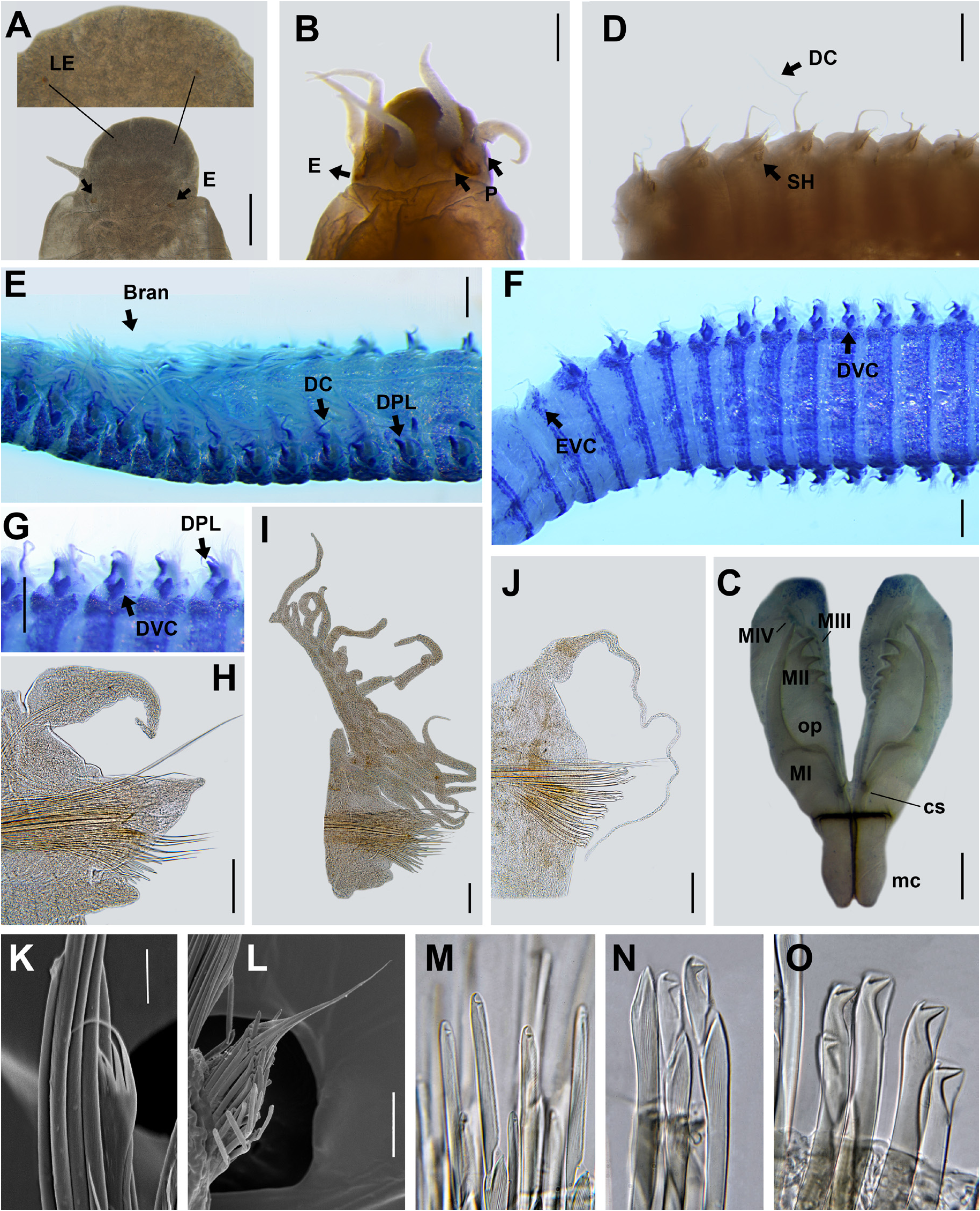
Description. Specimens with L 10 = 1.5 – 6.8 mm, W 10 = 0.4 – 1.8 mm. Prostomium entire (Fig. 1 A – B). Median antenna reaching from second peristomial ring to middle of the first chaetiger; lateral antennae reaching from middle of first peristomial ring to first chaetiger; palps reaching from first to second peristomial ring. Palpostyles and ceratostyles with peduncle. Eyes present (Fig. 1 A – B). Maxillary formula: MII 5 – 7 + 5 – 7, MIII 3 – 6, MIV 3 – 5 + 5 – 8 (Fig. 1 C). MI length from 0.4 mm to 1 mm, maxillary carrier length from 0.1 mm to 0.5 mm, closing system length from 0.005 mm to 0.1 mm, MII length from 0.2 mm to 0.7 mm, opening cavity length from 0.02 mm to 2 mm (Fig. 1 C). Pectinate branchiae (Fig. 1 D, I) starting from chaetigers 7 to 10 – 19. The maximum number of branchial filaments from 5 to 19. Dorsal cirri conical in anterior chaetigers (Fig. 1 H, E), filiform in following ones (Fig. 1 D, J), in median-posterior region twice times longer than pre-branchial chaetigers (Fig. 1 H, J). Prechaetal lobe as a transverse fold in all chaetigers. Chaetal lobe rounded in anterior region, triangular in media-posterior parapodia. Postchaetal lobe conical and well-developed in first 12 – 29 chaetigers; thinner and elongated in branchial chaetigers; inconspicuous in median-posterior chaetigers (Fig. 1 E – I). Ventral cirri conical in first chaetigers and posterior chaetigers; with a small swollen base from chaetigers 5 – 8 to 12 – 27 (Fig. 1 E – I). Aciculae blunt, translucent in all parapodia (Fig. 1 H – I). Limbate chaetae of two sizes in same chaetiger. Two types of pectinate chaetae: (1) in anterior chaetigers, 2 – 3 pectinate isodonts narrow chaetae with 6 – 9 long and slender teeth, with transverse distal edge (Fig. 1 K); (2) in median-posterior chaetigers, 5 – 6 pectinate isodonts narrow chaetae with 15 – 16 short and slender teeth, with oblique distal edge. Compound spinigers present in first 12 – 26 chaetigers (Fig. 1 L). Compound falcigers present in all parapodia (Fig. 1 L – N), with blades of two lengths in anterior chaetigers, one length in median-posterior chaetigers. Subacicular hooks bidentate, amber, starting in chaetigers 24 – 38, with up to 5 to 15 hooks per chaetiger (Fig. 1 O). Variation. We found nine juveniles (Fig. 1 A), one of them complete, with 37 chaetigers and a total length of 0.5 mm. The juveniles varied in L 10 = 1.5 to 1.9 mm, and W 10 = 0.35 to 0.5 mm. Two of the six juveniles presented only media and lateral antennae, the rest of the specimens had five appendages. Media / lateral antennae reached up to the second peristomial ring to first chaetiger; palps reached up to the middle of the first peristomial ring to the second peristomial ring. The maxillary formula varied: MII, 5 – 6 + 5 – 7, MIII, 5, MIV 3 + 6 – 7. Length of complete maxillary apparatus ranged from 0.5 to 0.65 mm, and its width from 0.2 to 0.3 mm. MI length varied from 0.35 to 0.45 mm. Maxillary carrier length from 0.15 to 0.25 mm, closing system length from 0.05 mm, MII length from 0.2 to 0.3 mm, opening cavity length 0.07 to 0.1 mm. Length of mandible varied from 0.4 to 0.5 mm. The last chaetiger with branchiae varied from 10 – 14, the number of chaetigers with branchiae from 4 – 8, the maximum number of branchial filaments varied from 5 – 7. Length of dorsal cirri (LDC) in pre-, branchial, and post-branchial region varied in the following form: LDC in chaetiger 4, from 0.15 to 0.25 mm; LDC in chaetiger 10, from 0.17 to 0.3 mm, LDC in chaetigers 20 – 40: from 0.2 to 0.4 mm. Width of dorsal cirri (WDC) in pre-branchial, and post-branchial regions varied in following: WDC in chaetiger 4, from 0.02 to 0.04 mm, WDC in chaetiger 10, from 0.02 to 0.03 mm, WDC in chaetigers 20 – 40, from 0.01 to 0.02 mm. Last chaetiger with postchaetal lobe developed in chaetigers 12 – 16. Ventral cirri with swollen base start in chaetigers 5 – 6 and end in chaetigers 12 – 16. Subacicular hooks start from chaetigers 13 to 19. Last chaetiger with compound spiniger in chaetigers 12 – 14. We found thirty adults’ specimens (Fig. 1 B), all incomplete, with L 10 from 2 to 6.8 mm, W 10 from 0.45 to 1.8 mm. Prostomial appendages extension varied in following: median antenna reach from second peristomial ring to middle of the first chaetiger; lateral antennae reach from the middle of the first peristomial ring to the first chaetiger; palps reach from the first to second peristomial ring. The maxillary formula varied: MII 5 – 7 + 5 – 7, MIII 3 – 6, MIV 3 – 5 + 5 – 8. Length of complete maxillary apparatus changed from 0.6 to 2.4 mm, and its width from 0.3 to 0.8 mm. MI length varied from 0.4 to 1 mm. Maxillary carrier length from 0.1 to 0.5, closing system length from 0.05 to 0.1 mm. MII length from 0.23 to 0.7 mm, opening cavity length from 0.07 to 0.2 mm. Length of mandible from 0.4 to 1.2 mm. The last chaetiger with branchiae varied from 13 – 19, the number of chaetigers with branchiae from 7 – 13, the maximum number of branchial filaments varied from 7 – 19. Length of dorsal cirri in pre-, branchial, and postbranchial region varied in the following: LDC in chaetiger 4, from 0.1 to 0.45 mm; LDC in chaetiger 10, from 0.2 to 0.6 mm, LDC in chaetigers 20 – 40: from 0.3 to 1.3 mm. Width of dorsal cirri in pre-, branchial, and post-branchial region varied in following: WDC in chaetiger 4, from 0.03 to 0.1 mm, WDC in chaetiger 10, from 0.02 to 0.25 mm, WDC in chaetigers 20 – 40, from 0.01 to 0.1 mm. Last chaetiger with postchaetal lobe developed in chaetigers 14 – 27. Ventral cirri with swollen base start in chaetigers 5 – 8 and end in chaetigers 13 – 27. Subacicular hooks start from chaetigers 14 – 23. Last chaetiger with compound spiniger in chaetigers 13 – 26.
Molina-Acevedo, Isabel C., Fernández-Rodríguez, Vanessa, Idris, Izwandy (2022): Morphometric approach to supports distinction among three species of Paucibranchia Molina-Acevedo, 2018 (Annelida: Eunicidae). Zootaxa 5155 (3): 347-370, DOI: 10.11646/zootaxa.5155.3.3

Figure 1
Molina-Acevedo, Isabel C., Fernández-Rodríguez, Vanessa, Idris, Izwandy (2022): Morphometric approach to supports distinction among three species of Paucibranchia Molina-Acevedo, 2018 (Annelida: Eunicidae). Zootaxa 5155 (3): 347-370, DOI: 10.11646/zootaxa.5155.3.3
Remarks. As indicated above, P. carrerai was part of the P. bellii species complex. Since the species was distinguishable morphologically, Molina-Acevedo (2018) proposed it as a new taxon from the Vietnam area. Herein, its distribution is extended to the southern part of the South China Sea, on the east coast of Peninsular Malaysia. The specimens assigned as the holotype and paratypes were collected 60 years ago and sustained various damage (cutting marks in the anterior region, loss of some parapodia, and extracted maxillary apparatus). For this reason, some details were overlooked in the original description. Herein, we compared the type material with fresh specimens collected in Malaysia, and we found they were similar in the prostomium, branchiae, branchial filament, parapodia and chaetae shapes. These details allowed us to confirm its identification as P. carrerai. However, two traits not observed in the original description, including a short peduncle at the base of the prostomial appendages and a pair of large, brown and reniform eyes, are now included herein.
Molina-Acevedo, Isabel C., Fernández-Rodríguez, Vanessa, Idris, Izwandy (2022): Morphometric approach to supports distinction among three species of Paucibranchia Molina-Acevedo, 2018 (Annelida: Eunicidae). Zootaxa 5155 (3): 347-370, DOI: 10.11646/zootaxa.5155.3.3
Distribution. South Vietnam, east coast of Peninsular Malaysia.
Molina-Acevedo, Isabel C., Fernández-Rodríguez, Vanessa, Idris, Izwandy (2022): Morphometric approach to supports distinction among three species of Paucibranchia Molina-Acevedo, 2018 (Annelida: Eunicidae). Zootaxa 5155 (3): 347-370, DOI: 10.11646/zootaxa.5155.3.3
Type material examined. Holotype (LACM-AHF POLY 6924) 1 adult specimen, one nautical mile south of eastern end of Hòn T ằm, Bay of Nha Trang, South China Sea, South Vietnam, 12 ° 09 ’ 43 ’’ N 109 ° 14 ’ 10 ’’ E, sta. 142 I, in mud, 13 m, 16 Feb 1960, coll. V. A. Gallardo. Additional material examined. (RRC UMTAnn 01028, RRC UMTAnn 01046, RRC UMTAnn 01048, RRC UMTAnn 01050, RRC UMTAnn 01052, RRC UMTAnn 01057, RRC UMTAnn 01058) 9 juveniles, Teluk Kalong, Kemaman, Terengganu, Malaysia, South China Sea, 4 o 15.720 ’ N 103 o 28.760 ’ E, sandy bottom, Day grab, 15 m, July 2012. (RRC UMTAnn 01020 – 27, RRC UMTAnn 01029 – 45, RRC UMTAnn 01047, RRC UMTAnn 01049, RRC UMTAnn 01051, RRC UMTAnn 01053 – 56, RRC UMTAnn 01059) 33 adult specimens, same data with juveniles.
Molina-Acevedo, Isabel C., Fernández-Rodríguez, Vanessa, Idris, Izwandy (2022): Morphometric approach to supports distinction among three species of Paucibranchia Molina-Acevedo, 2018 (Annelida: Eunicidae). Zootaxa 5155 (3): 347-370, DOI: 10.11646/zootaxa.5155.3.3

Export occurrence data

Darwin Core Archive (ZIP)

CLASSIFICATION

Taxonomic Classification Tree

MULTIMEDIA

Media Files(1)

FIGURE 1. Paucibranchia carrerai Molina-Acevedo, 2018. A) Prostomium from juvenile specimen, dorsal view; B) Prostomium from adult specimens, dorsal view; C) Maxillary apparatus, dorsal view; D) Median chaetigers, ventral view; E) Branchial region of the body, dorsal-lateral view; F) Branchial region of the body, ventral view; G) Ventral cirri and postchaetal lobe in branchial region of the body, ventral view; H) Parapodium 3; I) Parapodium 10; J) Parapodium 33; K) Pectinate chaetae, parapodium 10; L) Compound spinigers, parapodium 5; M) Compound falciger, parapodium 10; N) Compound falciger, parapodium 33; O) Subacicular hook, parapodium 33. A, from RRC UMTAnn 01028, B–O, from RRC UMTAnn 01020. E–G, stained with a methylene blue solution. Abbreviations: E, eyes; LE, larval eyes; P, peduncle; DC, dorsal cirri; SH, subacicular hook; Bran, branchiae; DPL, postchaetal lobe development; ECV, ventral cirri with swollen base end; DVC, ventral cirri development; mc, maxillary carrier; cs, closing system; MI, maxilla I; op, opening cavity; MII, maxilla II; MIII, maxilla III; MIV, maxilla IV. Red arrow point out broken dorsal cirrus. Scale bars: A–C, 0.2 mm; D, 0.5 mm; E–G, 0.4 mm; H–J, 100 μm; K, 10 μm; L, 50 μm; M–O, 20 μm.

Imageimage/png© Molina-Acevedo, Isabel C.;Fernández-Rodríguez, Vanessa;Idris, IzwandyMolina-Acevedo, Isabel C.;Fernández-Rodríguez, Vanessa;Idris, Izwandy

IMAGES

Gallery(1)

See Gallery

Occurrences with images

Source Information

Morphometric approach to supports distinction among three species of Paucibranchia Molina-Acevedo, 2018 (Annelida: Eunicidae)

checklist

This dataset contains the digitized treatments in Plazi based on the original journal article Molina-Acevedo, Isabel C., Fernández-Rodríguez, Vanessa, Idris, Izwandy (2022): Morphometric approach to supports distinction among three species of Paucibranchia Molina-Acevedo, 2018 (Annelida: Eunicidae). Zootaxa 5155 (3): 347-370, DOI: 10.11646/zootaxa.5155.3.3

Abstract

In this study, we performed a morphometric approach of 23 quantitative features of Paucibranchia bellii (Audouin & Milne-Edwards, 1833), P. disjuncta (Hartman, 1961), and P. carrerai Molina-Acevedo, 2018 in order to evaluate their importance in interspecific discrimination. We found that eight of the 23 features measured were correlated with the organism’s size, in particular, branchiae, parapodia, and chaetae. The features that were not size-dependent presented a low range of variation related to the maxillary apparatus (as the maxillary formula) or the prostomial appendages and could be used as taxonomically informative characters. The multivariate analysis selected six characteristics that best contributed to the three species’ discrimination. At least four of these features were related to the start of the branchiae and subacicular hooks, the maximum number of chaetigers with branchiae, and the maximum number of branchial filaments, all of them considered size-dependent. However, two other features, teeth in maxilla III and the length of the opening cavity in the maxillary apparatus, were not size-dependent. The results allowed us to demonstrate that both sized- and non-sized depending on characters are helpful and necessary to improve species discrimination within the genus Paucibranchia. Finally, we provide a detailed analysis of the ontogenetic changes of P. carrerai with additional material found on the east coast of Peninsular Malaysia.

Molina-Acevedo I C, Fernández-Rodríguez V, Idris I, plazi (2022). Morphometric approach to supports distinction among three species of Paucibranchia Molina-Acevedo, 2018 (Annelida: Eunicidae). Plazi.org taxonomic treatments database. Checklist dataset https://doi.org/10.15468/tks9ck accessed via GBIF.org on 2026-06-16.

CC0Published 6/22/2022View dataset
GBIF Usage Key
196159518
Dataset Key
03553f1f-b6d0-4f2b-acf9-d5a8cd7ccf8d
Origin
source
Backbone Key
10583265
Taxon ID
C76287D7FFEE0F3398A49BEBFC7CFE0D.taxon
Last Crawled
6/9/2026
Last Interpreted
6/9/2026