
AnimaliaNot EvaluatedacceptedspeciesAccepted
Paucibranchia bellii
(Audouin & Milne-Edwards, 1833) Mnhn-AZ
GBIF:196159520
0year
ABOUT
Descriptions(5)
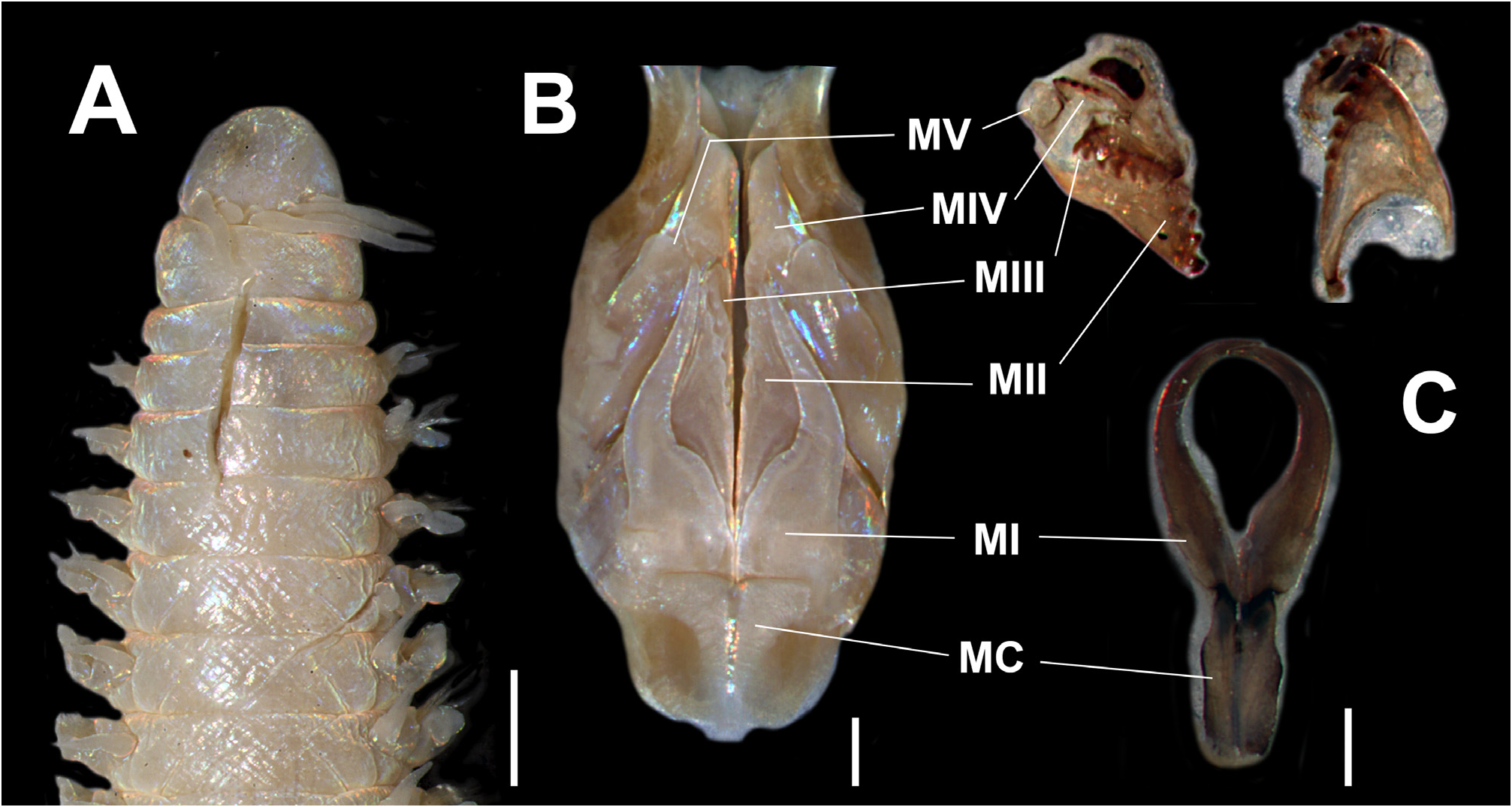
Description. Specimens with L 10 = 3.7 – 9 mm, W 10 = 0.6 – 2.3 mm. Prostomium entire. Median antenna reaching from second peristomial ring to middle of the second chaetiger; lateral antennae reaching from second peristomial ring to first chaetiger; palps reaching from first to second peristomial ring. Palpostyles and ceratostyles without peduncle. Eyes present. Maxillary formula: MII 6 – 8 + 7 – 9, MIII 6 – 8, MIV 5 – 7 + 9 – 10 (Fig. 6 A – C). MI length from 0.5 mm to 1.2 mm, maxillary carriers’ length from 0.35 mm to 1.3 mm, closing system length from 0.1 mm to 0.2 mm, MII length from 0.55 mm to 1.2 mm, opening cavity length from 0.4 mm to 1 mm (Fig. 6 A – C). Pectinate branchiae starting from chaetigers 10 – 15 to chaetigers 22 – 43. The maximum number of branchial filaments from 9 to 22. Dorsal cirri conical, in median-posterior region 1.2 times longer than pre-branchial chaetigers. Prechaetal lobe as a transverse fold in all chaetigers. Chaetal lobe rounded in the anterior region, triangular in media-posterior parapodia. Postchaetal lobe tongue-shaped in pre-branchial chaetigers, conical in branchial chaetigers, inconspicuous in median-posterior chaetigers; well-developed in first 32 – 72 chaetigers. Ventral cirri digitiform in first chaetigers and posterior region; with a small swollen base from chaetigers 4 – 5 to chaetigers 37 – 78. Aciculae blunt, dark in the anterior region, amber in median-posterior parapodia. Limbate chaetae of two sizes in same chaetiger. Two types of pectinate chaetae: (1) in anterior chaetigers, 1 – 2 pectinate isodont narrow chaetae with 4 – 5 long and slender teeth, with oblique distal edge; (2) in median-posterior chaetigers, 4 – 5 pectinate isodont narrow chaetae with 10 – 13 short and slender teeth, with transverse distal edge. Compound spinigers present in first 23 – 53 chaetigers. Compound falcigers present in all parapodia, with blades of two lengths in anterior chaetigers, one length in median-posterior chaetigers. Subacicular hooks bidentate, amber, starting in chaetigers 24 – 38, with one or two hooks per chaetiger.
Molina-Acevedo, Isabel C., Fernández-Rodríguez, Vanessa, Idris, Izwandy (2022): Morphometric approach to supports distinction among three species of Paucibranchia Molina-Acevedo, 2018 (Annelida: Eunicidae). Zootaxa 5155 (3): 347-370, DOI: 10.11646/zootaxa.5155.3.3
Figure 6
Molina-Acevedo, Isabel C., Fernández-Rodríguez, Vanessa, Idris, Izwandy (2022): Morphometric approach to supports distinction among three species of Paucibranchia Molina-Acevedo, 2018 (Annelida: Eunicidae). Zootaxa 5155 (3): 347-370, DOI: 10.11646/zootaxa.5155.3.3
Remarks. The species was recently redescribed by Molina-Acevedo (2018). For many years, P. bellii was considered as a widely distributed species since was recorded in the Northwest Atlantic Ocean, Grand Caribbean, Vietnam, and the Persian Gulf. However, a recent morphological revision restricts the distribution of P. bellii to the Northeast Atlantic and West Mediterranean Sea (Molina-Acevedo 2018). Some of these records were later described as a new species (Paucibranchia andresi Molina-Acevedo, 2018 from Massachusetts (USA), P. carrerai from Vietnam, and unnamed taxa Paucibranchia sp. 1 Molina-Acevedo, 2018 from the Gulf of Mexico), revealing the diversity hidden under the same name.
Molina-Acevedo, Isabel C., Fernández-Rodríguez, Vanessa, Idris, Izwandy (2022): Morphometric approach to supports distinction among three species of Paucibranchia Molina-Acevedo, 2018 (Annelida: Eunicidae). Zootaxa 5155 (3): 347-370, DOI: 10.11646/zootaxa.5155.3.3
Distribution. English Channel, Western Mediterranean Sea.
Molina-Acevedo, Isabel C., Fernández-Rodríguez, Vanessa, Idris, Izwandy (2022): Morphometric approach to supports distinction among three species of Paucibranchia Molina-Acevedo, 2018 (Annelida: Eunicidae). Zootaxa 5155 (3): 347-370, DOI: 10.11646/zootaxa.5155.3.3
Type material examined. Lectotype (MNHN TYPE 568) 1 Adult, Chausey Island, France, English Channel, Atlantic. Paralectotype (MNHN TYPE 567) 1 Adult, Chausey Island, France, English Channel, Atlantic. Additional material examined. (MNHN-A 39) 1 adult specimen, St. Vaast, Normandy, France, Atlantic Ocean, (R.) N ° 155 d, 1868. (MNHN-A 39) 1 adult specimen, St. Vaast, Normandy, France, Atlantic Ocean, (R.) N ° 155 f, 1868. (MNHN-A 39) 2 adult specimens, Pier of Croisic, France, Atlantic Ocean, L. du Réau, Fauvel collection, June 1908. (MNHN-A 39) 2 adult specimens, Tatihou Island, Normandy, France, Atlantic Ocean, 1895, Fauvel collection. (AZ 778 30 – 16) 2 adult specimens, Cosqueville, Normandy, France, Atlantic Ocean, 19 April 1909. (MNHN-A 39) 1 adult specimen M. P. Fauvel collection, 1895. (MNCN 16.01 / 2445) 1 adult specimen, between Cabo de San Antonio and Valencia Port, Spain, Mediterranean Sea, sta. F – 32, coll. G. San Martin. (MNCN 16.01 / 2446) 1 adult specimen, between Cabo de San Antonio and Valencia Port, Spain, Mediterranean Sea, sta. F 152, coll. G. San Martin. (ECO- SUR – P 2173) 1 adult specimen, Carnac, Morbihan, France, 21 Apr 1967, coll. F. Rullier. (ZIN RAS 1 / 11135) 1 adult specimen, Marsella, France, Mediterranean Sea, 1961. (MNHN-AZ 779) 2 adult specimens, France, Mediterranean Sea, 11 August 1919. (ZMB 3996) 1 adult specimen, Roscoff, Finisterre, France, Atlantic Ocean, coll. Grube.
Molina-Acevedo, Isabel C., Fernández-Rodríguez, Vanessa, Idris, Izwandy (2022): Morphometric approach to supports distinction among three species of Paucibranchia Molina-Acevedo, 2018 (Annelida: Eunicidae). Zootaxa 5155 (3): 347-370, DOI: 10.11646/zootaxa.5155.3.3
Export occurrence data
Darwin Core Archive (ZIP)
CLASSIFICATION
Taxonomic Classification Tree

MULTIMEDIA
Media Files(1)
FIGURE 6. Moulting of Paucibranchia bellii (Audouin & Milne-Edwards, 1833) MNHN-AZ779,. A) Anterior region of the body, dorsal view; B) New generation of maxillae, dorsal view; C) Moulting of maxillae. Abbreviations: MI-V: maxillae from I to V, MC: maxillary carrier. Scale bars: A, 1.1 mm; B–C,0.7 mm.
Imageimage/png© Molina-Acevedo, Isabel C.;Fernández-Rodríguez, Vanessa;Idris, IzwandyMolina-Acevedo, Isabel C.;Fernández-Rodríguez, Vanessa;Idris, Izwandy
IMAGES