
AnimaliaNot EvaluatedacceptedspeciesAccepted
Trigonodictya elegans
(Ulrich, 1893)
GBIF:196202559
0year
0
Synonyms
ABOUT
Descriptions(5)
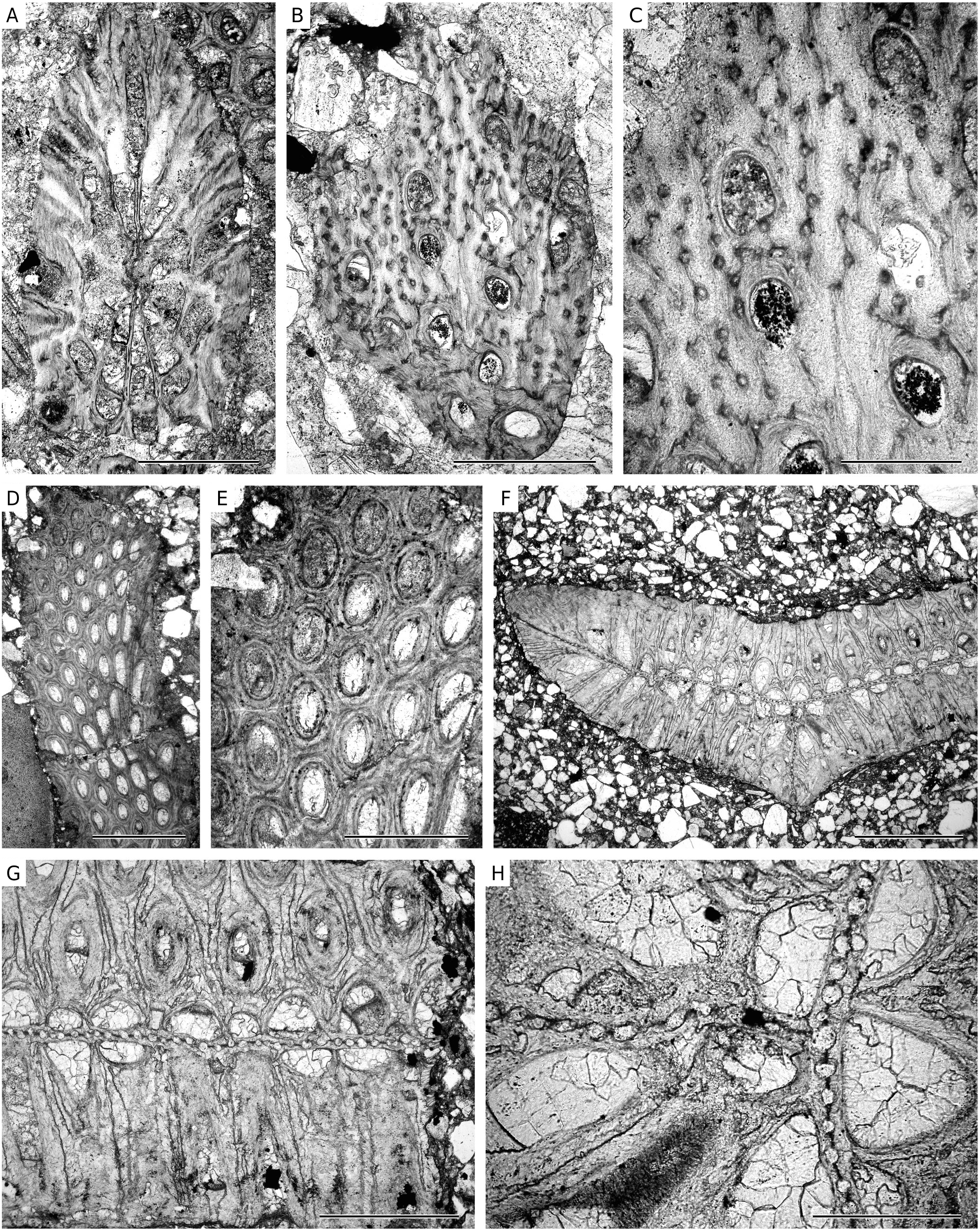
(Fig. 14 D-H; Appendix 1)
Ernst, Andrej, Carrera, Marcelo G. (2022): A cool-water bryozoan association from the La Pola Formation (Sandbian, Ordovician) of Argentine Precordillera. Geodiversitas 44 (20): 563-601, DOI: 10.5252/geodiversitas2022v44a20
DESCRIPTION Branched bifoliate, dichotomous colonies. Branches flattened, with sharp edges, 2.40 - 3.25 mm wide and 0.9 - 1.4 mm thick. Mesotheca three-layered, straight both in longitudinal and transverse sections, containing abundant median rods, 0.03 - 0.05 mm thick. Median rods densely spaced, 0.015 - 0.038 mm in diameter, continuous in dark zones separating longitudinal rows of autozooecia. Autozooecia regularly arranged in 10 - 14 alternating longitudinal rows, semicircular to trapezoid in transverse section in endozone, rectangular in deep tangential section, becoming oval on the colony surface. Autozooecial diaphragms common, straight. Autozooecial walls laminated, 0.015 - 0.025 mm thick in endozones. Autozooecial boundaries distinct, delineated laterally by continuous dark zones. Extrazooecial skeletal deposits well developed, consisting of laminar and vesicular portions. Laminar stereom with dark zones, longitudinally aligned, separating autozooecia in exozones, containing abundant mural styles. Mural styles 0.02 - 0.04 mm in diameter. Vesicular structures small and sparse, having flat to rounded roofs, rare to common on branch edges. COMPARISON
Ernst, Andrej, Carrera, Marcelo G. (2022): A cool-water bryozoan association from the La Pola Formation (Sandbian, Ordovician) of Argentine Precordillera. Geodiversitas 44 (20): 563-601, DOI: 10.5252/geodiversitas2022v44a20
Trigonodictya elegans (Ulrich, 1893) is similar to T. cirrita Karklins, 1983 from the Upper Ordovician of United States and from the Las Plantas and Las Aguaditas formations (Sandbian) of Argentina, but differs from it in smaller autozooecial apertures (average aperture width 0.11 mm vs 0.14 mm in T. cirrita), and in larger distances between aperture centres (at average 0.36 mm vs 0.42 mm in T. cirrita). Trigonodictya elegans is similar to T. acuta (Hall, 1847) from the Middle Ordovician of New York, United States, but differs from it in smaller autozooecial apertures (aperture width 0.08 - 0.15 mm vs 0.10 - 0.16 mm in T. acuta).
Ernst, Andrej, Carrera, Marcelo G. (2022): A cool-water bryozoan association from the La Pola Formation (Sandbian, Ordovician) of Argentine Precordillera. Geodiversitas 44 (20): 563-601, DOI: 10.5252/geodiversitas2022v44a20
OCCURRENCE. — Upper Ordovician of United States and Europe. La Pola Formation, Upper Ordovician, Sandbian; La Pola creek section near Albardon village, San Juan Province, Argentine Precordillera, western Argentina.
Ernst, Andrej, Carrera, Marcelo G. (2022): A cool-water bryozoan association from the La Pola Formation (Sandbian, Ordovician) of Argentine Precordillera. Geodiversitas 44 (20): 563-601, DOI: 10.5252/geodiversitas2022v44a20
MATERIAL EXAMINED. — CEGH-UNC 27507 b, c, CEGH-UNC 27527 b, c, CEGH-UNC 27528 a-c, CEGH-UNC 27529 b, CEGH-UNC 27530 c, e, CEGH-UNC 27539 e, CEGH-UNC 27541 a, CEGH-UNC 27542 b, CEGH-UNC 27544 b.
Ernst, Andrej, Carrera, Marcelo G. (2022): A cool-water bryozoan association from the La Pola Formation (Sandbian, Ordovician) of Argentine Precordillera. Geodiversitas 44 (20): 563-601, DOI: 10.5252/geodiversitas2022v44a20
Export occurrence data
Darwin Core Archive (ZIP)
CLASSIFICATION
Taxonomic Classification Tree

NOMENCLATURE
Synonyms(2)
MULTIMEDIA
Media Files(1)
FIG. 14. — A-C, Arthroclema sp.A:A, branch oblique thin section,CEGH-UNC 27530 e;B, C, tangential thin section showing autozooecial apertures and paurostyles, CEGH-UNC 27529 b; D-H, Trigonodictya elegans (Ulrich, 1893): D, E, tangential thin section showing autozooecial apertures, CEGH-UNC 27530 c; F-H, branch transverse thin section showing autozooecial chambers and mesotheca with rods,CEGH-UNC 27542 b.Scale bars: A, B, E, G, 0.5 mm; C, H, 0.2 mm;D, F, 1 mm.
Imageimage/png© Ernst, Andrej;Carrera, Marcelo G.Ernst, Andrej;Carrera, Marcelo G.
IMAGES