
AnimaliaNot EvaluatedacceptedspeciesAccepted
Pseudostictoporella simplex
Ernst & Carrera, 2022
GBIF:196202563
0year
ABOUT
Descriptions(6)
(Fig. 15 A-H; Appendix 1) urn: lsid: zoobank. org: act: 54 CAAD 81 - 853 C- 4879 - BE 5 C-B 78 DCD 98 D 7 E 9
Ernst, Andrej, Carrera, Marcelo G. (2022): A cool-water bryozoan association from the La Pola Formation (Sandbian, Ordovician) of Argentine Precordillera. Geodiversitas 44 (20): 563-601, DOI: 10.5252/geodiversitas2022v44a20
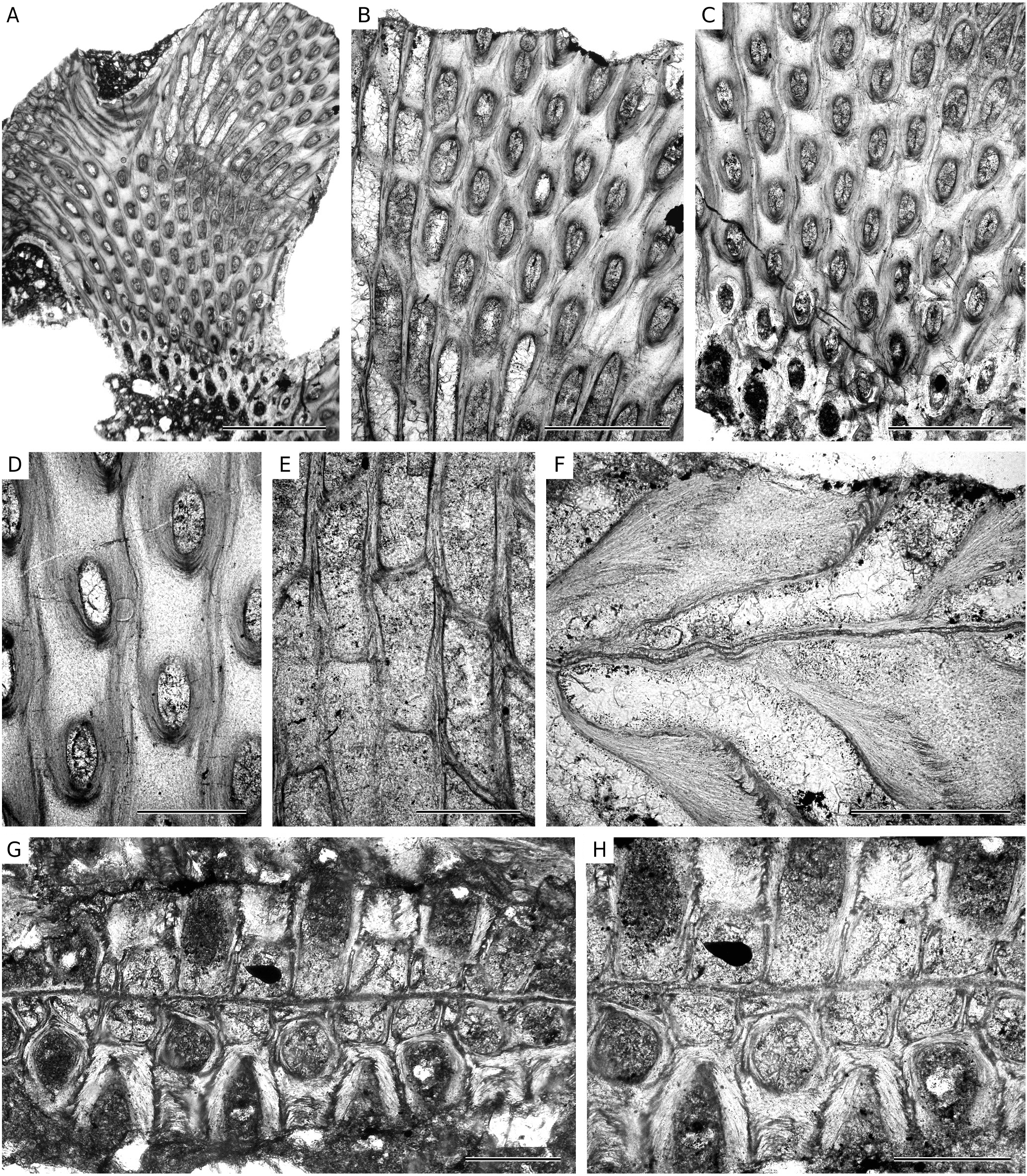
DESCRIPTION Bifoliate branched colony. Branches 1.8 - 2.1 mm wide and 0.60 - 1.30 mm thick. Mesotheca straight, 0.015 to 0.045 mm thick, median rods absent. Autozooecia short, tubular, bending sharply to branch surface, rectangular at their bases, becoming oval at branch surface, arranged in 10 to 20 regular alternating rows on branches. Hemisepta absent. Rare diaphragms occurring. Metazooecia and styles absent. Autozooecial walls granular, 0.030 to 0.055 mm thick in endozone; thick, finely laminated in exozone. Extrazooecial skeleton well developed, consisting of laminated material. Longitudinal ridges between autozooecial apertures present. COMPARISON
Ernst, Andrej, Carrera, Marcelo G. (2022): A cool-water bryozoan association from the La Pola Formation (Sandbian, Ordovician) of Argentine Precordillera. Geodiversitas 44 (20): 563-601, DOI: 10.5252/geodiversitas2022v44a20
DIAGNOSIS. — Bifoliate branched colonies; mesotheca straight, median rods absent, autozooecia arranged in 10 to 20 regular alternating rows on branches; hemisepta absent; rare diaphragms occurring; metazooecia and styles absent; longitudinal ridges between autozooecial apertures.
Ernst, Andrej, Carrera, Marcelo G. (2022): A cool-water bryozoan association from the La Pola Formation (Sandbian, Ordovician) of Argentine Precordillera. Geodiversitas 44 (20): 563-601, DOI: 10.5252/geodiversitas2022v44a20
Pseudostictoporella simplex n. sp. is similar to P. typicalis Ross, 1970, but differs from it in absence of metazooecia and pustules. P. iberiensis Jiménez-Sánchez, 2009 from the Katian of Spain possesses hemisepta and may not belong to the genus Pseudostictoporella.
Ernst, Andrej, Carrera, Marcelo G. (2022): A cool-water bryozoan association from the La Pola Formation (Sandbian, Ordovician) of Argentine Precordillera. Geodiversitas 44 (20): 563-601, DOI: 10.5252/geodiversitas2022v44a20
ETYMOLOGY. — The species name reflects the simple morphology defined by lacking of metazooecia and pustules (from Latin “ simplex ” – simple)
Ernst, Andrej, Carrera, Marcelo G. (2022): A cool-water bryozoan association from the La Pola Formation (Sandbian, Ordovician) of Argentine Precordillera. Geodiversitas 44 (20): 563-601, DOI: 10.5252/geodiversitas2022v44a20
HOLOTYPE. — CEGH-UNC 27508 a. PARATYPES. — CEGH-UNC 27528 b, CEGH-UNC 27530 e, f, g (three thin sections of one colony), CEGH-UNC 27533 a, b, c, d (four thin sections of one colony). TYPE LOCALITY. — La Pola creek section near Albardon village, San Juan Province, Argentine Precordillera, western Argentina. TYPE HORIZON. — La Pola Formation, Upper Ordovician, Sandbian.
Ernst, Andrej, Carrera, Marcelo G. (2022): A cool-water bryozoan association from the La Pola Formation (Sandbian, Ordovician) of Argentine Precordillera. Geodiversitas 44 (20): 563-601, DOI: 10.5252/geodiversitas2022v44a20
Export occurrence data
Darwin Core Archive (ZIP)
CLASSIFICATION
Taxonomic Classification Tree
AnimaliaBryozoaStenolaemataCryptostomidaStictoporellidaePseudostictoporellaPseudostictoporella simplex

MULTIMEDIA
Media Files(1)
FIG. 15. — A-H, Pseudostictoporella simplex n. sp.: A-E, branch tangential section showing autozooecial chambers and apertures,holotype CEGH-UNC 27508 a; F, branch longitudinal thin section autozooecial chambers, paratype CEGH-UNC 27533 a; G, H, branch transverse thin section showing autozooecial chambers and mesotheca without rods, paratype CEGH-UNC 27533 d. Scale bars: A, 1 mm; B, C, 0.5 mm; D-H, 0.2 mm.
Imageimage/png© Ernst, Andrej;Carrera, Marcelo G.Ernst, Andrej;Carrera, Marcelo G.
IMAGES