
AnimaliaNot EvaluatedacceptedspeciesAccepted
Tarphophragma macrostoma
(Loeblich, 1942)
GBIF:196202575
0year
0
Synonyms
ABOUT
Descriptions(5)
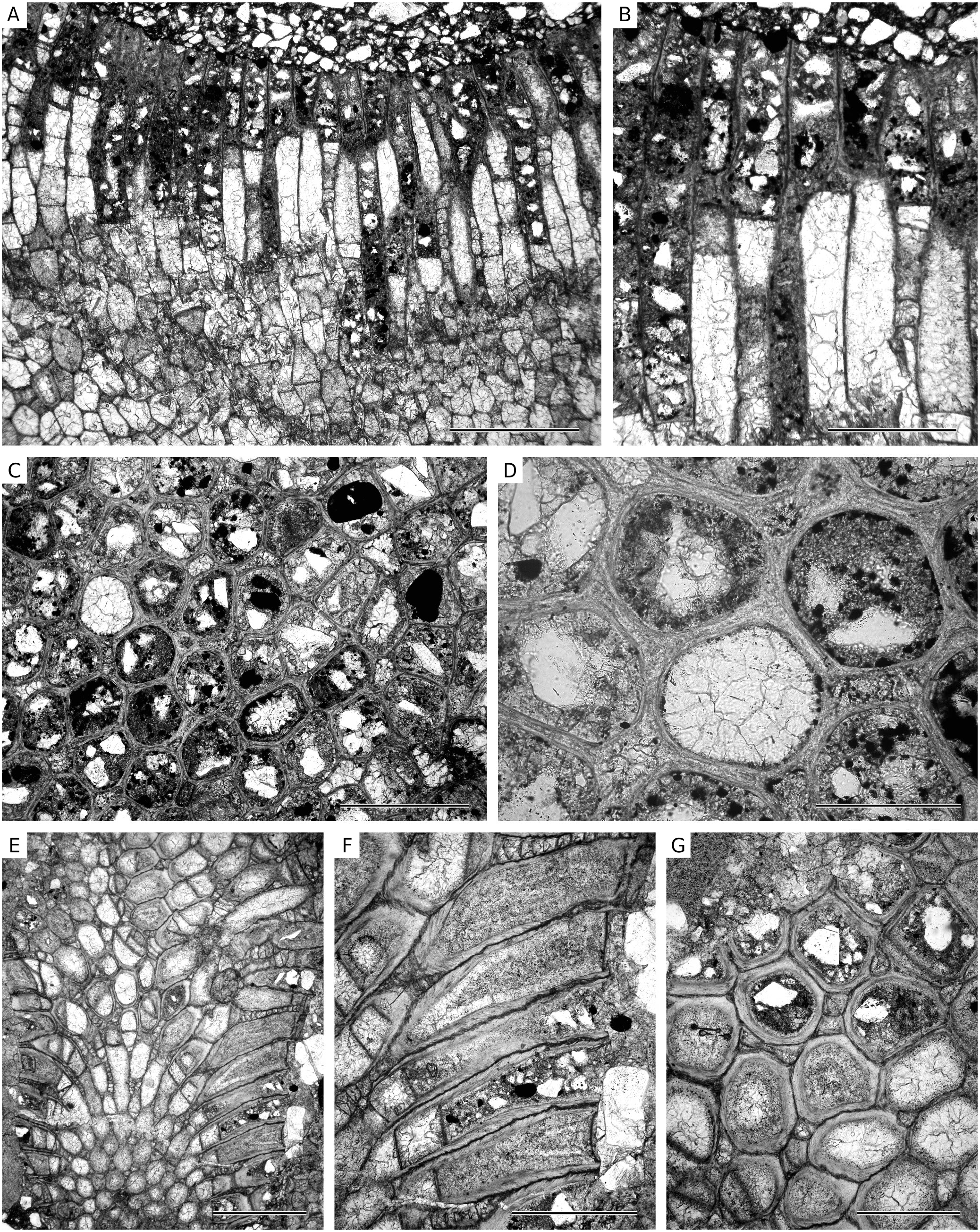
(Figs 10 E-G; 11 A; Appendix 1)
Ernst, Andrej, Carrera, Marcelo G. (2022): A cool-water bryozoan association from the La Pola Formation (Sandbian, Ordovician) of Argentine Precordillera. Geodiversitas 44 (20): 563-601, DOI: 10.5252/geodiversitas2022v44a20
DESCRIPTION Ramose colonies, branch diameter 3.0 - 3.6 mm. Exozone distinct, 0.5 - 0.6 mm wide, endozone 2.0 - 2.4 mm wide. Autozooecia long, growing parallel to branch axis for a long distance in endozone and bending sharply in exozone, having rounded-polygonal shape in transverse section in endozone. Autozooecial apertures oval to polygonal. Autozooecial diaphragms thin, planar, widely spaced in endozone; common to abundant in exozone, planar, rarely inclined, developed as extension of wall cortex. Mesozooecia arising in endozone, polygonal in transverse section, 2 - 6 surrounding each autozooecial aperture. Mesozooecial diaphragms planar, densely spaced. Acanthostyles absent. Autozooecial walls indistinctly laminated, 0.005 - 0.008 mm thick in endozone; displaying distinct reverse V-shaped structure with dark autozooecial boundary, with weakly developed wall cortex continued in diaphragms, 0.04 - 0.12 mm thick in exozone. Maculae indistinct, consisting of macrozooecia. COMPARISON
Ernst, Andrej, Carrera, Marcelo G. (2022): A cool-water bryozoan association from the La Pola Formation (Sandbian, Ordovician) of Argentine Precordillera. Geodiversitas 44 (20): 563-601, DOI: 10.5252/geodiversitas2022v44a20
Tarphophragma macrostoma (Loeblich, 1942) differs from T. ovata (McKinney, 1971) from the Middle Ordovician of United States in larger autozooecial apertures (average aperture width 0.21 mm vs 0.17 mm in T. ovata; measurements for T. ovata from McKinney 1971), as well as in less abundant and smaller mesozooecia. Tarphophragma macrostoma differs from T. multitabulata (Ulrich, 1886) from the Middle Ordovician of United States in larger autozooecial apertures (average aperture width 0.21 mm vs 0.19 mm in T. multitabulata; measurements for T. multitabulata from Karklins 1984).
Ernst, Andrej, Carrera, Marcelo G. (2022): A cool-water bryozoan association from the La Pola Formation (Sandbian, Ordovician) of Argentine Precordillera. Geodiversitas 44 (20): 563-601, DOI: 10.5252/geodiversitas2022v44a20
OCCURRENCE. — Bromide Formation, Upper Ordovician, lower Sandbian; Oklahoma, United States. La Pola Formation, Upper Ordovician, Sandbian; La Pola creek section near Albardon village, San Juan Province, Argentine Precordillera, western Argentina.
Ernst, Andrej, Carrera, Marcelo G. (2022): A cool-water bryozoan association from the La Pola Formation (Sandbian, Ordovician) of Argentine Precordillera. Geodiversitas 44 (20): 563-601, DOI: 10.5252/geodiversitas2022v44a20
MATERIAL EXAMINED. — CEGH-UNC 27520 c, d, CEGH-UNC 27539 c, d, g, CEGH-UNC 27537 d, CEGH-UNC 27538 d.
Ernst, Andrej, Carrera, Marcelo G. (2022): A cool-water bryozoan association from the La Pola Formation (Sandbian, Ordovician) of Argentine Precordillera. Geodiversitas 44 (20): 563-601, DOI: 10.5252/geodiversitas2022v44a20
Export occurrence data
Darwin Core Archive (ZIP)
CLASSIFICATION
Taxonomic Classification Tree

NOMENCLATURE
Synonyms(1)
MULTIMEDIA
Media Files(1)
FIG. 10. — A-D, Diplotrypa sp. A, CEGH-UNC 27543 a: A, B, longitudinal section showing autozooecial chambers with diaphragms and mesozooecia; C, D, tangential thin section showing autozooecial apertures and mesozooecia; E-G, Tarphophragma macrostoma (Loeblich, 1942), CEGH-UNC 27520 d: E, oblique section through the colony; F, longitudinal section showing autozooecial chambers and mesozooecia; G, tangential thin section showing autozooecial apertures and mesozooecia. Scale bars: A, E, 1 mm; B, C, F, G, 0.5 mm; D, 0.2 mm.
Imageimage/png© Ernst, Andrej;Carrera, Marcelo G.Ernst, Andrej;Carrera, Marcelo G.
IMAGES