
AnimaliaNot EvaluatedacceptedspeciesAccepted
Heterotrypa enodis
Ernst & Carrera, 2022
GBIF:196202588
0year
ABOUT
Descriptions(6)
(Fig. 8 A-F; Appendix 1) urn: lsid: zoobank. org: act: C 5482952 - 9218 - 4600 - BDBE-C 77 CE 258 D 9 DD
Ernst, Andrej, Carrera, Marcelo G. (2022): A cool-water bryozoan association from the La Pola Formation (Sandbian, Ordovician) of Argentine Precordillera. Geodiversitas 44 (20): 563-601, DOI: 10.5252/geodiversitas2022v44a20
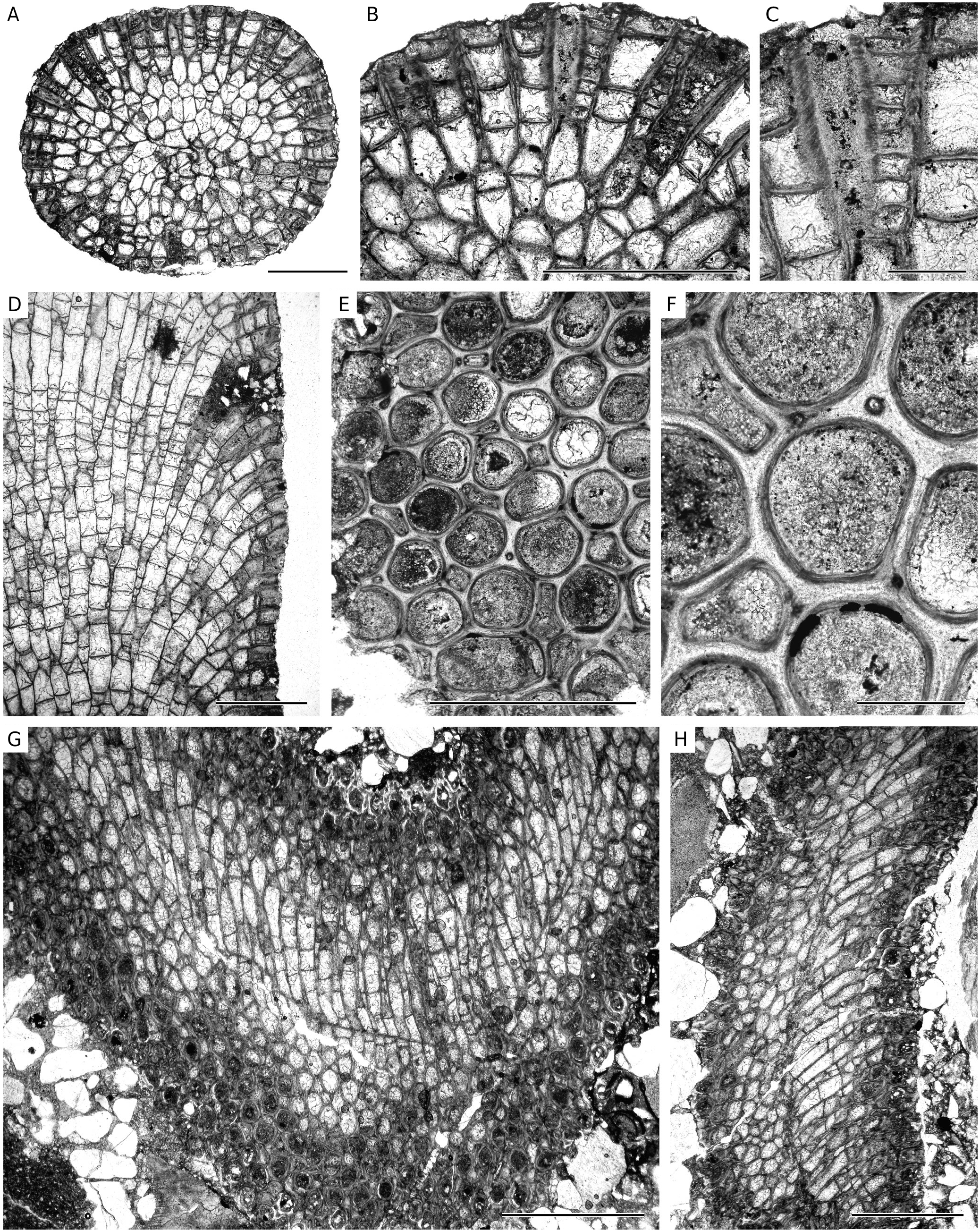
DESCRIPTION Ramose colonies, branch diameter 3.6 to 3.9 mm. Exozone distinct, 0.68 to 0.78 mm wide, endozone 2.24 to 2.34 mm wide. Autozooecia long, growing parallel to branch axis for a long distance in endozone, in exozone bending sharply and intersecting branch surface at angles of 66 to 74 °, having rounded-polygonal shape in transverse section in endozone. Autozooecial apertures oval to polygonal. Autozooecial diaphragms thin, planar, widely spaced in endozone; common to abundant in exozone, planar, rarely inclined, developed as extension of wall cortex. Mesozooecia arising in endozone, polygonal in transverse section, few to common, 1 - 4 surrounding each autozooecial aperture. Mesozooecial diaphragms planar, densely spaced. Acanthostyles small, having laminated sheaths and indistinct hyaline cores, relatively abundant, 1 - 3 surrounding each autozooecial aperture. Endozonal styles absent. Autozooecial walls indistinctly laminated, 0.005 to 0.010 mm thick in endozone; displaying distinct reverse V-shaped structure with dark autozooecial border, with weakly developed wall cortex continued in diaphragms, 0.033 to 0.075 mm thick in exozone. Maculae consisting of macrozooecia, 1.25 - 1.35 mm in diameter. COMPARISON
Ernst, Andrej, Carrera, Marcelo G. (2022): A cool-water bryozoan association from the La Pola Formation (Sandbian, Ordovician) of Argentine Precordillera. Geodiversitas 44 (20): 563-601, DOI: 10.5252/geodiversitas2022v44a20
DIAGNOSIS. — Ramose colonies with distinct exozones; autozooecia with rounded-polygonal apertures; autozooecial diaphragms rare in endozone, common to abundant in exozone, developed as extension of wall cortex; mesozooecia moderately large, 1 - 4 surrounding each autozooecial aperture; acanthostyles small, 1 - 3 surrounding each autozooecial aperture; endozonal styles absent; autozooecial walls with distinct reverse V-shaped lamination with dark autozooecial border and weakly developed wall cortex continued in diaphragms; maculae consisting of macrozooecia.
Ernst, Andrej, Carrera, Marcelo G. (2022): A cool-water bryozoan association from the La Pola Formation (Sandbian, Ordovician) of Argentine Precordillera. Geodiversitas 44 (20): 563-601, DOI: 10.5252/geodiversitas2022v44a20
The present species shows similarities to the genus Heterotrypa Nicholson, 1879 in the wall microstructure, abundant diaphragms arising from the wall cortex, presence of mesozooecia and acanthostyles. Heterotrypa enodis n. sp. differs from H. trentonensis (Ulrich, 1883) from the Upper Ordovician of North America in absence of endozonal styles, smaller exozonal acanthostyles (average acanthostyle diameter 0.03 mm vs 0.05 mm in H. trentonensis; measurements from Karklins 1984), and more abundant mesozooecia. Heterotrypa enodis differs from H. subtrentonensis Marintsch, 1998 from the Upper Ordovician of North America in absence of endozonal styles, less abundant exozonal acanthostyles (1 - 3 per aperture vs 3 - 5 in H. subtrentonensis), and more abundant mesozooecia.
Ernst, Andrej, Carrera, Marcelo G. (2022): A cool-water bryozoan association from the La Pola Formation (Sandbian, Ordovician) of Argentine Precordillera. Geodiversitas 44 (20): 563-601, DOI: 10.5252/geodiversitas2022v44a20
ETYMOLOGY. — The species name refers to small acanthostyles of the new species (from Latin “ enodis ” – smooth).
Ernst, Andrej, Carrera, Marcelo G. (2022): A cool-water bryozoan association from the La Pola Formation (Sandbian, Ordovician) of Argentine Precordillera. Geodiversitas 44 (20): 563-601, DOI: 10.5252/geodiversitas2022v44a20
HOLOTYPE. — CEGH-UNC 27504 a-c (one colony, three thin sections). PARATYPES. — CEGH-UNC 27519 a, b (two thin sections of one colony), 27542 a, c-e (four thin sections of one colony). TYPE LOCALITY. — La Pola creek section near Albardon village, San Juan Province, Argentine Precordillera, western Argentina. TYPE HORIZON. — La Pola Formation, Upper Ordovician, Sandbian.
Ernst, Andrej, Carrera, Marcelo G. (2022): A cool-water bryozoan association from the La Pola Formation (Sandbian, Ordovician) of Argentine Precordillera. Geodiversitas 44 (20): 563-601, DOI: 10.5252/geodiversitas2022v44a20
Export occurrence data
Darwin Core Archive (ZIP)
CLASSIFICATION
Taxonomic Classification Tree

MULTIMEDIA
Media Files(1)
FIG. 8. — A-F, Heterotrypa enodis n. sp.: A-C, branch transverse section showing autozooecial chambers and mesozooecia, holotype CEGH-UNC 27504 b; D, branch longitudinal section showing autozooecial chambers with diaphragms and mesozooecia, CEGH-UNC 27504 a; E, F, tangential thin section showing autozooecial apertures,mesozooecia,and acanthostyles,CEGH-UNC 27504 c; G, H, Albardonia bifoliata n. gen., n. sp., oblique thin section through the bifoliate colony, holotype CEGH-UNC 27538 c. Scale bars: A, B, D, E, G, H, 1 mm; C, F, 0.2 mm.
Imageimage/png© Ernst, Andrej;Carrera, Marcelo G.Ernst, Andrej;Carrera, Marcelo G.
IMAGES