
AnimaliaNot EvaluatedacceptedspeciesAccepted
Orbignyella multitabulata
Coryell, 1921
GBIF:196202598
0year
ABOUT
Descriptions(5)
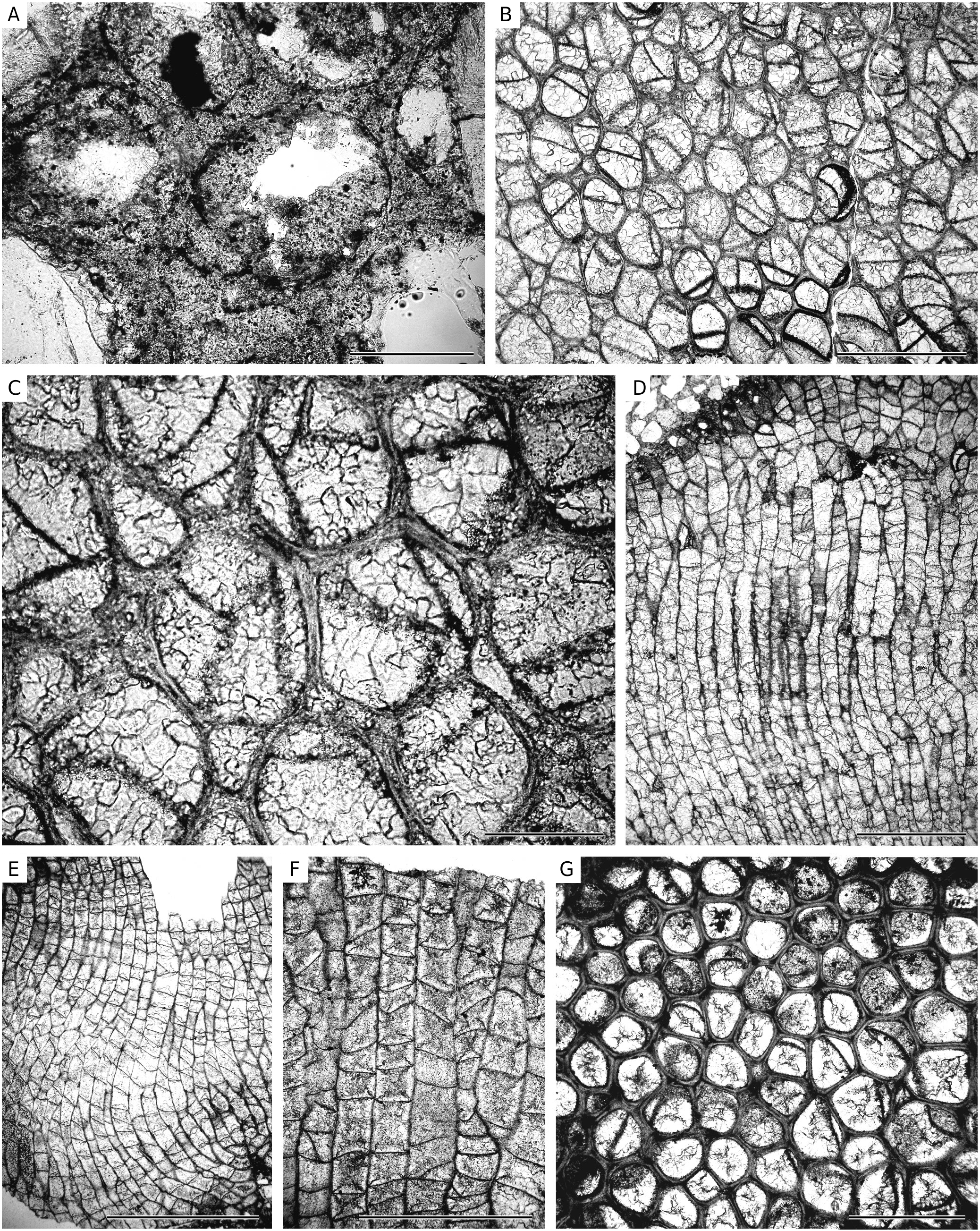
(Fig. 6 E-G; Appendix 1)
Ernst, Andrej, Carrera, Marcelo G. (2022): A cool-water bryozoan association from the La Pola Formation (Sandbian, Ordovician) of Argentine Precordillera. Geodiversitas 44 (20): 563-601, DOI: 10.5252/geodiversitas2022v44a20
DESCRIPTION Massive, subramose multilayered colonies. Secondary overgrowths common, 1 - 2 mm thick. Autozooecia bending gently from endozone, intersecting colony surface at right angles. Autozooecial apertures rounded to polygonal. Diaphragms in autozooecia common to abundant, straight to curved. Exilazooecia rare, polygonal in cross section, restricted to exozone. Acanthostyles common, moderately large, situated at junctions of autozooecial apertures. Autozooecial walls granular-prismatic, 0.005 - 0.010 mm thick in endozone; irregularly thickened, finely laminated, displaying reverse V-structure in longitudinal section, 0.020 - 0.033 mm thick in exozone. Maculae of macrozooecia 0.70 - 1.25 mm in diameter, spaced 1.9 - 2.0 mm from centre to centre. COMPARISON
Ernst, Andrej, Carrera, Marcelo G. (2022): A cool-water bryozoan association from the La Pola Formation (Sandbian, Ordovician) of Argentine Precordillera. Geodiversitas 44 (20): 563-601, DOI: 10.5252/geodiversitas2022v44a20
The present material is morphologically similar to Orbignyella multitabulata Coryell, 1921 from the Sandbian of United States. The only metric characteristic for O. multitabulata is the number of apertures per 2 mm given as 8 - 8.5 (Coryell 1921: 284). Interpolated, it gives apertural spacing of c. 0.23 - 0.25 mm what overlaps the range in the present species (0.13 - 0.22 mm). The present material differs from Orbignyella wetherbyi (Ulrich, 1890) from the Upper Ordovician of United States in smaller autozooecia (aperture width 0.11 - 0.19 mm vs 0.25 - 0.28 mm in O. wetherbyi).
Ernst, Andrej, Carrera, Marcelo G. (2022): A cool-water bryozoan association from the La Pola Formation (Sandbian, Ordovician) of Argentine Precordillera. Geodiversitas 44 (20): 563-601, DOI: 10.5252/geodiversitas2022v44a20
OCCURRENCE. — La Pola Formation, Upper Ordovician, Sandbian; La Pola creek section near Albardon village, San Juan Province, Argentine Precordillera, western Argentina. Pierce Limestone, Upper Ordovician (Sandbian); Tennessee, United States.
Ernst, Andrej, Carrera, Marcelo G. (2022): A cool-water bryozoan association from the La Pola Formation (Sandbian, Ordovician) of Argentine Precordillera. Geodiversitas 44 (20): 563-601, DOI: 10.5252/geodiversitas2022v44a20
MATERIAL EXAMINED. — CEGH-UNC 27505 a-c, CEGH-UNC 27518 a-c.
Ernst, Andrej, Carrera, Marcelo G. (2022): A cool-water bryozoan association from the La Pola Formation (Sandbian, Ordovician) of Argentine Precordillera. Geodiversitas 44 (20): 563-601, DOI: 10.5252/geodiversitas2022v44a20
Export occurrence data
Darwin Core Archive (ZIP)
CLASSIFICATION
Taxonomic Classification Tree

MULTIMEDIA
Media Files(1)
FIG. 6. — A, Dianulites rocklandensis Wilson,1921, tangential section showing autozooecial apertures, CEGH-UNC 27503 a; B-D, Monticulipora aff. mammulata d’Orbigny,1850,CEGH-UNC 27516 d; B, C, tangential thin section showing autozooecial apertures;D, longitudinal thin section showing autozooecial chambers with cystiphragms; E-G. Orbignyella multitabulata Coryell, 1921; E, F, longitudinal thin section showing autozooecia with diaphragms, CEGH-UNC 27505 a; G, tangential thin section showing autozooecial apertures, CEGH-UNC 27505 b. Scale bars: A, C, 0.2 mm; B, G, 0.5 mm; D, F, 1 mm; E, 2 mm.
Imageimage/png© Ernst, Andrej;Carrera, Marcelo G.Ernst, Andrej;Carrera, Marcelo G.
IMAGES